“History is a nightmare from which I am trying to awake.”
— Stephen Dedalus reflects on the burden of history and personal trauma.

James Joyce (2012)
Genre
Literary Fiction
Reading Time
2500 min
Key Themes
See below
Sign in to track this book
This novel follows an ordinary day in Dublin, 1904, where everyday events become myth through new prose, stream-of-consciousness, and language that changes what a novel can be.
The novel starts on the morning of June 16, 1904, at the Martello Tower in Sandycove. Stephen Dedalus, a young intellectual, lives there with medical student Buck Mulligan and an English Oxford student, Haines. Buck Mulligan teases Stephen about his mother's death and his art, calling him 'Kinch.' Stephen feels guilty because he refused to pray at his dying mother's bedside. Haines shows interest in Irish culture but also makes anti-Semitic remarks. Stephen feels distant from his companions, sensing their condescension. He decides to leave the tower later, needing to escape Mulligan's presence and find his own way.
Stephen teaches history at Dalkey school, where he works for Mr. Deasy, the headmaster. His mind wanders from the lesson on Pyrrhus to thoughts about time, history, and knowledge. He struggles to teach his students, feeling his efforts are useless. After class, Mr. Deasy talks to Stephen about economics, the cattle trade, and the 'Jewish peril,' asking him to deliver a letter about foot-and-mouth disease to a newspaper editor. Stephen, though disgusted by Deasy's prejudice, agrees, feeling stuck in obligations. His thoughts return to his mother, his art, and his wish to be free from society.
Stephen walks alone along Sandymount Strand. His mind is a continuous flow of thoughts. He thinks about sensory experiences, literary theory, philosophy (especially Aristotle and Berkeley), his own identity, and language. He reflects on his family, his time in Paris, and his artistic goals, struggling with the idea of the artist as a creator. He thinks of a poem, watches a dog, and meets a cockle-picker. This chapter shows Stephen's intellectual and emotional world, his distance from others, and his search for meaning and artistic expression.
Leopold Bloom, a Jewish advertising canvasser, starts his day at 7 Eccles Street. He makes breakfast for himself and his wife, Molly Bloom, and feeds his cat. His thoughts move between daily tasks, scientific facts, memories of his dead son, Rudy, and worries about Molly's upcoming concert tour and her likely affair with her manager, Blazes Boylan. He feels a quiet sadness. He walks to the butcher to buy a pork kidney for his breakfast, enjoying the early morning sights and sounds of Dublin. He is an ordinary man starting an ordinary day, but his mind is always active, watching and thinking.
Bloom continues his morning, taking a bath at the public baths. He enjoys the feeling and thinks about many subjects, from the body to hygiene. He then visits a post office to pick up a letter from Martha Clifford, a woman he secretly writes to as 'Henry Flower.' He buys soap, passes a church, and watches people on the streets, including a blind youth. His thoughts are a mix of practical concerns, scientific observations, and fantasies, especially about Martha and other women. He feels a quiet separation from the world around him, lost in his private thoughts and desires.
Bloom rides in a carriage with Simon Dedalus (Stephen's father), Martin Cunningham, and Jack Power to attend Paddy Dignam's funeral. During the ride and at the cemetery, Bloom watches his companions, listens to their talks, and thinks about death and life. He thinks about his own father's suicide and the death of his infant son, Rudy, which still affects him. He meets various Dubliners, including John Henry Menton, who ignores him, making Bloom feel more alone. The experience is a somber reflection on death, memory, and shared grief. Bloom's thoughts often go to practical or scientific observations.
Bloom visits the Freeman's Journal office to place an advertisement for Alexander Keyes. He meets Stephen Dedalus, who is delivering Mr. Deasy's letter about foot-and-mouth disease. The office is busy, filled with journalists and printers, all talking. Bloom watches the news being made and the people involved, feeling distant from the noisy, often drunk, atmosphere. Stephen recites a story about two old women, showing his intellect but also his detachment. Bloom's ad is not placed as he hoped, and he leaves, feeling a familiar mild frustration and like an outsider.
Bloom walks through Dublin, his thoughts often on food and digestion. He considers lunch options, choosing a vegetarian meal at Burton restaurant, finding the meat-eating atmosphere of Davy Byrne's pub unappealing. As he eats, his mind drifts to memories of Molly, his past, and nature. He observes the people around him and the city's sights and sounds. The thought of Blazes Boylan meeting Molly at 4 o'clock constantly bothers him, creating anxiety and jealousy. He tries to distract himself with intellectual thoughts but cannot escape the pain of his marriage.
Bloom enters the Ormond Hotel bar. He overhears Miss Douce and Miss Kennedy, the barmaids, singing and listens to Simon Dedalus and Ben Dollard sing. The chapter's prose is musical, imitating the sounds of instruments and voices. Bloom watches the interactions, still thinking about Molly and Boylan, who he sees passing in a car on his way to meet her. Stephen Dedalus is also at the Ormond Hotel with his father and friends, but Bloom and Stephen do not see each other, their paths nearly crossing.
Bloom enters Barney Kiernan's pub. He finds a group of men, including the 'Citizen' (a caricature of an Irish revolutionary), and the pub's dog, Garryowen. A long, often exaggerated and satirical, conversation happens, touching on Irish politics, nationalism, religion, and anti-Semitism. Bloom, trying to collect a debt from Martin Cunningham, feels increasingly isolated and targeted by the Citizen's prejudice. The chapter includes fantastical additions and parodies of literary styles, making the pub's atmosphere more absurd and angry. The argument ends with the Citizen throwing a biscuit tin at Bloom as he leaves, shouting anti-Semitic insults. Bloom responds by saying Christ was a Jew.
As evening comes, Bloom sits on Sandymount Strand, watching Gerty MacDowell, a young woman with a lame leg. The first half of the chapter is from Gerty's view, a romantic, sentimental, and clichéd internal thought, as she dreams of a suitor and flirts with Bloom from a distance. She shows her leg and underwear, attracting him. The second half shifts to Bloom's view, showing his thoughts as he watches Gerty, has sexual fantasies, and masturbates as fireworks go off in the distance. The chapter explores desire, watching, and the difference between fantasy and reality. It shows Bloom's loneliness and his private world of sexual longing.
Bloom visits the National Maternity Hospital to ask about Mrs. Mina Purefoy, who is in labor. He meets Stephen Dedalus and his medical student friends, who are drinking and talking about fertility, birth control, and ideas about birth and creation. The chapter uses many styles, copying the evolution of English prose from Anglo-Saxon verse through different historical periods and literary styles, ending in chaotic, modern slang. The men drink and debate, while Bloom, always an outsider, watches and thinks about birth and the continuation of life, feeling a longing for his lost son, Rudy.
Bloom follows Stephen into Nighttown, Dublin's red-light district, a chaotic and strange place. The chapter is a dream-like play, full of visions, sexual fantasies, and psychological pain. Characters from Bloom's past and present appear in changed forms. Bloom faces accusations, public shame, and meets various figures, including Bella Cohen, the brothel madam, who becomes a dominant male figure, Bello. Stephen is drunk and angry, breaking a chandelier, saying 'Non serviam,' and fighting two British soldiers, Private Carr and Private Compton. Bloom steps in, saving Stephen from more harm, and offers help. This is an unexpected fatherly connection.
After the chaos of Nighttown, Bloom guides the confused Stephen to a cabman's shelter run by Skin-the-Goat. The chapter is written in tired, wordy, and clichéd prose, reflecting the late hour and the characters' exhaustion. Bloom and Stephen have a rambling conversation, discussing politics, travel, art, and their lives. Bloom feels a growing, almost fatherly, connection to Stephen, seeing in him a potential intellectual friend and a son. Stephen, though thankful, keeps some intellectual distance. They share coffee and a quiet companionship, a temporary break from the day's events.
Bloom and Stephen return to 7 Eccles Street. Bloom offers Stephen cocoa, and they have a formal, question-and-answer talk, summarizing their day and their places in the world. Stephen declines Bloom's offer to stay the night and leaves, leaving Bloom alone. Bloom then does his nightly routines: checking the house, winding the clock, and tidying up. His thoughts are presented in a scientific, detached way, recounting the day's events, his money, and his marriage. He gets into bed where Molly is sleeping, thinking about her, their past, and their future, finding a quiet sense of home and order.
The novel ends with Molly Bloom's famous, unpunctuated, eight-sentence stream-of-consciousness monologue, as she lies in bed next to Bloom. Her thoughts move freely and openly over her past lovers (especially Blazes Boylan), her marriage to Bloom, her sexual desires, her body, her childhood in Gibraltar, her opinions on men and women, and her dreams. She thinks about Bloom's quirks, his kindness, and his sexual shortcomings, but also her deep affection for him. The monologue ends with her affirmation of life and love, remembering Bloom's proposal and her clear 'yes' on Howth Head. This provides a sensual, earthy, and optimistic contrast to the intellectual thoughts of Stephen and Bloom.
The Protagonist
Bloom navigates a day of emotional and social isolation, ultimately finding a fleeting paternal connection with Stephen and returning to a quiet, if complicated, domesticity.
The Protagonist
Stephen searches for intellectual and artistic freedom, culminating in a brief, unfulfilled paternal encounter with Bloom and a continued sense of artistic isolation.
The Supporting
Molly's character is fully revealed in her unpunctuated soliloquy, showcasing her complex inner world of desire, memory, and enduring love for Bloom despite her infidelity.
The Supporting
Mulligan remains a static character, a charming but ultimately parasitic figure who Stephen must leave behind to pursue his own path.
The Supporting
Boylan's role is primarily as a catalyst for Bloom's internal conflict regarding Molly's infidelity, remaining a flat character.
The Supporting
Simon Dedalus remains a largely static figure, embodying the familial and societal constraints Stephen seeks to transcend.
The Supporting
Gerty's character is explored through her internal romantic fantasies and her physical interaction with Bloom, which serves as a moment of mutual, if unacknowledged, desire.
The Supporting
The Citizen remains a static, symbolic figure of Irish nationalism and intolerance, provoking Bloom's assertiveness.
The Mentioned
Bella/Bello serves as a symbolic figure in Bloom's hallucinatory journey, representing his psychological fears and desires.
Stephen Dedalus and Leopold Bloom both search for who they are. Stephen wants to define himself as an artist, rejecting his family, church, and country to create his own artistic voice, as seen in his 'Proteus' wanderings and his 'Non serviam' statement in 'Circe.' Bloom, an outsider because of his Jewish background and his intellect, deals with his place in Dublin society, always observing and thinking about his unique view. His identity comes from his past, his grief over Rudy, and his complex relationship with Molly, as explored in his private thoughts and his quiet strength against prejudice in 'Cyclops.'
“History is a nightmare from which I am trying to awake.”
The novel explores fathers and sons. Stephen Dedalus, a 'Telemachus' figure, is distant from his biological father, Simon, and seeks a spiritual or intellectual father. This search ends when he meets Bloom, who, having lost his own son Rudy, acts as a father figure, especially in 'Circe' and 'Eumaeus.' Bloom's grief over Rudy's death is always present, fueling his empathy and his unspoken wish for a son. Stephen and Bloom's paths show their need for connection, even if it is not fully met.
“A father, a son, and a holy ghost. The Father and Son are one. The Son suffers. But the father is in the son. The son is in the father.”
Joyce makes the ordinary events of a single day in Dublin seem important, like Homer's Odyssey. Bloom's errands—buying a kidney, going to a funeral, placing an ad—become his 'wanderings,' filled with internal thoughts and symbolic meetings. Stephen's intellectual struggles are his 'heroic' battles. The novel gives everyday life deep meaning, showing that the epic can be found in the thoughts and experiences of regular people. The detailed descriptions of Dublin's streets, pubs, and people make the city itself a character, a setting for universal human experiences.
“Mr. Leopold Bloom ate with relish the inner organs of beasts and fowls. He liked thick giblet soup, nutty gizzards, a stuffed roast heart, liverslices fried with a slice of white bacon, and grilled mutton kidneys which gave to his palate a fine tang of faintly scented urine.”
Sexuality, both open and hidden, is a theme. Molly Bloom's open monologue in 'Penelope' frankly explores female desire and her sexual past, challenging social norms. Bloom's sexual fantasies, watching (as with Gerty MacDowell in 'Nausicaa'), and his worries about Molly's affair are central to his character. The 'Circe' chapter goes into a dream-like exploration of sexual perversion and psychological issues in Nighttown. The novel explores the full range of human desire, from tender to forbidden, showing its role in shaping identity and relationships.
“yes I said yes I will Yes.”
*Ulysses* explores language itself. Joyce uses many narrative techniques, from stream-of-consciousness (Stephen's 'Proteus,' Molly's 'Penelope') to parody ('Cyclops,' 'Oxen of the Sun'), interior monologue, free indirect discourse, and onomatopoeia ('Sirens'). Each chapter often has a distinct style, reflecting its theme or character's view. This language experimentation is not just stylistic; it is part of the novel's meaning, showing how language shapes thought, perception, and reality. The novel pushes the limits of literary expression, making language a main character.
“Ineluctable modality of the visible: at least that if no more, thought Stephen. He closed his eyes to hear if it were true and I saw the sea, he thought. The noise of the waves, a silent roar. Sound no sound is in the ear, he said. No such thing as a silent roar.”
Direct presentation of characters' unfiltered thoughts and feelings.
This is the dominant narrative technique, particularly evident in Stephen's 'Proteus' chapter and Molly Bloom's 'Penelope' monologue. It allows readers direct access to the characters' unfiltered, often chaotic, internal thoughts, sensations, and memories, blurring the lines between conscious and subconscious. It creates a deeply intimate and subjective experience, immersing the reader in the minds of Stephen, Bloom, and Molly, and revealing their complex psychological landscapes without authorial mediation or conventional punctuation.
Structuring the narrative around Homer's 'Odyssey'.
Joyce meticulously structures 'Ulysses' as a modern parallel to Homer's 'Odyssey.' Leopold Bloom is Odysseus (Ulysses), Stephen Dedalus is Telemachus, and Molly Bloom is Penelope. Each of the 18 chapters corresponds to an episode in the epic poem, though often loosely and ironically. This device provides a grand framework, elevating the mundane events of a single day in Dublin to an epic scale and inviting readers to find heroic meaning in the lives of ordinary people, while also subverting traditional notions of heroism.
Extended passages of a character's thoughts, distinct from stream-of-consciousness.
While related to stream-of-consciousness, interior monologue in 'Ulysses' often refers to more structured, though still unvoiced, reflections of a character. It's used extensively for Bloom's observations and ruminations, providing insights into his scientific curiosity, his anxieties, and his philosophical ponderings. Unlike the raw, associative flow of stream-of-consciousness, interior monologue can sometimes present thoughts with a clearer, more logical (though still internal) progression, allowing for detailed exploration of a character's intellectual and emotional landscape.
Imitation and exaggeration of various literary styles.
Joyce employs a wide range of stylistic parodies, most notably in 'Cyclops' and 'Oxen of the Sun.' In 'Cyclops,' the narrative is repeatedly interrupted by exaggerated, often satirical, parodies of journalistic reports, epic poetry, legal documents, and biblical texts, reflecting the bombastic and nationalistic rhetoric of the pub. In 'Oxen of the Sun,' the prose mimics the historical evolution of English language and literature, from Anglo-Saxon to modern slang. This device is not just for humor; it highlights the constructed nature of language, the influence of history on expression, and the diverse ways in which reality can be represented.
Recurring images, phrases, and objects with symbolic significance.
Joyce uses numerous leitmotifs and symbols that recur throughout the day, enriching the text with layers of meaning. Examples include the pork kidney (representing the mundane and the body), the ashplant (Stephen's artistic and intellectual weapon), the sea (symbolizing change, eternity, and the subconscious), the color green (Irish nationalism), and references to food and digestion (the physical realities of life). These recurring elements create thematic connections, foreshadow events, and deepen character insights, often with multiple layers of interpretation, binding the disparate narrative threads together.
“History is a nightmare from which I am trying to awake.”
— Stephen Dedalus reflects on the burden of history and personal trauma.
“Love loves to love love.”
— Narrator's playful commentary on the nature of love in the "Nausicaa" episode.
“A man of genius makes no mistakes. His errors are volitional and are the portals of discovery.”
— Stephen Dedalus discusses art and creativity in conversation.
“Stately, plump Buck Mulligan came from the stairhead, bearing a bowl of lather on which a mirror and a razor lay crossed.”
— Opening line introducing Buck Mulligan at the Martello Tower.
“I am a servant of two masters, an English and an Italian... And a third... there is who wants me for odd jobs.”
— Leopold Bloom muses on his divided loyalties and identity as a Jewish Irishman.
“The snotgreen sea. The scrotumtightening sea.”
— Stephen's vivid, bodily description of the sea at Sandymount Strand.
“Yes because he never did a thing like that before as ask to get his breakfast in bed with a couple of eggs since the City Arms hotel.”
— Molly Bloom's stream of consciousness recalling past moments with Leopold.
“To learn one must be humble. But life is the great teacher.”
— Mr. Deasy advises Stephen on wisdom and experience.
“Every life is many days, day after day. We walk through ourselves, meeting robbers, ghosts, giants, old men, young men, wives, widows, brothers-in-love. But always meeting ourselves.”
— Stephen contemplates the journey of self-discovery and human experience.
“The heaventree of stars hung with humid nightblue fruit.”
— Poetic description of the night sky in the "Ithaca" episode.
“What's in a name? That is what we ask ourselves in childhood when we write the name that we are told is ours.”
— Stephen reflects on identity and naming in the library scene.
“Think you're escaping and run into yourself. Longest way round is the shortest way home.”
— Leopold Bloom's thoughts on circular journeys and self-confrontation.
“A child convalesced after illness. They read it on the doorplate.”
— Brief, poignant moment from the "Wandering Rocks" episode, highlighting urban life.
“I was a Flower of the mountain yes when I put the rose in my hair like the Andalusian girls used or shall I wear a red yes.”
— Molly Bloom's famous closing monologue, reminiscing about youth and love.
Ready to see how well you understood this book? Take our interactive quiz with 10 questions.
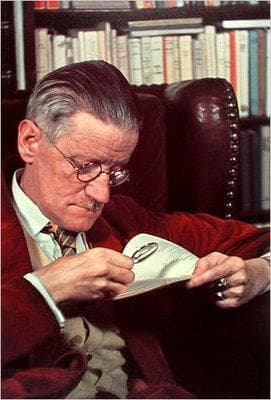
James Augustine Aloysius Joyce was an Irish novelist, poet, and literary critic. He contributed to the modernist avant-garde movement and is regarded as one of the most influential and important writers of the 20th century. Joyce's novel Ulysses (1922) is a landmark in which the episodes of Homer's Odyssey are paralleled in a variety of literary styles, particularly stream of consciousness. Other well-known works are the short-story collection Dubliners (1914), and the novels A Portrait of the Artist as a Young Man (1916) and Finnegans Wake (1939). His other writings include three books of poetry, a play, letters, and occasional journalism.







