“She had always known that the world was a strange place, but she had never suspected that it was this strange.”
— Early in the novel, as the protagonist, Slim, begins to perceive the monstrous Goblins.

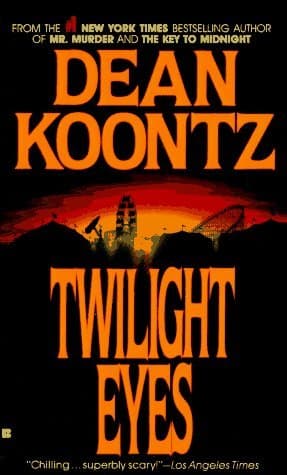
Dean Koontz (1985)
Genre
Thriller / Fantasy / Mystery / Science Fiction
Reading Time
450 min
Key Themes
See below
Sign in to track this book
Haunted by twilight eyes that reveal the monstrous parasites lurking in human form, Slim MacKenzie's search for sanctuary in a traveling carnival leads him into a terrifying hunting ground where humanity is the unsuspecting prey.
Slim MacKenzie, a young man who sees grotesque, insectoid entities he calls 'gargoyles' (later G's), has lived in isolation and fear, often thought to be insane. After a traumatic event, he seeks anonymity at the Jolly Time Carnival. He gets a job as a handyman, hoping to escape his visions. However, the carnival is not a sanctuary but a magnet for the creatures he dreads. He soon realizes many carnival residents, human and animal, are affected by the G's, which are more active and numerous here than anywhere he has been, suggesting a deeper connection to this place.
While at the carnival, Slim sees a G-possessed man murder another worker. This confirms the G's existence and shows their malevolent power over human hosts. Slim learns that G's, when fully manifested, are capable of extreme violence and feed on negative emotions and suffering. This event changes Slim, making him want to understand and fight these entities. He realizes his 'sight' is a tool, not just a curse, and he feels responsible for protecting those unaware of the hidden horrors.
Slim meets Lacey, a kind and mysterious young woman who works at the carnival. He is drawn to her, and she seems to understand his burdens. As they spend time together, Slim discovers Lacey also has a psychic ability, different from his. She can sense people's 'auras' or 'feelings' and has an empathy that connects her to others deeply. This shared experience of being 'different' strengthens their bond. Together, they begin to find clues about the G's presence at the carnival, realizing the creatures are not random but seem to be drawn to or cultivate certain individuals and locations within the carnival.
As Slim and Lacey investigate, they uncover a disturbing truth: the G's are a widespread infestation within the Jolly Time Carnival. They find that many long-term employees and some animals are possessed or influenced by the G's. The creatures seem to be manipulating events, creating conflict and an atmosphere of misery and despair, which they feed upon. The carnival, once a place of escapism, is slowly becoming a breeding ground for these entities, with humans unknowingly serving as sustenance and agents. The scale of the problem becomes clear.
Slim and Lacey, driven by a need for answers, examine cryptic clues and shared psychic experiences. They discover ancient texts and lore that suggest the G's are an ancient, extra-dimensional race of parasitic entities. These creatures are not from Earth but have periodically crossed dimensions, drawn by human suffering and negative energy. They are a form of consciousness that can inhabit and manipulate living beings, slowly consuming their hosts. This revelation changes the conflict from monster-hunting to a struggle against an insidious, almost spiritual, evil that preys on life itself.
Slim's suspicions increasingly fall on Funhouse, the carnival's owner. Funhouse shows strange behaviors, a chilling lack of empathy, and an unnatural awareness of things he should not know. Through his 'twilight eyes,' Slim begins to see an unusually powerful G presence from Funhouse, stronger and more integrated than any other host he has seen. It becomes clear Funhouse is not just a victim but a willing host for a high-ranking G, serving as a central point for their operations within the carnival. This discovery makes the fight personal and dangerous.
Realizing they cannot run, Slim and Lacey make a desperate plan. They understand that the G's thrive on secrecy and the misery they create. Their strategy involves using Slim's sight and Lacey's empathic abilities to expose the G's to other carnival workers and generate a wave of positive human emotion—hope, courage, and unity—which they believe might harm the creatures. They aim to disrupt the G's psychic network and force them out of their hosts, especially Funhouse, by creating an environment where they cannot thrive. This plan is risky, as it puts them directly against powerful entities.
The final fight takes place in the carnival's funhouse, a labyrinth of illusions and distorted reality. Slim and Lacey, with a few trusted allies they have alerted, confront Funhouse. The funhouse becomes a battleground, physically and psychically. Slim uses his abilities to project images of the G's to those who can see them, breaking their hold. Lacey channels her empathy, radiating positive energy that weakens the G's. Funhouse, almost entirely consumed by a powerful G, unleashes mental attacks and manipulations, trying to crush their spirits and turn the carnival into a G domain. The battle is a terrifying mix of physical danger and psychic warfare.
In the battle's final moments, as Funhouse and the G's threaten to overwhelm them, a sacrifice occurs. This act, driven by love and a desire to protect humanity, creates a surge of pure, uncorrupted energy that defeats the G's. This burst of positive force shatters the G's psychic network, ripping them from their hosts and forcing them back to their dimension. The victory is hard-won, and while the G's are expelled, the cost is significant, leaving a lasting impact on Slim, Lacey, and the few survivors who witnessed the truth. The carnival is scarred, but the immediate threat is gone.
Afterward, the Jolly Time Carnival is in disarray, its dark secrets partially known to a few, and its general population left with fragmented, disturbing memories. Slim and Lacey, having survived, are changed. Their bond is strong due to their shared trauma and triumph. They decide to leave the carnival, seeking a new path together. They understand their unique abilities are both a blessing and a burden, and they are now more aware of the unseen forces in the world. They begin a journey, not just physically, but in understanding their roles as protectors against darkness, ready to face whatever other threats may lurk in the 'twilight' of human perception.
The Protagonist
Slim transforms from a fearful, isolated individual burdened by his psychic abilities into a courageous hero who accepts his gift and actively fights against the G's.
The Supporting
Lacey evolves from a supportive companion to an active participant in the fight against the G's, utilizing her empathy as a powerful weapon.
The Antagonist
Funhouse's true nature as a powerful G host is gradually revealed, culminating in his defeat and the expulsion of the G's from his body.
The Antagonist
The G's are revealed as a pervasive, organized threat that is ultimately repelled, but not eradicated, from the human dimension.
The Supporting
Mrs. Higgins remains a constant, grounding presence, representing the everyday humanity worth saving.
The Supporting
The Fat Man's character arc demonstrates the pervasive control of the G's over seemingly ordinary people, eventually being freed from their influence.
The Supporting
The Fortune Teller provides crucial, albeit cryptic, information that aids Slim and Lacey's understanding of the G's.
The novel explores how psychic abilities, while offering insight, can also be a curse. Slim's ability to see the G's isolates him and fills him with fear. His gift is initially a torment, making him an outcast. However, as the story progresses, he learns to use this 'curse' as a tool for understanding and fighting unseen evil. Lacey's empathy is a gift that connects her to people but also exposes her to their deepest pain. The theme shows the dual nature of extraordinary perception, emphasizing that strength comes from accepting and mastering one's unique abilities, as seen when Slim uses his sight to expose the G's in the funhouse.
“My twilight eyes saw what no one else could, and it was a curse that had haunted me my entire life. But maybe, just maybe, it was also the key.”
Dean Koontz shows evil not as a simple force, but as an insidious, parasitic entity that preys on human suffering and negativity. The G's are not just monsters; they are a cosmic force that thrives on despair, manipulation, and the erosion of the human spirit. They do not just kill; they corrupt and consume from within. The carnival itself becomes a small example of this theme, where the G's subtly create an environment of misery and conflict to feed. This theme is clear in how Funhouse, a human character, is almost entirely consumed by a G, showing how evil can slowly take root and dominate.
“They didn't just kill the body; they devoured the soul, leaving behind only an empty husk for their own vile purposes.”
A central theme is the contrast between appearance and reality. The Jolly Time Carnival, outwardly a place of joy, is a hunting ground for interdimensional parasites. People who seem normal are secretly hosts for grotesque entities. Slim's 'twilight eyes' are the only way this hidden reality is seen, making him a solitary witness to the truth. This theme creates unease, making the reader question surface appearances. The funhouse, with its distorting mirrors, serves as a metaphor for the distorted reality the G's create.
“The world was not what it seemed, and I was the only one cursed to see the cracks in the facade.”
Despite the overwhelming evil and the isolating nature of Slim's gift, human connection and empathy are strong forces against the G's. Slim's bond with Lacey, built on mutual understanding and shared vulnerability, gives him strength and purpose. Lacey's empathic abilities are not just passive but become a weapon against the G's, as she channels positive emotions to repel them. This theme suggests that while negative emotions feed the G's, love, courage, and unity are their ultimate weakness, offering hope even in the darkest times. Their combined efforts show that collective human spirit can overcome even cosmic evil.
“Her empathy was a shield, a beacon against the darkness that sought to consume us all.”
Slim MacKenzie's unique ability to perceive invisible, interdimensional entities.
This is the central plot device, driving the entire narrative. Slim's 'twilight eyes' allow him to see the G's, which are otherwise imperceptible to normal human vision. This ability serves as both a curse, isolating him and marking him as insane, and later as a blessing, making him the only one capable of understanding and combating the true threat. It functions as the primary source of conflict and mystery, as Slim tries to make sense of what he sees and convince others of its reality. Without this device, the G's would remain completely hidden, and the conflict would never arise.
A seemingly innocent setting that serves as a breeding ground and central hub for the G's.
The carnival is more than just a setting; it's a critical plot device. It acts as a symbolic microcosm of humanity, with its varied cast of characters, illusions, and hidden depths. Its transient nature and ability to attract eccentrics provide cover for the G's operations. The carnival's funhouse, in particular, becomes a symbolic battleground, representing the distorted reality the G's impose. Its festive facade sharply contrasts with the horror lurking beneath, amplifying the sense of dread and providing a contained environment for the unfolding mystery and conflict.
Interdimensional entities that possess and feed on human hosts, representing an unseen cosmic horror.
The G's themselves function as a key plot device. Their nature as invisible, parasitic, and mind-controlling entities allows for a subtle, pervasive horror that slowly infects the story. Their ability to possess hosts provides a constant threat, as any character could potentially be a G agent. This device creates suspense and paranoia, as Slim can never be entirely sure who is truly human. Their cosmic origin elevates the threat beyond mere physical monsters to a profound existential horror, requiring not just physical combat but psychic and emotional resistance to defeat them.
The developing empathic and perceptive bond between Slim and Lacey.
The evolving psychic connection between Slim and Lacey is a crucial plot device that facilitates their understanding of the G's and their eventual defeat. Slim's visual perception combined with Lacey's empathy allows them to piece together the full scope of the threat in a way neither could alone. This bond not only strengthens their personal relationship but also provides a synergistic power that is essential for confronting the G's, especially in the final battle where their combined abilities generate a powerful counter-force against the entities.
“She had always known that the world was a strange place, but she had never suspected that it was this strange.”
— Early in the novel, as the protagonist, Slim, begins to perceive the monstrous Goblins.
“The greatest evil is not done in the shadows, but in the open, in the full light of day, by those who believe they are doing good.”
— A philosophical reflection on the nature of evil, often linked to human capacity for self-deception.
“Fear can be a terrible thing, a paralyzing thing, but it can also be a weapon.”
— Slim's internal struggle with her fear and her eventual decision to confront the Goblins.
“There are things in the world that defy explanation, things that exist beyond the boundaries of our understanding.”
— A recurring theme as Slim grapples with the inexplicable nature of the Goblins.
“Sometimes, the only way to find out what you're capable of is to be pushed to the brink.”
— Slim facing extreme danger and discovering her own resilience.
“Sanity is a fragile thing, easily shattered by the impossible.”
— As Slim questions her own sanity while witnessing events no one else can see.
“The past is never truly gone; it merely waits for the right moment to return.”
— Relates to the long-standing presence of the Goblins and their ancient origins.
“Even in the darkest places, a flicker of hope can ignite a fire.”
— Slim's determination to fight back despite overwhelming odds.
“The world is not always what it seems; sometimes, there are deeper, darker truths hidden beneath the surface.”
— A foundational concept of the novel, revealing the hidden world of the Goblins.
“To deny what you see, even when it's terrifying, is to surrender your mind to deceit.”
— Slim's internal struggle to accept her visions despite the disbelief of others.
“Love, even in its most twisted forms, can be a powerful motivator.”
— Explores the motivations of both protagonists and antagonists, including distorted affections.
“There are some battles you have to fight alone, no matter how much you wish you didn't.”
— Slim's solitary struggle against the Goblins, often misunderstood by others.
“Sometimes, the monster isn't under your bed. Sometimes, it's just a different kind of human being.”
— A reflection on the nature of the Goblins, blurring the lines between human and monster.
“The greatest prison is a mind that refuses to see beyond its own limitations.”
— Relates to the skepticism and denial faced by Slim from those who cannot perceive the Goblins.
Ready to see how well you understood this book? Take our interactive quiz with 10 questions.

Dean Koontz is a prolific American author best known for his suspenseful thrillers and horror novels. His works often blend elements of the supernatural, science fiction, and detective fiction, exploring themes of good versus evil and the human condition. Notable books include 'Life Expectancy,' 'The Bad Place,' and 'Strangers,' which have garnered international acclaim and bestseller status.







