“The sea is only the embodiment of a supernatural and wonderful existence. It is nothing but love and emotion; it is the 'living infinite.'”
— Nemo's philosophical reflection on the ocean's profound beauty and mystery.

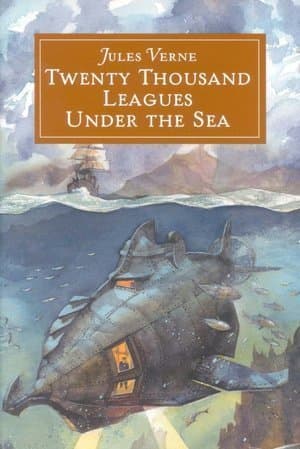
Jules Verne (1970)
Genre
Fantasy / Science Fiction
Reading Time
10-12 hours
Key Themes
See below
Sign in to track this book
Captain Nemo takes three castaways on an extraordinary journey through undersea forests, coral labyrinths, and the sunken city of Atlantis aboard his futuristic submarine, the Nautilus.
In 1866, stories of a huge, fast sea creature sinking ships spread. Professor Pierre Aronnax, a French marine biologist, first thought the creature was a hoax or a large narwhal. However, after more incidents, he was asked by the American government to join an expedition on the USS Abraham Lincoln to hunt this 'monster.' Aronnax, joined by his assistant, Conseil, accepted, driven by scientific interest. They left New York with the crew, including the harpooner Ned Land, who was eager for the hunt.
The USS Abraham Lincoln, a powerful frigate, spent months searching the Pacific Ocean without success. Aronnax, Conseil, and Ned Land grew frustrated. Ned Land, especially, was annoyed by the lack of action, constantly looking for the creature. Finally, near Japan, the 'monster' was seen. The Abraham Lincoln chased it, leading to a tense fight. During the chase, the creature was agile and tough. In the chaos, the frigate's rudder was damaged, and Aronnax, Conseil, and Ned Land were thrown overboard.
After falling into the ocean, Aronnax, Conseil, and Ned Land found each other and held onto a floating object. They were amazed to discover it was a large, sleek, metal submarine. As they climbed aboard, a hatch opened, and the crew took them prisoner. They were brought before Captain Nemo, an intelligent and somber man. Nemo revealed the vessel was the Nautilus, his advanced submarine, and that they were now his permanent guests, forbidden to ever return to the surface.
Captain Nemo, though holding them captive, treated Aronnax with respect due to his scientific background, giving him access to the Nautilus's library and observations. Aronnax was amazed by the submarine's technology, its self-sufficiency, and Nemo's knowledge of the ocean. They explored incredible underwater places: coral reefs, deep-sea trenches, and marine life. Ned Land, however, remained restless and planned to escape, while Conseil observed everything quietly. Nemo often took Aronnax on dives outside the submarine, showing him wonders.
The Nautilus went on many trips. Aronnax joined an underwater hunt in the forest of Crespo, where Nemo used electric rifles to kill large sea animals for food. They visited a huge underwater coal mine, showing how the Nautilus got its own fuel. Aronnax was constantly amazed by the marine life and geology. Ned Land, despite seeing these wonders, focused on his desire for freedom, often telling Aronnax and Conseil his frustrations. Nemo, while showing Aronnax beauty, also hinted at his deep sadness and anger against humanity.
The Nautilus traveled through the Red Sea, and to Aronnax's surprise, Nemo revealed a secret underwater passage, the Arabian Tunnel, allowing them to enter the Mediterranean Sea without surfacing. This showed Nemo's detailed knowledge of the ocean's hidden routes. In the Mediterranean, they saw the ruins of ancient cities underwater, further strengthening Aronnax's appreciation for Nemo's unique abilities. Ned Land, seeing land nearby, tried several times to convince Aronnax to join an escape plan, but Aronnax's scientific interest often outweighed his desire for freedom.
The journey continued, taking the Nautilus to the sunken city of Atlantis, where Aronnax walked among ancient ruins. Later, Nemo set a course for the South Pole. Despite extreme conditions, icebergs, and freezing temperatures, the Nautilus reached the pole, an amazing feat of navigation. Nemo claimed the South Pole for himself. This journey showed Nemo's ambition to explore the Earth's last frontiers, far from human civilization.
As the Nautilus sailed the Atlantic Ocean, it met a group of giant squids, one of them huge. The monster squid attacked the submarine, its tentacles wrapping around the hull. The crew, led by Captain Nemo, fought back with axes and harpoons. Ned Land, a skilled harpooner, was very helpful in the battle. During the fight, a crewman was pulled away by a squid, a moment that affected Nemo deeply, showing a rare glimpse of his human emotion and the dangers of their isolated life.
The Nautilus found the wreckage of a sunken ship, a reminder of human destruction. Nemo later showed his vengeful nature when he met a warship, which he identified as belonging to a nation that had wronged him. With cold resolve, he rammed the warship, sinking it. Aronnax, horrified by this act of deliberate destruction, began to understand Nemo's deep hatred for the surface world and his reason for living beneath the waves. This event strengthened Ned Land's resolve to escape.
As the Nautilus continued its journey, Captain Nemo became more withdrawn and sad, spending more time alone. The submarine eventually got caught in the Maelstrom, a giant whirlpool off the coast of Norway. Amidst the chaos and the Nautilus's violent movements, Ned Land seized the chance. He, Aronnax, and Conseil got into the small dinghy attached to the submarine. They were thrown into the raging waters, losing consciousness. When they woke, they were safe on a fishing boat, having miraculously escaped the Nautilus and the Maelstrom, leaving Captain Nemo's fate unknown.
The Protagonist
Aronnax transforms from an academic observer to an active participant in extraordinary undersea adventures, witnessing both the beauty and destructive potential of the ocean and human ingenuity.
The Supporting
Conseil remains steadfast and loyal throughout the journey, a constant and reliable presence for Aronnax.
The Supporting
Ned Land's primary motivation remains consistent: to escape captivity and return to the surface world, culminating in his successful leadership of the escape.
The Antagonist/Complex Figure
Nemo's character deepens from an enigmatic captor to a tragic figure driven by past trauma and a quest for ultimate freedom and vengeance, ultimately remaining an unsolved mystery.
The Central Plot Device/Character-like
The Nautilus serves as the primary setting and enabler of the plot, facilitating the extraordinary journey and symbolizing both scientific progress and isolation.
The Mentioned
Farragut's role is limited to the initial pursuit of the 'monster' and his ship's eventual defeat by the Nautilus.
The novel explores science's dual nature. The Nautilus is an advanced machine, allowing exploration and self-sufficiency, showing humanity's potential for discovery. Aronnax represents the pursuit of knowledge. However, Captain Nemo also uses this technology for destruction and revenge, sinking warships and isolating himself, showing how science can be used for destructive or isolating ends without moral limits. The wonders Aronnax sees are often contrasted with Nemo's acts of revenge, like sinking the warship.
““The sea is everything. It covers seven tenths of the terrestrial globe. Its breath is pure and healthy. It is an immense desert, where man is never lonely, for he feels life stirring on all sides. The sea is only a embodiment of a supernatural and wonderful existence; it is nothing but love and emotion; it is the 'living infinite,' as one of your poets has said.””
This theme is central to the story, mainly shown by Ned Land's constant desire for escape and Aronnax's conflict between scientific interest and his wish to return to the surface. Captain Nemo, despite his freedom from society, is also a prisoner—of his past grievances and his chosen exile. The Nautilus, while offering freedom of movement in the ocean, is also a gilded cage for its inhabitants. The tension between personal liberty and the appeal of unique experiences drives much of the character interaction and plot.
““I wished to know what was going on in the world, what new discoveries had been made, what new thoughts had been evolved.””
Verne presents the ocean as a vast, mysterious, and inspiring place, mostly untouched by human interference. Aronnax's observations highlight the biodiversity and wonders of the deep sea. Captain Nemo, in his respect for the ocean and his rejection of the surface world, embodies a radical separation from destructive human civilization. He sees the sea as a purer existence, untouched by the wars and injustices of land-dwellers. Yet, even in this pristine environment, human elements like sunken Atlantis or hunting for food show humanity's complex interaction with nature.
““Man is a creature of the land, and it is on land that he has made all his conquests.””
Captain Nemo is shaped by a deep sense of grievance and a desire for revenge against a nation or nations that caused him great suffering. His self-imposed isolation aboard the Nautilus is a direct result of this trauma, serving as both a refuge and a way to enact his retribution. His actions, like deliberately sinking a warship, show this burning desire for vengeance. This theme explores the destructive nature of unchecked anger and how it can lead to extreme alienation, even for a genius like Nemo, making him a tragic and solitary figure.
““I am not what you call a civilized man. I have done with society for ever, for reasons which I alone have the right to appreciate. I do not, therefore, obey its laws, and I desire you never to allude to them before me again.””
The story is told from Professor Aronnax's limited perspective.
Professor Aronnax narrates the story, providing a scientific and often awestruck perspective on the events. However, his understanding of Captain Nemo's true motivations and past remains incomplete, filtered through his own observations and Nemo's cryptic hints. This narrative choice creates suspense and mystery around Nemo's character and the ultimate fate of the Nautilus, as Aronnax can only report what he sees and hears, leaving many questions unanswered for the reader.
Hints and clues throughout the story suggest future events or reveal deeper truths.
Verne uses foreshadowing to build suspense and deepen the mystery surrounding Captain Nemo. Early in the narrative, Nemo's intense reactions to news of surface conflicts, his melancholic demeanor, and his cryptic remarks about past wrongs hint at his vengeful nature and the tragic backstory that drives him. For example, his deep sorrow after the death of a crewman during the squid attack, or his intense musical compositions, suggest a profound emotional depth and a history of loss, preparing the reader for his later act of destruction against the warship.
The 'sea monster' that drives the initial plot.
The initial 'sea monster' serves as a MacGuffin, a plot device that sets the story in motion and brings the main characters together. Its true nature (the Nautilus) is quickly revealed, but its existence is what compels Aronnax, Conseil, and Ned Land to embark on the USS Abraham Lincoln and ultimately encounter Captain Nemo. The mystery of the monster is less important than its role in initiating the extraordinary journey and the subsequent exploration of the undersea world.
Objects and settings represent deeper ideas.
Numerous elements in the novel carry symbolic weight. The Nautilus itself symbolizes both the pinnacle of human ingenuity and technology, and the ultimate form of isolation and escape from society. The ocean represents both boundless freedom and an unforgiving wilderness. Captain Nemo's vast library symbolizes his intellectual prowess and his connection to human culture, even as he rejects humanity. The sunken Atlantis can symbolize lost civilizations or the fragility of human achievements against the power of nature.
“The sea is only the embodiment of a supernatural and wonderful existence. It is nothing but love and emotion; it is the 'living infinite.'”
— Nemo's philosophical reflection on the ocean's profound beauty and mystery.
“I may brave human laws, but I will not brave those of nature.”
— Captain Nemo explaining his respect for natural laws despite his defiance of human society.
“The earth does not want new continents, but new men.”
— A reflection on humanity's potential for self-improvement rather than mere territorial expansion.
“The sea is everything. It covers seven tenths of the terrestrial globe. Its breath is pure and healthy. It is an immense desert, where man is never lonely, for he feels life stirring on all sides.”
— Aronnax describing the vastness and life within the ocean.
“There is no such thing as chance; everything is preordained.”
— Nemo's deterministic view on events and destiny.
“Science, my lad, is composed of errors, but of errors that are good to commit, for they lead little by little to the truth.”
— A reflection on the iterative and experimental nature of scientific discovery.
“It is a horrible thing to be alone in the world, to have no one to whom one can pour out one's heart.”
— Nemo expressing the profound loneliness of his self-imposed exile.
“We are of a race of men who have made a pact with the sea.”
— Nemo emphasizing his crew's deep connection and commitment to life beneath the waves.
“The Nautilus is a world in itself, an independent world, and I am its master.”
— Nemo proudly asserting his absolute control and autonomy within his submarine.
“What is it, after all, this world of ours, but a speck of dust in the immensity of the universe?”
— A philosophical musing on the insignificance of human existence in the grand scheme.
“To struggle with the sea is a terrible thing, but to struggle with humanity is still worse.”
— Nemo's cynical view on the inherent conflicts and evils of human society.
“The ocean is a living abyss. It is a boundless realm of mystery and wonder.”
— A description highlighting the enigmatic and awe-inspiring nature of the deep sea.
“Man is a land animal, and he has no business in the sea.”
— Conseil's simple, practical perspective contrasting with Aronnax's enthusiasm for undersea exploration.
“I am not what is commonly called a civilized man!”
— Nemo defiantly rejecting the norms and constraints of conventional society.
Ready to see how well you understood this book? Take our interactive quiz with 10 questions.
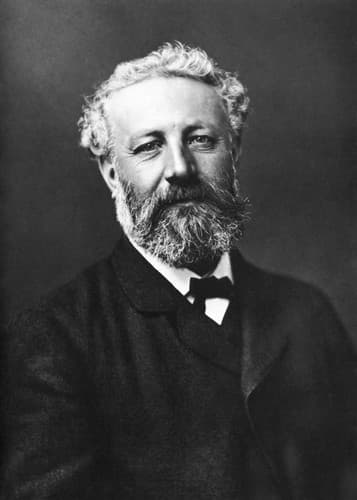
Jules Gabriel Verne was a French novelist, poet, and playwright. His collaboration with the publisher Pierre-Jules Hetzel led to the creation of the Voyages extraordinaires, a series of bestselling adventure novels including Journey to the Center of the Earth (1864), Twenty Thousand Leagues Under the Seas (1870), and Around the World in Eighty Days (1872). His novels, always well documented, are generally set in the second half of the 19th century, taking into account the technological advances of the time.







