“He found himself wondering, as he often did, why women were so intent on changing men, and men so intent on understanding women.”
— A character reflects on gender differences.

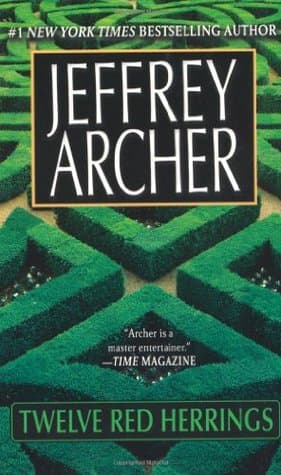
Jeffrey Archer (1994)
Genre
Thriller / Mystery
Reading Time
370 min (approx. 30 min per story)
Key Themes
See below
Sign in to track this book
Jeffrey Archer's "Twelve Red Herrings" offers a collection of short stories, each with a clever twist, challenging readers to spot the misdirection before the surprising end.
Sir Matthew Roberts, a skilled defense lawyer, represents Harvey Metcalfe, accused of murdering his business partner, David Kershaw. The prosecution provides strong evidence, including Kershaw's blood in Metcalfe's car and a body identified by dental records. However, Metcalfe insists he is innocent, claiming Kershaw is alive. Sir Matthew, despite his doubts, plans a bold move: he challenges the prosecution to bring Kershaw to court. The judge, interested and a little annoyed, agrees to a 24-hour delay. The legal teams rush, and tension grows as Metcalfe's future depends on this last effort, with Sir Matthew risking his reputation on his client's unlikely claim.
Rupert Heath, a seemingly successful businessman, is secretly near bankruptcy, having gambled away his money. He owes a large sum to a harsh loan shark, Mr. Cohen, who gives him one last chance to pay by midnight. Desperate, Rupert suggests a coin toss for double or nothing. Cohen, sure of his luck, agrees. The tension is high as the coin is flipped, with Rupert's entire future, and possibly his life, depending on the result. The story details Rupert's inner struggle and the weight of his past mistakes leading up to this single moment.
Dr. Karim Al-Fayed, an Iraqi nuclear scientist who left for the West, lives in fear of Saddam Hussein's agents. Despite a new identity and protection, he is taken and flown back to Iraq. During the frightening flight, Karim realizes his captors want him to work on Iraq's nuclear program or they will kill him. He tries to plan an escape, knowing his life depends on outsmarting his captors. The story details his terror and desperate search for any chance to escape from a regime that wants him dead.
Art critic Anthony Spencer and his wife, Lady Felicity, are at an auction where a valuable painting by a lesser-known artist is for sale. Anthony, known for his good eye and reputation, calls the painting a fake. Felicity, however, likes it, which annoys Anthony. As the bidding increases, Anthony publicly states the painting is not real, confident in his judgment. The story builds tension around the competitive art world and Anthony's belief in his expertise, setting up a twist that questions his authority and view.
Professor Philip Dexter, a respected historian at Oxford University, is approached by a former student, Stephen Bradley, who is applying for a research fellowship. Bradley knows about a past mistake of Dexter's—a forgotten affair that could ruin his reputation and career. Bradley subtly blackmails Dexter, implying that his support for the fellowship depends on Dexter's silence. Dexter faces a moral problem, torn between protecting his career and doing what is right. The story explores the harmful nature of blackmail and how it affects a person's honesty.
Julian and Lucy, a seemingly elegant and loving couple, celebrate Lucy's birthday at a fancy restaurant. Julian showers Lucy with attention and gifts, creating an image of a perfect marriage. However, beneath the romance, Lucy has a secret desire, and Julian has a carefully planned surprise beyond a simple birthday celebration. The story shows the couple's complex relationship and their evening's careful plan, revealing that their reasons are more complex than they seem. The restaurant setting is a backdrop for their act and the reveal of their true intentions.
Sir James Braden, a grieving widower, wants revenge against the hit-and-run driver who killed his wife. He carefully tracks down the driver, a rich and arrogant man named Robert Miller. Braden, a former military strategist, plans his revenge with cold precision, wanting Miller to suffer in a way that reflects his own loss. The story details Braden's intense search for justice, showing his cold determination and the psychological cost of his grief. He carefully sets up events to trap Miller, showing a relentless and calculating pursuit of revenge.
Laura Jenkins, a talented but struggling artist, gets a big chance: to paint a portrait of the American First Lady. This important job could launch her into the art world's elite. However, the First Lady's assistant sets a strange condition: Laura must paint the portrait without ever meeting the First Lady, working only from photos and descriptions. Laura struggles with the artistic challenge and the ethics of this unusual request, knowing that success depends on capturing the essence of someone she cannot directly see. The story explores the compromises artists sometimes make for a big break.
Roger Metcalfe, deep in debt and resentful of his wealthy wife, Margaret, carefully plans her murder. He believes he has created the perfect crime, one that will leave no trace and ensure he inherits her money. Roger studies forensic science and legal loopholes, sure he can outsmart the authorities. The story goes into his mind, detailing his cold calculations and his arrogance in believing he can commit a flawless act. He prepares for what he expects will be his freedom, unaware of the unexpected problems that often arise in even the most carefully planned schemes.
Four victims—a doctor, a lawyer, an art dealer, and a lord—have all been financially ruined by the ruthless financier, Harvey Metcalfe. United by their desire for revenge and to get their money back, they form an alliance. Each man uses his skills and connections to plan a scheme to reclaim exactly what Metcalfe stole from them, 'not a penny more, not a penny less.' The story details their careful planning and teamwork as they work to outsmart the man who thought he was untouchable, showing a clever and complex plot of financial payback.
Frank Watson, convicted of murder and awaiting execution, is troubled by his coming fate. His lawyer, a dedicated but initially doubtful public defender, finds a small legal loophole in the old laws of the jurisdiction. This technicality, missed by both the prosecution and earlier defense teams, offers a bit of hope for Frank. The story focuses on the urgent race against time as the legal team works to use this loophole, showing the complexities of the law and the desperate fight for life. Tension builds as Frank's life is uncertain, depending on the interpretation of a single, obscure rule.
Sir Charles, a known millionaire, receives an invitation to a private luncheon with influential and wealthy people. Flattered by the perceived importance and the promise of a free meal, he accepts, despite usually not liking to socialize. However, his hosts have a hidden goal related to a charity, and they plan to get a large donation from him. The story humorously details Sir Charles's inner conflict between his vanity and his deep stinginess, setting up a clever psychological game where his hosts try to make him generous.
The Antagonist/Central Figure
His arc shifts between being the seemingly uncatchable villain and the target of meticulously planned revenge.
The Protagonist
He tests the limits of legal strategy and his own professional courage.
The Protagonist
He confronts the ultimate consequences of his addiction in a single, high-stakes moment.
The Protagonist
He faces his deepest fears when forcibly returned to the country he fled.
The Protagonist/Flawed Expert
His professional infallibility is challenged, forcing him to confront his own biases.
The Protagonist
He grapples with a moral dilemma that threatens to expose his past and ruin his career.
The Protagonist
He transforms from a grieving husband into a calculating instrument of vengeance.
The Protagonist
She navigates the ethical and artistic challenges of a high-profile commission.
The Antagonist
He believes he is orchestrating a flawless crime, only to face unforeseen consequences.
The Protagonist
He experiences a rollercoaster of despair and hope as his execution looms.
The Protagonist/Flawed Figure
He is manipulated by others who exploit his vanity and stinginess for a greater cause.
Many stories explore the unclear line between legal justice and personal revenge. In 'An Eye for an Eye,' Sir James Braden takes justice into his own hands after the legal system fails him, carefully planning revenge against the man who killed his wife. Similarly, in 'Not a Penny More, Not a Penny Less,' a group of men, cheated by Harvey Metcalfe, avoid usual legal ways to get their stolen money back, showing a form of vigilante justice. The theme questions if true justice can always be found within the law or if personal revenge is sometimes seen as the only choice.
“An eye for an eye, and a tooth for a tooth. But sometimes, a life for a life.”
A common theme throughout the collection is the use of deception, often for personal gain or to outsmart an opponent. In 'Trial and Error,' the entire defense strategy relies on a clever deception to prove a man's innocence. 'A La Carte' features a couple whose romantic dinner hides a deeper, manipulative plan. Characters often use clever schemes, misdirection, and carefully built lies to reach their goals, whether avoiding justice, securing money, or getting revenge. The stories often show how people can be good at complex deceit.
“The greatest trick the devil ever pulled was convincing the world he didn't exist.”
Several stories look at how truth can be subjective and how perception can be changed. In 'Trial and Error,' the courtroom drama centers on whether the 'truth' of a murder victim's existence can be proven or disproven, challenging known facts. 'Clean Sweep Ignition' shows a famous art critic's 'truth' about a painting's authenticity being questioned, revealing that even expert judgment can be wrong. The stories often play with the reader's perception, presenting a situation one way before showing a different reality, emphasizing that what seems true is not always so.
“Truth, like beauty, is often in the eye of the beholder, or, in this case, the one who pays the most.”
Greed and unchecked ambition are strong motivators, often leading to bad results for the characters. Harvey Metcalfe, a recurring character, shows this theme, with his strong desire for wealth causing him to cheat many victims in 'Not a Penny More, Not a Penny Less.' Rupert Heath's gambling problem in 'A Good Toss' is another example of greed, pushing him to the edge of ruin. The stories often show how seeking money, status, or power can corrupt people and lead them down morally wrong or self-destructive paths.
“There are some men who would sell their own mother for a penny more, and then regret not having asked for two.”
The collection shows characters facing extreme difficulty and their displays of strength. Dr. Karim Al-Fayed in 'The Road to Damascus' is a defector living in constant fear, yet he shows great inner strength when abducted and forced back to Iraq. Frank Watson in 'The Loophole,' a man on death row, finds a desperate burst of strength when a legal technicality offers a small hope. These stories highlight the human ability to endure and fight back, even when facing seemingly impossible odds, revealing the strength of the human spirit under pressure.
“Even in the darkest cell, a man's spirit can find a crack of light, if he only looks hard enough.”
A deliberate misdirection to mislead the reader.
Each story explicitly contains at least one 'red herring' – a piece of information or a narrative thread that is designed to distract the reader from the true plot twist or solution. This device is core to the collection's premise, challenging readers to identify the false leads. For example, in 'Trial and Error', the initial focus on the missing body and forensic evidence serves as a red herring, diverting attention from the true nature of Metcalfe's defense. The red herring creates suspense and encourages active reader participation, making the unexpected twists more impactful.
Information presented from a biased or incomplete viewpoint.
Many stories utilize an unreliable perspective, where the reader is privy to the thoughts and assumptions of a character who is either mistaken, deluded, or intentionally deceptive. This device is particularly evident in stories like 'The Perfect Murder', where Roger Metcalfe's arrogant conviction in his flawless plan leads the reader to believe his success is inevitable, only for the twist to reveal his misjudgment. This allows Archer to control the flow of information and create dramatic irony, setting up the final reveal with maximum impact by subverting the reader's expectations.
A conclusion that subverts expectations, often with a sense of poetic justice or dark humor.
The signature device of this collection is the unexpected and often ironic twist ending. Each story builds towards a seemingly inevitable conclusion, only to pivot sharply in the final paragraphs. For instance, in 'Clean Sweep Ignition', the art critic's pronouncement about a painting's forgery is spectacularly overturned. These twists frequently deliver a sense of poetic justice, where a character's arrogance or misdeeds are met with a fitting, often humiliating, comeuppance, or reveal a hidden truth that recontextualizes the entire narrative. This device is crucial for the 'surprise' element promised by the book's description.
Hints or clues about future events, often disguised.
Archer frequently employs foreshadowing, sometimes subtly woven into dialogue or description, other times more overtly presented as a character's internal monologue about future plans. This device builds anticipation and, upon reread, reveals the cleverness of the plot construction. For example, in 'A La Carte', seemingly innocuous details about Julian and Lucy's behavior or their choice of restaurant might subtly hint at their true intentions. The foreshadowing often works in tandem with the red herrings, with some clues pointing towards the twist while others lead astray.
“He found himself wondering, as he often did, why women were so intent on changing men, and men so intent on understanding women.”
— A character reflects on gender differences.
“The greatest trick the devil ever pulled was convincing the world he didn't exist.”
— A character muses on deception and hidden forces.
“Never underestimate the power of a woman, especially one who feels she has been wronged.”
— A warning about the resolve of a scorned woman.
“There are some things in life that money can't buy, but for everything else, there's always a price.”
— A cynical observation about the pervasive influence of money.
“The truth, like a good wine, needs time to mature and reveal its full flavour.”
— A character discusses the slow unfolding of truth in a mystery.
“A lie can travel halfway around the world while the truth is still putting on its shoes.”
— Highlighting the speed at which falsehoods spread.
“It's amazing how quickly people forget their principles when personal gain is involved.”
— An observation on human hypocrisy and self-interest.
“Sometimes the most obvious explanation is the one we are least willing to accept.”
— A character struggling with a simple yet unpalatable truth.
“Justice, like beauty, is often in the eye of the beholder.”
— A reflection on the subjective nature of justice.
“The past is a foreign country; they do things differently there.”
— A character contemplating how history shapes the present.
“Every man has his price, but some are more expensive than others.”
— A cynical view on human corruption and motivations.
“The difference between a good lawyer and a great lawyer is knowing when to keep your mouth shut.”
— A piece of advice given about legal strategy.
“Life is a game of chess, and you can't win if you don't know the rules.”
— A metaphor for navigating life's challenges.
“Never trust a man who smiles too much, or one who never smiles at all.”
— A character's observation on judging character.
Ready to see how well you understood this book? Take our interactive quiz with 10 questions.

Jeffrey Howard Archer, Baron Archer of Weston-super-Mare is an English novelist, life peer, convicted criminal, and former politician. Before becoming an author, Archer was a Member of Parliament (1969–1974), but did not seek re-election after a financial scandal that left him almost bankrupt.







