“ttyl, I'm going to go eat a sandwich.”
— Angela signs off from an IM conversation to get food.

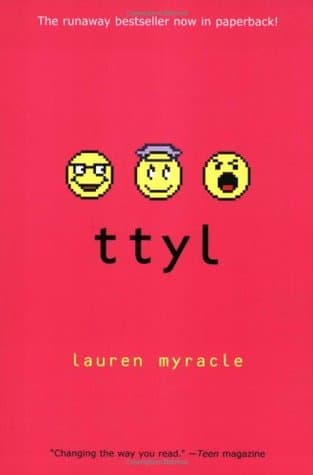
Lauren Myracle (2004)
Genre
Children's / Young Adult / Romance
Reading Time
150 min
Key Themes
See below
Sign in to track this book
Three best friends navigate tenth grade through instant messages, facing boy drama, teacher flirtations, and school gossip that tests their friendship.
The story begins on the first day of tenth grade with best friends Maddie, Angela, and Zoe instant messaging each other. They talk about their anxieties and excitements for the new school year, especially advanced classes and social dynamics. Maddie, sarcastic, tries to keep things light. Angela, optimistic, looks for the good. Zoe, reserved, is nervous but determined. They agree to stick together through all the 'school stupidness,' promising to share everything and support each other, strengthening their bond for the new year.
Angela quickly develops a crush on Owen, a boy in her class, and often discusses him with Maddie and Zoe via IM. Her initial excitement turns to disappointment when Owen seems to ignore her or acts dismissively, leaving her feeling rejected. Meanwhile, Maddie, known for her quick wit, finds herself in a humiliating situation when she accidentally sends a graphic message about a teacher to the wrong person. This leads to widespread gossip and makes her feel exposed, challenging her usual confident demeanor.
Zoe, the quietest and most academic of the three, starts getting instant messages from her English teacher, Mr. Hansford. At first, the messages are about classwork, but they gradually become more personal and flirtatious. Zoe feels uncomfortable yet flattered by the attention. She keeps these exchanges secret from Maddie and Angela, feeling confused, excited, and guilty. The messages escalate, with Mr. Hansford complimenting her appearance and suggesting they meet outside school, pushing Zoe into a morally ambiguous and potentially dangerous situation she struggles to handle alone.
As Angela feels sad about Owen, Maddie deals with her embarrassing message, and Zoe hides her interactions with Mr. Hansford, their close friendship begins to weaken. They communicate less, each consumed by their own problems. Maddie tries to support Angela, but her own embarrassment makes her withdrawn. Zoe, burdened by her secret, finds it hard to genuinely engage with her friends, feeling a growing gap between her inner turmoil and their shared experiences. Their usual lighthearted IM banter is replaced by strained and less frequent conversations, showing their growing emotional distance.
Angela and Maddie notice Zoe's increasing secretiveness and distracted behavior. They become worried and, during an intense IM conversation, press her to say what's wrong. After much hesitation and emotional struggle, Zoe finally confesses about Mr. Hansford's instant messages, showing them the increasingly inappropriate content. Maddie and Angela are shocked and angry about the teacher's behavior, immediately seeing the serious implications. This revelation marks a turning point, as the friends unite in their concern for Zoe and start to plan how to address the issue, putting their own problems aside to support her.
After Zoe's confession, the three friends discuss what to do. Maddie, protective, is furious and wants to confront Mr. Hansford directly, but Angela, more level-headed, suggests they need adult help. They decide to approach Ms. Pace, the school guidance counselor, whom they all trust. The girls carefully gather the IM logs as evidence. This decision is hard for Zoe, who fears consequences and public exposure, but Maddie and Angela's support gives her the strength to move forward, understanding the need to report the predatory behavior.
Ms. Pace takes their report seriously and starts an investigation. Mr. Hansford is suspended and eventually fired, though the process is stressful and draws unwanted attention to Zoe. The school community reacts with a mix of shock, disbelief, and support. Zoe feels a range of emotions, from relief that the ordeal is over to embarrassment and anxiety about being the center of gossip. Maddie and Angela stand by her, protecting her from negative comments and offering constant emotional support, showing their friendship's strength. The incident affects all three girls, making them mature and understand trust and betrayal.
After Zoe's situation is resolved, Maddie thinks about her own earlier embarrassment. Inspired by Zoe's courage, she decides to address the rumors she started. She posts an honest message to her online friends and in her social circles, admitting her mistake and expressing regret for the inappropriate message. While not everyone immediately forgives her, her sincerity begins to repair her reputation. This act of humility shows a new side to Maddie, demonstrating her growth beyond her usual sarcastic persona, and allowing her to reconnect more genuinely with her peers and friends.
Angela, having supported Zoe through her crisis, gains a new outlook on her own problems. Her earlier crush on Owen now seems minor compared to what Zoe went through. She realizes Owen's dismissive behavior did not reflect her worth. Angela stops pursuing him and instead focuses on her studies and friendships. She starts doing activities that truly interest her, rebuilding her self-esteem and finding happiness independent of male attention. This experience strengthens her optimism but also grounds it in a more mature understanding of relationships and self-worth, making her more resilient and confident.
With their individual challenges largely resolved, Maddie, Angela, and Zoe reconnect more deeply. The trials they faced have made their bond even stronger. They continue to IM each other, but their conversations now have more depth and understanding. They share their ongoing high school experiences, offering advice and comfort, and celebrate their small victories. The 'stupidness' of tenth grade, while hard, ultimately brought them closer, proving their initial pact to stick together was more resilient than they imagined. They end the year with a renewed appreciation for their friendship and the knowledge they can overcome anything together.
The Protagonist
Maddie learns to be more vulnerable and honest, moving past her tough facade to embrace genuine connection and responsibility for her actions.
The Protagonist
Angela evolves from being boy-obsessed to understanding her own self-worth and finding confidence independent of romantic attention.
The Protagonist
Zoe transforms from a timid, secretive girl into a courageous individual who stands up for herself and asserts her boundaries.
The Antagonist
Mr. Hansford's arc is one of exposure and professional downfall, as his inappropriate actions are revealed and he faces consequences.
The Supporting
Owen's arc is minimal; he remains largely unchanged, serving as a plot device for Angela's development.
The Supporting
Ms. Pace remains a steadfast, supportive figure, representing responsible adult intervention.
The novel is told entirely through instant messages, showing how integrated online communication is in teen lives. It highlights both benefits, like instant connection and emotional support among friends, and dangers, such as miscommunication, cyberbullying, and predatory behavior. The format itself shows how essential this medium is for their relationships and how it can be both a help and a source of significant trouble.
“mad maddie: lol. u guys r my lifelines.”
At its heart, the novel celebrates the strong bond between Maddie, Angela, and Zoe. Despite their individual struggles and secrets that threaten to separate them, their friendship endures. They rely on each other for advice, emotional support, and protection. When Zoe is in danger, Maddie and Angela set aside their own problems to support her, showing fierce loyalty. This theme stresses the value of a strong support system during adolescence.
“SnowAngel: we're a team, zoegirl. always.”
Each protagonist grows significantly during tenth grade. Angela learns to define her self-worth beyond male attention, Maddie faces her vulnerabilities and takes responsibility, and Zoe finds her voice to stand up against a manipulative adult. Their challenges force them to mature, confront difficult truths, and understand the world around them. These experiences push them out of their comfort zones, leading to a deeper understanding of themselves.
“zoegirl: I never thought I'd be brave enough.”
The storyline with Mr. Hansford and Zoe directly addresses an adult in authority exploiting a minor. The novel shows the grooming process, from innocent messages to inappropriate communication. It highlights student vulnerability and the impact of such abuse, as well as the importance of speaking out and seeking help from trusted adults. This theme serves as a warning and a call for vigilance.
“mad maddie: he's a creep, zoe. a total pervert.”
The entire novel is composed of instant message conversations.
The novel's unique epistolary format, presented entirely through instant message logs, is its most defining plot device. This format immerses the reader directly into the characters' world, providing an intimate and immediate perspective on their thoughts, feelings, and interactions. It allows for rapid-fire dialogue, reveals character personalities through their typing styles and emoticons, and creates a sense of realism for the target young adult audience. It also cleverly demonstrates the dual nature of online communication: a source of connection and a platform for danger, as seen with Zoe's storyline.
Early hints of Zoe's guardedness and discomfort.
From the beginning, Zoe's more reserved nature and occasional hints of unease or distraction in her messages subtly foreshadow the secret she is keeping about Mr. Hansford. Her less frequent contributions to conversations, her vague responses, and her increasing emotional distance from her friends all serve as early indicators that something serious is happening beneath the surface. This device builds suspense and allows the reader to piece together clues, making the eventual revelation of Mr. Hansford's actions more impactful and less sudden.
The reader knows the full extent of Maddie's mistake before she fully grasps the public fallout.
Dramatic irony is employed when Maddie accidentally sends her embarrassing message to the wrong recipient. The reader immediately understands the catastrophic implications of this misclick, while Maddie experiences a delayed realization of the widespread gossip and humiliation it causes. This creates tension and allows the reader to anticipate the social fallout, highlighting the vulnerability of online communication where a single mistake can quickly spiral out of control and become public knowledge, magnifying the emotional impact on Maddie as she slowly comprehends the extent of her blunder.
“ttyl, I'm going to go eat a sandwich.”
— Angela signs off from an IM conversation to get food.
“I can't believe I have to go to school tomorrow. It's like, the worst thing ever.”
— Angela complains about returning to school after a break.
“OMG, did you see what he just wrote? He is SO cute.”
— Angela reacts to an IM from a boy she likes.
“Sometimes I just want to disappear. Like, poof, gone.”
— Angela expresses feelings of being overwhelmed or wanting to escape.
“I think I'm in love. No, seriously this time.”
— Angela declares her feelings for a new crush.
“It's so hard to talk to him in person. I always just freeze up.”
— Angela discusses her shyness around her crush in real life.
“My mom is driving me insane. She just doesn't understand anything.”
— Angela complains about her mother.
“I wish life was like a movie, where everything just works out.”
— Angela reflects on the difference between fiction and reality.
“You guys are the only ones who get me.”
— Angela expresses her appreciation for her friends.
“I feel like I'm constantly trying to figure things out, but I never do.”
— Angela shares her struggles with self-discovery.
“Is it possible to be addicted to IM? Because I think I am.”
— Angela jokes about her frequent use of instant messaging.
“Sometimes I just want to run away and start over somewhere new.”
— Angela expresses a desire for a fresh start.
“I hate drama. But it always finds me.”
— Angela laments the constant drama in her life.
“It's so weird how you can feel so close to someone you've never even met in person.”
— Angela reflects on the nature of online friendships.
Ready to see how well you understood this book? Take our interactive quiz with 10 questions.

Biography coming soon.

Dan Gemeinhart
4.5

Kate O'Hearn
4.4

Jeanne Birdsall
4.4

Jen Wang
4.4

Wendelin Van Draanen
4.3

John Marsden
4.3

Chris Van Allsburg
4.3
Jennifer A. Nielsen
4.2