“The orange rolled through the city like a dream of the past, a premonition of the future, a thing of beauty and terror.”
— Describing the journey of the central orange through Los Angeles.

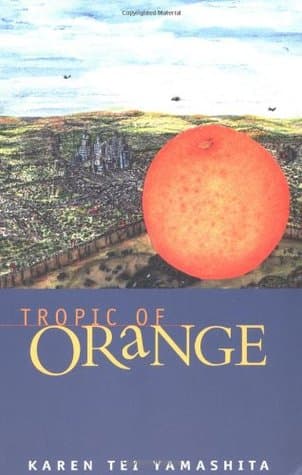
Karen Tei Yamashita (1997)
Genre
Literary Fiction / Fantasy
Reading Time
360 min
Key Themes
See below
Sign in to track this book
As a magical orange line descends upon Los Angeles, an ambitious TV executive and a jaded reporter chase their next big story, oblivious to the fantastical chaos unraveling the city around them.
The novel opens in Mazatlán, Mexico, introducing an old man named Rafael, who lives with his granddaughter Manzanar. Rafael possesses a magical, glowing orange, which he believes connects the world. Driven by an unexplained urge, Rafael decides to travel north, carrying the orange with him. His journey is slow and deliberate, a pilgrimage that seems to defy logic, as he makes his way towards the U.S. border. Meanwhile, in Los Angeles, various characters are introduced, their lives seemingly disconnected but soon to be intertwined by the strange events unfolding. Gabriel, a Latino newspaper reporter, and Emi, an Asian-American television news executive, are both immersed in their media-driven lives, largely unaware of the mystical occurrences beginning to ripple through the region.
In Los Angeles, reality begins to fray. The Tropic of Cancer, an imaginary line usually far to the south, inexplicably shifts its position and begins to move north, directly through the city. This geographical anomaly brings with it a series of surreal and chaotic events. Freeways become gridlocked beyond imagination, strange weather patterns emerge, and the city's infrastructure starts to crumble. Homeless populations grow, and a sense of unease permeates the air. Gabriel and Emi, despite their professional proximity to these events, initially report on them with a detached, almost cynical, perspective, treating the chaos as just another story to cover, failing to grasp the deeper implications of what is happening.
Rafael continues his arduous journey north, his only companion the mystical orange. As he crosses the border into the United States, his presence seems to amplify the bizarre phenomena. The Tropic of Cancer's northward migration accelerates, causing even more disruptions in Los Angeles. Traffic becomes an insurmountable problem, with commuters essentially living in their cars. Water and electricity services become unreliable. The media, represented by Emi and Gabriel, struggles to make sense of the escalating crisis, often resorting to sensationalism or superficial explanations. Yet, beneath the surface, a deeper connection between Rafael's journey and the city's unraveling begins to subtly emerge.
Rafael, after his long pilgrimage, finally arrives in Los Angeles, still clutching the glowing orange. His arrival coincides with the Tropic of Cancer settling directly over the heart of the city, bringing with it a complete breakdown of urban order. The freeways become permanent encampments, and vast numbers of people find themselves displaced. The orange's mystical energy seems to activate and intensify the fantastical elements of the story, blurring the lines between reality and magic. Gabriel, reporting on the escalating crisis, begins to notice the old man and the strange orange, though he still struggles to connect the dots beyond a journalistic narrative.
As the chaos in Los Angeles reaches a fever pitch, different groups become aware of Rafael and his powerful orange. A shadowy organization, a mystical cult led by the enigmatic figure of Superna, and even the established authorities, all begin to converge on Rafael, believing the orange holds the key to either controlling or understanding the unfolding events. Gabriel and Emi, caught in the journalistic frenzy, find themselves inadvertently drawn into the power struggle, trying to report on the factions while also navigating the increasingly surreal city. Rafael, a simple man, finds himself at the center of a complex and dangerous conflict, his orange a coveted prize.
With the Tropic of Cancer firmly established over Los Angeles, the conventional social and political order completely collapses. The freeways transform into semi-permanent, self-governing communities, each with its own rules, leaders, and economies, often based on barter and mutual aid. These 'freeway cities' are microcosms of the larger societal breakdown, yet also show remarkable resilience and ingenuity. Gabriel, now more immersed in the human stories of the crisis, reports on these emerging societies, while Emi tries to capture the visual spectacle for her news network, both grappling with the enormity of the transformation and the new forms of community arising from the ashes of the old.
Amidst the urban collapse, a group of eccentric, yet determined, individuals, including a cartographer and various academics, forms a makeshift expedition. Their goal is to physically locate the displaced Tropic of Cancer and, if possible, return it to its original position. They believe that by understanding and manipulating this geographical anomaly, they can reverse the chaos gripping Los Angeles. Their journey takes them through the surreal city, encountering the diverse communities and strange phenomena that have become commonplace. Gabriel and Emi, initially skeptical, find themselves drawn to this quest, recognizing its potential for a compelling story, but also slowly beginning to believe in the impossible.
Superna, the enigmatic leader of a powerful cult, reveals her true intentions: to harness the mystical energy of Rafael's orange for her own spiritual and political agenda. She believes the orange is a conduit to a new era, and she seeks to control its power to reshape the world according to her vision. She orchestrates various schemes to acquire the orange, using her followers and influence. Rafael, with the help of Manzanar, tries to protect the orange, understanding its inherent goodness and its potential for misuse. The struggle for the orange is a central conflict, symbolizing the battle for the soul of the transforming city.
The various plotlines converge in a climactic confrontation. Rafael, Manzanar, Gabriel, Emi, the Tropic-seeking expedition, Superna's cult, and even the remnants of official authority, all find themselves in proximity, often in the chaotic 'freeway cities.' The orange, now radiating an immense, almost overwhelming, energy, becomes the focal point. Superna makes a desperate bid to seize it, leading to a dramatic struggle. The boundaries between the real and the fantastical completely dissolve, as the city itself seems to react to the struggle, with further inexplicable phenomena occurring, showing the impact of the orange's power.
After the confrontation, the orange's power is either released or shared, leading to a resolution that is not a return to normalcy, but rather an acceptance of a new reality. The Tropic of Cancer may or may not return to its original location, but Los Angeles is irrevocably changed. The freeway communities persist, and the people have adapted to a world where the fantastical is commonplace. Gabriel and Emi, altered by their experiences, begin to understand their roles not just as reporters, but as participants in a grand, unfolding narrative. The novel concludes with a sense of open-ended transformation, suggesting that the new reality, while strange, holds its own forms of beauty and community, forged in chaos.
The Protagonist
Rafael begins as a quiet, solitary pilgrim and ends as a reluctant, yet central, figure in the transformation of Los Angeles.
The Supporting
From a child left behind, Manzanar becomes an active participant and guardian in the unfolding magical events.
The Protagonist
Gabriel evolves from a detached, cynical reporter to a more empathetic, engaged observer and participant in the new reality.
The Protagonist
Emi transforms from a superficial media executive to someone grappling with the profound implications of the new world.
The Supporting
Bobby Ngu evolves from a street informant to a respected leader and voice of wisdom in the new freeway communities.
The Antagonist
Superna attempts to seize control of the orange's power, ultimately failing to fully dominate the new reality.
The Supporting
The Cartographer moves from a purely academic pursuit to a more direct, physical engagement with the changing reality.
The Supporting
Dr. Chan adapts from a traditional academic role to a street-level philosopher in the transformed city.
The Plot Device/Symbol
The Orange travels from Mazatlán to Los Angeles, its power unleashed and ultimately integrated into the new reality.
Yamashita satirizes the detached, often superficial way modern society, particularly through media, processes crisis and change. Gabriel and Emi initially view the literal unmooring of the world as just another story, focusing on sensationalism and ratings rather than the implications. The traffic jams, the consumerism, and the political rhetoric continue even as reality itself bends, showing a deep-seated self-absorption and an inability to adapt to truly unprecedented events. This theme is shown by the almost blasé reactions of many characters to increasingly bizarre phenomena, treating them as mere inconveniences.
“What do you do when the world falls apart? You report it.”
The novel directly tackles the fluid and often artificial nature of borders, both geographical and cultural. Rafael's journey from Mazatlán to Los Angeles, accompanied by the shifting Tropic of Cancer, physically blurs the line between Mexico and the U.S. This geographical anomaly mirrors the cultural intermingling and conflicts inherent in a globalized world, particularly along the U.S.-Mexico border. The 'freeway cities' that emerge in Los Angeles are diverse, multinational communities, showing how new social structures arise when old boundaries dissolve, reflecting the complex realities of migration, identity, and belonging in a border-shifting world.
“The Tropic of Cancer, a line of demarcation, was now a moving target, blurring the lines between north and south, rich and poor, real and imagined.”
As the Tropic of Cancer moves, Los Angeles undergoes a catastrophic breakdown of its established social, political, and infrastructural systems. This collapse, however, is not just destructive; it paves the way for new, often improvised, forms of community and governance. The 'freeway cities' are prime examples, where individuals from diverse backgrounds forge new societies based on cooperation and necessity. This theme explores humanity's resilience and adaptability, suggesting that even in the face of ultimate chaos, new orders and ways of living can arise, often more organic and community-focused than the ones they replaced.
“The city had died, but in its place, a hundred small cities bloomed on the asphalt, each with its own heartbeat.”
A central tension in the novel is the clash between the mystical, unexplained forces (like the glowing orange and the shifting Tropic) and humanity's attempts to understand them through rational, scientific, or journalistic means. Rafael embodies the mystical, intuitive connection to the world, while characters like Gabriel, Emi, and the Cartographer initially represent rational inquiry. The novel suggests that conventional frameworks are insufficient to grasp the changes occurring, forcing characters to confront the limits of their understanding and embrace a more magical, less logical reality. This theme questions what constitutes 'truth' when the fundamental rules of the world are rewritten.
“There are some things, reporter, that cannot be put into words, only felt.”
With geographical and social boundaries dissolving, characters are forced to re-evaluate their identities and where they belong. The diverse populations of Los Angeles, particularly the marginalized, find new communities and roles in the 'freeway cities.' Manzanar and Rafael's journey highlights the search for a spiritual home, while Emi and Gabriel grapple with their professional identities in a world where traditional news becomes obsolete. The novel explores how identity is not fixed but fluid, shaped by environment and circumstance, especially when the very ground beneath one's feet is literally moving. It asks what it means to be 'from' a place when that place is constantly transforming.
“You are where the Tropic is. And the Tropic is everywhere now.”
A literal geographical line that moves north, disrupting reality.
This is the central fantastical element and a major plot device. The Tropic of Cancer, an imaginary geographical line, inexplicably begins to move north from its conventional position, eventually settling directly over Los Angeles. This provides the primary engine for the plot, causing the breakdown of infrastructure, the emergence of 'freeway cities,' and the blurring of reality. It serves as a powerful metaphor for globalization, the collapse of borders, and the arbitrary nature of human-defined boundaries. Its movement directly correlates with Rafael's journey and the orange's power, suggesting a mystical connection between the two.
A glowing, sentient-like orange that acts as a catalyst and symbol.
Rafael's glowing orange is a potent symbol and plot device. It is the object of Rafael's pilgrimage and the focus of desire for various factions, including Superna's cult. The orange is imbued with immense mystical power, seemingly connected to the shifting Tropic of Cancer and the overall transformation of the world. It represents ancient wisdom, spiritual connection, and a power that transcends human understanding. Its presence and journey are directly linked to the escalating chaos and the eventual resolution, making it a central, almost character-like, element in the narrative.
The story is told through various character viewpoints, often in short, fragmented scenes.
Yamashita employs a narrative structure that shifts rapidly between the perspectives of numerous characters – Rafael, Manzanar, Gabriel, Emi, Bobby Ngu, and others. These short, often staccato scenes create a sense of frenetic energy and reflect the fragmented nature of modern life and media. This device allows the reader to experience the unfolding chaos from different angles, highlighting the subjective nature of reality and the varied impacts of the crisis. It also underscores the interconnectedness of seemingly disparate lives, gradually revealing how their paths converge in the transforming city.
The use of exaggeration and irony to critique societal norms.
The novel heavily utilizes satire and absurdist humor to critique contemporary society, particularly media culture, consumerism, and political rhetoric. The characters' often detached reactions to increasingly surreal events, the focus on ratings and sensationalism amidst literal urban collapse, and the creation of 'freeway cities' with their own bureaucratic absurdities, all serve to highlight the ridiculousness of modern life. This device allows Yamashita to deliver sharp social commentary while maintaining a tone that is both entertaining and thought-provoking, preventing the apocalyptic scenario from becoming purely bleak.
“The orange rolled through the city like a dream of the past, a premonition of the future, a thing of beauty and terror.”
— Describing the journey of the central orange through Los Angeles.
“All of Los Angeles was a stage, and the players were all trying to find their parts in a drama they didn't quite understand.”
— Reflecting on the various characters and their interactions within the city's unfolding chaos.
“The freeway was the bloodstream of the city, carrying its life and its toxins, its dreams and its nightmares.”
— Metaphorically describing the significance of the freeways in Los Angeles.
“There was a line, invisible but palpable, that divided the city, the haves from the have-nots, the seen from the unseen.”
— Exploring themes of social division and inequality within Los Angeles.
“Magic was not a trick, but a shift in perception, a way of seeing the world as it truly was, not as it appeared to be.”
— A character's understanding of the nature of magic in the fantastical elements of the story.
“The city hummed with a thousand stories, each one a thread in the vast, tangled tapestry of its existence.”
— Emphasizing the multitude of narratives and experiences within Los Angeles.
“Sometimes the most ordinary things held the most extraordinary power.”
— Referring to the seemingly simple orange and its profound impact.
“Memory was a river, constantly flowing, constantly changing, carrying fragments of the past into the present.”
— A character's contemplation on the nature of memory and history.
“The sun was a giant orange in the sky, burning bright, promising both warmth and destruction.”
— Linking the sun to the central orange motif, highlighting duality.
“To truly see a place, you had to see its ghosts, its past, its unfulfilled promises.”
— A commentary on understanding the deeper layers of a city's identity.
“The border was not just a line on a map, but a wound in the heart of the land, constantly bleeding.”
— Reflecting on the geopolitical and human impact of borders.
“Chaos was not the absence of order, but a different kind of order, one that defied easy understanding.”
— Attempting to make sense of the escalating events in Los Angeles.
“The future was not something to be predicted, but something to be created, moment by moment.”
— A character's philosophical outlook on agency and destiny.
“Even in the heart of the city, there were wild places, untamed corners where anything could happen.”
— Highlighting the unpredictable and untamed aspects of urban environments.
Ready to see how well you understood this book? Take our interactive quiz with 10 questions.

Biography coming soon.







