“The stories are like… maps. They show you where to go, and where you’ve been.”
— Gum Baby explaining the importance of stories to Tristan.

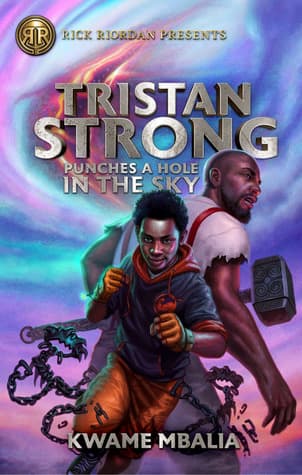
Kwame Mbalia (2019)
Genre
Fantasy / Children's / Young Adult
Reading Time
10-12 hours
Key Themes
See below
Sign in to track this book
Grief-stricken Tristan Strong, haunted by a bus accident, accidentally punches a hole into a world of African American gods and West African folklore figures, forcing him to confront his fears and become the hero he never thought he could be to save both worlds.
Tristan Strong, a seventh-grader from Chicago, is reeling from the death of his best friend, Eddie, who died in a bus accident Tristan blames himself for. Eddie's journal, filled with his imaginative stories, is one of Tristan's most treasured possessions. To help him cope, Tristan's parents send him to his grandparents' farm in Alabama for the summer. Upon arrival, Tristan feels out of place and isolated, struggling with his grief and the unfamiliar rural environment. He carries the weight of Eddie's memory and the guilt of being unable to save him, making him feel anything but strong, despite his surname. The journal becomes a symbol of his lost friendship and a tangible link to Eddie's spirit.
On his first night at the farm, Tristan is startled by a small, humanoid creature made of sap and leaves, which he initially mistakes for a doll. This creature, later identified as a 'haint,' snatches Eddie's journal from his room. Tristan, desperate to retrieve the last vestige of his friend, chases the haint outside to the Bottle Tree in his grandparents' yard. A struggle ensues beneath the tree, with Tristan trying to wrestle the journal back. In a moment of frustration and desperation, Tristan punches the ancient Bottle Tree, a seemingly harmless act that has unforeseen and catastrophic consequences, tearing a hole in reality.
Tristan's punch through the Bottle Tree doesn't just damage wood; it rips open a shimmering, swirling portal into another dimension. He, along with the haint and Eddie's journal, is flung into the MidPass, a fantastical and dangerous world populated by figures from African-American folklore and mythology. This realm is in disarray, with a burning sea, haunted bone ships, and terrifying iron monsters known as 'Fiends' or 'Maafa' that hunt its inhabitants. Tristan immediately realizes this is no ordinary place, and his simple desire to retrieve a journal has landed him in a conflict far beyond his comprehension, disrupting the balance of an entire world.
Shortly after arriving in the MidPass, Tristan witnesses a battle and meets two legendary figures: John Henry, the powerful steel-driving man, and Brer Rabbit, the wily trickster. They are exhausted from fighting the Maafa, the iron monsters that are invading the MidPass. John Henry, though initially skeptical of Tristan, recognizes the magnitude of the hole Tristan created and its connection to the weakening of their world. Brer Rabbit, ever the opportunist, sees Tristan as a potential pawn or catalyst. Tristan learns that the hole in the sky, which he inadvertently created, is destabilizing their reality, and the gods and folk heroes are struggling to contain the chaos.
John Henry and Brer Rabbit explain to Tristan that the only entity powerful enough to seal the hole in the sky and restore balance to the MidPass is Anansi, the Weaver, the trickster god. However, Anansi has gone into hiding, driven by fear and resentment after a past betrayal. Tristan is told that finding and convincing Anansi to help is his only way to repair the damage he caused and, more importantly, to find a way back home to his own world. This sets Tristan on a dangerous quest, forcing him to confront not only external dangers but also his own internal struggles and guilt.
As Tristan, John Henry, and Brer Rabbit journey through the MidPass, they encounter many obstacles and engage in battles against the relentless Maafa. They navigate treacherous landscapes, including the Burning Sea, and face other mythical creatures. Tristan learns more about the history of the MidPass, its connection to African-American oral traditions, and the origins of the Maafa, which are revealed to be manifestations of forgotten stories and suppressed pain. During this time, Tristan begins to understand the power of stories and their role in sustaining the MidPass, a concept directly linked to Eddie's journal.
After a challenging journey, Tristan and his allies finally locate Anansi. The trickster god is bitter and suspicious, having retreated from the world. Anansi is reluctant to help, viewing Tristan as an outsider who caused more harm than good. True to his nature, Anansi demands a significant price for his assistance in weaving the hole in the sky shut. He proposes a series of intricate and often misleading challenges or exchanges, testing Tristan's resolve, wit, and moral compass. Tristan realizes that bartering with Anansi is not straightforward and requires him to think like a trickster himself, pushing him out of his comfort zone.
As Tristan interacts with Anansi and continues his journey, he begins to piece together the deeper truths behind the MidPass's plight. He learns that the Maafa are not just random monsters but are born from the neglect and forgetting of stories, particularly those of the 'Stolen' – the people enslaved and brought across the ocean. Anansi's fear stems from the power these forgotten stories hold and his own past failures. Tristan's role, and particularly Eddie's journal, is central to understanding how stories can both create and destroy, and how remembering is key to healing the MidPass.
Through his experiences in the MidPass, Tristan starts to understand the power of storytelling and the importance of remembering. Eddie's journal, initially just a personal memento, transforms into a vital artifact, a source of new stories and a link between worlds. Tristan begins to channel his grief and guilt into action, realizing that his 'weakness' can be a source of strength. He starts to see himself not just as the boy who failed to save Eddie, but as an 'Anansesem' – a storyteller – capable of weaving new tales and helping to mend the broken world, confronting his self-blame.
With Anansi's reluctant aid and Tristan's newfound courage, the heroes prepare for a climatic confrontation with the surging Maafa and the growing instability of the MidPass. Tristan, using his wits, his ability to inspire, and even his physical strength, plays a central role in rallying the mythological figures. The battle is fierce and desperate, testing the limits of everyone involved. Tristan learns that true strength isn't just physical, but also comes from resilience, belief, and the power to connect with others through shared stories and purpose, using his own unique skills to contribute to the fight.
In a climatic effort, Tristan works alongside Anansi and the other gods to finally seal the hole in the sky. This act requires not only Anansi's weaving magic but also Tristan's emotional input and the power drawn from Eddie's journal and the stories within it. The sealing of the hole brings a fragile peace to the MidPass, but it also signifies Tristan's growth. He accepts that while he couldn't save Eddie, he has honored his friend's memory by saving an entire world. He finds a measure of closure, understanding that grief is a part of life, and that strength can be found even in vulnerability and remembrance.
Having fulfilled his quest and helped save the MidPass, Tristan finds a way back to his grandparents' farm. He is no longer the guilt-ridden, insecure boy who arrived. The experiences in the MidPass have transformed him, instilling in him a sense of purpose, self-worth, and an understanding of the power of his own voice and stories. While he still grieves Eddie, he now carries that grief differently, integrated with his new strength and wisdom. He returns with an invisible but deep understanding of his own strength, ready to face the world with newfound resilience and a deeper appreciation for the tales that shape us.
The Protagonist
Tristan transforms from a guilt-ridden, insecure boy into a courageous storyteller (Anansesem) who embraces his strength and the power of his own narrative.
The Supporting/Mentioned
Though not physically present, Eddie's legacy through his journal provides the initial impetus for Tristan's adventure and remains a guiding force.
The Supporting
John Henry maintains his role as a protector, finding renewed hope and purpose in Tristan's arrival and the potential for stories to be remembered.
The Supporting
Brer Rabbit remains true to his trickster nature but ultimately aids Tristan, showing that even self-serving actions can contribute to a greater good.
The Supporting/Antagonist
Anansi moves from reclusive bitterness to reluctantly engaging with the world again, acknowledging the need for new stories and shared responsibility.
The Supporting
Gum Baby evolves from a thieving creature to a loyal, if still mischievous, companion to Tristan.
The Antagonist
The Maafa serve as a constant threat, their power waxing and waning with the collective memory and storytelling in the MidPass.
The Supporting/Mentioned
They remain largely static, representing the anchor of Tristan's 'real' life and the heritage he is reconnecting with.
The novel emphasizes how stories literally build and sustain worlds. The MidPass itself is woven from African-American folktales and myths, and its very existence is threatened when these stories are forgotten or ignored. Eddie's journal isn't just a book; it's a living artifact that can summon characters and influence reality. Tristan's journey forces him to become an 'Anansesem' (storyteller), understanding that his words and his ability to remember and create narratives are powerful tools for healing and rebuilding. The Maafa are born from neglected stories, showing the destructive consequence of forgetting.
““Stories are like seeds. You plant them, and they grow, and they keep growing. And sometimes they grow so big, they become a whole world.””
Tristan's entire journey is driven by his grief for Eddie and the guilt he feels for not being able to save his friend. This guilt makes him feel weak and undeserving. The MidPass adventure acts as a metaphor for his internal struggle, as he confronts his fears and failures. Through his quest to save the MidPass, Tristan indirectly seeks to make amends for his perceived failure with Eddie. Ultimately, he learns that true strength isn't about preventing tragedy but about finding resilience in its aftermath and forgiving himself, allowing him to carry Eddie's memory not as a burden, but as a source of inspiration.
““You can't save everyone, Tristan. But you can make sure their stories live on.””
Tristan, a city kid, initially feels out of place on his grandparents' Alabama farm and even more so in the MidPass. His journey is a deep dive into his African-American heritage, as he encounters gods and heroes from his cultural folklore. He learns about the 'Stolen' and the historical trauma that underlies some of the MidPass's suffering, connecting his personal grief to a broader collective memory. By embracing these stories and his role within them, Tristan begins to understand who he is and where he belongs, finding strength in his roots and the rich details of his cultural identity.
““You carry the blood of those who came before you, Tristan. Their stories are your stories. Their strength is your strength.””
Tristan begins the story feeling weak, defined by his inability to save Eddie. The MidPass challenges his perception of strength, showing him that it's not just physical prowess (like John Henry's) but also cunning (Brer Rabbit), wisdom (Anansi), and the courage to face one's fears and vulnerabilities. His 'weakness' – his grief and empathy – often becomes his greatest strength, allowing him to connect with others and understand the meaning of the MidPass's plight. He learns that embracing his whole self, including his imperfections, is the path to true power.
““Sometimes, the strongest thing you can do is admit you're scared.””
A magical tree that serves as a portal between worlds.
The Bottle Tree in Tristan's grandparents' yard is not just a decorative element but a powerful magical conduit. Rooted in Southern folk magic, it acts as the accidental gateway to the MidPass when Tristan punches it. It symbolizes the thin veil between the mundane and the magical, and how everyday objects can hold profound spiritual or mystical significance. Its destruction is the inciting incident, ripping open the fabric of reality and setting Tristan's adventure in motion, directly linking his 'real' world to the fantastical.
A magical journal that contains and influences the stories of the MidPass.
Eddie's journal is initially a cherished memento of Tristan's deceased best friend. However, in the MidPass, it reveals itself to be a powerful magical artifact. The stories and drawings within it are not merely static tales; they can influence reality, summon characters, and provide vital clues or power. The journal represents the enduring life of stories, the creative spirit of Eddie, and the potential for new narratives to be woven. Its theft is the initial catalyst for Tristan's chase and entry into the MidPass.
Monsters representing forgotten stories and collective trauma.
The Maafa, or Fiends, are the iron monsters that plague the MidPass. They are more than just physical threats; they are symbolic manifestations of forgotten stories, neglected memories, and the collective trauma of the 'Stolen' – the enslaved African people whose narratives were lost to history. Their destructive presence underscores the novel's central theme about the importance of memory and storytelling. They serve as a constant external antagonist that forces Tristan and the other characters to confront the consequences of forgetting.
A fantastical world built from African-American folklore.
The MidPass is the primary setting for Tristan's adventure, a vibrant, dangerous, and magical dimension woven from the fabric of African-American folktales, myths, and historical narratives. It is a world where legendary figures like John Henry and Brer Rabbit exist, a burning sea rages, and bone ships sail. The MidPass is not merely a backdrop; it is a character in itself, reflecting the health and memory of its stories. Its precarious state mirrors Tristan's internal turmoil and the fragility of forgotten histories.
“The stories are like… maps. They show you where to go, and where you’ve been.”
— Gum Baby explaining the importance of stories to Tristan.
“Sometimes you gotta make your own way, even when the path ain't clear.”
— John Henry's advice to Tristan about facing challenges.
“A story ain't just words on a page, boy. It's a living, breathing thing, and it needs to be told.”
— Miss Sarah telling Tristan about the power of oral tradition.
“You can't punch away your feelings, Tristan. You gotta feel 'em, and then you gotta figure out what to do with 'em.”
— Mama Jo comforting Tristan after a difficult moment.
“Fear ain't the problem. It's letting fear stop you from doing what needs to be done that's the problem.”
— Brer Rabbit offering a piece of wisdom to Tristan.
“Every legend starts with someone just trying to make sense of the world.”
— A reflection on the origins of myths and legends.
“It ain't about being strong enough to lift a mountain. It's about being strong enough to stand your ground.”
— John Henry explaining true strength to Tristan.
“The past ain't something you can run from. It's something you gotta learn from, and then carry with you.”
— Tristan realizing the importance of his history and heritage.
“Sometimes the biggest monsters are the ones you carry inside yourself.”
— Tristan's internal struggle with guilt and self-doubt.
“A hole in the sky ain't just a hole. It's a doorway. And sometimes, you gotta walk through it to find what you're looking for.”
— The metaphorical meaning of the book's title.
“You got a whole world of stories in you, boy. Don't ever let anyone tell you they ain't worth tellin'.”
— Miss Sarah encouraging Tristan to embrace his own narrative.
“Even the smallest spark can light the darkest night.”
— A metaphorical statement about hope and impact.
“Grief is a heavy thing, but it don't mean you gotta carry it alone.”
— Mama Jo offering support and understanding to Tristan.
Ready to see how well you understood this book? Take our interactive quiz with 10 questions.







