“The wind was a living thing, full of a thousand voices, and each one spoke to Lonnie.”
— Lonnie, marooned on the island, begins to understand the natural world around him.

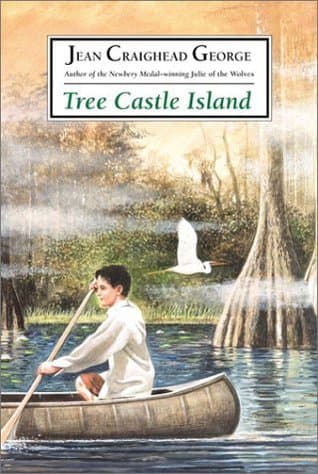
Jean Craighead George (2002)
Genre
Children's / Young Adult
Reading Time
256 min
Key Themes
See below
Sign in to track this book
Stranded in the vast Okefenokee Swamp after an alligator attack, fourteen-year-old Jack must decipher an ancient island mystery that unexpectedly unravels secrets from his own past.
Fourteen-year-old Jack, an aspiring naturalist, builds a dugout canoe named 'Swampfire' for a solo trip into the Okefenokee Swamp. His grandmother, a knowledgeable woman, gives him supplies and a compass, but warns him about the swamp's dangers. Jack, confident in his skills, dismisses her concerns, eager to prove himself and explore the wilderness. He packs his gear, including books, sketching supplies, and food, then sets off, excited for discoveries in the swamp's heart.
Jack spends several days enjoying the swamp, observing wildlife like sandhill cranes and otters, sketching and taking notes. He feels a deep connection to the wilderness, believing he understands its secrets. However, his trip changes sharply when a large alligator, drawn by his food, attacks his canoe, tearing a hole. While fighting the gator, Jack also loses his compass. Stranded and lost, with a damaged canoe and no way to navigate, he struggles to paddle, his confidence shaken by the swamp's unpredictable nature.
Following a faint current, Jack finds an uncharted, almost perfectly circular island surrounded by cypress trees. He names it 'Tree Castle Island.' Exploring, he discovers an old, well-preserved treehouse, seemingly abandoned but filled with interesting artifacts. There are books, scientific instruments, and organized natural specimens. The treehouse feels like a time capsule, suggesting a previous inhabitant who shared Jack's love for nature but had a deeper, scientific understanding. This discovery sparks his curiosity, momentarily distracting him from his predicament.
Jack begins to learn about the treehouse's former resident. He finds a journal with detailed observations of the swamp's plants and animals, along with thoughts on nature and humanity. The journal shows a highly intelligent, solitary person, likely a scientist, who chose to live apart from society. Jack learns about the hermit's routines, studies, and deep respect for the swamp. He also finds evidence of advanced knowledge, including complex diagrams and a carefully made herbarium, suggesting the hermit was a dedicated scholar, not just a survivalist.
Among the hermit's belongings, Jack discovers a coded message and scientific notes detailing a theory about the interconnectedness of all life and the cyclical nature of ecosystems. The hermit, a man named Dr. George, had developed a concept of 'life energy' and its flow through the swamp, a theory that challenged conventional science. Jack, with his developing scientific mind, is captivated by Dr. George's complex work. He spends hours trying to decipher the code and understand the profound implications of the hermit's biological philosophy.
As Jack reads Dr. George's journal, he finds references to a specific rare orchid and a bird migration pattern his grandmother had mentioned. A growing sense of familiarity with some of the hermit's observations bothers him. He also notices striking similarities between Dr. George's scientific illustrations and sketches he'd seen in his grandmother's old books. The pieces slowly come together, leading him to a shocking realization about the hermit's identity and his connection to Jack's own family history.
Jack uncovers a hidden compartment containing old photographs and letters, confirming his suspicion: Dr. George was his grandfather, a renowned scientist who disappeared decades ago and was presumed dead. The letters reveal his grandfather, disillusioned with academia, chose to retreat to the Okefenokee to pursue his groundbreaking research alone. This revelation deeply affects Jack, as he confronts his family's past and the secret his grandmother kept. He feels a powerful connection to this brilliant, reclusive ancestor.
With knowledge of his grandfather's identity and his revolutionary scientific work, Jack faces a moral choice. He feels a strong desire to stay on Tree Castle Island, continuing his grandfather's legacy and immersing himself in nature. The island offers a sense of belonging he hasn't found elsewhere. However, he also understands the importance of sharing Dr. George's discoveries with the scientific community and telling his grandmother the truth. He considers the implications of revealing this secret, weighing solitude against the responsibility of knowledge.
Using salvaged materials, Jack carefully repairs his damaged canoe. This act of practical problem-solving shows his renewed sense of purpose and his integration of wilderness skills with his intellectual curiosity. As he prepares to leave Tree Castle Island, he takes his grandfather's journal and some key research notes, understanding their immense value. He feels transformed, no longer just an explorer but a custodian of a significant scientific legacy. The swamp, once a place of simple adventure, now represents a deeper connection to his past and a clearer vision for his future.
After a challenging journey back through the swamp, Jack finally reaches home. His grandmother, worried sick, greets him with immense relief. Jack shares his extraordinary discovery about Dr. George's identity and scientific work. His grandmother, initially shocked, explains her reasons for keeping the truth hidden—to protect his grandfather's work and allow him his chosen solitude. Together, they begin to process the implications of Dr. George's legacy, promising to honor his memory and potentially share his theories with the world, bridging the gap between the wilderness and the scientific community.
The Protagonist
Jack evolves from a self-assured boy seeking adventure to a mature young man who understands the weight of legacy and the interconnectedness of life and family.
The Supporting
She moves from a secretive guardian to a more open figure, sharing the burden of family history with Jack.
The Mentioned/Influential
His life's work, though completed in isolation, finds its way to the world through his grandson, achieving posthumous recognition.
The Antagonist/Force of Nature
Remains a consistent force of nature, initiating the conflict.
The novel explores the contrast between human society and nature's freedom. Jack initially seeks adventure in the Okefenokee, viewing it as a place to prove himself. His grandfather, Dr. George, represents a deeper rejection of civilization's limits for scientific pursuit and spiritual connection with nature. The island is a sanctuary for both, offering a retreat from societal expectations and a space for discovery. The conflict arises when Jack must decide whether to stay in this natural haven or return to share his discoveries with the wider world.
““The swamp offered a freedom no city could give, a freedom to think and be.””
A central theme, especially through Dr. George's scientific theories, is the idea that all living things are linked within an ecosystem. Jack's grandfather's research on 'life energy' emphasizes the cyclical flow of nutrients and energy, showing each organism's vital role. Jack's own observations of the swamp's plants and animals reinforce this, as he sees predator-prey relationships, symbiotic interactions, and the environment's delicate balance. This theme encourages a holistic view of nature and humanity's place within it, rather than as its dominant force.
““Every leaf, every insect, every creature was a thread in the great tapestry of life.””
The story is about discovering a hidden legacy and its impact. Jack begins his journey seeking personal discovery, but instead unearths his grandfather, Dr. George's, life's work. This legacy is not just scientific notes but a revolutionary way of understanding the natural world. Jack's role changes from explorer to inheritor, as he grapples with the responsibility of carrying forward his grandfather's groundbreaking, unacknowledged theories. The theme shows how past generations can influence the future, often unexpectedly, and how personal journeys can intertwine with larger historical and scientific narratives.
““His grandfather’s words echoed not from the past, but from a future Jack was now bound to.””
Jack's journey is a coming-of-age story where he learns self-reliance and grows. Initially confident but naive, he underestimates the swamp's challenges. The alligator attack and loss of his compass make him vulnerable, forcing him to use his ingenuity and wilderness skills to survive. His ability to repair his canoe and navigate home shows his newfound practical competence. More deeply, his intellectual and emotional maturity grows as he deciphers his grandfather's work and grapples with the ethical implications of his discovery, moving from boyish adventure to responsible young adulthood.
““The swamp had stripped away his certainties, leaving him with only his wits and the courage to use them.””
A vast, wild, and mysterious setting that acts as a character itself.
The Okefenokee Swamp is more than just a backdrop; it functions as a powerful, living entity in the story. It is both a place of immense beauty and profound danger, serving as a catalyst for Jack's transformation. Its vastness disorients him, its creatures challenge him, and its hidden depths conceal the secrets of his past. The swamp's isolation allows Dr. George to pursue his research without interference and provides the perfect setting for Jack's journey of self-discovery and the unearthing of a forgotten legacy. It represents both the allure and the peril of the untamed wilderness.
A symbolic refuge and a repository of forgotten knowledge.
The treehouse on Tree Castle Island serves as a central plot device, acting as a physical manifestation of Dr. George's isolated life and intellectual pursuits. It is a time capsule, meticulously preserved, holding his journals, scientific instruments, and research. For Jack, it becomes a sanctuary and a classroom, where he learns about his grandfather's life and groundbreaking theories. The treehouse symbolizes the retreat from society, the pursuit of pure knowledge, and the enduring power of a legacy waiting to be discovered. Its elevated position also suggests a higher perspective or a detached view of the world.
A narrative device that reveals the past and advances the scientific mystery.
Dr. George's journal is the primary means by which Jack (and the reader) uncovers the mystery of the hermit's identity and his revolutionary scientific work. It serves as a direct link to the past, providing not only factual information about the swamp's ecosystem but also Dr. George's philosophical musings and scientific theories. The journal entries are crucial for character development, allowing Jack to connect with his grandfather's mind and eventually realize their familial bond. It is both a historical document and a scientific treatise, driving the central conflict of discovery and legacy.
A symbol of disorientation and the need for internal guidance.
The loss of Jack's compass early in his journey is a crucial plot device. It immediately plunges him into a state of vulnerability and disorientation, forcing him to rely on his instincts and observational skills rather than external tools. Symbolically, it represents his initial loss of direction and the need to find his own moral and intellectual compass. Its absence underscores the theme of self-reliance and forces Jack to engage more deeply with the natural world, ultimately leading him to Tree Castle Island and his profound discoveries.
“The wind was a living thing, full of a thousand voices, and each one spoke to Lonnie.”
— Lonnie, marooned on the island, begins to understand the natural world around him.
“He was an island himself now, separate and alone, and the island was teaching him its ways.”
— Reflecting on Lonnie's solitude and his adaptation to the wilderness.
“Every bird, every insect, every plant had a story to tell, if only he knew how to listen.”
— Lonnie's growing awareness of the intricate ecosystem of Tree Castle Island.
“Fear was a cold knot in his stomach, but curiosity was a stronger, warmer pull.”
— Lonnie confronting dangers and his innate drive to explore and understand.
“The tree was not just a tree; it was a fortress, a home, a sentinel watching over him.”
— Describing the significance of the giant cypress tree where Lonnie builds his shelter.
“He learned to read the clouds, the currents, the flight of birds – a language older than words.”
— Lonnie's developing wilderness skills and his connection to the environment.
“Loneliness was a taste in his mouth, but freedom was the air he breathed.”
— Contrasting the challenges of solitude with the liberating aspects of his situation.
“To survive, you had to become part of the land, not just live on it.”
— Lonnie's realization about true wilderness survival.
“The silence was not empty; it was filled with the hum of life, the rustle of leaves, the whisper of water.”
— Lonnie's changed perception of the natural sounds of the island.
“He was no longer just a boy from the city; he was a creature of the swamp.”
— Lonnie's transformation as he fully adapts to his wild surroundings.
“Every sunrise was a promise, every sunset a lesson.”
— Lonnie's daily rhythm and his continuous learning from nature.
“The island was his teacher, harsh but fair, demanding but generous.”
— Lonnie's personification of the island as a mentor.
“He understood then that true strength wasn't in fighting nature, but in flowing with it.”
— A key realization for Lonnie about the principles of survival.
“The taste of wild berries, the warmth of the sun, the cool touch of water – these were his riches.”
— Lonnie appreciating the simple, fundamental joys and necessities of his existence.
Ready to see how well you understood this book? Take our interactive quiz with 10 questions.
Biography coming soon.
Dan Gemeinhart
4.5
Kate O'Hearn
4.4

Jeanne Birdsall
4.4

Jen Wang
4.4
Wendelin Van Draanen
4.3

John Marsden
4.3

Chris Van Allsburg
4.3
Jennifer A. Nielsen
4.2