“She had survived, and she would continue to survive. That was the core of her, the steel that ran through her.”
— Eve Dallas reflecting on her past and resilience.

J.D. Robb (2011)
Genre
Thriller / Mystery / Science Fiction / Romance
Reading Time
13 hours 14 mins (audio) / ~7.5 hours (reading 375 pages)
Key Themes
See below
Sign in to track this book
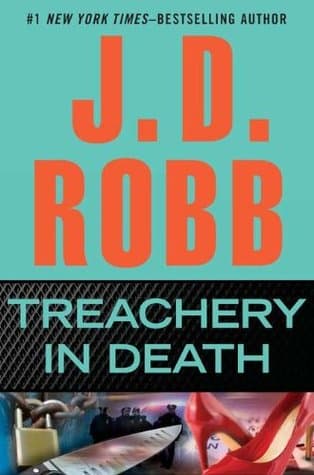
When Detective Peabody overhears two dirty cops discussing murder and corruption, she teams up with Eve Dallas and Roarke to expose them before becoming their next victim.
Detective Delia Peabody is the primary detective on a straightforward, yet brutal, case: the murder of elderly grocery store owner Paul Rogan. Three young, drug-addled punks – Darvon, Tommy, and Spike – beat Rogan to death during a robbery for snacks and a small amount of cash. Eve Dallas acts as her second, guiding Peabody but letting her lead witness interviews and scene processing. This initial investigation helps Peabody develop her detective skills under Eve's supervision. They quickly identify and arrest the perpetrators.
After the grocery store murder case ends, Peabody decides to work out at the rarely-used Central Precinct gym. In a shower stall after her workout, she hears two officers, Detective Garnet and Officer Oberman, enter the locker room. Unaware of Peabody, they discuss 'delivering product,' a 'house in the islands,' and a man named Keener whose death was made to look like an overdose. Peabody, naked and vulnerable, realizes she has stumbled upon a major corruption and murder conspiracy involving her colleagues, specifically the cover-up of Keener's death.
Shaken by what she heard, Peabody struggles with the secret. She feels torn between her duty and the fear of confronting dangerous officers. Reporting them, knowing they kill, terrifies her. Eventually, she tells Eve Dallas everything she overheard in the gym. Eve immediately sees the seriousness of the situation and the danger Peabody is in, understanding they are dealing with deep corruption within their department.
Understanding the sensitive and dangerous nature of investigating corrupt police officers, Eve brings her husband, Roarke, into their confidence. Roarke's resources, technology, and contacts are valuable for an unofficial investigation that cannot use official channels without risk. Together, the three begin to plan how to gather evidence against Garnet and Oberman without alerting them. They know any mistake could put Peabody's life, and possibly their own, in extreme danger.
The team's first step is to re-investigate the death of 'Keener,' the man Garnet and Oberman discussed. Keener's death was officially ruled an overdose, but Peabody's information suggests murder. Eve and Peabody discreetly pull the old case files, looking for inconsistencies or overlooked details. They covertly re-examine the scene, interview Keener's acquaintances under false pretenses, and look for connections between Keener and the corrupt officers, slowly building a picture of their illegal activities.
Using his technology and network, Roarke traces the 'product' Garnet and Oberman mentioned. He uncovers a sophisticated drug trafficking ring, with the corrupt officers using their badges to move narcotics, exploiting their positions to avoid detection and get rich. Roarke's investigation reveals the scale of their operation, connecting them to various illegal activities and confirming their deep involvement in organized crime, beyond just corruption.
To catch Garnet and Oberman, the team sets up a covert surveillance operation. Roarke uses advanced technology to monitor their communications, movements, and meetings. Peabody, with Eve's help, uses her detective skills to predict their patterns and find weak points in their operation. The tension is high as they watch the corrupt officers, knowing they are dealing with dangerous individuals who are always alert for anyone who might expose them. Every move is critical.
During surveillance, Peabody nearly gets discovered by Garnet and Oberman. While trying to plant a listening device or observe an exchange, she narrowly avoids detection. This incident highlights the extreme danger of their mission and the ruthlessness of their targets. It reminds them that Garnet and Oberman are not just corrupt, but murderous, and will stop at nothing to protect their secrets, increasing the urgency and caution the team needs.
With significant evidence, Eve plans to corner Garnet and Oberman. She uses their collected information and calculated moves to force the corrupt officers into a situation where they will either expose themselves further or try to escape, giving Eve and her team a chance to legally apprehend them. This involves setting up a scenario that plays into Garnet and Oberman's greed and sense of security, leading them to a predetermined location where the trap will be sprung.
The planned operation ends in a tense confrontation. Garnet and Oberman, realizing they have been outmaneuvered, react violently. A dangerous pursuit follows, testing the skills of Eve, Peabody, and the tactical officers Eve brought in. The corrupt officers are eventually arrested after a struggle. The evidence against them is overwhelming, ensuring they will face severe consequences for their crimes, including murder and drug trafficking.
Afterward, the department deals with the shock and betrayal of two of their own being so corrupt. Eve and Peabody reflect on the emotional toll of the case, the danger they faced, and the importance of justice, even when confronting colleagues. Peabody, having faced extreme peril and played a key role, gains new confidence and maturity as a detective. Her bond with Eve strengthens, and she becomes a formidable force for justice.
The Protagonist
Eve continues to refine her leadership skills, trusting Peabody to take the lead while offering critical support, and navigates the personal and professional betrayal of corrupt officers.
The Protagonist/Supporting
Peabody steps into a primary detective role for the first time, then faces a terrifying personal and professional challenge when she uncovers police corruption, forcing her to confront immense fear and rely on her training and instincts.
The Supporting
Roarke utilizes his vast resources and technical expertise to support Eve and Peabody's covert investigation, showcasing his unwavering loyalty and his unique ability to navigate both legal and illicit worlds.
The Antagonist
Garnet is exposed from a seemingly untouchable position within the police force as a corrupt, murderous drug trafficker, leading to his downfall and arrest.
The Antagonist
Oberman's complicity in corruption and murder is brought to light, leading to his capture and the dismantling of his criminal activities alongside Garnet.
The Supporting
McNab provides crucial technical support to the covert investigation, demonstrating his loyalty and skill, and solidifying his role as Peabody's steadfast partner.
The Mentioned
His death instigates Peabody's first primary investigation, serving as a catalyst for the events that follow.
The Mentioned
His past murder is uncovered and re-investigated, leading to the exposure of Garnet and Oberman's crimes.
The main theme is the betrayal of public trust when law enforcement becomes criminal. Garnet and Oberman's actions are the ultimate corruption, using their badges for drug trafficking and murder. Peabody's shock and fear upon discovering their treachery highlight this, forcing her to confront the dark side of her own institution. The story explores the moral decay within systems meant to protect, and its impact on law enforcement's integrity, as seen in the team's secret efforts to expose their own.
““They were cops. They were supposed to be the good guys.””
This theme explores the courage needed to do what is right, especially when it risks one's life and means confronting colleagues. Peabody's initial fear after hearing Garnet and Oberman, and her decision to report them to Eve, shows her growing moral strength. Despite being scared, she prioritizes justice over personal safety. Eve, in turn, shows this by taking on the dangerous and politically sensitive task of investigating her own department. She demonstrates an unwavering commitment to the law, regardless of personal cost or the identity of the criminals.
““You do the job, Peabody. No matter who they are. No matter what it costs.””
The relationship between Eve Dallas and Delia Peabody is central to this theme. Eve is a demanding but supportive mentor, pushing Peabody to develop her skills and confidence. Peabody's growth is clear as she takes on her first primary investigation and, more importantly, navigates the terrifying discovery of police corruption. She applies Eve's lessons on observation, deduction, and resilience under extreme pressure. This case is a test for Peabody, changing her from a capable but sometimes hesitant detective into a more confident, courageous, and independent officer. It shows the impact of strong mentorship on professional development.
““You’re ready, Peabody. Now go get 'em.””
The story constantly weighs the pursuit of justice against the dangers to personal safety, especially when criminals are fellow officers. Peabody's fear of Garnet and Oberman, knowing they are murderers, is clear. The secret nature of the investigation by Eve, Peabody, and Roarke highlights this tension. They cannot use official channels openly without risking exposure and possibly their lives. The theme emphasizes the sacrifices individuals sometimes make when facing evil, showing that true justice often requires great personal risk and courage, especially when the threat comes from within.
““They already killed once to keep their secret. They’d do it again.””
Peabody overhears a crucial conversation that exposes police corruption.
This device is the catalyst for the entire main plot. Peabody's accidental presence in the gym locker room allows her to overhear Garnet and Oberman's conversation, revealing their drug trafficking and murder of Keener. This specific incident immediately thrusts Peabody into extreme danger and sets the stakes for the entire investigation. It's a classic 'wrong place, wrong time' scenario that provides the initial, unshakeable evidence needed to kickstart the covert operation, without which the corruption might have remained hidden indefinitely.
Peabody's vulnerability as a hidden observer heightens tension.
Peabody being naked and trapped in a shower stall while overhearing the corrupt officers intensifies the tension and her vulnerability. Her inability to act or reveal herself, coupled with the fear of discovery, underscores the immediate peril she faces. This device effectively creates a sense of helplessness and fear, making the subsequent decision to report the officers even more courageous. It also provides a clear, visceral image of her isolation and the personal stakes involved.
The use of Peabody's status as a police officer to gather intel.
Peabody's position as a detective allows her and Eve to access internal systems and information, such as Keener's case files, without raising immediate suspicion. While the investigation itself is covert, their ability to navigate police resources and understand internal protocols gives them an advantage. This device highlights the double-edged sword of police corruption – the very system designed to catch criminals is being exploited, but also provides the means for honest officers to uncover the truth from within.
Roarke's immense wealth and technological prowess as a deus ex machina.
Roarke's virtually unlimited financial resources, advanced technology, and global network serve as a crucial plot device. His ability to provide covert surveillance equipment, secure communications, and conduct deep background checks without official paper trails is indispensable for an investigation that cannot rely on standard police procedures. This allows Eve and Peabody to operate outside the system, providing solutions to complex logistical and technological challenges that would otherwise be insurmountable, ensuring the safety of the team and the success of the mission.
“She had survived, and she would continue to survive. That was the core of her, the steel that ran through her.”
— Eve Dallas reflecting on her past and resilience.
“The dead don't care about your feelings. They just are. And it's my job to find out why.”
— Eve explaining her professional detached approach to murder investigations.
“Roarke was her anchor, her storm, her everything. And she was his. It was a truth as solid as the ground beneath them.”
— Eve's internal thoughts about her relationship with Roarke.
“There was no such thing as a perfect crime, only imperfect investigations.”
— Eve's professional maxim regarding the solvability of crimes.
“Sometimes you had to break a few rules to make things right. Especially when the rules were wrong to begin with.”
— Eve contemplating bending protocol for the sake of justice.
“Evil wasn't always a snarling beast; sometimes it wore a pretty face and spoke in honeyed tones.”
— Eve's observation about the deceptive nature of villains.
“Fear was a tool, not a master. You could use it, or it could use you.”
— Eve's internal monologue about confronting fear during a dangerous situation.
“He didn't just love her; he saw her. All of her. The broken pieces and the shining strength.”
— Eve's understanding of Roarke's deep acceptance of her.
“Justice wasn't about revenge; it was about balance. About setting things straight.”
— Eve's philosophical view on the purpose of her work.
“The city never slept, and neither did its shadows. Or those who hunted in them.”
— A description of New York City and the constant struggle against crime.
“Every victim deserved to have their story told, to have someone fight for them.”
— Eve's unwavering commitment to the victims of crime.
“Life had a way of throwing curveballs, but it was how you swung that mattered.”
— Eve reflecting on facing unexpected challenges.
“Some secrets were meant to stay buried, but murder had a way of digging them up.”
— Eve's experience with how murder investigations expose hidden truths.
“Even in the darkest corners, there was always a spark of humanity, a flicker of hope.”
— Eve's occasional discovery of goodness amidst depravity.
Ready to see how well you understood this book? Take our interactive quiz with 10 questions.

Biography coming soon.







