“To remember everything is a form of madness.”
— Hugh, the schoolmaster, reflects on the nature of memory and history.

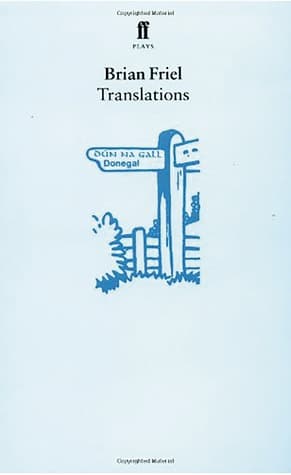
Brian Friel (2000)
Genre
Historical Fiction
Reading Time
90 min
Key Themes
See below
Sign in to track this book
In 1833 rural Ireland, a British survey to translate Gaelic place names into English changes an Irish-speaking community's lives and culture, showing the human cost of an administrative act.
The play starts in a hedge-school in Baile Beag, County Donegal, run by Hugh O'Donnell, a classical scholar, and his son, Manus. The students, including the elderly Jimmy Jack, young Sarah, and Maire, are in lessons. Manus often helps explain his father's teaching to the students. Owen, Hugh's other son, returns after six years in Dublin. He is with two English Royal Engineers: Captain Lancey and Lieutenant Yolland. Owen, who now prefers 'Roland' to the English, interprets for them. Their goal is to survey the area for the Ordnance Survey, which means standardizing and translating Irish place names into English. This immediately causes confusion and discomfort among the Irish speakers.
Captain Lancey, with Owen interpreting, explains the Ordnance Survey's goal: to create a complete map of Ireland, which requires Anglicizing all local place names. Lancey is purely administrative and detached. Lieutenant Yolland, however, is interested in the Irish language and culture, though he cannot speak it. He likes Baile Beag and its people and feels uneasy about renaming places. Owen, at first eager and good at translating, works closely with Yolland, translating names like 'Poll na gCaorach' (Hole of the Sheep) into English. This process shows the cultural gap and the inherent loss in translation.
Maire, a young woman tired of Baile Beag's poverty, wants to emigrate to America and learn English to help her escape. She asks Yolland to teach her English. Despite the language barrier, they connect deeply. Yolland, increasingly charmed by Maire and Irish life, tries to express his feelings. They share a tender, wordless moment, trying to communicate through touch and a few shared words. They eventually say they love each other, mostly by repeating place names like 'Druim Dubh' and 'Bun na hAbhann,' which gain new, personal meaning for them. This growing romance contrasts with the formal, destructive renaming process.
Manus, Hugh's loyal son, feels increasingly left out. His father often overlooks him, favoring Owen, and Maire does not return his romantic interest, especially after she spends time with Yolland. Manus's role as a hedge-school assistant is weakened by Owen's return and the English presence. He sees his community's language and traditions fading. After a misunderstanding where he thinks Owen stole his wages, and further saddened by Maire's clear affection for Yolland, Manus decides to leave Baile Beag. His departure symbolizes an early loss for the community, a direct result of the changing social landscape.
A celebratory dance is held in the hedge-school, where Irish and English characters awkwardly mix. Yolland, drunk and immersed in Irish culture, says he loves the place and its people, though few understand his English. He dances with Maire, strengthening their bond. Later that night, Yolland goes missing. Captain Lancey, angry, announces that if Yolland is not found, drastic actions will be taken, including evicting villagers and destroying livestock. The disappearance creates fear and hostility in the community, breaking the fragile peace that had begun to grow.
After Yolland's disappearance, Owen must interpret Captain Lancey's harsher threats. He sees his community's fear and anger and starts to question his role in the Ordnance Survey. His initial enthusiasm for the project, seeing it as progress, turns into a moral conflict. He realizes the destructive effects of the renaming on his people and their identity. Owen tries to mediate, but Lancey is firm. This internal struggle marks a turning point for Owen; he begins to drop his 'Roland' persona and reconnect with his Irish roots, recognizing the cultural harm he has unknowingly helped.
The English soldiers begin a brutal search for Yolland, destroying property and threatening villagers. Captain Lancey's demands become more extreme, including the threat to shoot all livestock and evict people if Yolland is not found. Hugh, the hedge-school master, gives a moving speech, reflecting on the cyclical nature of conquest and the resilience of language and culture. He accepts that change is coming but also speaks of his people's enduring spirit. Despite the rising tensions, Yolland's disappearance remains unsolved, leaving the community in terror and uncertainty.
As the play ends, Hugh, with Owen, prepares for the hedge-school's inevitable closure and the arrival of new National Schools, which will teach in English. He recites a passage from Virgil, reflecting on history's cycles and the past's loss. He acknowledges the pain of cultural erosion but also expresses a nuanced understanding of adaptation and survival. Yolland's fate is unknown, and Manus's return is uncertain. The play closes with a sense of significant change, loss, and an unclear future for the Irish language and its people, leaving the audience to consider the lasting impact of the Ordnance Survey.
The Supporting
Hugh remains largely steadfast in his intellectual identity but grapples with the decline of his traditional world, ultimately accepting the inevitability of change with a philosophical resignation.
The Supporting
Manus becomes increasingly disillusioned and marginalized by the changes brought by the English, leading him to leave Baile Beag, symbolizing a loss for the community.
The Protagonist
Owen undergoes a significant transformation from an enthusiastic collaborator to a conflicted figure who realizes the devastating cultural implications of his actions, ultimately rejecting his 'Roland' persona.
The Supporting
Yolland's initial enthusiasm for Irish culture deepens into love, making him a tragic figure whose disappearance highlights the destructive consequences of imposed change.
The Supporting
Maire's aspirations for a new life are complicated by her emotional connection to Yolland, leaving her future uncertain and her dreams potentially shattered by his disappearance.
The Antagonist
Lancey remains steadfast in his mission and colonial mindset, escalating his authoritarian tactics in response to Yolland's disappearance, demonstrating the unyielding nature of the colonial power.
The Supporting
Jimmy Jack remains largely unchanged, retreating further into his classical world as his own culture is threatened, a poignant symbol of intellectual preservation amidst decay.
The Supporting
Sarah briefly finds her voice with Manus's help but retreats into silence, symbolizing the struggle for expression within a threatened culture.
The play shows how language connects to individual and cultural identity. The forced Anglicization of place names directly attacks the Irish people's sense of self and history. Characters like Owen, who first uses 'Roland' and English, struggle with a split identity. Others like Hugh and Manus hold onto Gaelic as a key part of who they are. The untranslatable nuances and historical layers in Irish place names, like 'Druim Dubh' or 'Tobair Vree,' are removed, leading to a loss of shared memory and a redefinition of the landscape that distances its inhabitants. This theme is central to the play's conflict, showing how language conquest is also an identity conquest.
“It is not the King's English the King speaks. This is a bastard language.”
Friel explores the subtle and obvious ways colonialism works through the seemingly harmless act of mapping. The Ordnance Survey, presented as an administrative task, is a powerful tool for British control and for dismantling Irish culture. Captain Lancey represents the detached, bureaucratic side of colonialism, while Yolland, despite his good intentions, is still part of this process. The play shows that resistance is not always violent; it can be found in preserving language, storytelling, and community bonds, even as these are undermined. The eventual military response to Yolland's disappearance highlights the underlying power imbalance and the threat of force that supports colonial rule.
“We are being wiped out, Manus, and nobody is doing anything.”
Translation is a central metaphor, not just for language but for cultural understanding. Owen's role as interpreter shows the difficulties and losses in translating between two very different ways of seeing the world. Literal translations often fail to capture the poetic, historical, or emotional meaning of Irish names, simplifying their meaning. The play also explores miscommunication beyond language, such as the love between Maire and Yolland, which grows despite a language barrier but eventually fails due to the larger cultural gap. This theme suggests that true understanding requires more than just word-for-word conversion; it needs empathy and recognizing different realities.
“We name a thing and, in a sense, we create it.”
The play has a strong sense of coming loss—the loss of the Irish language, traditional education (the hedge-school), and a way of life. Renaming places directly attacks shared memory, as the stories and histories in the original names are erased. Characters like Hugh mourn the passing of old ways, while Maire wants to escape a dying culture. Yolland's disappearance and Manus's departure represent personal losses that mirror the larger cultural erosion. Friel suggests that while change is unavoidable, how it happens can be deeply traumatic, separating a people from their past and their identity.
“It is not the King's English the King speaks. This is a bastard language.”
The hedge-school itself symbolizes traditional Irish education, where classical learning exists with local knowledge and oral tradition. Hugh and Manus represent different aspects of this system: Hugh's classical knowledge and Manus's practical teaching. The imminent closing of the hedge-school and its replacement by English-speaking National Schools signifies the systematic dismantling of native educational structures. The play emphasizes the importance of oral tradition, storytelling, and shared community memory in preserving culture, contrasting it with the written, standardized, and imposed knowledge of the English survey. The students' struggles with literacy also show the limits and potential for empowerment through education.
“A civilization can be imprisoned in a linguistic contour which no longer matches the landscape of fact.”
A literal and metaphorical divide between characters and cultures.
The inability of most Irish characters to speak English, and the English characters to speak Irish, is a central device. It creates both comedic and tragic moments, driving much of the miscommunication and highlighting the cultural chasm. Owen acts as the crucial, yet flawed, bridge. This barrier is not just about words; it symbolizes the deeper divide in understanding, values, and power between the colonizer and the colonized. It forces characters like Maire and Yolland to seek non-verbal ways to connect, emphasizing the limits of language while also demonstrating its profound importance.
The act of renaming as a tool of cultural and political conquest.
The Ordnance Survey and the systematic Anglicization of Irish place names are the primary plot drivers. This seemingly benign administrative task becomes a powerful metaphor for colonialism, demonstrating how controlling the map means controlling the narrative and identity of a place. Each name holds historical, mythological, and personal significance for the Irish, which is erased when translated into a standardized English equivalent. The process is a symbolic 'erasure' of Irish history and culture, replacing it with a new, imposed reality that serves the colonial power. It makes concrete the abstract concept of cultural imperialism.
A setting that symbolizes traditional Irish culture and education on the brink of extinction.
The hedge-school serves as the central setting and a powerful symbol. It represents the informal, traditional Irish education system, where classical learning and local knowledge are passed down. Its ramshackle nature, Hugh's eccentric teaching, and Manus's diligent support embody a dying way of life. The arrival of the English soldiers and the impending establishment of National Schools directly threaten its existence. The hedge-school is a microcosm of Baile Beag, showcasing its intellectual traditions, community bonds, and vulnerability to external forces, making its inevitable closure a poignant symbol of cultural loss.
A catalyst that escalates conflict and reveals the underlying tensions.
Lieutenant Yolland's sudden disappearance is a pivotal plot device. It transforms the initially uneasy coexistence between the English and Irish into open hostility and fear. It serves as a dramatic turning point, forcing characters like Owen to confront their loyalties and revealing the brutal underbelly of colonial power through Captain Lancey's retaliatory threats. The ambiguity of his fate leaves the audience to ponder whether it was an accident, an act of resistance, or a tragic misunderstanding, underscoring the volatile nature of the cultural clash and the individual casualties of imperial projects.
“To remember everything is a form of madness.”
— Hugh, the schoolmaster, reflects on the nature of memory and history.
“We are being wiped out, Tom, my father said. No, I said, we're being translated.”
— Owen/Roland recounts a conversation with his father about the changing landscape and language.
“Words are not things.”
— Hugh argues that language is separate from the physical world.
“It is not the King's English, it is the King's Gaelic.”
— Manus asserts the dominance and authenticity of the Irish language.
“Sure, when I open my mouth, I'm a walking anthology of the Irish language.”
— Jimmy Jack, the elderly scholar, boasts about his command of Gaelic.
“We name a thing and, in a sense, at that moment, it exists.”
— Owen/Roland explains the process of mapping and renaming places.
“To hell with all your genealogies! I want to live now—now—now!”
— Yolland (Lieutenant Yolland) expresses his frustration with the past and desire for the present.
“My mind is a tabula rasa, a blank sheet. I can learn anything.”
— Sarah, who has difficulty speaking, expresses her eagerness to learn.
“It's an eviction of sorts. From ourselves.”
— Owen/Roland reflects on the deeper implications of the renaming of places.
“Indeed, it is. A civilization can be imprisoned in a linguistic contour.”
— Hugh discusses the limitations and power of language in shaping culture.
“We must learn where we are in this new world.”
— Hugh acknowledges the inevitable changes and the need to adapt.
“The only thing I know about Latin is that it's a dead language.”
— Maire, pragmatic and focused on the future, dismisses the relevance of classical languages.
“Consensus is what is important. Not accuracy.”
— Owen/Roland reveals the practical, rather than scholarly, approach to renaming.
“I will provide a lexicon of the new names.”
— Owen/Roland takes on the role of cultural intermediary and translator.
Ready to see how well you understood this book? Take our interactive quiz with 10 questions.

Brian Friel was an acclaimed Irish playwright and short story writer. His most famous work, 'Translations,' is a seminal piece of postcolonial literature, exploring themes of language, identity, and cultural change. Friel's plays often delve into the complexities of Irish life and history, earning him widespread critical recognition and numerous awards.







