“The past is not a story for us to tell. It is a story for us to learn from.”
— Reflecting on the nature of history and its lessons.

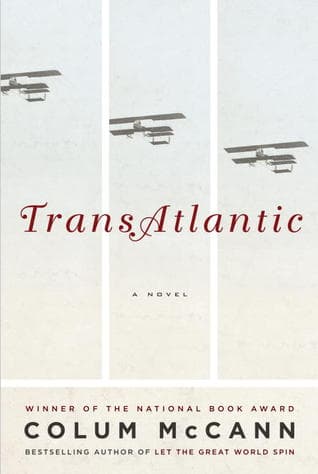
Colum McCann (2013)
Genre
Literary Fiction / Historical Fiction
Reading Time
300 min
Key Themes
See below
Sign in to track this book
From the transatlantic flight of aviators in 1919 to Frederick Douglass's plea for abolition in famine-stricken Ireland and Senator George Mitchell's pursuit of peace in 1998, three crossings link generations of women whose lives span a century of history, hope, and connection.
In June 1919, Captain John Alcock and Lieutenant Arthur Whitten Brown prepare for their dangerous flight across the Atlantic from St. John's, Newfoundland, to Clifden, Ireland. Their Vickers Vimy biplane, a modified bomber, is a marvel of engineering but not tested for such a trip. Despite the risks and basic navigation tools, they want to make history. Brown also wants to escape the lingering trauma of World War I. Their takeoff is difficult, the plane barely clearing the trees, and the flight has mechanical issues, like a broken exhaust pipe and a frozen airspeed indicator. They face bad weather, fog, and the constant threat of falling into the ocean, relying on sheer will and luck.
In 1845, Frederick Douglass, an escaped slave and abolitionist, arrives in Dublin, Ireland, for a lecture tour. He is with his friend and fellow abolitionist, Richard Webb. Douglass finds surprising warmth and support from the Irish people, who, despite their own problems, sympathize with the cause of ending slavery. He sees a clear difference between the intellectual freedom he has in Ireland and the racism he faced in America. However, as his tour continues into 1846, he becomes more aware of the growing potato blight and the famine starting to spread across the country. He struggles with the irony of fighting for freedom abroad while his own people are enslaved, and the suffering he sees in Ireland affects him deeply.
During Frederick Douglass's time in Dublin, a young housemaid named Lily Duggan works for a rich family. She is quiet and observant, deeply affected by the poverty and social inequality around her, made worse by the famine. Lily attends one of Douglass's lectures, drawn by his powerful words and the fervent atmosphere. She is captivated by his speech and his message of freedom and human dignity. This meeting with Douglass, though brief, plants a seed of awareness and possibility in her. She sees in him resilience and the potential for change, despite the hardships of her own life and her countrymen's suffering.
In 1998, former U.S. Senator George Mitchell arrives in Belfast, Northern Ireland. He faces the difficult task of leading multi-party peace talks. The political climate is full of deep-seated animosity, suspicion, and a history of violence. Mitchell, who has Irish and Lebanese heritage, feels a personal connection to the region's conflicts. He handles endless rounds of complex negotiations, dealing with stubborn politicians, paramilitary representatives, and old grievances. His patience, fairness, and commitment to finding common ground are constantly tested as he tries to guide the groups toward a historic agreement that could end decades of bloodshed.
After sixteen hours of terrifying flight, Alcock and Brown finally see the coast of Ireland. Tired and battered, they mistake a flat green field in Clifden for a landing strip. It turns out to be a bog, and their plane crashes, nose-first, into the soft peat. Both men are unhurt, though the Vickers Vimy is damaged. Their historic feat is immediately recognized. Local Irish villagers meet them with awe and relief. The successful transatlantic flight captures the world's imagination, symbolizing human ingenuity and resilience after the Great War, securing their place in aviation history.
Years after meeting Frederick Douglass and experiencing the Irish famine, Lily Duggan makes the difficult journey across the Atlantic to America. She wants a better life and the promise of opportunity, but she carries memories of Ireland's suffering and Douglass's inspiring words. In America, she builds a new life, marries, and raises a family. Her experiences, though not told in great detail, subtly shape her view of the world and are passed down through her family, influencing her daughter and granddaughter in ways she might not fully understand. Her crossing shows the lasting hope and resilience of immigrants.
Emily, Lily Duggan's daughter, grows up in America, part of her family's transatlantic story. She inherits a strong sense of her Irish heritage and the values her mother taught her, including quiet determination and appreciation for hard-won freedom. Emily's life, though more comfortable than her mother's, is still shaped by past struggles and the ongoing challenges of assimilation and identity. She marries and has her own daughter, Lottie, continuing the family line. Emily represents how history and personal experiences are passed down through generations, affecting choices and views, even without clear historical lessons.
Lottie, Emily's daughter and Lily Duggan's granddaughter, becomes a journalist. This job lets her explore and report on the world, much like her ancestors observed and endured. She is intelligent and perceptive, often thinking about her family's history and broader events. Lottie is drawn to stories of resilience, struggle, and connection. She becomes a link for the family's narratives, subtly putting together the threads that connect her to Lily, Emily, and the historical figures they met. Her work provides a modern view through which the novel's themes of crossing, connection, and historical impact are explored, leading to the present day.
After months of difficult, often frustrating negotiations, Senator George Mitchell's persistence pays off. Against great odds, he guides the parties in Northern Ireland to a historic agreement on April 10, 1998 – the Good Friday Agreement. This landmark accord sets up a framework for peace, power-sharing, and reconciliation, ending decades of violence known as 'The Troubles.' Mitchell's role as a fair mediator and his ability to build trust among deeply divided groups are crucial to its success. The agreement shows the power of diplomacy and the possibility of overcoming even the most entrenched conflicts, offering hope for a peaceful future.
Hannah Carson, Lottie's daughter, represents the current generation and the end of the novel's connected stories. She lives in the modern world, yet she is deeply tied to her female ancestors' history. Through her, the echoes of Lily's meeting with Douglass, the aviators' daring flight, and Mitchell's peace efforts resonate. Hannah is a photographer, a visual storyteller, and she finds herself increasingly drawn to the stories that link her family to these historical moments and figures. She understands that her identity is shaped by the journeys and choices of those who came before her. She deals with the responsibility of carrying on their legacy, acknowledging both the successes and the unresolved complexities.
The story ends with Hannah Carson thinking about the lasting legacy of transatlantic crossings – both literal and metaphorical – that have shaped her family and the wider world. She understands that the fights for freedom, the pursuit of new ideas, and the efforts for peace are not separate events but connected threads woven through generations. The book shows how seemingly different historical moments and personal journeys are linked by invisible currents of human experience, resilience, and memory. Hannah's thoughts highlight the idea that every crossing, every decision, and every act of kindness or struggle, affects time, influencing the present and shaping the future in subtle yet strong ways.
The Supporting
From a quiet observer in famine-stricken Ireland, she becomes a resilient immigrant who carries the seeds of hope and historical awareness to a new continent.
The Protagonist (historical)
He begins his tour focused on American slavery but broadens his understanding of human suffering and injustice through his experiences during the Irish Famine.
The Protagonist (historical)
He arrives as an outsider to a deeply divided conflict and, through sheer perseverance, becomes the architect of a fragile but enduring peace.
The Protagonist (historical)
From an ambitious aviator, he becomes a historical figure who proves the possibility of long-distance flight, surviving a perilous journey.
The Protagonist (historical)
He undertakes the flight partly to escape his wartime trauma and emerges having confronted both external dangers and internal demons.
The Supporting
She lives a life shaped by her mother's immigrant journey, subtly carrying forward the family's story and values.
The Supporting
As a journalist, she begins to consciously piece together her family's historical narrative, giving voice to the echoes of the past.
The Protagonist
She starts as a modern woman and evolves to fully embrace and understand the profound historical legacy woven into her family's identity.
The novel shows how large historical events—like the first transatlantic flight, the Irish Famine, or the Northern Ireland peace talks—are not separate but are deeply connected to the personal lives of individuals. Lily Duggan's brief meeting with Frederick Douglass, for example, subtly influences her family for generations. Similarly, Alcock and Brown's flight, while public, is also a personal journey for two men affected by war. The book argues that history is not just made by 'great men' but is a mix of countless individual experiences, choices, and movements across time and space.
“History is not a line, but a circle, and the past is always present.”
The idea of 'crossing' is central, appearing both literally and metaphorically. Literal crossings include Alcock and Brown's flight, Frederick Douglass's voyage to Ireland, Lily Duggan's move to America, and Senator Mitchell's diplomatic trips. These journeys are full of danger and promise, symbolizing the human desire for progress, freedom, and a better life. Metaphorically, 'crossing' means bridging divides—between continents, cultures, historical eras, and even warring groups. The novel explores how these physical and ideological crossings shape identities, create new connections, and leave lasting marks on individuals and nations.
“Every crossing is a gamble, a leap into the unknown, but the human heart is built for such journeys.”
Memory, both personal and shared, is a strong force throughout the novel. The characters are shaped by their direct experiences and by the inherited memories of their ancestors. Lily's descendants, Emily, Lottie, and Hannah, carry echoes of her Irish past and her meeting with Douglass, even if they are not always aware of the direct links. The novel suggests that historical trauma, resilience, and hope are passed down through generations, influencing identity and worldview. Hannah, as a photographer, actively engages with this theme, trying to capture and understand the visual and emotional legacies that connect her to the past.
“What is remembered carries weight, but what is forgotten carries more.”
This theme supports the motivations of several key figures. Frederick Douglass seeks freedom from slavery for his people and finds a different kind of freedom in Ireland. Lily Duggan and other Irish immigrants seek economic and social freedom by crossing the Atlantic. Senator George Mitchell works to make peace in Northern Ireland, a quest for freedom from violence and sectarian oppression. The novel contrasts these quests, showing that freedom and peace are complex and often hard to win, requiring courage, sacrifice, and persistence. It highlights the ongoing nature of these struggles in different historical settings.
“Peace is not an absence of conflict, but the ability to cope with conflict by peaceful means.”
Multiple seemingly disparate storylines converge through shared themes and characters.
McCann employs a non-linear, multi-perspective structure, presenting three distinct historical events and the lives of a matrilineal line of women. Initially, these narratives appear separate: Alcock and Brown's flight, Frederick Douglass in Ireland, and George Mitchell's peace talks. However, the novel gradually reveals their profound interconnectedness through shared themes of transatlantic crossings, struggle, and human connection, ultimately linking them to the family of Lily Duggan. This device allows for a rich exploration of how history, seemingly disparate, actually flows together, influencing generations and demonstrating the subtle ripples of impact across time and space.
A family line of women connects historical events across generations.
The lineage of Lily Duggan, Emily, Lottie, and Hannah Carson serves as the primary unifying thread that ties together the disparate historical narratives. Each woman, through her life experiences and inherited memories, subtly carries forward the echoes of the past. Lily's encounter with Douglass, for instance, indirectly shapes her descendants' understanding of freedom and identity. This device allows McCann to explore themes of legacy, inherited memory, and the enduring impact of history on individual lives across multiple generations, demonstrating how personal stories are caught up in the swells of history and passed down through a specific family line.
Real historical figures act as pivotal points for fictional characters and themes.
The novel uses real historical figures—Jack Alcock, Arthur Brown, Frederick Douglass, and George Mitchell—not merely as subjects, but as catalysts for the fictional characters' journeys and the overarching themes. Lily Duggan's life is fundamentally altered by witnessing Frederick Douglass. The aviators' flight becomes a symbol of human daring and resilience that resonates through time. Mitchell's peace efforts represent the enduring human quest for reconciliation. These figures ground the narrative in historical reality while simultaneously elevating the fictional characters' experiences, allowing for a deeper exploration of how individual lives intersect with and are shaped by pivotal moments in history.
The act of crossing represents physical journeys, overcoming divides, and transitions.
The concept of 'crossing' is a pervasive and multifaceted symbol. It literally refers to transatlantic journeys (flight, sea voyage), but extends to metaphorical crossings: bridging cultural divides, overcoming personal struggles, transitioning between historical eras, and seeking reconciliation between warring factions. The act of crossing embodies risk, hope, transformation, and the constant human desire to move beyond boundaries—geographic, social, or emotional. This pervasive symbolism reinforces the novel's central idea of interconnectedness, illustrating how every journey, every leap of faith, contributes to the larger human narrative.
“The past is not a story for us to tell. It is a story for us to learn from.”
— Reflecting on the nature of history and its lessons.
“There are times when the only thing you can do is keep going.”
— A character's determination to persevere through hardship.
“Every journey begins with a single step, but it is the steps that follow that define the journey.”
— Considering the progression and meaning of a long journey.
“The wind carries the voices of the dead, if you only listen close enough.”
— A character's perception of the lingering presence of past generations.
“We are all just trying to make sense of the chaos, to find a pattern in the noise.”
— A philosophical reflection on the human desire for order and meaning.
“Love is a strange thing. It can be a burden and a blessing, all at once.”
— A character contemplating the complex nature of love.
“The world is full of stories, and each one is waiting to be told.”
— An observation about the richness of human experience and narrative.
“Sometimes the greatest courage is simply to be yourself.”
— A character's realization about authenticity and self-acceptance.
“The silence between words can often speak louder than the words themselves.”
— Reflecting on unspoken communication and subtext.
“History is not just dates and names, it is the beating heart of humanity.”
— Emphasizing the emotional and human aspect of historical events.
“We build bridges, not just of steel and stone, but of understanding and empathy.”
— A metaphor for forging connections between people and cultures.
“The future is always uncertain, but that doesn't mean we shouldn't reach for it.”
— A hopeful outlook despite the unknown nature of what's to come.
“To truly see someone, you must first be willing to look beyond what is visible.”
— A reflection on deeper perception and understanding of others.
“The sea remembers what the land forgets.”
— A poetic statement about the enduring memory of the ocean, particularly in relation to historical crossings.
Ready to see how well you understood this book? Take our interactive quiz with 10 questions.

Colum McCann is an Irish-born novelist known for his critically acclaimed works that often explore themes of connection and displacement. His novel "Let the Great World Spin" won the National Book Award for Fiction, and "This Side of Brightness" was a New York Times Notable Book. McCann's writing is celebrated for its lyrical prose and ambitious scope.







