“There are some things in this world that can never be fixed. But that doesn’t mean you shouldn’t try.”
— Spoken by the protagonist, Riley, reflecting on the state of the world and her own mission.

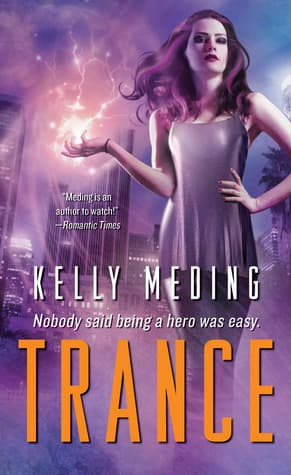
Kelly Meding (2011)
Genre
Fantasy / Science Fiction / Young Adult / Romance
Reading Time
500 min
Key Themes
See below
Sign in to track this book
A former telepathic Ranger, now with volatile new abilities, must reunite her similarly transformed team in war-torn Los Angeles to stop an enemy who weaponizes their gifts.
Fifteen years after the Meta War stripped all Rangers of their powers, Teresa 'Trance' West works at a diner in Chicago. One day, her telepathic abilities violently return, amplified and uncontrollable. The sudden flood of thoughts and emotions from others overwhelms her, causing her to collapse. This marks the start of her powers' return. They now cause her physical pain and make her a danger to herself and others. She realizes she needs answers about what happened to her and the other former Rangers.
Needing answers and control over her enhanced powers, Trance decides to go to Los Angeles, where many former Ranger Corps members lived. She hopes to find others with similar power resurfacings or who know why their powers vanished. Her journey is difficult. She battles constant mental noise and the physical toll of her new abilities, making her wary of human contact and isolated despite her telepathy.
In Los Angeles, Trance finds Kyle 'Shift' Harrison, another former Ranger with teleportation abilities. He works as a mechanic, seemingly still powerless. As they talk about their past and Trance's reawakened abilities, an unknown psychic attacker strikes. During the fight, Shift's powers reactivate, letting him teleport them to safety. This attack confirms Trance's fears: someone is targeting former Rangers, and their powers are returning.
Realizing they are in danger and their powers are back, Trance and Shift decide to find other surviving Rangers. They first look for Marcus 'Maelstrom' Finch, a former weather manipulator. They find him living a quiet life, also without powers, but their presence and the threat quickly bring him into the group. Gathering the team is hard, as many Rangers have moved on or do not want to revisit their past, especially with the Meta War's trauma still fresh.
As the team reunites, including 'Maelstrom' and later 'Catalyst,' they learn a truth: their powers are not just returning; they are changed and stronger. Trance's telepathy now includes telekinesis, Shift's teleportation is more precise, and Maelstrom's weather manipulation is more destructive. These enhanced abilities have major drawbacks, often causing pain, exhaustion, or risking their lives if not controlled. They also realize their powers connect to their emotions, making them unstable.
The mysterious attacker, whom they identify as 'Null,' continues to hunt the reawakened Rangers. Null can absorb and copy others' powers, and he targets the Rangers to steal or integrate their new abilities. The Rangers figure out Null was a Meta human himself, driven by a desire for power and possibly revenge for the Meta War. His attacks become more complex and deadly as he learns their new capabilities.
With Null's threat growing, the reunited Rangers must learn to control their amplified powers. They set up a training area, pushing each other to understand and master their new abilities. Trance struggles with her overwhelming telepathy and new telekinesis, often suffering severe headaches and mental overload. Shift, Maelstrom, and Catalyst also face big challenges, realizing their old training methods are not enough for their changed powers.
As they fight Null and train, the Rangers find clues about the Meta War and why their powers vanished. They discover that the original power loss was not natural but engineered, possibly by a shadowy group or even one of their own. They also realize Null and the return of their powers are linked to this past event, suggesting a deeper conspiracy, possibly involving the source of Meta human abilities.
The Rangers discover Null is not alone; he is manipulating a disillusioned former Ranger named 'Apex,' who also absorbed powers. Apex, feeling abandoned after the Meta War, is used by Null to amplify his own power absorption. Apex's involvement is a painful betrayal for the team, showing the lingering trauma and resentment from their past. They realize they must defeat Null and save Apex from his path.
The story's climax is the reunited and re-powered Rangers confronting Null in a devastating battle. Null, having absorbed immense power, is a strong foe, constantly copying and using the Rangers' own abilities against them. The fight is physically and mentally exhausting, pushing each Ranger to their limits. Trance uses her combined telepathy and telekinesis, Shift his enhanced teleportation, and Maelstrom his powerful weather control. They realize they must work together, combining their transformed powers in new ways to win against Null.
Using strategy, teamwork, and their evolved powers, the Rangers defeat Null. The battle leaves them exhausted and bruised, but they win. However, the victory is not entirely happy. Apex is very weak, and the source of Null's power, a mysterious artifact, is secured but not fully understood. The Rangers have more questions than answers about their powers, the Meta War conspiracy, and the future of Meta humans. They know their fight is not over; their powers are still volatile, and the world now knows they are back.
The Protagonist
Trance transforms from a fearful, isolated individual into a leader who embraces her amplified powers and the responsibility that comes with them.
The Supporting
Shift reclaims his identity as a hero, moving past the trauma of the Meta War to become a crucial asset and emotional anchor for the team.
The Supporting
Maelstrom comes to terms with his past trauma and embraces his renewed powers, finding a new purpose in protecting his friends and the innocent.
The Antagonist
Null is revealed to be a product of the Meta War's aftermath, a twisted reflection of the Rangers' own power, ultimately defeated but leaving a lasting impact.
The Supporting
Apex serves as a cautionary tale of unchecked bitterness, ultimately becoming a victim of the very power he sought.
The Supporting
Catalyst learns to harness his volatile new powers, evolving from a standard energy user to a more potent and strategic combatant.
The main theme is the reawakened Rangers dealing with their amplified and unstable powers. After fifteen years of normal life, they are thrown back into a world where their abilities are both a gift and a problem. Trance struggles with her overwhelming telepathy and new telekinesis, which often causes her physical pain and mental distress. Shift, Maelstrom, and Catalyst also find it hard to control their changed powers, fearing the destruction they could cause. This theme shows in their reluctance to use their powers, their intense training for control, and their acceptance of being protectors, despite the personal cost.
“My powers aren't just back. They're... more. And they're going to destroy me if I can't figure them out.”
The Meta War left deep scars on all the Rangers. They lost their powers and had to cope with a world that no longer needed heroes. Their return to power reopens old wounds and forces them to face their past trauma. Marcus 'Maelstrom' Finch, especially, struggles with his abilities' destructive potential, haunted by war memories. Despite this, the characters show great resilience, choosing to face their fears and reunite to fight a new threat, showing their lasting spirit and commitment to justice.
“We lost everything once. We're not going to let that happen again.”
After losing their powers, the Rangers had to find new identities outside their heroic roles. Trance became a diner waitress, Shift a mechanic, and Maelstrom sought a quiet life. The mysterious return of their powers forces them to confront who they are now and who they were meant to be. This theme looks at the struggle to balance their normal lives with their returning heroic destinies. Their journey is not just about defeating Null, but about finding their purpose and accepting their true selves as Meta human heroes, even if the world is not ready.
“For fifteen years, I tried to forget who I was. Now, I don't think I have a choice.”
The story is driven by a conspiracy about the Meta War and the Rangers' power loss and return. The team gradually learns that their power loss was not accidental but engineered, hinting at a larger, hidden organization. The discovery of Apex's manipulation by Null deepens this theme, showing how past trauma and disappointment can lead to betrayal. This theme creates distrust and urgency, as the Rangers realize their enemies are not just external but possibly hidden among those they once trusted.
“This wasn't an accident. Someone did this to us. To all of us.”
The mysterious and amplified return of the Rangers' Meta human abilities.
This device is the central catalyst for the plot. The unexpected return of the Rangers' powers, after fifteen years of dormancy, ignites the entire conflict. Crucially, these powers are not merely restored but transformed and amplified, introducing new challenges and dangers. This forces the characters to not only relearn their abilities but also cope with their increased potency and volatility, driving their search for answers and their struggle for control. It also makes them targets for the antagonist, Null.
An antagonist with power absorption abilities who targets the reawakened Rangers.
Null serves as the primary external threat and a driving force for the plot. His ability to absorb and mimic powers makes him a unique and terrifying adversary, constantly pushing the Rangers to adapt and evolve. He forces the team to reunite, train, and confront their past. Null's existence and his motives are intrinsically linked to the larger conspiracy surrounding the Meta War, making him more than just a villain but a key to unraveling the overarching mystery.
The link between the Rangers' emotional state and the control of their enhanced powers.
This device adds a layer of internal conflict and danger to the power resurgence. The Rangers' amplified abilities are often tied to their emotional states, particularly their past traumas from the Meta War. When under stress, angry, or fearful, their powers become harder to control, more destructive, and sometimes painful. This forces the characters to confront their emotional baggage and learn self-mastery, adding a significant personal stake to every use of their abilities and highlighting the psychological impact of their past.
“There are some things in this world that can never be fixed. But that doesn’t mean you shouldn’t try.”
— Spoken by the protagonist, Riley, reflecting on the state of the world and her own mission.
“Sometimes, the hardest choices are the only ones worth making.”
— Riley grappling with a difficult decision that will impact many lives.
“Fear can be a weapon, or it can be a cage. It’s up to you which one you let it be.”
— A mentor figure advising Riley on how to confront her anxieties and the threats she faces.
“The past is a stubborn thing. It clings, even when you try to outrun it.”
— Riley contemplating her own history and the events that led her to her current predicament.
“Not all monsters look like monsters. Some wear the most beautiful faces.”
— A warning about deceptive appearances and hidden dangers within the narrative.
“Trust is a fragile thing. Once broken, it’s rarely whole again.”
— Riley dealing with betrayal from someone she once considered an ally.
“Even in the darkest of times, there’s always a flicker of light. You just have to be brave enough to look for it.”
— An encouraging thought during a moment of despair for the characters.
“Love isn't about finding someone perfect. It's about finding someone who makes your imperfections feel perfect.”
— A reflection on the developing romantic relationship between two main characters.
“Some battles you fight with your fists, and some you fight with your mind. But the most important ones you fight with your heart.”
— Riley understanding the different forms of struggle and what truly matters in her quest.
“The world doesn't care about your intentions. It only cares about your actions.”
— A harsh reality check for a character who meant well but caused harm.
“You can't save everyone. But you can try to save someone.”
— Riley struggling with the overwhelming scope of her mission and the limits of her power.
“Sometimes, the greatest strength is knowing when to ask for help.”
— A moment of vulnerability and growth for a character who usually prefers to work alone.
“Magic isn't just about power. It's about understanding, and respect, and balance.”
— A discussion about the true nature of the supernatural abilities in the book.
“Change is inevitable. How you adapt to it defines who you are.”
— A character reflecting on the constantly shifting world and their own evolution.
Ready to see how well you understood this book? Take our interactive quiz with 10 questions.







