“The gods are real. They are dangerous. And they don't care about us.”
— Maggie's internal thoughts about the world and her powers.

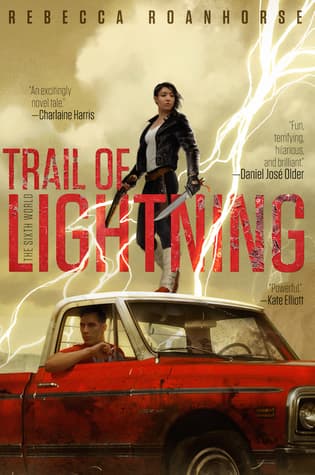
Rebecca Roanhorse (2018)
Genre
Fantasy / Science Fiction / Young Adult
Reading Time
300 min
Key Themes
See below
Sign in to track this book
In a drowned world where Navajo legends walk the earth, a jaded monster hunter must confront ancient evils and her own past to save a missing girl from a terror far greater than she imagined.
Maggie Hoskie, a Dinétah monster hunter, lives a solitary life in her hogan, haunted by her past and the supernatural abilities given to her by the god Neizghání. Elders from the town of White Rock ask her to find a missing girl named Naomi. Maggie reluctantly agrees, using her clan powers to track the girl. She finds Naomi's body, horribly mutilated and seemingly killed by a monster, but the scene is unusual. The monster's tracks are too clean, almost deliberate. Maggie senses a more intelligent, manipulative force at play than a typical beast. This first encounter shows that this case is different from her usual monster hunts.
Recognizing the unusual nature of the monster, Maggie realizes she needs help beyond her own strength and tracking skills. She visits her former mentor and grandfather figure, Tah, a powerful medicine man, who advises her to seek out his grandson, Kai Arviso. Kai is a young, charming, and unconventional medicine man with healing and protective abilities. Maggie initially distrusts him and prefers working alone, but she is drawn to Kai's calm demeanor and unique skills. Their partnership begins tentatively, marked by Maggie's gruffness and Kai's persistent, gentle curiosity, as they start to investigate the strange killings together.
As more people go missing, Maggie and Kai follow clues that lead them to various supernatural entities within Dinétah. They visit First Woman, a powerful and ancient deity, who provides cryptic advice about the monster and hidden dangers. Later, they encounter Coyote, the trickster god, who offers information in exchange for a favor—a dangerous and unpredictable bargain. These interactions show the complex and often dangerous relationship between humans and the gods in the Sixth World, where ancient legends are living realities and power comes with a price.
Through their investigations, Maggie and Kai discover that the 'monsters' are not natural creatures but engineered beings, created through a mix of science and dark magic. They find evidence of advanced technology and genetic manipulation, suggesting a human hand behind the chaos. This revelation disturbs Maggie, as it challenges her understanding of the world and the threats she hunts. The monsters are not just beasts, but tools, implying a master orchestrating their actions and a more insidious plot unfolding across Dinétah. This discovery shifts the focus from simple monster hunting to uncovering a conspiracy.
Following the engineered monsters, Maggie and Kai infiltrate a hidden compound and uncover a cult. They learn that the cult is led by a renegade medicine man named James, a former apprentice of Tah. James uses ancient rituals combined with modern genetic science to create these 'monsters' for his own purposes. James believes he is purifying Dinétah, eliminating those he deems unworthy, and sees himself as a new prophet. The cult's operations are extensive, with a network of followers and a lab where the creatures are bred and controlled. This discovery reveals the true scale of the threat.
Maggie and Kai confront James, who reveals his ideology: he believes he is culling the weak to strengthen Dinétah, seeing the Sixth World as an opportunity to reshape society according to his own vision. During the confrontation, a shocking truth comes to light: Tah, Maggie's mentor, had a deeper, more complicated connection to James than previously known. Tah had, in fact, taught James some of the foundational magic he now corrupts, and had even unintentionally guided him towards this path through his own teachings and past experiments. This revelation is a betrayal for Maggie, shaking her trust in the one person she considered family.
Tah confesses the full truth of his past: he had experimented with forbidden magic and inadvertently created the conditions for James's rise. He also reveals that he had used some of Neizghání's blood, obtained during a past conflict, in his own attempts to control the monsters, which further complicated the situation. As the battle intensifies against James and his creations, Neizghání, the god who gave Maggie her powers, finally appears. He intervenes directly, not just to help Maggie, but to confront the blasphemy of James's actions and the misuse of divine power. Neizghání's presence turns the tide, demonstrating the immense power of the gods.
The climax sees Maggie, Kai, Tah, and Neizghání confronting James and his remaining cultists and monsters. The battle is fierce, with Maggie unleashing her full monster-hunting abilities, Kai providing healing and protective magic, and Neizghání wielding his godly power. James, fueled by his warped ideology and dark magic, is a formidable opponent. The fight is not just physical; it is a clash of ideologies and a test of Maggie's control over her own violent nature. She grapples with the urge to simply kill and the need to understand, ultimately choosing to protect rather than solely destroy.
James is defeated, his cult dismantled, and the immediate threat of his engineered monsters is neutralized. However, the victory is bittersweet. Tah, weakened and remorseful, offers Maggie an incomplete explanation for his actions, leaving many questions unanswered about his true motivations and the extent of his involvement. Maggie grapples with the revelations about her powers, her connection to Neizghání, and the unsettling truth about Tah's past. The experience has changed her, forcing her to confront the complexities of good and evil, and the blurred lines between gods, monsters, and humans in the Sixth World. Her relationship with Kai has deepened, but the future remains uncertain.
In the aftermath, Maggie decides to continue her life as a monster hunter, but with a new awareness. She understands that her powers, while violent, are a necessary tool for protecting Dinétah. Her relationship with Kai, though still evolving, has become a source of strength and companionship. She accepts that Tah's mentorship was flawed but still valuable, and she must forge her own path. The novel ends with Maggie embracing her identity, ready to face the next threats that emerge in the Sixth World, carrying the weight of her past but also the hope of a future where she can use her abilities for good, on her own terms.
The Protagonist
Maggie learns to accept her violent powers as a necessary part of her identity and purpose, moving from isolation to a tentative acceptance of partnership and community.
The Supporting
Kai grows in confidence and skill as he partners with Maggie, demonstrating his own strength and conviction in the face of dangerous magical threats.
The Supporting
Tah's hidden past is slowly revealed, exposing his moral compromises and the consequences of his actions, forcing Maggie to re-evaluate her trust in him.
The Supporting
Neizghání remains largely consistent as a force of nature, though his direct intervention in the climax underscores his role in the ongoing cosmic balance of Dinétah.
The Antagonist
James's descent into villainy and his ultimate defeat solidify the dangers of unchecked power and twisted ideology.
The Supporting
Coyote remains true to his trickster nature, serving as an unpredictable force in the narrative.
The Supporting
First Woman remains a constant, wise presence, embodying the enduring spirit of Dinétah.
The Mentioned
Her memory drives Maggie's internal conflict and fear of her own powers, a constant reminder of her past trauma.
Maggie's central struggle is accepting her identity as a monster hunter, gifted with violent, god-given powers. She views her abilities as a curse, fearing the bloodlust and the potential to harm those she cares about, as shown by her accidental killing of her grandmother. Her journey involves learning to control and harness this power, recognizing it as an integral part of who she is, rather than something to be suppressed or hated. This theme is explored through her internal monologues and her gradual willingness to trust Kai with her true nature.
“"I was a killer. That was all I was. All I ever would be. But maybe that was enough. Maybe it had to be."”
The novel questions the traditional definition of a 'monster.' Initially, Maggie hunts supernatural creatures, but the plot reveals that the most terrifying monsters are human-engineered and controlled, driven by a twisted ideology. This forces Maggie and the reader to question whether true monstrosity lies in inherent supernatural evil or in the corrupted hearts and actions of humans. James, the antagonist, embodies this. His human cruelty and manipulation are more insidious than the beasts he creates, blurring the lines between the natural and the man-made horrors of the Sixth World.
“"It wasn’t just the beasts that were monsters. It was the ones who made them."”
The Sixth World of Dinétah is a blend of ancient Navajo traditions and fractured modern technology in a post-apocalyptic setting. The novel explores how the Diné people adapt, integrating old gods and ceremonies with scavenged remnants of the past world. This is evident in characters like Kai, who is a medicine man but also knowledgeable about technology, and in the antagonist James, who fuses ancient magic with genetic engineering. The narrative shows the resilience of cultural heritage while acknowledging the necessity of adapting to new realities, showing an evolving culture rather than one stuck in the past.
“"The Sixth World was a strange place. Old gods walked and ancient stories were new again, but we still used cell phones and drove cars, or what was left of them."”
Trust is a fragile commodity in Dinétah. Maggie, due to her past trauma and violent powers, struggles to trust anyone, including herself. Her relationship with Kai slowly builds on tentative trust. The revelation of Tah's morally ambiguous past and his connection to James is a betrayal. This theme explores the difficulty of forming bonds in a dangerous world and the pain when those closest to you are revealed to have hidden agendas or compromised ethics. It forces Maggie to re-evaluate her understanding of loyalty and the nature of mentorship.
“"I’d trusted Tah. He was my family. And he’d lied. To me, to everyone."”
Maggie's supernatural abilities, while making her an unparalleled monster hunter, are also a heavy burden. They come with a dangerous bloodlust and the constant fear of losing control, as shown by her accidental killing of her grandmother. The novel explores the personal cost of wielding immense power, especially when it is destructive. This theme is also reflected in Tah's past experiments and James's misuse of power, illustrating how even good intentions can be corrupted when power is wielded without sufficient wisdom or morality.
“"My power was a monster in itself, always hungry, always wanting to break free."”
Supernatural abilities inherited from gods, integral to character and conflict.
Maggie's clan powers, derived from Neizghání, are a central plot device. They manifest as enhanced strength, speed, healing, and a 'sixth sense' for monsters, but also come with a dangerous bloodlust. These powers are both her greatest asset in monster hunting and her deepest internal conflict, driving her isolation and fear of losing control. They directly link her to the divine and the mythical past of Dinétah, making her a unique and powerful protagonist whose abilities are a direct consequence of the gods walking the Sixth World.
A post-apocalyptic Dinétah where gods and monsters are real.
The 'Sixth World' is a unique and vibrant setting that acts as a significant plot device. It's a world reshaped by climate apocalypse (the 'Big Water'), where the Navajo reservation has become Dinétah, a land where the old gods and monsters have returned. This setting allows for the seamless integration of mythology, magic, and a fragmented modern society. It provides the backdrop for the conflicts, the source of Maggie's powers, and the reason for the existence of the monsters she hunts, grounding the fantasy elements in a believable, if fantastical, reality.
A chaotic and unpredictable force that provides information at a cost.
Coyote, as a trickster god, serves as a classic literary archetype and a plot device. His unpredictable nature, self-serving bargains, and cryptic information introduce an element of chaotic uncertainty into the narrative. He is not a direct antagonist but acts as a catalyst, pushing Maggie and Kai into difficult situations or providing essential, but often misleading, clues. His presence highlights the complex moral landscape of the Sixth World and the dangers of dealing with powerful, non-human entities, forcing the protagonists to rely on their wits and caution.
A seemingly wise guide whose hidden past drives character development and plot twists.
Tah initially functions as the archetypal wise mentor figure for Maggie, providing guidance and a sense of family. However, his hidden history and moral compromises transform this device into a source of betrayal and a major plot twist. His past actions, particularly his connection to James and his experiments with forbidden magic, are revealed gradually, challenging Maggie's trust and forcing her to reassess her own understanding of right and wrong. This subversion of the mentor archetype adds depth to the narrative and fuels Maggie's character development.
Monsters that are creations of science and magic, blurring ethical lines.
The revelation that the monsters Maggie hunts are not natural but rather human-engineered creations is a pivotal plot device. It shifts the focus from simple monster hunting to uncovering a deeper conspiracy and challenges Maggie's moral compass. This device allows the author to explore themes of human hubris, the dangers of unchecked scientific and magical experimentation, and the blurred lines between natural and artificial threats. It elevates the conflict from mere survival against beasts to a confrontation with the ethical implications of power.
“The gods are real. They are dangerous. And they don't care about us.”
— Maggie's internal thoughts about the world and her powers.
“My grandmother taught me how to kill. My grandfather taught me how to hide. Together, they taught me how to survive.”
— Maggie reflecting on her upbringing and the skills she learned from her grandparents.
“Sometimes you have to break things to fix them.”
— Maggie's pragmatic approach to problem-solving, often involving destruction.
“The world ended. We just didn't notice it at first.”
— A reflection on the Great Flood and the post-apocalyptic state of the world.
“Being a monster wasn’t a choice. Being a hero was.”
— Maggie grappling with her identity and the nature of her powers.
“There are no good monsters, only monsters who haven't been caught yet.”
— A cynical view on the nature of supernatural beings.
“Magic always has a price. Always.”
— Maggie's understanding of the fundamental rules of her world's magic.
“Hope is a dangerous thing. It can get you killed.”
— Maggie's wary perspective on optimism in a dangerous world.
“You don't fight monsters because you want to. You fight them because you have to.”
— Maggie explaining her motivation for her monster-hunting work.
“The stories are real. All of them.”
— The realization that traditional Navajo myths and legends are literal truths.
“Sometimes the best way to get rid of a monster is to become a bigger one.”
— Maggie's internal struggle with her immense, destructive power.
“Silence is a weapon, too. A sharp one.”
— Maggie observing the power of unspoken words and hidden intentions.
“The wind carries the whispers of the dead, if you know how to listen.”
— Maggie's connection to the spiritual world and her abilities.
“You can't outrun your past, no matter how fast you are.”
— Maggie's lingering guilt and trauma from her past actions.
Ready to see how well you understood this book? Take our interactive quiz with 10 questions.

Biography coming soon.







