“God made the land, but the devil made the people.”
— Jeeter Lester often muses on the futility of his life and the land.

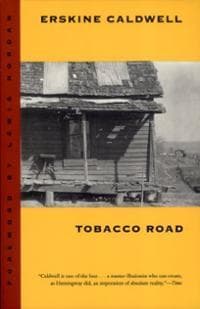
Erskine Caldwell (1932)
Genre
Historical Fiction
Reading Time
180 min
Key Themes
See below
Sign in to track this book
In the desolate dust of Great Depression Georgia, the Lester family's sharecropping existence unravels into a brutal, visceral struggle against poverty that strips away their humanity, one desperate act at a time.
The novel opens on the impoverished farm of Jeeter Lester in rural Georgia. Jeeter, a sharecropper, is a man obsessed with the land, despite its barrenness and his family's abject poverty. He laments the decline of the land and the passing of the 'good old days' when cotton was king. His wife, Ada, and his children, Dude and Ellie May, are introduced, living in squalor. Dude, a seventeen-year-old, is more interested in playing with his stick than working, while Ellie May, described as having a harelip, is shy and withdrawn. Jeeter's primary concern is his desire to farm the land, a dream that seems increasingly impossible as he lacks the resources to even plant a crop. He reflects on his past and the perceived betrayal of his landlord, Captain John, who has moved to Augusta.
Lov Bensey, Jeeter's son-in-law, arrives at the Lester home, having walked seven miles from Fuller to beg for food. Lov is married to Pearl, Jeeter's daughter, who is only twelve years old and refuses to speak to anyone, including Lov. Lov complains about Pearl's stubborn silence and her refusal to fulfill her wifely duties. Jeeter, however, is more concerned with Ada's desire for a sack of coal, which he believes will ease her suffering. Lov has little food to offer, having barely enough for himself. The interaction highlights the extreme scarcity of resources and the self-serving nature of the characters, even amidst familial distress. Lov's desperation for food is palpable, but Jeeter's focus remains on his own immediate, albeit trivial, desires.
Driven by hunger, Jeeter convinces Lov to accompany him to a nearby farm to steal turnips. Lov is hesitant, fearing the consequences, but Jeeter's persuasive, almost childlike, insistence eventually wins him over. They sneak onto the property of another farmer, Tom Darley, and begin pulling up turnips. During their raid, they are discovered by Tom, who fires a shotgun at them. They flee in a panic, dropping most of their stolen goods. This episode underscores the Lesters' desperate struggle for survival and their complete disregard for conventional morality. The act of stealing, while born of necessity, is presented with a disturbing lack of shame, further illustrating their dehumanization.
Sister Bessie Rice, a forty-year-old, self-proclaimed preacher and widow, arrives at the Lester house, drawn by the family's notoriety and her own fervent religious convictions. She is loud, boisterous, and possesses an almost manic energy. Bessie immediately takes an interest in Dude, Jeeter's seventeen-year-old son, proposing marriage to him despite the significant age difference. Dude, somewhat bewildered but intrigued by the prospect of a new car that Bessie promises, agrees. Bessie's arrival injects a chaotic and darkly comedic element into the already dysfunctional household, further highlighting the family's moral destitution and their susceptibility to any offer of material gain, no matter how outlandish.
Sister Bessie, true to her word, marries Dude and purchases a brand-new automobile with her late husband's insurance money. The marriage is a bizarre spectacle, driven by Bessie's religious zeal and Dude's superficial desire for a car. The car becomes a central object of fascination and conflict within the Lester family. Dude, an inexperienced and reckless driver, immediately crashes the car multiple times, causing significant damage. The car, a symbol of modernity and a fleeting taste of prosperity, quickly becomes a source of further chaos and destruction, mirroring the family's inability to manage even the smallest improvements to their lives. Jeeter, meanwhile, remains fixated on his land, oblivious to the new developments.
Ada, Jeeter's wife, has been suffering from pellagra, a debilitating disease caused by malnutrition, for a long time. Her condition worsens significantly, yet her family largely ignores her suffering, absorbed in their own petty concerns. Jeeter is preoccupied with the land, Dude with his new car, and Ellie May with her own shyness. Ada's pleas for food and comfort are met with indifference or annoyance. She eventually dies during the night, her death going unnoticed by her family until morning. Her demise is a stark and brutal illustration of the extreme neglect and emotional desolation within the Lester household, where even the most fundamental human bonds have withered.
Ada's burial is a perfunctory affair, devoid of any genuine grief or ceremony. The family, still largely indifferent, quickly disposes of her body. Later, in a moment of absentmindedness, Jeeter accidentally sets the house on fire while trying to light a fire to warm himself. The fire quickly consumes the dilapidated shack, destroying the last vestiges of their home. The fire symbolizes the complete collapse of the Lester family's already fragile existence, leaving them utterly destitute and homeless. The incident, like many others, is presented with a chilling lack of emotional impact from the characters, highlighting their profound detachment from their circumstances.
Lov Bensey continues to struggle with Pearl, his twelve-year-old wife, who remains completely silent and resistant to his advances. Lov is frustrated by her refusal to speak or engage with him, and he resorts to increasingly desperate measures to control her. He physically restrains her and attempts to force her into submission. However, Pearl, despite her youth and vulnerability, possesses a silent defiance. She eventually manages to escape Lov's grasp and runs away, disappearing into the woods. Her escape represents a small act of rebellion and a desperate bid for freedom from a life of abuse and neglect, leaving Lov alone and defeated.
Following Pearl's escape, Ellie May, Jeeter's harelipped daughter, begins to show an unsettling interest in Lov Bensey. Driven by a desperate loneliness and a yearning for any form of connection or attention, Ellie May attempts to seduce Lov. She follows him around, making suggestive gestures and overtures. Lov, initially repulsed by her appearance and still distraught over Pearl's departure, eventually succumbs to Ellie May's advances. This disturbing encounter further emphasizes the moral decay and the desperate, primal urges that govern the lives of the Lester family members, highlighting their complete abandonment of societal norms and decency.
Dude's reckless driving continues unabated. He repeatedly crashes Bessie's new car, causing significant damage and injuring several people, including Bessie herself. His actions demonstrate a complete lack of responsibility, foresight, or concern for others. The car, which was supposed to be a symbol of their newfound, albeit fleeting, prosperity, becomes an instrument of chaos and destruction in Dude's hands. His behavior reflects the broader theme of the family's inability to manage even the simplest aspects of their lives, leading to a constant cycle of self-inflicted misery and escalating misfortune.
Even after the house burns down, Ada dies, and his family is scattered, Jeeter's singular obsession remains the land. He continues to talk about planting a crop, despite having no seeds, no tools, and no means of support. His fixation is a tragic symbol of his inability to adapt to changing circumstances or to acknowledge the futility of his dreams. He wanders the land, muttering about cotton and corn, a ghost of a farmer on a barren landscape. This unwavering, almost delusional, devotion to the land underscores his profound disconnect from reality and his ultimate powerlessness against the forces of poverty and neglect that have consumed his family.
In the concluding scenes, Jeeter and his remaining family members are left in a state of utter destitution. Dude and Bessie, despite their destructive relationship, are still together, their future uncertain. Ellie May is left with Lov, a relationship born of desperation. Jeeter, now utterly homeless and without any prospects, continues to cling to his dream of farming, a dream that has become a delusion. The novel ends without resolution, leaving the Lesters to face an unending cycle of poverty, hunger, and moral decay. Their future is bleak, mirroring the tragic and dehumanizing impact of their circumstances, with no hope of escape or redemption.
The Protagonist
Jeeter remains largely static, his obsession with the land intensifying even as his family and home disintegrate, highlighting his inability to adapt or change.
The Supporting
Ada's physical and emotional state deteriorates throughout the novel, culminating in her death from pellagra, a tragic end for a woman who never knew comfort or care.
The Supporting
Dude's character shows no real development; he remains a destructive, impulsive force, his actions consistently leading to chaos and harm.
The Supporting
Ellie May's desperation for affection and belonging leads her to increasingly desperate and morally ambiguous actions, ultimately leaving her in a precarious and undesirable situation.
The Supporting
Lov's attempts to control Pearl and improve his situation consistently fail, leaving him increasingly desperate and isolated.
The Supporting
Pearl's arc is one of silent defiance leading to a successful escape from her abusive marriage and family.
The Supporting
Bessie's character remains consistent in her zealous and often misguided actions, her influence on the Lesters creating further chaos.
The Mentioned
N/A - Mentioned character.
The novel vividly portrays how extreme poverty strips individuals of their dignity, morality, and even their basic humanity. The Lester family's constant hunger, lack of hygiene, and dilapidated living conditions reduce them to a primal state of existence. Their actions, such as stealing turnips, the casual neglect of Ada's illness leading to her death, and the disturbing sexual encounters, demonstrate a complete breakdown of societal norms and familial bonds. Their focus shifts entirely to immediate gratification and survival, leaving no room for compassion, foresight, or self-respect. This theme is central to the entire narrative, showing how their circumstances have eroded their very essence, leaving them as mere shells of people.
“What was the use of planting anything, when there was no money to buy seeds with?”
Despite the introduction of new elements like Sister Bessie's car or the prospect of moving to the city, the Lester family remains trapped in a cycle of poverty and despair. Jeeter's unwavering attachment to the barren land, even as his home burns down, symbolizes a resistance to change and an inability to adapt. The car, a symbol of modernity and potential escape, becomes an instrument of further destruction in Dude's hands. Any attempt at 'progress' or improvement is met with failure, either due to the characters' own incompetence or the overwhelming weight of their circumstances. The novel suggests that for some, escape from their predetermined fate is impossible, and any perceived progress is merely an illusion leading to further decline.
“It was no longer possible to grow cotton on the land, but Jeeter could not bring himself to believe it.”
The novel serves as a bleak commentary on the decline of the agricultural South during the Great Depression. The once-fertile land is now barren, the cotton crops have failed, and the traditional way of life for sharecroppers like the Lesters has become unsustainable. The departure of landlords like Captain John and the move of the cotton mills to the cities leave the rural poor without economic support or hope. The dilapidated Lester homestead, with its crumbling walls and leaking roof, is a metaphor for the broader decay of the region. This theme highlights the socio-economic forces that contributed to the widespread poverty and the abandonment of the land and its people.
“The land had been worn out by cotton, and there was nothing left but broom sedge and gullies.”
The Lester family is a prime example of extreme dysfunction and neglect. There is a complete absence of genuine affection, support, or responsibility among its members. Ada's death from pellagra, largely ignored by her family, is a stark illustration of this neglect. Jeeter is preoccupied with his land, Dude with his car, and Ellie May with her own desperate needs. Communication is minimal, and self-interest reigns supreme. This theme explores how the pressures of poverty can erode the most fundamental human bonds, turning family members into isolated individuals struggling for their own survival, devoid of empathy or care for one another.
“Nobody cared what happened to anybody else, as long as it wasn't happening to them.”
The barren land symbolizes the Lesters' spiritual and physical decay.
The land is a central symbol in 'Tobacco Road.' Initially, it represents Jeeter's connection to his heritage and his dream of a prosperous life. However, as the novel progresses, the barren, eroded soil comes to symbolize the Lesters' own physical and spiritual decay. It reflects their inability to sustain themselves, their lack of growth, and their ultimate destitution. Jeeter's unwavering, almost delusional, attachment to this infertile land underscores the futility of his dreams and his inability to adapt to the changing world, trapping him in a cycle of poverty and despair. The land is both his obsession and his prison.
Darkly comedic elements highlight the absurdity and horror of the Lesters' lives.
Caldwell employs black humor and grotesque imagery to depict the Lesters' desperate situation. The absurd marriage between Dude and Sister Bessie, Dude's reckless driving and repeated accidents, or the casual, almost comical, way Ada's death and burial are handled, all serve to highlight the horrifying reality of their lives through a lens of dark comedy. This device prevents the reader from becoming completely overwhelmed by the bleakness, while simultaneously emphasizing the characters' detachment from normal human emotions and the sheer absurdity of their existence. It forces the reader to confront the dehumanizing aspects of extreme poverty in an unsettling way.
Early details hint at future misfortunes and the characters' ultimate fates.
Foreshadowing is used to build a sense of inevitability around the Lesters' decline. For instance, the descriptions of Ada's worsening illness early in the novel clearly point towards her eventual death. Dude's reckless behavior with his stick foreshadows his destructive actions with the car. The constant references to the barrenness of the land and Jeeter's inability to plant a crop hint at the family's ongoing starvation and lack of prospects. This device creates a pervasive atmosphere of doom and reinforces the idea that the characters are trapped in a cycle of misfortune from which there is no escape, making their tragic end feel predetermined.
The characters operate without a conventional moral compass, driven by primal needs.
The novel deliberately strips its characters of conventional morality, portraying them as driven solely by their most basic, primal needs: hunger, sex, and the desire for material objects. Jeeter's casual theft of turnips, Ellie May's desperate seduction of Lov, and the family's complete indifference to Ada's suffering and death all exemplify this absence. This device highlights the dehumanizing power of poverty, suggesting that when people are pushed to the absolute brink of survival, societal norms and ethical considerations dissolve, leaving only raw instinct. It forces the reader to confront the question of what remains when all else is lost.
“God made the land, but the devil made the people.”
— Jeeter Lester often muses on the futility of his life and the land.
“A man's got to scratch where he itches.”
— Jeeter's justification for many of his impulsive and often unproductive actions.
“The good Lord don't give a damn about a man's belly.”
— Jeeter's cynical view on divine providence in the face of starvation.
“It ain't no use to work when there ain't no sense to it.”
— Jeeter's philosophy on labor, often used to justify his idleness.
“People just ain't got no heart no more.”
— Jeeter's lament about the lack of charity and compassion from others.
“A man can't live on nothing but air.”
— A simple, yet profound statement about the basic need for food.
“The land's wore out, just like us.”
— Jeeter's comparison of the depleted soil to his own family's exhaustion and decline.
“Ain't no telling what a woman will do when she gets a hankering.”
— Reflecting on the unpredictable and often desperate actions of the female characters.
“It don't do no good to worry about what's going to happen.”
— A fatalistic acceptance of their dire circumstances.
“He just wanted to scratch in the dirt, the way he always had.”
— Describing Jeeter's innate desire to farm, even when it's futile.
“There ain't nothing left to steal.”
— A bleak statement highlighting the extreme poverty and lack of possessions.
“The sun was hot and the dust was thick, and there was nothing to eat.”
— A recurring description of the harsh conditions faced by the characters.
“Lord, it's a hard life, a mighty hard life.”
— A common refrain expressing the constant struggle and hardship.
“They was all just like animals, living off the land and each other.”
— A harsh observation about the primitive existence of the Lester family.
Ready to see how well you understood this book? Take our interactive quiz with 10 questions.

Erskine Preston Caldwell was an American novelist and short story writer. His writings about poverty, racism and social problems in his native Southern United States, in novels such as Tobacco Road (1932) and God's Little Acre (1933) won him critical acclaim.







