““There is no freedom for a princess until she is married.””
— A common sentiment in the royal court, reflecting the limited agency of women.

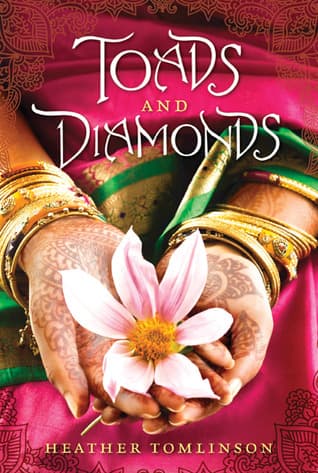
Heather Tomlinson (2010)
Genre
Fantasy / Historical Fiction / Young Adult / Romance
Reading Time
288 min
Key Themes
See below
Sign in to track this book
When a goddess gives one sister jewels and the other toads, their blessings and curses lead to royal conflict, plague, and self-discovery in historical India.
Diribani, a kind young woman from a poor family, goes to the village well for water. There, she meets a mysterious, beautiful woman who asks for a drink. Despite her own thirst, Diribani humbly offers the woman the first drink. The woman reveals herself to be Lakshmi, a powerful goddess, and rewards Diribani for her kindness. From that moment, whenever Diribani speaks, beautiful flowers and precious jewels fall from her lips, surprising her family, especially her mother and younger sister, Maya. This gift immediately ends their poverty, bringing them food and comfort.
Tana, Diribani's stepsister, is known for her sharp tongue and resentment. When she hears of Diribani's gift, she feels envy and wants similar fortune. She deliberately goes to the well, hoping to meet the goddess. When Lakshmi appears, disguised again, and asks Tana for water, Tana responds rudely and selfishly, refusing to share. Displeased by Tana's unkindness, Lakshmi curses her. From then on, whenever Tana speaks, toads and snakes fall from her mouth, horrifying everyone, including her own mother.
News of Diribani's gift spreads, reaching Prince Kiran, the heir to the local province. Curious about the tales of jewels and flowers, Prince Kiran sends his royal guards to summon Diribani to the palace. Her family is both awed and terrified by this unexpected attention. Diribani, though nervous, prepares herself, knowing this summons could be a great chance or a dangerous trap. She is brought before the Prince and his advisors; her every word shows her miraculous blessing.
Tana's curse makes her an outcast. The villagers, fearing the snakes and toads that come from her mouth, demand her expulsion. Her own mother, disgusted, cannot protect her. Tana is forced to flee the village, wandering alone and hungry. Meanwhile, a deadly plague, spread by rats, begins to devastate the province, causing widespread death. The governor, focused on order, is more concerned with the perceived threat of Tana's snakes than the actual illness, hindering effective response.
Diribani lives in the palace, a stark change from her humble beginnings. Prince Kiran is captivated by her unique gift and gentle nature, and they begin to form a bond. However, her presence and the Prince's growing affection for her stir resentment among some courtiers, particularly Minister Jagpal, a manipulative advisor who sees Diribani as a threat to his influence. Jagpal plots to remove her. He tries to poison her, but she narrowly escapes thanks to a loyal servant.
As Tana wanders, outcast and desperate, she finds a group of snake charmers who live on society's fringes. Initially wary of her, they soon realize the unique nature of her curse. Far from being repulsed, they see a connection to nature and their own craft. Tana begins to learn from them, observing their respect for snakes and their understanding of their behavior. She slowly starts to let go of her bitterness, realizing that the snakes she speaks are not evil but simply a part of her, and that her curse might have an unexpected purpose.
The plague continues to devastate the province, and the governor's poor leadership worsens the situation. His irrational fear of snakes leads him to ignore any potential solutions or wisdom connected to them. He prioritizes hunting down any reports of snakes — including Tana's — over addressing the public health crisis. This misdirection of resources, fueled by superstition and personal phobia, allows the rat-borne disease to spread unchecked, leading to many deaths and widespread suffering.
Diribani, having survived the assassination attempt, becomes more aware of palace politics. She grows in confidence and uses her gentle influence on Prince Kiran, subtly guiding him toward more compassionate governance. She observes the people's suffering from the plague and begins to question her gift's superficiality. While it brings wealth, it doesn't solve deeper problems. She starts to understand that true value lies not just in material blessings but in wisdom, empathy, and the ability to help others.
Living with the snake charmers, Tana has a realization. She notices that the snakes she speaks, especially the smaller, faster ones, are natural predators of rats. As the plague worsens, she connects the dots: her curse, which caused her so much pain, might be the key to saving the province. She begins to experiment, realizing she can direct the snakes she speaks. With the snake charmers' help, she plans to use her ability to fight the plague by releasing her snakes to hunt disease-carrying rats in affected areas.
As the plague peaks, Diribani, now betrothed to Prince Kiran, learns of Tana's efforts and the potential of her 'curse.' She convinces Kiran to allow Tana to return to the city. The sisters reunite, their roles somewhat reversed. Diribani, with her status and jewels, confronts the fearful governor, arguing for Tana's method. Meanwhile, Tana, guided by the snake charmers, unleashes her snakes into the plague-ridden areas, targeting the rat population. The governor, initially resistant, must agree as Tana's effectiveness becomes clear.
Tana's plan, first met with skepticism, begins to show results. The snakes she generates, along with those brought by the charmers, reduce the rat population, significantly slowing the plague's spread. The people, seeing fewer deaths, slowly overcome their fear of Tana and the snakes, realizing she is their savior. Diribani uses her influence to support Tana, ensuring she receives resources and protection. The province slowly recovers, and Tana's 'curse' is finally seen as a blessing.
With the plague controlled and Tana hailed as a hero, Prince Kiran investigates the earlier assassination attempt on Diribani. Minister Jagpal's treachery is exposed, and he is brought to justice. Diribani marries Prince Kiran, becoming a wise princess who uses her position for her people's welfare, understanding her gift represents a responsibility. Tana, no longer an outcast, finds her place as a respected healer and guardian, her connection to nature now seen as a vital force for good. Both sisters fully embrace their gifts' true meaning.
The Protagonist
From a humble, passive recipient of a miraculous gift, Diribani evolves into a wise and influential princess who understands the true meaning of leadership and compassion.
The Protagonist/Foil
Tana transforms from a bitter, cursed outcast into a courageous and respected savior, embracing her unique ability for the common good.
The Supporting
Prince Kiran evolves from an observant but somewhat naive prince into a wise and decisive ruler, guided by compassion and reason.
The Mentioned/Catalyst
Lakshmi's role is primarily as a catalyst, initiating the sisters' journeys through her judgments.
The Antagonist
Jagpal's arc shows his descent from influential advisor to exposed traitor, ultimately facing justice.
The Supporting/Antagonistic Force
The Governor's arc illustrates the failure of leadership, as he remains largely unchanged, his flaws exposed by the crisis.
The Supporting
Maya remains a consistent figure of familial support for Diribani.
The Supporting
Her arc serves to highlight Tana's isolation and the consequences of superficiality, as she rejects her own daughter when she becomes an outcast.
The Supporting
Their collective arc is to guide Tana towards understanding and accepting her gift, facilitating her transformation into a hero.
The central theme explores how blessings and curses are not always what they seem. Diribani's gift of jewels brings wealth but also danger, while Tana's curse of snakes, initially a source of shame, becomes the key to saving the province. This challenges the characters and the reader to look beyond surface appearances and understand the deeper responsibilities that come with extraordinary abilities. For example, Diribani realizes her jewels don't solve the plague, while Tana's snakes directly combat it.
“Blessings and curses are never so clear as they might seem, however.”
The story emphasizes that true worth comes from one's inner character, kindness, and selflessness, rather than outward beauty, wealth, or even magical gifts. Diribani's kindness earns her a blessing, while Tana's selfishness earns a curse. However, Tana's redemption shows that character can change, and even a 'cursed' appearance can hide a heroic heart. The superficiality of Tana's mother and the Governor's fear-driven judgment highlight the dangers of judging by appearances.
“It seems only right to Tana that the goddess judged her kind, lovely stepsister worthy of such riches.”
The novel examines different forms of leadership through Prince Kiran, the Governor, and eventually Diribani and Tana. The Governor's fear and incompetence worsen the plague, showing the failure of leadership driven by personal phobia. Prince Kiran learns to be a more compassionate ruler through Diribani's influence. Ultimately, both sisters show true leadership by using their unique abilities for the people's welfare, highlighting that true power is in service and wisdom.
“A ruler's duty is not merely to maintain order, but to protect and care for his people.”
The story explores how prejudice, often rooted in fear, can lead to ostracism and prevent solutions. Tana is driven out of the village because of fear of her snakes, mirroring how societies often reject what they don't understand. The snake charmers, themselves outcasts, represent a community of acceptance and alternative wisdom. The eventual acceptance of Tana and her snakes as saviors shows triumph over prejudice when faced with clear evidence and necessity.
“They saw not a monster, but a woman with a strange, powerful connection to the earth.”
Tana's journey is a powerful story of redemption. Initially a bitter and selfish character, her exile and the harsh realities she faces force her to rethink her perspective. Her time with the snake charmers and her realization that her 'curse' can save lives transforms her into a selfless hero. This theme suggests that even flawed individuals can find purpose and make amends, and that true change comes from within and through hardship.
“The snakes were not a punishment, but a path, a language she was finally learning to speak.”
The integration of magical phenomena into an otherwise realistic setting.
The core of the story relies on the magical gifts/curses bestowed by Lakshmi. These elements – jewels and flowers from Diribani's mouth, and snakes and toads from Tana's – are seamlessly woven into a setting that otherwise feels grounded in historical India. This device allows for the exploration of themes like the nature of blessings and curses, and the impact of extraordinary events on ordinary lives, without requiring a full-blown fantasy world. It heightens the stakes and the allegorical weight of the sisters' journeys.
The contrasting natures and fates of Diribani and Tana highlight each other's qualities.
Diribani and Tana serve as classic foil characters. Diribani's kindness, humility, and eventual wisdom are accentuated by Tana's initial bitterness, selfishness, and rashness. Conversely, Tana's journey of redemption and her eventual heroism make Diribani's gentle influence seem less miraculous. Their parallel yet opposing experiences with the goddess's gifts/curses provide a clear framework for exploring the novel's central themes about inner character and the true meaning of blessings and curses. Their contrasting arcs drive much of the narrative tension and resolution.
A widespread disease that forces characters to confront their true selves and roles.
The devastating plague that sweeps through the province acts as a critical plot device. It serves multiple functions: it creates a dire external conflict that affects everyone, forcing the characters to act; it exposes the weaknesses and prejudices of the Governor and the court; and most importantly, it provides the ultimate test and opportunity for Tana to redeem herself and for Diribani to demonstrate true leadership. Without the plague, Tana's 'curse' might never have found its heroic purpose, and the true value of both sisters' gifts might have remained unrevealed.
The direct involvement of a deity initiating the central conflict.
The appearance of Lakshmi at the village well and her direct bestowal of gifts and curses upon Diribani and Tana is a clear example of divine intervention. This device immediately sets the fantastical premise of the story and establishes the initial moral judgment that drives the sisters' respective journeys. It provides a clear origin for their supernatural abilities and serves as a foundational element, emphasizing the idea that their fates are, in part, divinely ordained, though their choices ultimately shape their destinies.
““There is no freedom for a princess until she is married.””
— A common sentiment in the royal court, reflecting the limited agency of women.
““A person might be beautiful on the outside, but if their heart was ugly, that ugliness would eventually show through.””
— A reflection on inner versus outer beauty, often discussed by the more observant characters.
““Sometimes the greatest magic is simply kindness.””
— A recurring theme, emphasizing the power of compassion over literal magic.
““Every choice has a consequence, whether you see it immediately or not.””
— A warning about the ripple effects of decisions, particularly for the protagonist.
““Silence can be a weapon, or a shield, depending on who wields it.””
— Observations on the strategic use of quietness in courtly intrigue.
““The world is not always fair, but that does not mean we should stop trying to make it better.””
— A philosophical outlook shared by characters striving for justice.
““Love, true love, does not demand perfection, but accepts flaws.””
— A romantic ideal contrasted with the superficiality of arranged marriages.
““The stories we tell ourselves shape who we become.””
— Characters reflecting on personal narratives and self-perception.
““Even a small act of defiance can spark a revolution.””
— Relates to moments where characters challenge established norms or authorities.
““Sometimes the most beautiful things are found in the most unexpected places.””
— Refers to discoveries made outside of the rigid court life, often in nature or among common folk.
““Fear is a powerful master, but hope is an even stronger ally.””
— A guiding principle for characters facing adversity and difficult choices.
““A crown may give you power, but it does not give you wisdom.””
— A critique of rulers who lack true understanding or empathy.
““The past is a river, always flowing, always changing the landscape, but never truly gone.””
— Characters grappling with historical events and their ongoing impact.
““Truth has a way of revealing itself, no matter how carefully it is hidden.””
— Pertains to mysteries and secrets that are eventually uncovered.
Ready to see how well you understood this book? Take our interactive quiz with 10 questions.







