“A man’s life is like a long road, and you never know what’s around the next bend.”
— Fugui reflects on the unpredictability of life after losing his family wealth.

Sign in to track this book
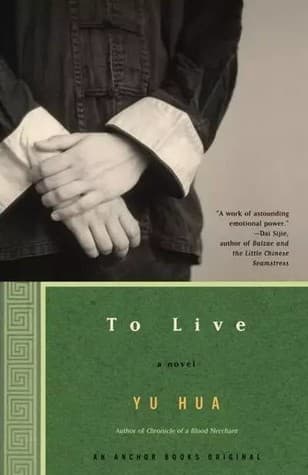
Through the eyes of Fugui, a former landlord's son turned resilient peasant, "To Live" chronicles a man's journey through the events of 20th-century China, enduring personal and national tragedies with an unyielding, humble appreciation for life.
Fugui Xu, the spoiled son of a wealthy landlord in rural China, lives a life of indulgence. He gambles away his family's fortune at the local casino and goes to brothels, upsetting his wife, Jiazhen, and his parents. His father warns him repeatedly, but Fugui does not listen. He loses all the family's land and their ancestral home to a gambler named Long'er. This loss forces Fugui's family, including his pregnant wife and young daughter, Fengxia, into poverty. They move into a dilapidated hut and work as tenant farmers on what was once their own land.
Soon after losing everything, Fugui's father dies of shame and anger, lamenting his son's recklessness. Fugui, changed by his father's death and their new life, begins to work the land as a tenant farmer. His wife, Jiazhen, gives birth to their son, Youqing. Despite their poverty, Fugui finds some happiness in honest work and his family. Their struggles continue, however. One day, while visiting his sick mother, Fugui is forced into the Nationalist Army, leaving his family to manage during a time of civil war.
Fugui spends several years as a soldier in the Nationalist Army, fighting the Communists. He sees the brutal realities of war, many deaths, starvation, and exposure. He becomes friends with another conscript, Chunsheng, who later becomes a high-ranking officer in the Communist army. Communist forces capture Fugui, but they spare him because he is a peasant. He is eventually released and begins the long journey home, carrying memories of the conflict and a strong desire to see his family.
After years away, Fugui returns to his village, which has changed under Communist rule. He finds his mother has died, and his wife, Jiazhen, and their children, Fengxia and Youqing, are barely surviving. Jiazhen is sick and frail from years of hardship. Fengxia, their daughter, became deaf and mute after a severe fever, a result of their poverty and lack of medical care. Despite the sadness and new challenges, the family is reunited, and Fugui, now a humble man, works hard to care for them.
The family endures the Great Leap Forward. During this time, their village shares resources, and food becomes scarce due to agricultural policies and famine. Fugui's family, like many others, struggles with hunger. Their son, Youqing, dies. He is killed accidentally while donating blood for the district chief's wife, who is giving birth. The chief's wife is Chunsheng's wife. The doctor takes too much blood, and Youqing collapses and dies on the way home, leaving Fugui and Jiazhen heartbroken.
As Fengxia gets older, her deafness and muteness make it hard for her to find a husband. Fugui and Jiazhen worry about her future. A kind and hardworking man named Erxi, who has a limp, enters their lives. Erxi leads a construction team in the city. He falls in love with Fengxia and treats her with care. Their wedding brings a rare moment of joy to the family. Fugui and Jiazhen are happy to see their daughter settled and loved, hopeful for her future with Erxi.
Fengxia becomes pregnant, and the family looks forward to the birth of her child. However, complications arise during childbirth. Despite the doctors' efforts, Fengxia has a severe hemorrhage and dies, leaving behind her newborn son, Kugen. The family is again sad. Fugui, Jiazhen, and Erxi are devastated by her loss, especially after the short happiness her marriage brought. Erxi, despite his sorrow, raises their son, Kugen, with quiet determination, keeping Fengxia's memory alive.
The Cultural Revolution brings more upheaval and persecution to China. Fugui's family, though not directly targeted, sees the chaos. During this time, Fugui learns of the tragic fate of his former comrade, Chunsheng, who had risen to a high position in the Communist Party. Chunsheng is denounced as a 'capitalist roader' and publicly humiliated. Unable to bear the shame, Chunsheng commits suicide. Before his death, he visits Fugui and Jiazhen, offering them money as a final gesture of friendship and apology for Youqing's death, which they refuse.
After years of illness and hardships, Jiazhen's health worsens. She dies peacefully at home, leaving Fugui as the sole surviving member of his immediate family, besides his son-in-law Erxi and grandson Kugen. Fugui is very sad about losing his wife, who stayed with him through all their troubles. Erxi, a devoted son-in-law, continues to support Fugui and raise Kugen, showing quiet strength in the face of misfortune, becoming Fugui's remaining family connection.
Tragedy strikes again when Fugui's grandson, Kugen, also dies young. Kugen, living with Erxi, is left in Fugui's care for a time. During this period, Kugen gets sick after eating too many beans, which he ate quickly because he was hungry and not used to such a treat. Despite Fugui's attempts to save him, Kugen dies. This final loss leaves Fugui alone, having outlived his entire family. His son-in-law, Erxi, also dies in an accident shortly after Kugen, leaving Fugui with no human family members left.
In his old age, Fugui lives alone, farming his small plot of land. His only companion is an old ox, which he names 'Fugui' as if the ox embodies the spirit of his own life. He talks to the ox, telling stories of his family, his past, and the joys and sorrows he has experienced. Despite the suffering and loss, Fugui finds dignity and appreciation for the simple act of living. He has come to terms with his past and accepts his present, showing a sense of endurance and the will to live.
The Protagonist
Fugui transforms from a selfish, irresponsible gambler into a compassionate, hardworking, and stoic survivor who finds meaning in simply living despite profound loss.
The Supporting
Jiazhen endures immense personal suffering and loss with quiet dignity and unwavering devotion to her family, becoming a symbol of enduring love.
The Supporting
Fengxia lives a life marked by disability and hardship but finds happiness in marriage before her untimely death during childbirth.
The Supporting
Youqing is a symbol of youthful innocence and the tragic loss of potential, dying prematurely due to unforeseen circumstances.
The Supporting
Erxi finds love and happiness with Fengxia, becoming a devoted family man who endures personal tragedy with quiet strength before his own untimely death.
The Supporting
Kugen's short life is a poignant symbol of the innocent suffering and the ultimate loss that Fugui endures.
The Supporting
Chunsheng rises in power but ultimately succumbs to political persecution, highlighting the arbitrary nature of fate and the human cost of political upheaval.
The Mentioned
Long'er rises by exploiting Fugui's weakness but ultimately meets a violent end under the new political regime.
The Supporting
The ox remains a constant, silent companion, embodying the enduring spirit of life alongside the aging Fugui.
The most prominent theme is the human capacity for endurance in the face of suffering and loss. Fugui outlives his entire family—his parents, wife, children, and grandson—and witnesses historical upheaval, yet he continues to live, finding dignity in simply existing. His conversations with his ox, named Fugui, in his old age, show an acceptance of life's brutal realities and a quiet appreciation for its continuation, even in solitude. This theme appears in his stoic acceptance of each new tragedy.
“What is important is not what happened, but how to live on.”
The novel shows how major historical events—the Chinese Civil War, the Great Leap Forward, and the Cultural Revolution—directly impact ordinary people. Fugui's personal tragedies often connect with these political upheavals, from his conscription into the Nationalist Army to Youqing's death during the Great Leap Forward. The story shows how individuals are powerless against the forces of history, yet they must adapt and survive, often at a high personal cost.
“He said that a person's life is just a few decades, and it's over in a flash, like a dream.”
Family is central to Fugui's life, and losing his loved ones forms the emotional core of the story. Each death—his parents, Fengxia, Youqing, Jiazhen, Erxi, and Kugen—is a deep blow, stripping him of connection and hope. These losses are not just plot points; they are deeply felt, shaping Fugui's character and his view of life. The theme explores the deep bonds within a family and the devastating impact of their dissolution, leaving Fugui alone but holding their memories dear.
“I often think that if Jiazhen were still alive, she would be beside me, looking at these children, and she would definitely be smiling.”
Fugui's journey is one of personal transformation. He starts as a selfish, irresponsible landlord's son, wasting his family's wealth. His downfall, caused by gambling, forces him into poverty and labor. Through suffering, he loses his arrogance and gains humility, compassion, and resilience. This change is not sudden but a gradual process shaped by hardship, leading him to quiet dignity and acceptance in his old age. His redemption is in his ability to simply 'live on'.
“I've thought it over, and people should live for the sake of living, not for anything else.”
The novel shows the arbitrary nature of the suffering Fugui and his family endure. Deaths happen not from dramatic battles but from accidents or unintended consequences of societal policies: Youqing's death from blood donation, Fengxia's from childbirth, Kugen's from eating too many beans. This randomness shows a sense of fatalism, where life's events are largely beyond individual control. The story suggests that life is not fair, and tragedies often strike without reason, demanding only endurance from those left behind.
“The more you live, the more you realize that people are just like animals, living for the sake of living.”
An unnamed folklorist interviews old Fugui, who narrates his life story.
The story of Fugui Xu is told through a framed narrative. An unnamed folklorist, who is collecting folk songs, encounters an elderly Fugui in the countryside and sits with him as he recounts his entire life story. This device allows for a reflective, retrospective tone, filtered through Fugui's own memory and perspective. It also provides a sense of authenticity and intimacy, making the reader feel like a direct listener to his incredible tale of survival and loss, lending a conversational and oral history quality to the narrative.
Fugui's past is recounted from his elderly, reflective perspective.
Within the framed narrative, the bulk of the novel is told in Fugui's first-person voice as he looks back on his life. This allows for deep insight into his personal experiences, emotions, and philosophical reflections. His voice is simple, direct, and often tinged with a blend of resignation and quiet humor. The retrospective nature means that events are processed through the lens of a survivor, emphasizing themes of endurance and the acceptance of fate, rather than immediate, raw emotion, giving his tragedies a weathered, philosophical quality.
The ox represents resilience, endurance, and the simple act of living.
In his extreme old age, Fugui's sole companion is an old ox, which he names 'Fugui'. The ox symbolizes the protagonist's own journey and characteristics: hard work, resilience, and an uncomplaining acceptance of one's lot. The ox is a creature of the land, embodying the peasant's connection to the earth and the cycle of life and death. Fugui's conversations with the ox are a poignant representation of his solitude and his profound connection to the simple, enduring aspects of life itself, mirroring his own will to live.
Fugui's initial downfall leads to his moral ascent, while Long'er's gain leads to his demise.
The novel employs ironic reversal of fortune, particularly with Fugui and Long'er. Fugui, initially wealthy, loses everything and is forced into poverty, which paradoxically leads to his moral transformation and a deeper appreciation for life. Conversely, Long'er, who gains Fugui's wealth, eventually faces execution as a landlord under the new Communist regime. This device highlights the unpredictable nature of fate and the shifting social hierarchies during China's tumultuous 20th century, suggesting that material wealth does not guarantee happiness or survival.
“A man’s life is like a long road, and you never know what’s around the next bend.”
— Fugui reflects on the unpredictability of life after losing his family wealth.
“People live for the sake of living itself, not for anything outside of living.”
— Fugui’s realization after enduring decades of hardship and loss.
“If you want to live a long life, you have to learn to endure.”
— Fugui advises his son Youqing during a difficult period.
“In this world, there’s nothing that can’t be endured, and nothing that can’t be let go.”
— Fugui’s philosophy after surviving war, famine, and political turmoil.
“A person’s greatest misfortune is not poverty or illness, but having no one to share life with.”
— Fugui laments the loneliness after his family members die one by one.
“Life is like a play, and we are all actors on the stage.”
— Fugui compares life to a performance during a conversation with his friend Chunsheng.
“The dead are gone, but the living must keep on living.”
— Fugui’s pragmatic outlook after the death of his daughter Fengxia.
“Wealth is like water in your hands—it slips through your fingers no matter how tightly you hold on.”
— Fugui recalls losing his family fortune through gambling.
“In times of famine, a grain of rice is worth more than a piece of gold.”
— Fugui describes the desperation during the Great Leap Forward famine.
“A man’s worth is not measured by what he has, but by what he endures.”
— Fugui reflects on his life of hardship and resilience.
“The sun rises and sets, and life goes on, no matter what.”
— Fugui observes the cyclical nature of life after personal tragedies.
“Sometimes, living is the hardest thing of all.”
— Fugui’s quiet remark to his ox in the final scenes of the novel.
“Memory is a burden, but it’s also what keeps us human.”
— Fugui thinks about his past while telling his life story.
“In the end, all we have is the story of how we lived.”
— Fugui concludes his narrative to the unnamed listener.
Ready to see how well you understood this book? Take our interactive quiz with 10 questions.

Biography coming soon.







