“If you don't know history, then you don't know anything. You are a leaf that doesn't know it is part of a tree.”
— Professor Johnston's core philosophy about the importance of history.

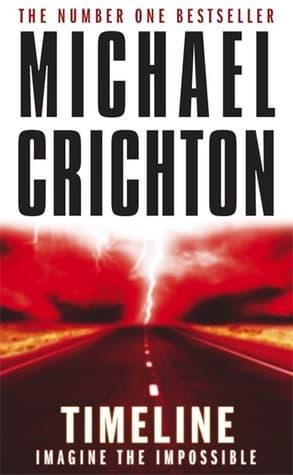
Michael Crichton (1999)
Genre
Thriller / Fantasy / Historical Fiction / Science Fiction
Reading Time
10-12 hours
Key Themes
See below
Sign in to track this book
When archaeologists find a way to travel to 14th-century France, their study of history turns into a fight for survival against knights, castles, and a corporation trying to control the past.
In the Arizona desert, a man named Gordon is found confused and speaking old French before he dies. A mysterious company, ITC, quickly cremates his body. At the same time, Professor Edward Johnston, leading an archaeological dig in France, finds a partially deciphered 14th-century document. It seems to be from his missing mentor, Professor Rudy Stern. ITC representatives, Robert Doniger and John Gordon (not the deceased man), approach Johnston and his team, which includes graduate students Kate Erickson, Chris Hughes, and Dr. André Marek. They reveal Stern is alive but trapped in the past, and ITC has quantum technology that allows travel to parallel universes, including one that perfectly matches 14th-century France.
Doniger explains ITC's quantum technology, which moves matter to a specific time. He asks Johnston's team to rescue Professor Stern from 1357 in Castelgard, France. The team trains rigorously, learning 14th-century French and combat skills. Before they leave, Chris accidentally breaks a critical 'transponder' component needed for their return. Despite this, Marek insists they go, believing Stern is in danger. They receive replacement transponders and are told not to change history, though Doniger assures them their universe is parallel, making paradoxes irrelevant. They prepare for the jump, unaware of the full problems with their damaged equipment.
The team—Marek, Kate, Chris, and two ITC security guards, Frank Gordon and Jimmy Gomez—arrives in 1357 France, near contested territory during the Hundred Years' War. Their arrival is chaotic; they land in a skirmish. Jimmy Gomez is killed by a French knight, and Frank Gordon is captured. Marek, Kate, and Chris are separated and flee. They quickly see the harsh reality of medieval warfare and how fragile their modern technology is. Marek, surprisingly good at medieval combat, leads their survival.
Marek, Kate, and Chris reach the fortress of La Roque, hoping to find Stern. They learn La Roque is under siege by the English and their allies. Inside, they meet Lord Oliver, the castle's old commander, and his ruthless nephew, Sir Guy de Malegant. Marek, using his historical knowledge and language skills, tries to fit them in. They find Professor Stern is indeed held captive there, as Sir Guy thinks Stern has a secret that could change the war. Sir Guy, however, is a traitor, secretly working with the English to betray La Roque for his own gain.
As the siege grows, Marek, Kate, and Chris continue searching for Professor Stern inside the castle. They learn their return window to the present is closing, as the portal to their specific parallel universe is open for a limited time. The damaged transponders become a major problem, as they realize they have limited 'charges' for returning. Frank Gordon, the captured security guard, is being tortured by Sir Guy, who believes Frank is a spy with information about a new weapon. The team must not only find Stern but also secure their return, all while dealing with medieval politics and violence.
Marek, Kate, and Chris plan to free Professor Stern. They find him, but Stern is weak and injured from Sir Guy's torture. As they try to escape with Stern, Sir Guy's betrayal becomes clear. He opens the castle gates to the English forces, letting them overrun La Roque. Lord Oliver and many of his men are killed. The team, with Stern, is caught in the chaos and must fight through the invading soldiers. Frank Gordon, held in the same dungeon, also tries to escape, leading to a desperate struggle.
After La Roque falls, Marek, Kate, Chris, a weakened Professor Stern, and Frank Gordon escape the castle grounds. Sir Guy and his men pursue them. Their path leads them toward a water mill, a planned meeting point for their return to the present. However, Sir Guy, expecting their route, sets an ambush at the mill. Another brutal fight happens, during which Frank Gordon is badly wounded protecting the others. The team is further reduced and desperate, seeing the true danger of their mission and their medieval enemies' ruthlessness.
The survivors—Marek, Kate, Chris, and Stern—evade Sir Guy and find refuge in a nearby monastery. Here, Professor Stern reveals the full truth: the document he found was not just an artifact, but a message from his future self. He had found evidence of ITC's past activities and was trying to warn them. The parchment they found in the present was a transponder instruction manual, hidden in a medieval context. Stern explains the transponders are faulty and they have only one 'charge' left, not enough for all of them to return. This creates a difficult choice for the group.
Sir Guy, still pursuing them, tracks the team to the monastery. A final fight breaks out. Marek, using his combat skills and knowledge of medieval warfare, leads the defense against Sir Guy's forces. During the battle, Professor Stern dies from his injuries. The transponder is further damaged, leaving only one charge. Kate and Chris realize only one of them can return to the present. Marek selflessly decides to stay, feeling a connection to the era and unable to abandon the past. He helps Kate and Chris activate the final return sequence.
Kate and Chris successfully return to the present, landing at the ITC facility just as the temporal window closes. They are angry with Doniger, exposing the faulty transponders and their colleagues' deaths. Doniger tries to cover up the incident and discredit their story. However, their experiences are confirmed by the historical records they now have, including the parchment Professor Johnston first found. Johnston, having figured out ITC's plan, confronts Doniger. The team exposes ITC's negligence and the dangers of their technology, ensuring such a mission cannot happen again.
Afterward, Kate and Chris, with Professor Johnston, piece together Marek's fate. They find historical documents and artifacts confirming Marek not only survived in the past but thrived. He became a respected knight, Sir André de Maregnac, known for his bravery. He married Lady Claire, a character they had met briefly in the past, and lived out his life in medieval France, becoming a notable, though obscure, historical figure. This gives a moving end to Marek's story, showing his decision to stay was not in vain and that he found purpose in the past.
The Protagonist
Chris evolves from a sheltered academic to a survivor, forced to confront his limitations and contribute practically to the group's survival. He learns resilience and courage.
The Protagonist
Kate's existing strengths are amplified by the challenges of the past, solidifying her as a capable leader and survivor, while also grappling with the emotional toll of their losses.
The Protagonist/Supporting
Marek initially seeks to rescue his mentor but discovers a deeper calling and purpose in the past, ultimately choosing to remain there and become a part of the history he once studied.
The Supporting
Johnston begins as a trusting academic but becomes a skeptical investigator, ultimately exposing ITC's unethical practices and protecting his students.
The Supporting
Stern's journey from an ambitious academic explorer to a trapped victim who sacrifices himself to warn his colleagues, underscores the dangers of unchecked scientific advancement.
The Antagonist
Doniger remains a static antagonist, consistently prioritizing corporate interests over human lives, ultimately facing exposure and public scrutiny.
The Antagonist
Sir Guy remains a static villain, embodying medieval treachery and ruthlessness, meeting a violent end that reflects his character.
The Supporting
Frank begins as a professional guard but becomes a tragic hero, sacrificing himself for the team he was assigned to protect.
The Mentioned
Lord Oliver represents the tragic fall of a noble figure due to internal treachery.
The novel examines the ethical problems of advanced technology when corporations prioritize profit over safety. ITC's quantum displacement technology, though advanced, is rushed out without enough testing, leading to faulty equipment and a disastrous mission. Robert Doniger's disregard for human life and his attempts to hide failures show the moral issues that can come with unchecked scientific ambition. The deaths of Jimmy Gomez, Frank Gordon, and Professor Stern are direct results of this corporate greed and carelessness, showing the deadly potential when science lacks ethical responsibility.
“History is not a tourism destination. It's a living, breathing thing, and you've just broken it.”
The story contrasts an idealized academic view of the past with its brutal reality. Chris and Kate, initially excited to experience medieval France, quickly lose their romantic ideas as they see and take part in warfare, disease, and torture. Marek, who had a deeper, almost spiritual connection to the past, is paradoxically the best prepared for its harshness, eventually choosing to stay. The novel suggests that while history can be studied, living it is far more complex and dangerous than modern people can easily grasp, forcing the characters to confront their assumptions.
“You can't study the Middle Ages in a library. You have to live it.”
A main theme is the characters' fight for survival and their ability to adapt to extreme situations. Thrown into a hostile medieval environment, the academic team quickly learns that their modern knowledge is often useless without practical skills. Chris and Kate, initially helpless, must develop resilience, combat skills, and cunning. Marek, already having these, becomes their main guide. Their ability to give up modern comforts and accept the harsh realities of 1357, including learning to fight and navigate medieval politics, is key to their survival. This theme highlights human adaptability when facing overwhelming odds.
“In the Middle Ages, you didn't have to be a genius to survive. You just had to be tough.”
The story explores how people find their place, both physically and emotionally. For Marek, the journey to 1357 reveals a deep sense of belonging he never fully felt in his own time. He finds purpose and community in the past, choosing to stay and create a new identity as Sir André de Maregnac. This contrasts with Chris and Kate, who desperately hold onto their modern identities and try to return home. The novel suggests that true belonging can cross time, and identity is not just defined by one's birth era but by where one feels most alive and purposeful.
“Some people are born in the wrong time.”
Crichton explores philosophical questions about history and time. The idea of parallel universes allows time travel without changing one's 'original' timeline, yet the characters still deal with the moral implications of interfering with the past. The discovery that Professor Stern sent a message from the past to the future creates a fascinating time loop, challenging linear views of time. The novel suggests that history is not a fixed story but a complex, many-sided reality, always being shaped and discovered, and that even 'parallel' histories offer important lessons for the present.
“The past is not dead. It's not even past.”
ITC's proprietary method for parallel universe travel.
This is the central plot device that enables the entire narrative. It allows for the instantaneous transport of matter to a specific temporal and spatial location in a parallel universe. The technology is initially presented as a marvel of science but quickly becomes a source of extreme danger due to its inherent instability and ITC's rushed, unethical deployment. Its limitations, such as the finite 'temporal windows' and the need for transponders, drive much of the plot's urgency and conflict, particularly when the transponders prove faulty.
A device crucial for returning from the past, which becomes a source of mounting tension.
The transponder is a small, personal device given to each time traveler, essential for their return to the present. Its accidental damage by Chris and the subsequent revelation of its limited 'charges' and unreliability create intense suspense. The dwindling number of working transponders and the final single charge force agonizing moral choices among the survivors, highlighting the theme of sacrifice and the dire consequences of technological failure. It serves as a ticking clock mechanism, constantly reminding the characters and the reader of their precarious situation.
A historical artifact that is actually a message from the future.
Initially presented as a partially deciphered 14th-century document, this parchment is a crucial plot device that links the past and present. It is eventually revealed to be a coded message from Professor Stern, written in the past to warn his colleagues in the future about ITC's dangerous technology and the faulty transponders. This creates a temporal paradox (or at least a causal loop within parallel universes) and drives the initial motivation for the rescue mission. It also provides the critical information needed to understand the transponder's true function and limitations.
ITC's explanation for time travel, allowing for historical intervention without paradoxes.
ITC explains that their technology doesn't alter 'our' past but rather sends travelers to a parallel universe that perfectly mirrors the chosen historical period. This device theoretically absolves the characters of paradox concerns and the fear of altering their own timeline. However, the story still explores the ethical implications of intervention, and the emotional impact of leaving someone in the past remains profound. It allows Crichton to explore historical detail and adventure without getting bogged down in traditional time travel paradoxes, while still maintaining high stakes for the characters.
“If you don't know history, then you don't know anything. You are a leaf that doesn't know it is part of a tree.”
— Professor Johnston's core philosophy about the importance of history.
“The past is not a place. It's a perception.”
— Discussion about the nature of time travel and historical reality.
“Nothing is ever so bad that it can't be made worse.”
— A character's cynical observation during a perilous situation.
“They had learned that the past was a foreign country, and they were very much strangers in it.”
— Reflecting on the challenges and dangers of being in 14th-century France.
“What you call the past is just a different present.”
— Explaining the mechanics of their time travel technology.
“The truth is, there are no good guys or bad guys. There are just guys.”
— A character's pragmatic view on human nature and conflict.
“History is not what happened. History is what is written.”
— Discussing the subjective and often biased nature of historical records.
“You can't change the past, but the past can certainly change you.”
— The personal impact of their experiences in the past.
“In the Middle Ages, the only way to get a message across was to kill the messenger.”
— Highlighting the brutal communication methods of the 14th century.
“It's never the technology that's the problem. It's always the people.”
— A common Crichton theme, applied to the misuse of time travel.
“The world of the past was far more vibrant, more immediate, and more dangerous than any history book could convey.”
— Describing the sensory overload and peril of medieval life.
“Death was never far away. It was a constant companion in the past.”
— Reflecting on the high mortality rates and ever-present threat of death in the 14th century.
“They were archaeologists, trained to dig up the past. Now they were living it.”
— The ironic predicament of the historical researchers.
“The past was not a museum. It was a battleground.”
— Realizing the harsh realities and conflicts of the historical period.
Ready to see how well you understood this book? Take our interactive quiz with 10 questions.
Biography coming soon.







