“The past is a foreign country; they do things differently there.”
— A general reflection on the nature of history and the challenges of understanding past eras.

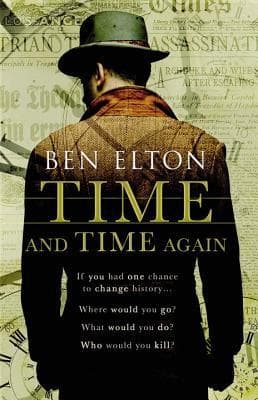
Ben Elton (2014)
Genre
Thriller / Fantasy / Historical Fiction / Science Fiction
Reading Time
450 min
Key Themes
See below
Sign in to track this book
Armed with knowledge from the future, a lone adventurer travels back to 1914 with a desperate plan to stop World War I by altering the path of a single, fateful bullet.
Hugh Stanton, a disillusioned former soldier, is approached by Professor Philip Drinkwater with an extraordinary proposition. Drinkwater, a brilliant but eccentric physicist, has developed a method for time travel. He reveals that a select group of international scientists and philanthropists, 'The Project,' aims to send someone back to June 1st, 1914, to prevent the assassination of Archduke Franz Ferdinand, thereby averting World War I. Hugh, chosen for his intelligence, combat skills, and historical knowledge, is initially skeptical but eventually agrees, driven by a desire to undo the horrors of the war that devastated his own timeline. He undergoes rigorous training and psychological conditioning to prepare for the immense task ahead, understanding the monumental stakes involved.
Hugh travels back to June 1st, 1914, arriving in a quiet London street. He has period-appropriate clothing, a false identity as 'Hugh Stanton, gentleman of leisure,' and a hidden cache of modern tools and information. His initial goal is to establish himself without drawing suspicion, while discreetly gathering intelligence and making contact with the Project's pre-arranged safe houses and resources. He experiences the sensory overload of early 20th-century London – the smells, sounds, and social customs – which are both familiar from history books and jarringly real. Hugh feels the immense pressure of his mission, knowing that every action, no matter how small, could have unforeseen consequences on the future.
Hugh travels to Sarajevo, meticulously tracking the movements of Archduke Franz Ferdinand and Sophie Chotek. His plan is to intervene directly to prevent Gavrilo Princip from firing the fatal shot. He gets close to the motorcade, witnessing the first bomb attempt by Čabrinović. In the chaos, Hugh tries to intercept Princip, but fate, or perhaps history, works against him. Princip, through a series of unlikely coincidences, still finds himself in position to shoot the Archduke and Sophie. Hugh is devastated, realizing the immense difficulty of altering a deeply ingrained historical event. He retreats, narrowly escaping capture, and returns to London, shaken but determined.
Back in his London safe house, Hugh debriefs with the remote Project team, relaying the details of his failed attempt. Professor Drinkwater and the others acknowledge the challenge: simply preventing the assassination might not be enough; the underlying geopolitical tensions are too great. They decide a more fundamental change is required. The new strategy is to target Kaiser Wilhelm II, the German Emperor, believing that removing him from power or discrediting him before the war begins could prevent the conflict's escalation. This new plan is far more dangerous, involving direct interference with a head of state, and carries a higher risk of altering history in unpredictable ways.
Hugh travels to Germany, adopting a new persona and carefully infiltrating social circles that could provide access to Kaiser Wilhelm II. He uses his charm, intelligence, and a fabricated backstory to gain invitations to aristocratic gatherings and military functions. He observes the Kaiser, noting his erratic behavior, his obsession with military might, and his complex relationship with his advisors. Hugh's goal is not necessarily to assassinate the Kaiser, but to find a way to discredit him, perhaps by exposing a scandal or manipulating events to undermine his authority and prevent him from leading Germany into war. The political landscape is a minefield of alliances, rivalries, and ingrained social hierarchies.
Hugh manages to engineer a situation where he has a direct, if brief, encounter with Kaiser Wilhelm II. He tries to subtly plant seeds of doubt or encourage a more peaceful path, but the Kaiser proves to be a formidable and unyielding personality, convinced of his own destiny and the righteousness of Germany's military ambitions. Hugh realizes that a direct appeal or even a subtle manipulation will not be enough. The Kaiser's ego and the political machinery around him are too powerful. This interaction reinforces Hugh's understanding that the forces leading to war are deeply entrenched and not easily swayed by individual actions or words, even from a man with future knowledge.
Hugh's attempts to influence the Kaiser, from planting compromising information to subtle psychological manipulation, all fail. The Kaiser remains resolute, and political tensions escalate. With time running out and the assassination of the Archduke looming, Hugh realizes he has one last, desperate option: target the weapon itself, the 'single bullet' that starts it all. He decides to focus on the technology of war, specifically the armaments being developed, believing that if he can disrupt the supply or development of key weaponry, he might still prevent the scale of the conflict. This involves a dangerous plan to sabotage a major arms manufacturer or military facility.
Hugh undertakes a perilous mission to sabotage a German armaments factory, using his military skills and future knowledge of explosives. He infiltrates the facility and causes significant damage, hoping to delay or cripple Germany's war-making capabilities. However, upon returning to his time portal, he finds the future has changed in an unexpected and horrifying way. Instead of preventing the war, his actions have inadvertently led to an even more devastating conflict, perhaps one involving different alliances or more destructive weapons, or simply shifting the timeline to a war that is even harder to stop. The Project team is in despair, realizing the immense and uncontrollable variables of time travel.
Hugh is brought back to the present, shattered by the catastrophic outcome of his last mission. Professor Drinkwater and the Project team are equally distraught, facing the grim reality that their attempts to 'fix' history have only made it worse. Hugh begins to question the very premise of their endeavor – whether history is a fixed entity, a river that always finds its way to the sea, or if human intervention is simply incapable of truly altering its course without creating new, perhaps worse, problems. He struggles with the immense guilt of potentially being responsible for an even more terrible future, pondering the ethical dilemma of playing God with time and the lives of millions.
After much introspection and debate with Professor Drinkwater, Hugh comes to a new understanding. He realizes that preventing the war might be beyond his capabilities. Perhaps his purpose is not to prevent the war, but to live through it, to experience the past, and to understand the human condition that leads to such conflicts. He decides to make one final, personal journey back to 1914, not to alter history, but to witness it, to learn from it, and perhaps to find a small measure of peace or understanding within it. This final act is less about changing the past and more about changing himself and his perception of humanity's struggles.
Hugh travels back to 1914, this time without a specific mission to alter events. He finds a quiet life for himself, perhaps settling in a small town or taking up a new profession. He observes the unfolding of history with a bittersweet understanding, knowing what is to come but choosing to live within it rather than fight against it. He might dedicate himself to humanitarian efforts, or simply live a quiet life, appreciating the moments of peace before the storm. This final decision represents Hugh's acceptance of the limits of his power and the realization that while history cannot always be changed, understanding and experiencing it can still be a powerful, transformative act. He finds contentment in living out his days in the past, no longer the lonely man of the future, but a man who has found his place in time.
The Protagonist
Hugh transforms from a man obsessed with altering history to one who accepts its flow, finding peace and purpose in living within the past rather than fighting against it.
The Supporting
Drinkwater moves from scientific optimism to a reluctant acceptance of the limitations of altering history, eventually finding common ground with Hugh's more philosophical approach.
The Antagonist (indirect)
Remains largely unchanged, serving as a representation of the immovable historical forces Hugh tries to overcome.
The Mentioned/Catalyst
His historical fate remains unchanged despite Hugh's efforts, underscoring the novel's themes of historical inevitability.
The Mentioned/Catalyst
His historical action remains unchanged, a testament to the difficulty of altering key historical moments.
The Supporting
They collectively move from initial optimism to a sobering understanding of the limitations of their power to change history.
The novel constantly grapples with whether history is a fixed, unchangeable entity or if individuals can truly alter its course. Hugh's repeated failures to prevent World War I, despite having foreknowledge and advanced technology, suggest a powerful, perhaps deterministic, force at play. Each intervention, instead of averting the war, either fails or inadvertently leads to an even worse outcome. This challenges the idea of individual free will to significantly alter large-scale historical events, positing that certain outcomes might be inevitable regardless of specific triggers. The theme culminates in Hugh's acceptance that some things cannot be changed, and perhaps should not be.
“A single bullet, Hugh. Can it truly corrupt an entire century? And, if so, could another single bullet save it?”
A central theme is the unpredictable and often disastrous results of attempting to alter complex systems, particularly history. Hugh's well-intentioned efforts consistently lead to unforeseen and often worse outcomes. His attempt to prevent the Archduke's assassination still results in the war, and his sabotage of the armaments factory potentially leads to an even more devastating conflict. This highlights the 'butterfly effect' and the difficulty of predicting how even small changes might ripple through time, cautioning against hubris in attempting to 'fix' the past. It suggests that even with the best intentions, human understanding of complex causality is limited.
“Every action, no matter how small, could have unforeseen consequences on the future.”
Hugh carries the burden of knowing the future's horrors while living in the past. This foreknowledge isolates him and fuels his desperate attempts to intervene, but also leads to guilt and despair when he fails. He understands the scale of suffering that is to come, making his interactions with unsuspecting people in 1914 particularly poignant. The Project team also shoulders this responsibility, grappling with the ethical implications of their time-travel experiments and the potential to worsen history. This theme explores the psychological toll of omniscience and the moral dilemmas inherent in wielding such power.
“No one he has ever known or loved has been born yet. Perhaps now they never will be.”
The novel suggests that World War I, and perhaps conflict in general, is not merely the result of a single event or a few bad actors, but rather a deeply ingrained aspect of human nature and geopolitical dynamics. Even when Hugh tries to remove specific triggers (the Archduke, the Kaiser), the underlying tensions and desires for power, nationalism, and revenge find new avenues to ignite conflict. This theme questions whether humanity truly learns from its mistakes or is condemned to repeat cycles of violence, implying that the 'war to end all wars' might be an unattainable ideal due to inherent human flaws and systemic issues.
“A great and terrible war is coming. A collective suicidal madness that will destroy European civilization.”
The central mechanism allowing the protagonist to attempt to alter history.
Time travel is the primary plot device, enabling Hugh Stanton to journey back to 1914. It is presented as a scientific, albeit highly complex and dangerous, endeavor, rather than magical. The mechanics, while not overly detailed, emphasize the precision required for temporal displacement. Crucially, the device serves to explore the philosophical implications of altering the past, particularly the 'butterfly effect' and the potential for unintended consequences. Its limitations and the difficulty of truly changing established events become central to the narrative, highlighting the immutability of certain historical moments.
Hugh's awareness of future events creates tension and highlights the tragedy of unpreventable history.
Hugh's foreknowledge of World War I and its devastating aftermath creates significant dramatic irony. He interacts with people in 1914 who are oblivious to the impending catastrophe, making his attempts to intervene both poignant and frustrating. This device builds tension as the audience knows what is coming, and watches Hugh's desperate, often futile, attempts to change it. It also underscores the theme of historical inevitability, as Hugh's knowledge of the future doesn't grant him the power to truly alter it, only to witness its unfolding with a heavy heart.
The concept that small changes in the past can have unpredictable and large-scale effects on the future.
The butterfly effect is a crucial plot device, driving the narrative's exploration of unintended consequences. Every action Hugh takes, no matter how seemingly minor, has the potential to ripple through time and create unforeseen changes. This is demonstrated by his failed attempts to prevent the war, which sometimes lead to even worse alternate futures. The device highlights the complexity and interconnectedness of historical events, suggesting that tampering with one element can destabilize the entire timeline in unpredictable ways, reinforcing the idea that history is a delicate and perhaps unalterable tapestry.
While not explicitly unreliable, Hugh's perspective is colored by his future knowledge and despair.
While Hugh is presented as a generally truthful narrator, his perspective is heavily influenced by his knowledge of the future and his personal biases. His descriptions of 1914 are filtered through his awareness of the impending war, leading to a sense of dread and melancholy. This subtle unreliability isn't about Hugh lying, but about how his unique position shapes his interpretation of events and his interactions, making his observations of the past tinged with a tragic irony. His despair and growing resignation also influence how he perceives his own failures and the nature of history itself.
“The past is a foreign country; they do things differently there.”
— A general reflection on the nature of history and the challenges of understanding past eras.
“Every single action, however small, had a ripple effect, changing the future in ways that were impossible to predict.”
— Hugh Stanton contemplates the butterfly effect after his initial journey into the past.
“Sometimes you have to break a few eggs to make an omelette. But what if the eggs are people?”
— Hugh grapples with the moral implications of his mission and the potential loss of life.
“History isn't just about dates and names; it's about the lives of ordinary people.”
— Hugh reflects on the human element of the past as he experiences 1914 firsthand.
“The arrogance of assuming you know better than the past, that you can 'fix' it.”
— A critique of the hubris inherent in attempting to alter historical events.
“He understood now why people tried to forget, why they built walls around their memories.”
— Hugh witnesses the horrors of war and the psychological impact on soldiers.
“Hope was a dangerous thing in a world that seemed determined to crush it.”
— Hugh's internal struggle with maintaining optimism amidst the grim realities of World War I.
“The future was not a fixed destination, but a constantly shifting landscape.”
— Hugh's evolving understanding of time and the malleability of history.
“Even the smallest act of kindness could shine a light in the darkest of times.”
— Hugh observes moments of human compassion amidst the brutality of the trenches.
“You can't save everyone. Sometimes you just have to choose your battles.”
— Hugh confronts the limitations of his mission and the impossible choices he faces.
“The greatest danger wasn't what you changed, but what you didn't understand.”
— A warning about the unforeseen consequences of tampering with complex historical systems.
“He was a ghost in his own past, a whisper in the wind of history.”
— Hugh's feeling of alienation and his precarious position as a time traveler.
“Sometimes, the right thing to do was nothing at all.”
— Hugh considers the wisdom of non-intervention after experiencing the complexities of the past.
“The world had always been chaotic, always on the brink of something terrible or wonderful.”
— A broader philosophical observation about the inherent instability and potential of human history.
Ready to see how well you understood this book? Take our interactive quiz with 10 questions.

Ben Elton is a renowned British comedian, author, playwright, and screenwriter. He is celebrated for his satirical wit and socially conscious storytelling, evident in novels like 'Two Brothers,' 'Popcorn,' and 'Time and Time Again.' Elton's work often tackles contemporary issues with sharp humor and a distinctive narrative voice.







