“All he could think was that he didn't want to die. Not like this. Not alone, in the cold, with a dog as his only witness.”
— Mr. Bones' internal thoughts as Willy is dying.

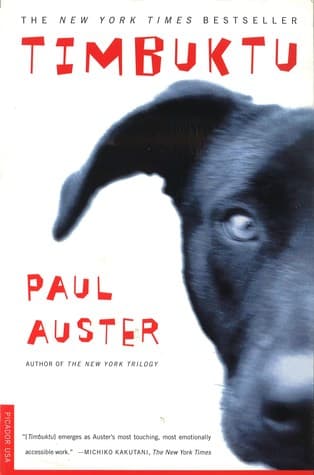
Paul Auster (1999)
Genre
Literary Fiction
Reading Time
180 min
Key Themes
See below
Sign in to track this book
Through the eyes of a loyal and philosophical dog, Mr. Bones, we follow the final journey of his brilliant, homeless owner, Willy G. Christmas, as they travel from Brooklyn to Baltimore to find Mr. Bones a new home before Willy dies.
The story begins with Mr. Bones, a mutt with a thoughtful inner voice, thinking about his life with his owner, Willy G. Christmas. Willy, a homeless and unusual poet, is quickly getting sicker. He knows he will die soon and needs to find a new home for Mr. Bones before then. They spend their last days in Brooklyn, moving through streets and shelters. Willy is often lost in thought, and Mr. Bones watches the world through his dog senses. Willy starts to carefully plan their trip to Baltimore, where he hopes to leave Mr. Bones with his former high school English teacher, Beatrice Swanson.
Willy gets enough money from odd jobs and begging, then buys two bus tickets to Baltimore – one for himself and one for Mr. Bones, hidden in a duffel bag. The bus ride is difficult for both. Mr. Bones endures being confined and the fear of being found, while Willy, growing weaker, uses the time to think and review his life and poems one last time. He drifts in and out of awareness, his thoughts a mix of memories, philosophical ideas, and worries about Mr. Bones's future. The trip is tense because of their secret passenger and Willy's quickly fading health.
They arrive in Baltimore, and Willy's health gets much worse. He is confused and weak, struggling to find his way in the new city. Mr. Bones, always watchful, senses his master's decline. Willy's first plan to find Beatrice Swanson is made harder by his poor memory and physical weakness. They wander the streets, looking for shelter and food, with Mr. Bones acting more and more as a protector. Willy's need to secure Mr. Bones's future becomes more desperate, as he knows his time is short. He holds a small, folded piece of paper with Beatrice's last known address, his only hope.
Willy and Mr. Bones finally find the street where Beatrice Swanson is supposed to live. However, Willy is too weak to walk further. He collapses in an alley, his strength gone. In his last moments, he speaks to Mr. Bones, trying to show his love and the importance of finding a new home. Mr. Bones, though not fully understanding the words, grasps the deep sadness and finality in Willy's voice. Willy G. Christmas dies in the alley, leaving Mr. Bones alone and confused beside his body. The dog stays by his master's side for a time, mourning.
After Willy's death, a young boy named Henry, playing nearby, finds Mr. Bones. Henry, drawn to the dog, takes him home. Mr. Bones meets Henry's family, the Johnsons, a large and lively African American family in a small but busy house. Mr. Bones, still sad about Willy, struggles to get used to this new place. The Johnsons are kind but noisy, and Mr. Bones, used to Willy's quiet ways, finds their constant activity overwhelming. He misses Willy's familiarity, even as he is fed and cared for.
Life with the Johnsons is very different from his life with Willy. Mr. Bones is given a new name, Sparky, which he dislikes. He often thinks back to his memories of Willy, replaying their talks and adventures. He misses Willy's intellectual company and their special bond. Despite the Johnsons' real affection, Mr. Bones feels like an outsider, a guest. He watches their family life, their joys and struggles, from a distance, always comparing it to his past with Willy. The book shows Mr. Bones's inner struggle to connect his past with his present.
Feeling overwhelmed and disconnected from his new name, Sparky, Mr. Bones finds a chance to escape the Johnson house. He runs through Baltimore's streets, driven by a desire to return to his old life, or at least to escape the overwhelming newness. This short time of freedom is marked by longing and a desperate search for something familiar. He meets other stray dogs and sees the harshness of street life, but his heart stays with Willy. The escape shows his deep sense of loss and his inability to fully accept his new situation.
After his short escape, Henry, upset by his disappearance, finds Mr. Bones. Henry's real concern and the family's relief at his return start to break down Mr. Bones's resistance. He slowly begins to realize that while the Johnsons are not Willy, they offer a different kind of love and stability. He starts to find comfort in their routines and their affection. The inner conflict between his past and present begins to ease, as he cautiously accepts his new name and his place with the Johnson family, though Willy's memory remains a constant, cherished part of him.
Throughout Mr. Bones's journey and thoughts, Willy G. Christmas's poetic talent is quietly shown. Mr. Bones remembers parts of Willy's poems and his intellectual talks, showing how much Willy affected him. Even after Willy's death, his artistic spirit lives on, mainly through Mr. Bones's memories. The story itself, told from Mr. Bones's view, shows the lasting power of Willy's unique way of seeing the world.
As Mr. Bones gets used to life with the Johnsons, his observations of people deepen. He thinks about the complexities of family life, the subtleties of human feelings, and the different ways people show love and sadness. His inner thoughts show a complex understanding of human nature, seen through his dog's perspective. He learns that love can come in many forms, and that while he will always remember Willy, he can also form new bonds. The book ends with Mr. Bones, now called 'Sparky,' accepting his present while always cherishing his past.
The Protagonist
From a devoted companion grappling with loss, Mr. Bones slowly transitions to accepting a new family, while always retaining the memory of his past.
The Supporting/Deceased Protagonist
Willy's arc is one of decline and resolution, as he faces his mortality and dedicates his final efforts to securing Mr. Bones' future.
The Supporting
Henry develops from a curious child to a caring pet owner, instrumental in Mr. Bones' integration into his new life.
The Mentioned
N/A, as she does not appear directly.
The Supporting
The family collectively offers a new environment for Mr. Bones, evolving from strangers to his new home and source of comfort.
The main theme is the deep and strong loyalty between Mr. Bones and Willy G. Christmas. Mr. Bones's whole life is centered on Willy, and his sadness after Willy's death is clear. Willy, in turn, shows his love by spending his last days making sure Mr. Bones has a future. This theme also includes Henry's loyalty to Mr. Bones, as he patiently works to earn the dog's trust and affection. The book shows how love, especially between humans and animals, can cross species and situations, offering comfort and meaning.
“He was a dog, but he was also a man, and he was both at the same time. He was a dog-man, a man-dog, and there was no separating one from the other.”
The book directly addresses themes of death and the human desire to leave a lasting impression. Willy G. Christmas knows he will die soon, and his main worry is not his own legacy, but his companion's future. His poems, though mostly unknown, are his attempt to create something that lasts. Mr. Bones, by remembering Willy and his words, becomes a living keeper of Willy's legacy. The book explores how a life, even if it seems unimportant to the wider world, can deeply affect those closest to it, giving a form of immortality.
“He was a vessel, a repository, a place where Willy Christmas could dump his words and thoughts and feelings.”
Mr. Bones struggles with his identity throughout the story. He is 'Mr. Bones' with Willy, a companion and intellectual equal, but becomes 'Sparky' with the Johnsons, a simple pet. His inner conflict reflects the human need for self-definition and belonging. He first resists his new name and environment, holding onto his past identity. The book's journey is his slow, difficult process of adapting to a new identity and finding a new place where he belongs, without forgetting where he came from. This theme is universal, showing how people adapt to new situations and form new connections while keeping who they are.
“He was no longer Mr. Bones. He was Sparky. And Sparky was a different dog altogether.”
Auster explores Mr. Bones's unique consciousness, blurring the lines between animal instinct and human-like thought. Mr. Bones's inner thoughts are rich with philosophical ideas, showing a deep understanding of human behavior and complex emotions. Language itself is a key part, especially through Willy's poetry and Mr. Bones's understanding of human speech. The book explores how language shapes perception and how even a non-human character can have a complex inner world, challenging usual ideas about intelligence and communication.
“He understood what Willy was saying, not the words themselves, but the music of the words, the feeling behind them.”
The entire story is narrated from the perspective of Mr. Bones, a dog.
This device is central to the novel's unique charm and depth. By narrating through Mr. Bones' consciousness, Auster provides a fresh, often poignant, and sometimes humorous perspective on human behavior, societal norms, and the profound bond between a human and an animal. It allows for philosophical insights into life, death, and loyalty that would be difficult to achieve from a human perspective. The canine viewpoint also emphasizes the sensory world and the unspoken communication that exists between species, making the emotional core of the story deeply resonant.
Mr. Bones' thoughts flow freely, mimicking the associative nature of a dog's mind while imbued with human-like introspection.
This device allows the reader direct access to Mr. Bones' internal world, which is a rich tapestry of memories, observations, anxieties, and philosophical musings. It blends a dog's sensory experiences (smells, sounds, instincts) with sophisticated intellectual processing, creating a unique narrative voice. This technique not only characterizes Mr. Bones as highly intelligent but also enables the author to explore complex themes like mortality and identity through an unconventional lens, blurring the lines between animal and human thought processes.
Willy and Mr. Bones' bus trip to Baltimore symbolizes a final passage and a search for meaning.
The physical journey from Brooklyn to Baltimore serves as a powerful metaphor for Willy's journey towards death and Mr. Bones' transition into a new phase of life. It represents a quest for a safe haven and a final act of love and responsibility. The challenges of the journey—Willy's declining health, the secrecy of Mr. Bones—mirror the larger struggles of life and the inevitability of change. It underscores the themes of mortality, belonging, and the search for a place in the world.
While seemingly reliable, Mr. Bones' interpretation of human events is filtered through a canine understanding.
Although Mr. Bones is highly intelligent, his understanding of human motivations and complex societal structures is inherently limited by his nature as a dog. He interprets human conversations, emotions, and decisions through his own unique, often literal, or instinct-driven lens. This subtle unreliability adds layers of meaning, inviting the reader to consider the gaps between human intention and animal perception, and highlighting the subjective nature of truth. It also allows for moments of gentle humor and profound insight into the disconnects and connections between species.
“All he could think was that he didn't want to die. Not like this. Not alone, in the cold, with a dog as his only witness.”
— Mr. Bones' internal thoughts as Willy is dying.
“Every dog is a lion at home.”
— A thought Mr. Bones has about the nature of dogs and their perceived bravery.
“The past was a country he had no desire to revisit.”
— Willy's general sentiment about his earlier life and decisions.
“He understood that life, even a dog's life, was a series of losses.”
— Mr. Bones reflecting on his experiences after Willy's death.
“A man without a dog is a man alone.”
— Willy's belief about the companionship and necessity of a dog.
“The world was a vast and terrifying place, and he was just a small dog in it.”
— Mr. Bones' feeling of vulnerability after being separated from Willy.
“Death was not an end but a transformation, a shedding of the old skin for something new.”
— Willy's philosophical musings on death, influenced by his own impending demise.
“He had always been a solitary creature, but it was a solitude he had chosen.”
— Willy's reflection on his life as a wanderer and his intentional isolation.
“Every step was an effort, every breath a struggle.”
— Description of Willy's physical state as he nears his death.
“To be forgotten was the worst kind of death.”
— Willy's fear that his work and existence would fade into oblivion.
“He had given his life to a man who had given his life to words.”
— Mr. Bones' understanding of his devotion to Willy, and Willy's devotion to writing.
“The future was a blank page, and he had no idea what would be written on it.”
— Mr. Bones' uncertainty about his fate after Willy's death.
“Love was a complicated thing, full of joy and sorrow, and sometimes, a little bit of madness.”
— A general observation on the nature of love as experienced by the characters.
“There was a reason for everything, even if he couldn't grasp it.”
— Mr. Bones' attempt to make sense of the events unfolding around him.
Ready to see how well you understood this book? Take our interactive quiz with 10 questions.

Paul Benjamin Auster is an American writer and film director. His notable works include The New York Trilogy (1987), Moon Palace (1989), The Music of Chance (1990), The Book of Illusions (2002), The Brooklyn Follies (2005), Invisible (2009), Sunset Park (2010), Winter Journal (2012), and 4 3 2 1 (2017). His books have been translated into more than forty languages.







