“Tikki tikki tembo-no sa rembo-chari bari ruchi-pip peri pembo.”
— The full, lengthy name of the elder son.

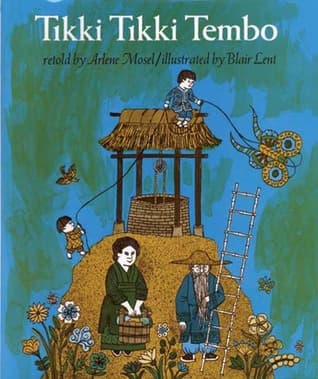
Arlene Mosel (1968)
Genre
Children's
Reading Time
5 min
Key Themes
See below
Sign in to track this book
A boy with an impossibly long and honorable name falls into a well, leading to a frantic, name-mangling rescue that changes ancient Chinese naming conventions forever.
In ancient China, a mother has two sons. She gives her firstborn son a very long and important name: Tikki tikki tembo-no sa rembo-chari bari ruchi-pip peri pembo. This name means 'the most wonderful thing in the whole wide world.' Her second son, being less important, is simply named Chang, which means 'little or nothing.' They live in a small house near a mountain with an old well. The two brothers play together, often near the well, despite their mother's warnings to stay away.
One day, while playing near the well, Chang falls in. Tikki Tikki Tembo, hearing his brother's cries, runs to their mother to tell her what happened. He shouts, 'Mother! Chang has fallen into the well!' Their mother, annoyed at being disturbed from her chores, scolds Tikki Tikki Tembo for interrupting her for such a small matter, reminding him that Chang's name is short and not important. However, she quickly realizes the urgency and sends Tikki Tikki Tembo to get the Old Man with the Ladder.
Tikki Tikki Tembo runs to the Old Man with the Ladder's house and explains that his brother Chang has fallen into the well. The Old Man, understanding the simple name and the urgency, quickly gets his ladder and rushes back with Tikki Tikki Tembo to their house. He lowers the ladder into the well and helps Chang climb out. Chang is wet and cold but unharmed. He is quickly brought inside to warm up and dry off.
A month later, the two brothers are again playing near the well. This time, Tikki Tikki Tembo falls into the well. Chang, seeing his older brother in trouble, runs to their mother to tell her. He shouts, 'Mother! Tikki tikki tembo-no sa rembo-chari bari ruchi-pip peri pembo has fallen into the well!' The mother, surprised by the long name, struggles to remember it and scolds Chang for taking so long to deliver the message, not understanding the difficulty of repeating the name.
The mother, after finally recalling and repeating the full name, sends Chang to get the Old Man with the Ladder. Chang runs to the Old Man's house and tries to explain. He starts, 'Old Man with the Ladder, Tikki tikki tembo-no sa rembo-chari bari ruchi-pip peri pembo has fallen into the well!' The Old Man, confused by the long name, struggles to understand and remember it, asking Chang to repeat it many times. Important time is lost as Chang tries to say the lengthy name.
After many repetitions and much frustration, the Old Man with the Ladder finally remembers Tikki tikki tembo-no sa rembo-chari bari ruchi-pip peri pembo's name and the urgent situation. He quickly gets his ladder and rushes back to the house with Chang. They lower the ladder into the well, and Tikki Tikki Tembo is pulled out. However, because of the delay in telling his name and getting help, Tikki Tikki Tembo has been in the cold water for a much longer time. He is very ill and swallows a lot of water.
Tikki Tikki Tembo is brought inside, but he is in a much worse state than Chang was. He is very sick from being in the cold well for so long. His mother and Chang spend a long time trying to help him recover. They give him warm rice water and ginger tea, and care for him day and night. It takes many months for Tikki Tikki Tembo to fully recover from his ordeal, a contrast to Chang's quick return to health.
From that day forward, the people of China learned a lesson. They decided that it was better to give their children short, simple names rather than long, honorable ones. This way, if a child ever fell into a well or had other trouble, help could be called quickly without the delay caused by a long name. This ancient tale explains why Chinese children now have shorter names, ensuring that no more time is lost in emergencies.
The Protagonist
Starts as a privileged firstborn, but his long name leads to a life-threatening incident, ultimately changing naming traditions.
The Supporting
Remains a simple character whose actions highlight the story's central conflict.
The Supporting
Initially bound by tradition, she learns the practical dangers of overly long names.
The Supporting
A static character whose actions serve as a plot device to highlight the theme of naming.
The story challenges the tradition of giving firstborn sons long, honorable names. While such names mean importance, the story shows they are not practical in emergencies. Tikki Tikki Tembo's near-death experience, because of the time it took to say his name, contrasts with Chang's quick rescue. This shows how sticking to tradition can have dangerous results, leading to a change towards more practical naming conventions in China.
“And from that day to this, the Chinese have always given their children short names instead of long names.”
A main theme is the challenge of clear communication, especially under stress. The simple, short name 'Chang' allows for quick and clear communication, leading to an immediate rescue. In contrast, Tikki Tikki Tembo's long, complicated name creates a big problem. Chang struggles to remember and repeat it, and the Old Man with the Ladder struggles to understand it, causing critical delays. This shows how clarity and conciseness in communication are important, especially in urgent situations.
“'Please, please, not so fast,' said the Old Man with the Ladder. 'What is the name again?'”
The story shows the direct results of choices made, specifically in naming. The mother's decision to give a grand name to her firstborn leads to a life-threatening situation. While the intention was to honor, the outcome was nearly tragic. Conversely, the simple name given to Chang ensures his safety. This theme shows that even seemingly harmless traditions or choices can have big and unexpected effects, teaching a lesson about foresight and the possible results of one's decisions.
“But because of the long name, it took a long, long time to tell the Old Man with the Ladder.”
Emphasizes the difficulty of the long name and builds narrative rhythm.
The repeated phrase 'Tikki tikki tembo-no sa rembo-chari bari ruchi-pip peri pembo' is a central literary device. It serves multiple purposes: it makes the name memorable for the reader, highlights its unwieldiness and length, and builds a rhythmic, almost chant-like quality to the storytelling. Each time a character struggles to recall or pronounce the name, the repetition underscores the plot's central conflict and the theme of communication breakdown.
Subtly hints at future danger through the contrast in names.
While not explicit, the initial description of the two brothers' names – one long and honorable, the other short and simple – implicitly foreshadows the differing outcomes of their respective accidents. The narrative establishes the 'less important' nature of Chang's short name, but his swift rescue subtly hints that its simplicity will be advantageous. Conversely, the very grandeur of Tikki Tikki Tembo's name, while presented as a privilege, implicitly sets the stage for it to become a burden.
The audience understands the danger of the long name before the characters do.
The audience quickly grasps the inherent problem with Tikki Tikki Tembo's long name, especially after Chang's swift rescue. However, the characters, particularly the mother and the Old Man with the Ladder, initially struggle to comprehend the magnitude of the communication breakdown caused by the name. This creates dramatic irony, as the reader anticipates the difficulties and the tragic delay long before the characters fully realize the life-threatening consequences of adhering to tradition.
“Tikki tikki tembo-no sa rembo-chari bari ruchi-pip peri pembo.”
— The full, lengthy name of the elder son.
“Chang.”
— The much shorter name of the younger son.
“Mother, I want to go to the well to fetch some water.”
— Tikki Tikki Tembo's request to his mother.
“The old woman with the ladder.”
— The description of the woman who helps rescue Tikki Tikki Tembo.
“He fell into the well!”
— Chang's desperate announcement to his mother about his brother.
“Go tell the old woman with the ladder to pull him out.”
— The mother's instruction to Chang.
“Tikki tikki tembo-no sa rembo-chari bari ruchi-pip peri pembo is in the well!”
— Chang's repeated, lengthy message to the old woman.
“It took so long to say his name.”
— The narrator's explanation for the delay in rescue.
“Chang fell into the well!”
— The mother's discovery after sending Chang for water.
“Help! Help! Chang is in the well!”
— The mother's simple cry for help for her younger son.
“They pulled him out quickly.”
— The swift rescue of Chang due to his short name.
“But because of the long name, it took a long, long time.”
— The direct comparison of the rescue times.
“And that is why, ever since that day, the Chinese people have always given their children short names.”
— The concluding moral of the story.
Ready to see how well you understood this book? Take our interactive quiz with 10 questions.

Arlene Mosel was an American author celebrated for her children's books. Her most famous work, 'Tikki Tikki Tembo,' published in 1968, became a classic, beloved for its storytelling and cultural representation. Mosel's career focused on adapting and retelling traditional tales for young readers.

Dan Gemeinhart
4.5

Kate O'Hearn
4.4

Jeanne Birdsall
4.4

Jen Wang
4.4

Wendelin Van Draanen
4.3

John Marsden
4.3

Chris Van Allsburg
4.3

Jennifer A. Nielsen
4.2