“It was in the woods that I first felt it. A chill, not of the air, but of something watching.”
— Opening of 'His Face All Red'

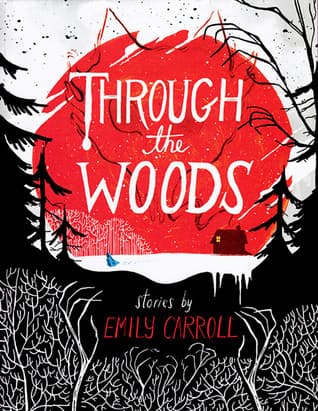
Emily Carroll (2014)
Genre
Fantasy / Young Adult
Reading Time
90 min
Key Themes
See below
Sign in to track this book
Emily Carroll's collection invites readers into five unsettling tales, where the forest's whispers lure travelers into nightmares, blurring reality and dread with every rustle of leaves.
The book begins with a short, unsettling poem, "It came from the woods. Most strange things do." This establishes the woods as a source of mystery and dread. The poem's simple, almost nursery-rhyme style hides its disturbing message, preparing the reader for the five tales that explore dangers and supernatural elements in forests and in-between places. It hints at the unknown, the monstrous, and the pull of the wilderness that appears in each story.
Three sisters, Elspeth, Margaret, and Anne, live in a remote cabin with their father. When he leaves to hunt, telling them to stay inside and away from the neighbor's house, the girls grow restless. Elspeth, the oldest, eventually goes to the neighbor's house, promising to return by sunset. She never does. Margaret follows, worried, and also disappears. Anne, left alone and afraid, eventually gives in to the same urge, finding the neighbor's house empty except for a disturbing, constant 'smile' that seems to follow her. She is caught in a repeating nightmare, unable to leave the house or the woods.
A young, unnamed woman marries a wealthy lord and moves into his grand, isolated manor. She quickly feels uneasy, especially when she hears a constant, sad singing from the walls. Her husband forbids her from entering the cellar. Driven by curiosity and growing dread, she disobeys him and finds a locked door in the cellar. Breaking it open, she finds the skeletal remains of her husband's previous wife, still wearing a ring and 'singing.' The ghost wife's hands are impossibly cold, and her husband, revealing his monstrous nature, appears and kills the new bride, adding her to his collection of 'cold-handed' wives.
Forest, a young man, returns home for his sister Rebecca's wedding to a mysterious man named Bellwether. Forest immediately distrusts Bellwether, finding him unsettling and too perfect. He notices odd things: Bellwether's unnatural stillness, his vague answers, and Rebecca's increasingly withdrawn behavior. Forest investigates Bellwether's past and discovers a truth: Bellwether is not human but a parasitic creature that sheds its skin and takes over its victims. He finds Bellwether's discarded skin and the real Bellwether's decaying body. He tries to warn Rebecca, but she is already too influenced by the imposter, having been 'nested' and transformed into a similar creature, leading to a confrontation.
Katie's friend Janna claims to be haunted by a ghost only she can see and hear. Janna's 'ghost' often makes her do strange or dangerous things, and Janna enjoys the attention and pity it brings her. Katie first thinks it's Janna being dramatic, but the incidents become more disturbing. The ghost begins to appear in ways that affect Katie, such as moving objects or leaving unsettling messages. Katie realizes Janna is not just pretending; the ghost is real and growing stronger, feeding on Janna's willingness to be its victim. The story ends with Katie fearing the ghost is now focusing on her, leaving her caught in Janna's created horror.
Two young sisters, Leanne and her younger sister, find a talking, disembodied witch's head on a stake in the woods. The head, still alive and evil, promises them a wish if they release it. Leanne, wary of the witch's tricks, refuses. Her younger sister, however, is drawn to the idea of a wish and secretly returns to the head. The head tricks the younger sister into releasing it, promising her beauty. When Leanne discovers this, she confronts the now-free witch. The witch, having regained its power, takes cruel revenge on the younger sister, turning her into a grotesque, bird-like creature. Leanne is left to deal with the horrifying results of her sister's choice.
After the younger sister releases the witch's head, the witch, now fully restored, shows its true, terrifying form. Instead of granting beauty, the witch twists the wish, transforming the younger sister into a hideous, bird-like creature with long limbs and a beak. The change is painful and permanent, a cruel punishment for her gullibility and disobedience. Leanne sees this horrifying change, realizing the true danger of interfering with the supernatural. The witch laughs, having taken revenge and shown its power, leaving Leanne to mourn her sister's grotesque fate and the permanent loss of her humanity.
Seeing her sister's monstrous transformation, Leanne feels both horror and strong resolve. She confronts the witch, demanding her sister be returned to normal. The witch, enjoying its cruelty, mocks Leanne, saying the bargain is done and the change is permanent. Leanne, however, refuses to give up. She uses her intelligence and knowledge of folklore, perhaps remembering how the witch was first defeated, to try and find a weakness. The confrontation is tense, showing Leanne's courage against great evil, even as her sister's chance of salvation fades.
Despite Leanne's bravery, the witch is too powerful, and the younger sister remains in her monstrous form. The witch disappears back into the woods, its evil goal met. Leanne is left alone with her transformed sister, a reminder of the dangers of the supernatural and the permanent results of foolish choices. The story ends sadly, with Leanne burdened by grief, guilt, and the knowledge that she could not save her sister. The woods, again, claim a victim and leave a lasting mark on those who get too close to its hidden evils.
The book ends, leaving the reader with a lasting sense of unease and the echoes of the supernatural. There is no neat or comforting ending; instead, the stories reinforce the idea that the woods, and the unknown, are always present and dangerous. The last tale, "The Witch's Head," has a particularly grim and unresolved ending, cementing the collection's themes of permanent horror and human vulnerability against old, evil forces. The reader is left to think about the thin line between the ordinary and the monstrous, and the dangers of curiosity and breaking rules.
The Protagonist
Anne transforms from a frightened child into a trapped, perpetually terrified victim, unable to escape the 'smile' and the cyclical nature of her fate.
The Protagonist
She begins as an optimistic newlywed but her journey quickly descends into dread as she uncovers a horrifying truth, ultimately becoming a victim herself.
The Antagonist
The Lord remains a static figure of malevolent evil, consistently repeating his horrific pattern of marrying and murdering.
The Protagonist
Forest begins as a suspicious brother and becomes a desperate, almost solitary warrior against a parasitic entity, ultimately failing to save his sister.
The Antagonist
Bellwether remains a static figure of quiet horror, a constantly repeating cycle of mimicry and predation.
The Supporting
Janna descends from a attention-seeking friend to a willing, yet ultimately tormented, conduit for a malevolent spirit.
The Protagonist
Katie evolves from a skeptical friend to a terrified witness, eventually fearing she will become the ghost's next target.
The Protagonist
Leanne begins as a protective older sister but is ultimately forced to bear the tragic burden of her sister's irreversible transformation.
The Supporting
The younger sister's desire for beauty leads to her grotesque, irreversible transformation, highlighting the perils of temptation.
The Antagonist
The Witch's arc is one of reasserting its power and malevolence, culminating in a successful act of cruel revenge.
The woods are always shown as a dangerous, in-between place, a source of old, evil power. In 'Our Neighbor's House,' the woods literally trap the sisters in a nightmare. In 'The Witch's Head,' the witch is found in the woods and returns there after casting its curse. The wilderness is not a safe place but one of hidden horrors, a border between the known and the monstrous that, once crossed, often leads to permanent ruin. It represents humanity's untamed, basic fears.
“It came from the woods. Most strange things do.”
Many characters face bad consequences because they cannot resist forbidden knowledge or commands. Anne and her sisters in 'Our Neighbor's House' are warned not to go to the neighbor's house, yet their curiosity and loneliness draw them in. The new bride in 'A Lady's Hands Are Cold' is told not to go into the cellar but cannot resist finding its secrets. The younger sister in 'The Witch's Head' disobeys Leanne to make a bargain. This theme highlights the human tendency to break rules, often leading to tragic and permanent outcomes from supernatural forces.
“The forbidden door, the forbidden path, it always calls to those who listen.”
Carroll often uses female characters as sources or victims of horror, sometimes changing traditional roles. The witch in 'The Witch's Head' is an old, powerful, and cruelly vengeful female entity. The ghost wives in 'A Lady's Hands Are Cold' are victims, but their endless singing is a haunting, powerful presence. Even Rebecca in 'The Nesting Place' becomes a monstrous host. This theme explores the darker parts of female power, vulnerability, and change, going beyond usual types to show complex, often terrifying, portrayals.
“Her hands were like ice, and the song never stopped.”
Physical change into something grotesque is a repeated element, showing how fragile the human form and identity are. In 'The Nesting Place,' Bellwether sheds his skin, and Rebecca is 'nested' and subtly changed. The younger sister in 'The Witch's Head' is gruesomely turned into a bird-like creature. This theme uses vivid images to show a deep sense of violation and loss of self, highlighting the terrifying possibility of the human body becoming something alien and horrifying.
“Her skin was stretched thin, her fingers lengthening into claws, her mouth twisting into a beak.”
The reader is often left to piece together the full horror, creating a deeper sense of dread.
Carroll frequently employs ambiguity, leaving certain details unexplained or allowing the reader to infer the full horror. In 'Our Neighbor's House,' the exact fate of the sisters is never explicitly shown, only implied by Anne's endless loop. In 'My Friend Janna,' the line between Janna's fabrication and genuine haunting is blurred until the very end. This device forces the reader to actively participate in constructing the horror, making it more personal and unsettling, and heightening the sense of pervasive dread and the unknown.
Familiar fairy tale elements are twisted into something dark and unsettling.
The stories draw heavily on classic folkloric and fairy tale tropes – the isolated cabin, the forbidden house, the wicked witch, the monstrous suitor, the talking head. However, Carroll subverts these familiar elements, twisting them into something much darker and more visceral. The 'neighbor's house' is not a place of help but a trap; the 'witch' grants wishes with cruel, irreversible curses. This device plays on the reader's pre-existing associations with these tales, making the subversion of expectations all the more impactful and chilling.
The artwork and paneling are integral to conveying atmosphere and horror.
As a graphic novel, the visual elements are not merely illustrative but are a primary plot device. Carroll uses stark black and white, splashes of red, unsettling character designs (like the 'smile' in 'Our Neighbor's House' or Bellwether's unnatural perfection), and dynamic panel layouts to convey mood, tension, and jump scares. The artwork often shows what words cannot, creating a pervasive sense of dread, claustrophobia, or sudden shock. The visual language is as crucial to the narrative as the text itself.
Characters become trapped in repeating patterns of horror or consequence.
This device creates a sense of inescapable doom. In 'Our Neighbor's House,' Anne finds herself trapped in a perpetual loop within the house, unable to escape the 'smile.' In 'A Lady's Hands Are Cold,' the Lord repeatedly marries and murders, and his wives are perpetually singing. This cyclical nature emphasizes the futility of resistance against certain evils and the idea that some horrors are not singular events but ongoing, inescapable fates, creating a profound sense of despair and dread for the characters involved.
“It was in the woods that I first felt it. A chill, not of the air, but of something watching.”
— Opening of 'His Face All Red'
“My brother... he came back. But it wasn't him.”
— The narrator's growing dread in 'His Face All Red'
“The thing about being lost in the woods is, sometimes you don't even know you are.”
— General theme applicable to several stories
“There are some houses that are just... waiting for someone to come inside, and never leave.”
— A character's observation about a haunted dwelling
“She had a feeling that the silence wasn't empty, but full of things she didn't want to hear.”
— A character alone, sensing unseen presences
“The moon was so bright, it cast shadows that looked like they had teeth.”
— Atmospheric description in a night scene
“Be careful what you wish for, little girl. The woods have a way of granting them... in their own fashion.”
— A warning given to a young protagonist
“He thought he was hunting, but he was the one being tracked.”
— A character's realization of being prey
“The path seemed to stretch on forever, and with every step, the trees grew closer, darker.”
— A journey into an increasingly ominous forest
“Sometimes, the scariest monsters are the ones you invite in yourself.”
— A reflection on internal fears or guilt
“The wind through the branches sounded like whispers, telling secrets no one should hear.”
— Sensory detail contributing to an eerie atmosphere
“She looked into the mirror, and for a moment, saw someone else looking back.”
— A moment of identity crisis or supernatural reflection
“It was a lovely day for a picnic, if you didn't mind the feeling of eyes on you from the trees.”
— An ironic observation about a seemingly mundane setting
“Some things are better left buried. Especially in the woods.”
— A warning about disturbing the past or hidden evils
Ready to see how well you understood this book? Take our interactive quiz with 10 questions.

Biography coming soon.







