“‘The time has come,’ the Walrus said, ‘To talk of many things: Of shoes—and ships—and sealing-wax—Of cabbages—and kings—And why the sea is boiling hot—And whether pigs have wings.’”
— The Walrus and the Carpenter poem

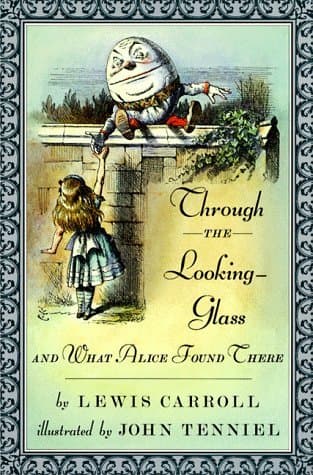
Lewis Carroll (1865)
Genre
Fantasy / Children's / Young Adult
Reading Time
150 min
Key Themes
See below
Sign in to track this book
Alice tumbles through a mirror into a backwards world of chess pieces and Red Queens, where logic is a game and nonsense reigns supreme.
Alice, a curious young girl, plays with her kittens, Kitty and Snowdrop, and a black queen chess piece in her cozy drawing-room. She wonders about the world on the other side of the looking-glass and, to her surprise, steps through the mirror's surface as if it were a soft curtain. She finds a room identical to her own but reversed, where the clock runs backward and the books are printed in mirror-writing. She then finds a poem, 'Jabberwocky', which she can only read by holding it up to the mirror, and considers the strange nature of this new reality before going into a garden.
Upon entering the garden, Alice is amazed to find that the flowers can talk. She talks with a Tiger-lily, a Rose, and other flowers, who are rather rude and opinionated. They tell her that the trees also talk. Suddenly, the Red Queen appears, growing rapidly in size. The Red Queen, stern and imperious, explains to Alice that the entire landscape is laid out like a giant chessboard and that Alice herself is a pawn. She instructs Alice on the rules of Looking-Glass chess, telling her that if she can reach the eighth square, she will become a Queen.
Alice tries to follow the Red Queen but finds herself continually brought back to where she started. She eventually boards a train that jumps over streams and through a forest, with nonsensical conversations among the passengers. After the train ride, she meets Tweedledum and Tweedledee, two round, identical brothers who quote poetry, including 'The Walrus and the Carpenter'. They warn her about a dream in which she is a figure, and then have a brief, absurd battle before a monstrous crow frightens them away, leaving Alice to continue her journey.
Alice next meets the White Queen, who is incredibly forgetful and lives life backward, remembering future events but not past ones. The White Queen offers Alice a job as her 'maid,' but their conversation is full of riddles and non-sequiturs. The White Queen then inexplicably turns into a Sheep, and Alice finds herself in a shop. The shop is filled with impossible objects that disappear or change shape as she tries to grasp them. She eventually buys an egg, which promptly rolls away.
The egg Alice bought rolls to a wall, where it turns into Humpty Dumpty. Humpty Dumpty, perched precariously, is an arrogant and pedantic egg-man who believes he can define words as he pleases, famously explaining the meaning of 'Jabberwocky' to Alice. He boasts about his unbirthday present and his unique understanding of language. Despite his pronouncements, Alice worries about his inevitable fall. He dismisses her concerns, but his eventual tumble is hinted at, prompting Alice to move on.
Alice encounters the Lion and the Unicorn, two creatures in a perpetual battle for the crown, as described in a nursery rhyme. After their fight, they are served plum cake, which must be cut and then distributed before it is passed around. Alice then meets the White King's messengers, Haigha (the March Hare) and Hatta (the Hatter from Wonderland), who are peculiar and prone to making strange observations. The White King himself observes everything and takes notes, seemingly unaware of Alice's presence.
Alice continues her journey and encounters the White Knight, a bumbling but kind-hearted figure who constantly falls off his horse. He rides a horse that wears anklets to prevent it from biting his ankles, and his helmet is covered in a birdcage. The Knight explains various 'inventions' of his, all of which are impractical and absurd, such as a pudding that would be good for swallowing. He sings a long, melancholic song about an old man and a fish. He escorts Alice to the final brook, which she must cross to become a Queen.
Alice finally crosses the last brook and is crowned Queen, completing her chess journey. She is immediately joined by the Red Queen and the White Queen, who subject her to a bizarre and nonsensical 'examination' that leaves her utterly confused. They lead her to a grand banquet in her honor. However, the feast quickly descends into chaos. The food, particularly the leg of mutton and the plum pudding, begins to talk and refuse to be eaten, and the other guests engage in increasingly absurd behavior.
The chaos at the banquet intensifies. The guests throw things, the candles grow tall, and the Red Queen's behavior becomes increasingly aggressive and overbearing. Alice, overwhelmed by the pandemonium and the Red Queen's imperious demands, can no longer tolerate the nonsense. She grabs the Red Queen, whom she perceives as the source of all the trouble, and begins to shake her violently, determined to end the madness that has consumed the feast and the entire Looking-Glass world.
Alice continues to shake the Red Queen until she wakes up in her own armchair, holding her black kitten, Kitty. She realizes that her entire journey through the Looking-Glass was a vivid dream, and that Kitty was the Red Queen all along. She recounts her adventures to Kitty and Snowdrop, trying to piece together the events. The book concludes with Alice pondering a question: who was dreaming whom? Was it she who dreamed the Red King, or did the Red King dream her, as Tweedledum and Tweedledee suggested?
The Protagonist
Alice begins as a passive observer but gradually asserts herself, culminating in her act of shaking the Red Queen to end the chaos.
The Antagonist/Supporting
The Red Queen remains consistently imperious and challenging, eventually becoming the symbolic target of Alice's frustration.
The Supporting
The White Queen remains consistently flighty and illogical, a source of both amusement and exasperation for Alice.
The Supporting
The twins remain static, representing perpetual, childish conflict and philosophical musing.
The Supporting
Humpty Dumpty remains a static character, a symbol of linguistic hubris and physical vulnerability.
The Supporting
The White Knight remains consistently bumbling and well-intentioned, serving as a brief, gentle guide for Alice.
The Mentioned/Supporting
They serve as an initial exposition to the bizarre nature of the Looking-Glass world and do not undergo any character development.
The Mentioned/Supporting
Kitty serves as the real-world inspiration for a major character in Alice's dream.
The central theme involves the constant clash between Alice's logical, real-world understanding and the illogic of the Looking-Glass world. Characters like the Red Queen and Humpty Dumpty deliberately twist language and reason, forcing Alice to confront a reality where rules are arbitrary or reversed. This is clear when Alice tries to follow the Red Queen's instructions, only to find herself back where she started, or when Humpty Dumpty declares that words mean 'just what I choose them to mean.' The book challenges the reader's own assumptions about order and sense.
“Now, here, you see, it takes all the running you can do, to keep in the same place. If you want to get somewhere else, you must run at least twice as fast as that!”
Alice's journey constantly questions her own identity and the reality of her experiences. Tweedledee and Tweedledum's assertion that Alice is merely a figure in the Red King's dream disturbs her, making her wonder if she is truly real or just an illusion. This theme ends with Alice's final question, 'Which dreamed it?', leaving the reader to ponder the subjective nature of reality and the thin line between dreams and waking life. The mirror itself symbolizes this duality, reflecting a reversed, yet strangely familiar, version of her world.
“You know very well you're not real.”
Lewis Carroll, a logician, explores the flexibility and arbitrary nature of language throughout the book. Humpty Dumpty's insistence on controlling the meaning of words ('When I use a word, it means just what I choose it to mean—neither more nor less.') is a prime example. The 'Jabberwocky' poem, initially incomprehensible but later 'translated' by Humpty Dumpty, shows how context and interpretation shape understanding. Conversations are often filled with puns, riddles, and non-sequiturs, showing how language can be both a tool for communication and a source of confusion.
“'When I use a word,' Humpty Dumpty said in rather a scornful tone, 'it means just what I choose it to mean—neither more nor less.'”
The book can be read as an exploration of the transition from childhood to the complexities of the adult world. Alice, a child, tries to navigate a world populated by adult-like figures (the Queens, Humpty Dumpty) who often behave in childish, illogical, or tyrannical ways. Her attempts to bring order and politeness to the chaotic Looking-Glass inhabitants reflect a child's struggle to understand and adapt to the often-unreasonable rules and behaviors of the adult world. Her eventual frustration and action against the Red Queen symbolize a child's rebellion against arbitrary authority.
“It's a poor sort of memory that only works backwards.”
The entire story is structured as a game of chess.
The Looking-Glass world is explicitly laid out as a giant chessboard, with Alice as a pawn. Her journey from the second square to the eighth square, where she becomes a Queen, provides the overarching structural framework for the narrative. Each major encounter and location can be mapped to a move or a square on the board, giving a sense of progression and purpose to Alice's seemingly random adventures. This device adds a layer of intellectual playfulness, connecting the whimsical narrative to a rigid, logical game.
The core conceit of the world being a reverse reflection.
The entire premise of the story—Alice stepping through a looking-glass—establishes a world that is a literal and metaphorical reversal of her own. This manifests in various ways: clocks running backward, books with mirror-writing, and characters who live life backward (like the White Queen). This device creates an immediate sense of disorientation and wonder, challenging common perceptions of reality and order. It allows Carroll to explore paradoxes and the nature of opposites, enriching the philosophical undertones of the narrative.
Poetry and wordplay that defy conventional meaning.
Carroll frequently employs nonsense verse, most famously 'Jabberwocky,' and an abundance of puns and wordplay. This device creates humor and contributes to the overall illogic of the Looking-Glass world. The poems often sound meaningful but are largely devoid of literal sense, or their meaning is arbitrarily assigned, as with Humpty Dumpty. This highlights the theme of language and meaning, demonstrating how words can be manipulated or enjoyed for their sound and rhythm rather than strict semantic content.
The entire adventure is presented as a vivid dream.
The story begins with Alice musing about the looking-glass world and ends with her waking up, revealing the entire adventure to have been a dream. This device allows for the complete suspension of disbelief, justifying all the fantastical and illogical events. It also introduces the philosophical question of 'Which dreamed it?', blurring the lines between the dreamer and the dreamed, and adding a layer of meta-narrative complexity to the story. The dream frame absolves the narrative of needing internal consistency, while still exploring profound ideas.
“‘The time has come,’ the Walrus said, ‘To talk of many things: Of shoes—and ships—and sealing-wax—Of cabbages—and kings—And why the sea is boiling hot—And whether pigs have wings.’”
— The Walrus and the Carpenter poem
““It seems very pretty,” she said when she had finished it, “but it’s rather hard to understand!””
— Alice reading 'Jabberwocky'
““If you think we’re wax-works,” he said, “you ought to pay, you know.””
— Tweedledum to Alice
““The question is,” said Humpty Dumpty, “which is to be master—that’s all.””
— Humpty Dumpty discussing words
““Why, sometimes I’ve believed as many as six impossible things before breakfast.””
— The White Queen to Alice
““When I use a word,” Humpty Dumpty said, in rather a scornful tone, “it means just what I choose it to mean—neither more nor less.””
— Humpty Dumpty on semantics
““It’s a poor sort of memory that only works backwards,” the Queen remarked.”
— The White Queen on memory
““Contrariwise,” continued Tweedledee, “if it was so, it might be; and if it were so, it would be; but as it isn’t, it ain’t. That’s logic.””
— Tweedledee explaining a paradox
““Here, you see, it takes all the running you can do, to keep in the same place. If you want to get somewhere else, you must run at least twice as fast as that!””
— The Red Queen to Alice
““A slow sort of country!” said the Queen. “Now, here, you see, it takes all the running you can do, to keep in the same place.””
— The Red Queen after a run with Alice
““Take care of the sense, and the sounds will take care of themselves.””
— The Duchess in Alice's Adventures in Wonderland, but a common Carrollian theme relevant to Looking-Glass's wordplay.
““I don’t know what you mean by ‘glory’,” Alice said. Humpty Dumpty smiled contemptuously. “Of course you don’t—till I tell you. I meant ‘there’s a nice knock-down argument for you!’””
— Humpty Dumpty defining 'glory'
““It’s a poor life this, if you can’t make a joke now and then.””
— The White Knight to Alice
““The rule is, jam to-morrow and jam yesterday—but never jam to-day.””
— The White Queen explaining the rules of the feast
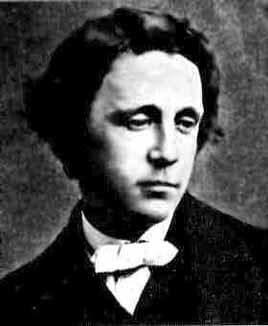
Ready to see how well you understood this book? Take our interactive quiz with 10 questions.
Charles Lutwidge Dodgson, better known by his pen name Lewis Carroll, was an English author, poet and mathematician. His most notable works are Alice's Adventures in Wonderland (1865) and its sequel Through the Looking-Glass (1871). He was noted for his facility with word play, logic, and fantasy. His poems Jabberwocky (1871) and The Hunting of the Snark (1876) are classified in the genre of literary nonsense.







