“The empire, long divided, must unite; long united, must divide. Thus it has ever been.”
— Opening lines of the novel, setting the cyclical nature of Chinese history.

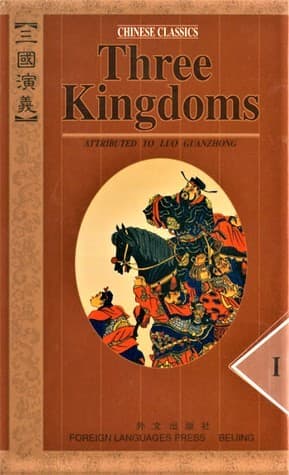
Luo Guanzhong (1644)
Genre
Historical Fiction
Reading Time
2339 min (approx. 39 hours assuming 1 min/page)
Key Themes
See below
Sign in to track this book
Three sworn brothers rise from humble beginnings to navigate a brutal world of warring lords, cunning strategists, and epic battles, shaping the destiny of a fractured empire during the Han Dynasty's collapse.
As the Han Dynasty crumbles under corrupt eunuchs and the Yellow Turban Rebellion, the imperial court calls for help. In Zhuo County, Liu Bei, a distant relative of the imperial house, laments the empire's state. He meets the formidable Zhang Fei, a wealthy butcher, and soon after, the dignified fugitive Guan Yu. Recognizing a shared goal to restore order and loyalty to the Han, the three men gather in Zhang Fei's peach garden and swear an oath of eternal brotherhood, vowing to live and die together. They raise a small army, joining the fight against the Yellow Turbans, beginning their journey into the world of warlordism.
After the Yellow Turban Rebellion, the Han court remains in disarray, manipulated by eunuchs. The ambitious warlord Dong Zhuo from Xiliang takes advantage of the power vacuum, entering Luoyang and seizing control of the young Emperor Shao, later replacing him with Emperor Xian. Dong Zhuo's brutal rule, marked by executions, sparks outrage. Various regional warlords, including Yuan Shao, Cao Cao, Sun Jian, and Liu Bei, form a coalition to remove Dong Zhuo. Despite initial successes, the fractured coalition fails to defeat Dong Zhuo, who eventually burns Luoyang and moves the capital to Chang'an.
After the anti-Dong Zhuo coalition's collapse, the northern plains become a battleground. Cao Cao, a shrewd strategist, gradually expands his territory, gaining control of Emperor Xian and the imperial court, which legitimizes his campaigns. He faces challenges, including the powerful northern warlord Yuan Shao, who commands a large army. Their rivalry culminates in the Battle of Guandu. Cao Cao, though outnumbered, uses superior tactics, intelligence, and audacious moves to defeat Yuan Shao's forces. This victory solidifies Cao Cao's control over northern China, setting the stage for future unification efforts.
Following the anti-Dong Zhuo coalition's collapse and subsequent defeats, Liu Bei, Guan Yu, and Zhang Fei wander as refugees, seeking refuge with various warlords. Despite their fighting skill, Liu Bei lacks a strategic mind. Hearing of a reclusive genius named Zhuge Liang, known as the 'Sleeping Dragon,' Liu Bei, driven by respect, makes three arduous visits to Zhuge Liang's cottage in Longzhong. On the third visit, Zhuge Liang agrees to serve Liu Bei, outlining the Longzhong Plan – a strategy for dividing the empire into three parts, which would become the blueprint for Liu Bei's future kingdom.
Having conquered the north, Cao Cao aims to unify China, launching a massive invasion of the south. His forces, bolstered by Jing Province's surrender, are overwhelming. Liu Bei, advised by Zhuge Liang, forms an alliance with Sun Quan, the warlord of Jiangdong. Against the odds, and despite being vastly outnumbered, Zhuge Liang and Sun Quan's strategist, Zhou Yu, devise a plan. Through fire attacks, deception, and exploiting Cao Cao's overconfidence and naval inexperience, the allied forces achieve a decisive victory at the Battle of Red Cliffs. This defeat shatters Cao Cao's dream of immediate unification and establishes the Three Kingdoms period.
After the Battle of Red Cliffs, the strategically important Jing Province, located at the crossroads of the three major territories, becomes a source of dispute. Liu Bei, through Zhuge Liang's maneuvering, gains temporary control of a significant portion of Jing. However, Sun Quan's forces, especially his general Zhou Yu, feel betrayed, believing Jing belongs to them. This contention leads to diplomatic and military skirmishes, marked by Zhuge Liang's cunning and Zhou Yu's frustration. The struggle for Jing Province strains the alliance between Liu Bei and Sun Quan, foreshadowing future conflicts and tragedies, particularly for Guan Yu.
Guided by Zhuge Liang's Longzhong Plan, Liu Bei targets the fertile lands of Yi Province (modern-day Sichuan), also known as Shu. Initially invited by governor Liu Zhang to help defend against Zhang Lu, Liu Bei gradually maneuvers to seize control of the region through political and military campaigns. With Chengdu's capture, Liu Bei establishes the Kingdom of Shu Han, declaring himself emperor. This achievement marks a step towards fulfilling Zhuge Liang's vision of a tripartite division of the empire, with Liu Bei ruling the western kingdom, ready to challenge Cao Cao's Wei and Sun Quan's Wu.
While Liu Bei consolidates power in Shu, Guan Yu, left to guard Jing Province, becomes involved in a conflict with Cao Cao's forces and, more critically, with Sun Quan's Wu. Despite his legendary bravery, Guan Yu's arrogance and misjudgment, combined with a scheme by Wu general Lu Meng, lead to his defeat, capture, and execution by Sun Quan. Enraged by his sworn brother's death, Liu Bei, against Zhuge Liang's advice, invades Wu to avenge Guan Yu. The campaign culminates in the disastrous Battle of Yiling, where Liu Bei's forces are routed by Lu Xun, leading to Liu Bei's retreat and eventual death.
After Liu Bei's death, his son Liu Shan becomes emperor of Shu Han, with Zhuge Liang as regent. Committed to Liu Bei's dying wish of restoring the Han Dynasty, Zhuge Liang undertakes a series of Northern Expeditions against Cao Wei. Despite his strategic brilliance and initial victories, logistical challenges, internal dissent, and Wei generals' defenses consistently thwart his goal of capturing Chang'an. Each expedition shows Zhuge Liang's loyalty and strategic genius, but also highlights the difficulty of overcoming Wei's power. His campaigns include famous stratagems and battles, though none achieve lasting success.
During Zhuge Liang's Northern Expeditions, the Wei state relies on the brilliant, cautious, and patient strategist Sima Yi. Sima Yi consistently avoids direct confrontation with Zhuge Liang when possible, focusing on defensive tactics and wearing down Shu's limited resources. Their rivalry becomes legendary, a battle of wits between two of the era's greatest minds. Ultimately, during the Fifth Northern Expedition, Zhuge Liang's health declines, and he dies of illness at the Battle of Wuzhang Plains. His death marks a turning point, as Shu Han loses its guiding genius, paving the way for Sima Yi's descendants' eventual dominance and China's unification under the Jin Dynasty.
After Zhuge Liang's death, Shu Han, under the increasingly incompetent Emperor Liu Shan and internal power struggles, weakens. Decades later, Wei, now controlled by the Sima clan, launches a massive invasion. Despite generals like Jiang Wei's efforts, Shu Han falls quickly, with Liu Shan surrendering to Wei forces. Eastern Wu, though more resilient, also faces internal strife and pressure from the unified North. Eventually, the Jin Dynasty, founded by Sima Yan (Sima Yi's grandson) after taking over Wei, conquers Wu, ending the Three Kingdoms period and reuniting China under one imperial rule, completing the historical cycle of division and unity.
The Protagonist
From a wandering, landless lord, Liu Bei rises to found the Kingdom of Shu Han, fulfilling part of his ambition before his tragic death driven by vengeance.
The Antagonist/Major Warlord
Cao Cao rises from a minor official to the undisputed ruler of northern China, laying the foundation for the Wei Dynasty, though he never achieves full unification.
The Major Warlord
Sun Quan establishes and maintains the Kingdom of Eastern Wu for decades, outliving his major rivals and ensuring the longevity of his dynasty.
The Supporting/Protagonist
From a reclusive scholar, Zhuge Liang becomes the guiding genius of Shu Han, tirelessly working to restore the Han until his death, securing his legacy as a legendary strategist.
The Supporting
Guan Yu rises as a legendary warrior and loyal brother, but his pride and strategic missteps lead to his tragic defeat and execution, becoming a martyr for loyalty.
The Supporting
Zhang Fei remains a loyal and fierce warrior throughout his life, his impulsiveness tempered slightly by experience, but ultimately falls victim to his own temper.
The Supporting/Antagonist
Sima Yi rises from a trusted general to the de facto ruler of Wei, outliving Zhuge Liang and establishing the foundation for his family's usurpation of the Wei throne.
The Supporting
Zhou Yu's brilliance secures Wu's future at Red Cliffs, but his rivalry with Zhuge Liang and overwhelming envy lead to his tragic early demise.
Loyalty, especially among sworn brothers, is central to the narrative. The Oath of the Peach Garden between Liu Bei, Guan Yu, and Zhang Fei creates an unbreakable bond that drives much of the plot. Their loyalty to each other and to the Han Dynasty (in Liu Bei's case) dictates their choices, sacrifices, and downfalls. Guan Yu's death, for instance, results from his loyalty to Liu Bei, and Liu Bei's revenge campaign against Wu shows the deep impact of this brotherhood.
“Though we were not born on the same day, we hope to die on the same day, in the same month, and in the same year.”
The novel opens with the line, 'The empire, long divided, must unite; long united, must divide. Thus it has ever been.' This cyclical view of history underpins the entire narrative. The story begins with division and chaos at the Han Dynasty's end, moves through attempts at unification (Cao Cao's ambition), the establishment of three separate kingdoms, and ends with reunification under the Jin Dynasty. This theme suggests an inevitable ebb and flow of power and territory, where no single state or leader can maintain absolute control, reflecting a philosophical understanding of Chinese history.
“The empire, long divided, must unite; long united, must divide. Thus it has ever been.”
Three Kingdoms explores different leadership philosophies through its main characters. Liu Bei represents benevolent, righteous leadership that inspires loyalty through virtue. Cao Cao represents pragmatic, ruthless, and effective leadership, prioritizing results over moral purity. Sun Quan shows patient, stable, and strategic leadership focused on consolidating and preserving his domain. The novel contrasts these styles, showing their strengths and weaknesses in war and governance. It also examines how power corrupts, as seen in Dong Zhuo's tyranny, and how it is wielded through military might, political maneuvering, and intellectual prowess.
“I would rather betray the world than have the world betray me.”
Military and political strategy, often involving elaborate deception, is a dominant theme. Characters like Zhuge Liang, Cao Cao, Sima Yi, and Zhou Yu are masters of strategy, using intricate plans, feints, and cunning ruses to gain advantages in battle and diplomacy. The Battle of Red Cliffs, Zhuge Liang's 'empty fort' stratagem, and his manipulation of Zhou Yu are prime examples. The novel emphasizes intelligence and foresight as crucial for success, often valuing a brilliant mind over sheer military strength, showing how wit can overcome overwhelming odds.
“A truly great man uses his wit, not his might.”
Zhuge Liang's strategic blueprint for a tripartite division of China.
The Longzhong Plan is Zhuge Liang's master strategy, presented to Liu Bei, outlining how to establish a strong base in Jing Province and then conquer Yi Province (Shu), forming one of three kingdoms alongside Cao Cao's Wei and Sun Quan's Wu. This plan provides Liu Bei with a clear, long-term objective and a strategic roadmap for achieving it. It functions as a central organizing principle for Liu Bei's campaigns and highlights Zhuge Liang's extraordinary foresight, acting as a prophecy that largely unfolds throughout the story, giving a sense of destiny and purpose to Liu Bei's actions.
A psychological tactic where a seemingly undefended position is used to deter an enemy.
This famous stratagem, most notably employed by Zhuge Liang against Sima Yi, involves deliberately leaving a city gate open and undefended, with Zhuge Liang calmly playing his guqin on the city wall. The sight of this apparent vulnerability, combined with Zhuge Liang's known cunning, makes the cautious Sima Yi suspect an ambush and retreat. This device highlights the power of psychological warfare and reputation, demonstrating how a brilliant mind can manipulate an opponent's fears and assumptions to overcome a seemingly impossible military disadvantage.
Supernatural signs and prophecies that foreshadow future events.
Throughout the novel, various portents, dreams, and omens are used to foreshadow significant events, character deaths, or shifts in fortune. These can range from unusual weather phenomena, celestial alignments, strange dreams experienced by characters, or even direct prophecies. For instance, Zhuge Liang's ability to 'borrow the east wind' at Red Cliffs or various dreams preceding a character's demise. This device adds a layer of mysticism and fatalism to the narrative, suggesting that destiny plays a role in the unfolding of history and that the characters are often acting within a larger, predetermined cosmic order.
A sacred pledge of eternal loyalty and shared destiny among characters.
The Oath of the Peach Garden, taken by Liu Bei, Guan Yu, and Zhang Fei, is the most prominent example of this device. It establishes an unbreakable bond and a core moral compass for these characters, dictating their actions and sacrifices throughout the narrative. Subsequent oaths or pledges, though less central, also serve to define alliances and loyalties. This device emphasizes the importance of personal honor and commitment in a chaotic world, providing a contrast to the often opportunistic and shifting allegiances among other warlords, and driving many key plot points, including Liu Bei's campaign of vengeance.
“The empire, long divided, must unite; long united, must divide. Thus it has ever been.”
— Opening lines of the novel, setting the cyclical nature of Chinese history.
“To plot against an enemy who is already defeated is like shooting a tiger after it has fallen into a pit.”
— Attributed to Cao Cao, reflecting on seizing opportunities against a weakened foe.
“Better to betray the world than have the world betray me.”
— Spoken by Cao Cao after a misunderstanding leads him to kill his benefactor's family, revealing his ruthless pragmatism.
“A hero is one who has great ambitions, and a plan for carrying them out.”
— Liu Bei and Cao Cao discuss what makes a true hero during their 'Plum-Boiling Heroes' conversation.
“Brothers, though not born of the same father, we vow to die on the same day.”
— From the Oath of the Peach Garden, where Liu Bei, Guan Yu, and Zhang Fei swear their eternal brotherhood.
“Just as a dragon cannot live without water, so a lord cannot rule without the support of his people.”
— Zhuge Liang uses this analogy to explain the importance of popular support to Liu Bei.
“The wise man is one who can change his mind.”
— Often attributed to Zhuge Liang, emphasizing adaptability and wisdom.
“The greatest joy in life is to defeat your enemy, to drive them before you, to take from them all they possess, to ride their horses, and to make their wives and daughters weep.”
— Spoken by Cao Cao, revealing his brutal and triumphant view of conquest.
“A general who does not know how to adapt to changing circumstances is like a fish out of water.”
— Zhuge Liang's advice on the importance of flexibility in military command.
“Though my body may die, my spirit will live on to haunt my enemies.”
— Guan Yu's defiant declaration before his execution, foreshadowing his later deification.
“The truly great man is he who can endure adversity and emerge stronger.”
— A general philosophical observation within the narrative, reflecting the arduous journeys of the heroes.
“To win without fighting is the best.”
— A core principle of strategy, often employed by Zhuge Liang through psychological warfare or diplomacy.
“Even a dragon can be trapped in a shallow pond if it is arrogant.”
— A warning against overconfidence, often seen in the downfall of proud characters.
“The path of righteousness is often thorny, but it leads to lasting peace.”
— Reflects Liu Bei's moral compass and the long-term vision of his quest.
Ready to see how well you understood this book? Take our interactive quiz with 10 questions.

Luo Ben, better known by his courtesy name Guanzhong, was a Chinese writer who lived during the Ming dynasty. He is also known by his pseudonym Huhai Sanren. Luo is credited with writing Romance of the Three Kingdoms, one of the Four Great Classical Novels of Chinese literature.







