“The night was a huge beast, and he was its prey.”
— Thomas's initial encounter with the profound darkness of the night.

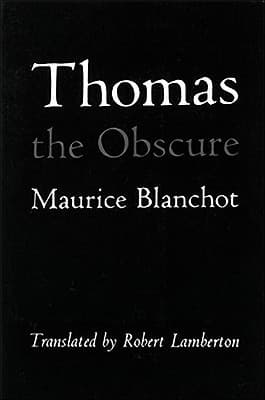
Genre
Literary Fiction / Philosophy
Reading Time
180 min
Key Themes
See below
Sign in to track this book
Thomas struggles with the elusive nature of being, searching for presence in absence and mystery in clarity, transforming the novel itself.
Thomas arrives at a desolate seaside town, a place that seems to lack distinct features or inhabitants beyond his immediate sight. He settles into a room overlooking the sea. Almost at once, he feels an intense, consuming gaze that seems to come from within him yet also from the external world. This gaze is not just visual; it is an internal experience that dissolves his sense of self and the boundaries between him and his surroundings. He struggles to define what he sees or who sees through him, experiencing a deep sense of dissolution and an inability to grasp solid reality. The sea itself mirrors this boundless, formless perception.
Thomas meets Anne, a woman whose presence is as mysterious as his own. She appears and disappears, her reality constantly shifting. Their interactions lack conventional communication, existing more as a shared space of being and non-being. Anne often seems to be fading, her form dissolving into the air. Thomas tries to grasp her, to define her existence, but she remains elusive, a figure who embodies the fluidity and impermanence he himself experiences. Her presence deepens his exploration of the limits of perception and the nature of otherness.
Thomas finds himself in a vast, silent library, a space filled with countless books. However, these books cannot be read in any usual way. Their pages are blank, or their words are incomprehensible, dissolving into meaningless symbols as he tries to focus on them. This library becomes a metaphor for his own internal state and the nature of language itself — a place of potential meaning that remains always out of reach. He feels deep frustration and a sense of being on the edge of understanding, yet always prevented from crossing it. 'Reading' in this space means confronting absence and the limits of knowledge.
Thomas goes into a dense, dark forest. Here, the individual trees, leaves, and sounds merge into an undifferentiated, overwhelming mass. The forest is not a collection of separate things but a single, breathing entity that threatens to absorb him. His senses are overwhelmed, yet he perceives nothing specific; instead, he experiences the raw, immediate presence of nature as an immense, indifferent force. This experience further erodes his sense of individual identity, blurring the lines between observer and observed. The walk is less a journey and more an immersion into a primal, pre-linguistic state of being where distinctions collapse.
Thomas meets a blind woman, whose presence highlights the complexities of perception. Her blindness seems to give her a different, perhaps deeper, form of insight or connection to the world. She perceives not through sight, but through an internal, tactile, or intuitive understanding. This encounter challenges Thomas's reliance on visual perception and makes him consider ways of understanding that go beyond the visible. He feels drawn to her, yet also alienated by her unique way of being, which seems to exist outside his own struggles with the gaze and the visible world. Her presence comments silently on the limits of conventional seeing.
Thomas stands before a mirror, but what he sees is not a stable image of himself. His reflection is distorted, fragmented, or even absent, showing the instability of his own identity. The mirror does not offer a coherent self; instead, it reflects the process of his dissolution. He feels a deep sense of unreality, as if his physical form is an illusion, constantly shifting and threatening to disappear. This confrontation with his reflection is a moment of intense self-alienation, where the boundary between self and non-self becomes porous, and the idea of a fixed, individual identity is thoroughly undermined, leaving him in a state of existential confusion.
Thomas experiences a night that seems unending, stretching beyond normal time. The darkness is not merely an absence of light but an active, consuming force that permeates everything. Within this prolonged night, the distinction between waking and dreaming, reality and illusion, blurs completely. Time itself loses its linear progression, becoming a stagnant, oppressive present. This 'night' is an internal state as much as an external one, reflecting his deep disorientation and the dissolution of conventional structures of experience. It is a period of heightened internal activity, yet one without tangible events or progress.
Throughout his time in the town, Thomas feels an almost irresistible pull towards the sea. The sea is not a calming presence but a vast, indifferent expanse that symbolizes ultimate dissolution and the void. He considers entering it, sensing in its depths a final surrender of form and identity. The sea represents the boundless, the formless, the origin and end of all things. His fascination with it is a fascination with his own potential non-existence, a desire to merge with the undifferentiated mass. This persistent draw signifies his deep engagement with the theme of absence and the allure of ceasing to be a distinct entity.
Thomas has a brief, confusing conversation with an unnamed stranger. The dialogue is fragmented, elliptical, and seems to revolve around deep, unanswerable questions about existence, perception, and the nature of reality. The stranger's words, like those in the library, offer no concrete answers or resolutions; instead, they deepen the sense of ambiguity and reinforce the idea that true understanding is always just out of reach. This interaction highlights the solitude of Thomas's experience, as even shared language fails to bridge the gap between individual consciousnesses or provide a solid ground for meaning. The stranger might even be an externalized aspect of Thomas's own internal monologue.
As the narrative progresses, Thomas's presence becomes increasingly indistinct and elusive. He retreats further into obscurity, not just as a character in a story, but as a being whose existence is defined by its lack of clear boundaries or fixed attributes. His actions become less purposeful, his thoughts more diffuse, his form more fluid. He seems to be merging with the undifferentiated background, embodying the 'obscure' nature suggested by his name. This final phase of the novel emphasizes the culmination of his journey into non-being, a state where the individual self dissolves into a pervasive, indeterminate presence.
The Protagonist
Thomas's arc is one of dissolution rather than development, moving from a discernible, albeit troubled, individual towards an increasingly indistinct and obscure presence, merging with the very questions he embodies.
The Supporting
Anne's 'arc' is not one of personal growth but rather a consistent manifestation of impermanence, serving as a constant reminder of the elusive nature of reality.
The Mentioned
The blind woman does not have an arc but functions as a static symbolic figure.
The Mentioned
The stranger has no discernible arc, serving as a momentary catalyst for philosophical reflection.
The novel explores the fluid and often indistinguishable boundary between existence and non-existence. Thomas's experiences, such as his dissolving reflection in the mirror or his merging with the forest, constantly challenge the idea of a stable, fixed being. The 'obscurity' of Thomas himself is not merely a psychological state but a condition of being, suggesting that being is inherently elusive and perhaps defined by its very absence. This theme is central to the novel's 'ontological narrative,' where the subject is the nature of being itself, often found in its negation.
“He entered into things, not by means of a grasp, but by a kind of surrender that left him empty.”
Thomas's journey includes a progressive erosion of his individual identity. His sense of self is constantly undermined by his perceptions, the elusive nature of others like Anne, and his inability to grasp a stable reality. The boundaries between his internal self and the external world become porous, leading to a deep sense of self-alienation. This dissolution is not presented as a tragic loss but as a fundamental condition of existence, a movement towards a more basic, undifferentiated state. His name, 'Thomas,' becomes less a marker of individuality and more a placeholder for a consciousness undergoing this process.
“He was no longer himself, but a fragment, a particle of the obscure.”
The novel consistently highlights that conventional perception and language are inadequate to grasp ultimate reality. Thomas's 'gaze' is an overwhelming, undifferentiated experience that goes beyond normal sight. The library filled with unreadable books and the fragmented conversations show how language, instead of clarifying, often obscures or fails to convey deep truths. Meaning is always delayed, and the act of looking or speaking often leads to greater ambiguity rather than understanding. This theme suggests that true apprehension lies beyond the structures we use to make sense of the world.
“Words, when he tried to seize them, dissolved into a meaningless murmur.”
Throughout the novel, there is a powerful, almost magnetic attraction to emptiness, absence, and the undifferentiated. The sea, in particular, represents this void, drawing Thomas towards a potential merging with its boundless, formless depths. This is not a morbid fascination with death in a literal sense, but an engagement with the philosophical 'nothingness' that underpins existence. The obscure is not merely dark but full of potential, a state of pre-form that promises liberation from the constraints of individual being. This allure suggests that true freedom might reside in the absence of form and definition.
“He felt the immense call of the void, a promise of ultimate peace in dissolution.”
A narrative style where the plot's primary subject is the nature of being itself.
Instead of focusing on external events or psychological development, 'Thomas the Obscure' uses an ontological narrative. The 'plot' is the unfolding of Thomas's internal experience of existence, non-existence, and the boundaries between them. The events described, such as the library or the sea, are not mere settings but manifestations of philosophical concepts. This device transforms the novel into a meditation on being, where the 'action' is primarily conceptual and experiential, pushing the boundaries of what a story can be about. It forces the reader to engage with abstract ideas through concrete, albeit surreal, descriptions.
An intense, all-consuming mode of perception that dissolves the subject-object distinction.
The 'gaze' is a central plot device, personified as a powerful, almost independent entity that consumes Thomas. It is not merely visual sight but a comprehensive mode of apprehension that blurs the lines between observer and observed, self and world. This gaze is both internal and external, overwhelming Thomas's sense of individual identity and making him a passive recipient of a boundless, undifferentiated reality. It functions to destabilize conventional perception and to immerse Thomas (and the reader) in a state of profound ambiguity and existential questioning.
Environments that function as extensions of Thomas's internal state and philosophical themes.
The various settings in the novel—the desolate seaside town, the silent library, the dense forest, the boundless sea—are not realistic backdrops but highly symbolic landscapes. Each environment mirrors and amplifies Thomas's internal struggles and the philosophical themes of the book. The library symbolizes the limits of language, the forest the undifferentiated mass of being, and the sea the allure of the void. These landscapes are less places to be acted upon and more states of being to be experienced, functioning as crucial elements in the novel's exploration of ontology and perception.
Characters whose presence is fleeting and whose nature remains ambiguous.
Characters like Anne and the blind woman are not fully fleshed-out individuals but rather elusive, almost spectral figures. Their ambiguity and impermanence serve to reinforce the novel's themes of absence, the instability of identity, and the limits of perception. They challenge Thomas's attempts to grasp and define reality, acting as catalysts for his internal explorations rather than as agents of external plot progression. Their very elusiveness is a key component of the narrative, highlighting the difficulty of making definitive statements about being and otherness.
“The night was a huge beast, and he was its prey.”
— Thomas's initial encounter with the profound darkness of the night.
“To see was to be, and to be was to be seen, but to see oneself was to cease to be.”
— Thomas's reflection on self-perception and the act of seeing.
“He was present at his own absence.”
— Describing Thomas's state of detachment and non-presence.
“The sea, which had no memory, no future, but only an eternal present.”
— Thomas observing the timeless nature of the sea.
“Language was a game played with absence, a game where the winner lost everything.”
— Thomas's thoughts on the limitations and paradoxes of language.
“The obscure was not the hidden, but that which, by its very nature, could not be revealed.”
— A central theme of the novel, defining the concept of 'the obscure'.
“He sought not to understand, but to be lost in the incomprehensible.”
— Thomas's approach to confronting the unknown.
“Each word was a tomb, burying the living meaning it sought to express.”
— Further reflection on the inadequacy of language.
“His solitude was not a choice, but a condition of being.”
— Describing Thomas's inherent isolation.
“The world was a book written in a language he almost understood, but never quite.”
— Thomas's perception of the world around him.
“He recognized in the nothingness a form of absolute presence.”
— Thomas's paradoxical experience of nothingness.
“Death was not an event, but a continuous possibility, always at the edge of life.”
— Thomas's contemplation of mortality.
“To write was to enter into the space of absence, where the author himself disappeared.”
— Blanchot's meta-commentary on the act of writing through Thomas.
“The light itself was obscure, not because it was dim, but because it revealed nothing.”
— Thomas's experience of a deceptive or meaningless light.
Ready to see how well you understood this book? Take our interactive quiz with 10 questions.

Biography coming soon.







