“When we meet on the battlefield, it will be a clash of titans. But here, in this quiet moment, we are just two people, sharing a secret.”
— Red and Blue exchange letters across time, acknowledging their rivalry and connection.

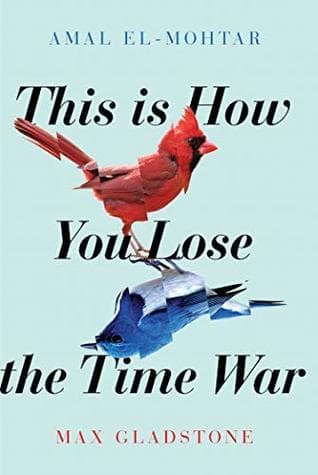
Amal El-Mohtar (2019)
Genre
Fantasy / Science Fiction / Romance
Reading Time
120 min
Key Themes
See below
Sign in to track this book
Two rival agents in a ceaseless 'Time War' exchange increasingly intimate letters across time, risking everything for a love that could alter the past and reshape the future.
On a war-torn battlefield, an agent named Blue, working for the cybernetically enhanced Garden, finds a letter left for her. The note, marked 'Burn before reading,' is from an agent of the opposing faction, the biologically engineered Agency, named Red. It is a taunt, a boast of Red's manipulation of a timeline Blue was trying to secure. This first exchange, a challenge across the vast, branching timelines of their perpetual Time War, starts an unexpected series of secret communications. Despite the danger and the rules of their sides, Blue is intrigued, and Red wants to engage, setting the stage for their unique and forbidden relationship.
After the first letter, Blue responds, and their elaborate game of hide-and-seek across time begins. They leave messages for each other in clever ways: carved into tree rings, embedded in geological layers, woven into tapestries, whispered into ancient winds, or encoded in the genetic material of an evolving species. Each letter shows their skill and deepens their connection, revealing glimpses of their personalities, missions, and the complex war they fight. Finding and leaving these letters becomes a ritual, a secret world they build together amidst the war's chaos.
As their correspondence continues, the letters go beyond taunts and strategic boasts. Blue, with her analytical and often poetic observations, and Red, with her passion and occasional vulnerability, begin to share details about their lives, missions, and the philosophies of their warring factions. Blue describes the Garden's pursuit of a 'perfect' timeline through technology, while Red explains the Agency's organic, evolving approach to history. They discuss the loneliness of their work, the toll of constant temporal manipulation, and the ethical questions of their war. These revelations create intimacy and understanding between them, bridging the ideological gap that separates their sides.
The letters become a universe for them, a sanctuary where Blue and Red can be vulnerable and authentic in ways they cannot be with their own factions. They share poetry, philosophical thoughts, and even everyday observations about the timelines they traverse. This shared space allows them to develop an emotional connection that goes against their conflict's nature. They begin to anticipate each other's thoughts, understand each other's humor, and even develop a unique language within their correspondence. The war, while still raging, starts to feel distant, a backdrop to the deeper connection they are forming.
As their bond deepens, the tone of their letters shifts from rivalry to affection, and then to something romantic. They acknowledge the impact they have had on each other, challenging their loyalty to their respective sides. The question of love, unspoken for a long time, finally comes up. They deal with the implications of their feelings, understanding that such a connection is forbidden and could be fatal if discovered by their superiors. This realization adds a new layer of tension and danger to their already precarious situation, forcing them to confront the choice between their duties and their hearts.
While their personal connection grows, the Time War itself continues. Both the Garden and the Agency push harder for victory. Blue and Red find themselves in dangerous situations, their missions intertwining in ways that make their secret correspondence even riskier. Pressure from their superiors mounts, and the possibility of their letters being intercepted or their connection being exposed becomes a real threat. They are constantly aware that a single mistake could lead to their demise, making every hidden message a gamble with their lives and the fate of their love.
Driven by their longing to truly meet, Red devises a daring and risky plan. She manipulates a timeline, creating an isolated pocket of time and space where they might physically meet without immediate detection. This act is a gamble, a direct defiance of all rules and a potential betrayal of her faction. Blue, upon deciphering Red's plan, understands the danger but also wants to finally bridge the physical gap. This moment is a turning point, as their abstract connection threatens to become tangible.
In a carefully constructed temporal anomaly, Blue and Red finally meet. The encounter is brief, intense, and emotional. They confirm the reality of their connection, the depth of their affection, and the physical presence they had only imagined. However, this meeting also shows the impossible nature of their love. The world they inhabit is one of constant conflict, where their existence as agents depends on the destruction of the other's side. The brief, stolen moment solidifies their bond but also highlights the reality that their love is a direct threat to the Time War and to their own lives.
Their secret correspondence and the true nature of their relationship are discovered by their superiors. Both the Commandant of the Garden and the Agency's leadership see their bond as treason, a catastrophic security breach that could destabilize the entire Time War. Blue and Red are given an ultimatum: eliminate the other, or face termination themselves. This revelation shatters their fragile world, forcing them to confront the brutal reality that their love has become a weapon, and they are now caught in a deadly trap.
Faced with an impossible choice, Blue and Red refuse to betray each other. Instead, they use their talents and knowledge of temporal mechanics to attempt an audacious, unprecedented feat: to forge an entirely new timeline, a 'third way' where they can exist together, free from the war and their factions. This involves complex manipulation of causality, a final, desperate act of creation and defiance against the systems that created them. Their plan shows their love and their shared desire for a future beyond the endless conflict, a future they must literally build themselves.
Through their combined efforts, using their unique skills and understanding of time, Blue and Red execute their plan. They sever their ties to their original timelines and factions, creating a new, stable reality where they can finally be together, unburdened by the war. This act of creation is their ultimate victory, not over each other, but over the war itself. They find themselves in a peaceful, garden-like setting, a world of their own making, where their love can flourish. The story ends with them living a life together, having transcended the conflict that once defined them, proving that love can win the Time War.
The Protagonist
Blue transforms from a disciplined agent of the Garden into a lover willing to defy her faction for a shared future with Red.
The Protagonist
Red evolves from a competitive, taunting agent into a devoted lover who risks everything to forge a life with Blue.
The Antagonist/Mentioned
Remains static, embodying the unchanging, opposing force to Blue and Red's evolving love.
The Antagonist/Mentioned
Remains static, acting as the institutional barrier to Red and Blue's relationship.
The Antagonist
The War persists and intensifies, but is ultimately transcended by Blue and Red's creation of a new timeline.
The Mentioned
Remains a static, mythical figure, a source of ancient wisdom.
The novel's main theme is how love between Blue and Red is not just an emotion, but an act of defiance against the destructive forces of war and an act of creation. Their correspondence, and eventually their shared timeline, represent a choice to build something new and nurturing in a universe based on conflict and erasure. Their love creates a new future, going beyond the opposition of their warring factions. This is clear in their final act of forging a unique timeline where they can exist together, a rejection of the war's destructive goal.
““I love you. I love you. I love you. I will burn the world to the ground to keep you.””
Blue and Red, initially defined by their roles as agents of opposing factions, undergo a journey of self-discovery through their correspondence. Their letters allow them to shed the strictures of their identities and explore deeper aspects of themselves – their vulnerabilities, their poetic inclinations, their longing for connection. Through the eyes of the other, they understand who they are beyond the war. Their evolving relationship challenges their loyalties and forces them to re-evaluate their purpose, leading them to forge new identities together outside the war.
““I find myself in your words, Blue. I find myself in your silence, too.””
The book explores time not as a linear progression but as a fluid, changeable entity, constantly being written and rewritten. The Time War is a battle over narrative – whose version of history will prevail. Blue and Red's letters are acts of storytelling, weaving their personal narrative into time. The novel suggests that narratives, whether personal or historical, are tools that can shape reality. By creating their own timeline, they don't just escape the war; they write their own story, asserting their control over the grand narrative of existence.
““Time is a story. We are all writing it, all the time.””
Despite being rivals in a vast, impersonal war, Blue and Red form a deep connection through written communication. Their letters become a lifeline, a shared secret world built amidst isolation and danger. Writing, hiding, and finding these messages is a ritual that binds them. The novel emphasizes the power of words to bridge distances and ideological divides, creating intimacy and understanding where none should exist. Their struggle shows the human need for connection, even under extreme circumstances, proving that communication can overcome barriers.
““I want to be able to tell you things that are not for burning.””
The Time War is an endless, self-perpetuating conflict that has lost its original meaning, becoming an existential state rather than a means to an end. Both factions are trapped in a cycle of destruction and temporal manipulation, constantly erasing and rewriting history without achieving victory. Blue and Red's relationship shows the futility of this cycle, as their connection offers a path to peace and creation that the war itself cannot provide. Their escape comments on the emptiness of perpetual conflict and the possibility of breaking free from destructive patterns.
““The war is not a place, but a state of being. An endless becoming.””
The primary storytelling method, composed of letters between the two protagonists.
The entire novel is structured as an epistolary narrative, consisting solely of the letters exchanged between Blue and Red. This device allows for an intimate, subjective exploration of their developing relationship, revealing their personalities, philosophies, and the nuances of the Time War through their own voices. The letters also serve as the central plot mechanism, driving the story forward as each message responds to and builds upon the last. The varying forms and hiding places of the letters themselves become part of the narrative's charm and complexity, illustrating the agents' ingenuity and the deepening of their bond.
Alternating viewpoints between Blue and Red, each contributing to the narrative.
The epistolary format inherently creates a dual perspective, with the narrative alternating between Blue's and Red's letters. This allows the reader to experience the Time War and their growing connection from two distinct ideological and personal viewpoints. Blue's Garden-influenced, more analytical voice contrasts with Red's Agency-influenced, more passionate and visceral prose. This dual perspective enriches the story by providing different interpretations of events, showcasing the evolving dynamic between them, and highlighting the unique ways they perceive their shared universe and each other.
The core mechanic of the Time War and the means by which agents operate.
Temporal manipulation and time travel are not just plot devices but the fundamental premise of the Time War. Both the Garden and the Agency constantly alter timelines, erasing and rewriting history to gain an advantage. This device creates a fluid, non-linear narrative where past, present, and future are constantly in flux. It also allows Blue and Red to leave messages for each other across vast stretches of time and in impossible locations, making their communication itself an act of temporal defiance. Ultimately, it is their mastery of temporal mechanics that enables their escape and the creation of their own timeline.
The physical form and hiding places of the letters are integral to the plot and character development.
Beyond their content, the letters themselves, as physical (or sometimes conceptual) artifacts, are a crucial plot device. They are hidden in incredibly imaginative ways—embedded in geological strata, carved into a tree's rings, woven into tapestries, or even genetically encoded. The creativity and effort required to hide and find these messages reflect the agents' skills and the increasing depth of their connection. The evolution of the letters' hiding places, from simple battleground notes to intricate temporal puzzles, mirrors the growing intimacy and risk of their relationship, making the medium as important as the message.
Symbolic representations of opposing ideologies and approaches to life/time.
The names of the two warring factions, the 'Garden' and the 'Agency,' function as powerful metaphors. The Garden represents order, control, technological precision, and a desire to cultivate an 'ideal' future, often at the expense of natural growth. The Agency, conversely, embodies organic evolution, wildness, adaptation, and a more chaotic, vital approach to time. These contrasting metaphors extend to the personalities of Blue and Red, who initially embody aspects of their factions but ultimately transcend them. Their union, creating a new, harmonious 'garden' of their own, symbolically resolves these opposing philosophies.
“When we meet on the battlefield, it will be a clash of titans. But here, in this quiet moment, we are just two people, sharing a secret.”
— Red and Blue exchange letters across time, acknowledging their rivalry and connection.
“I have built a thousand bridges, and I have burned a thousand more. But I have never built a bridge to you.”
— Blue reflects on her actions as an agent and her growing feelings for Red.
“The war is a lie. The future is a lie. But this? This is real.”
— Red writes to Blue, questioning their missions and affirming their bond.
“You are the only enemy I have ever feared, and the only friend I have ever loved.”
— Blue confesses the complexity of her relationship with Red.
“Time is a river, and we are the stones that break its flow.”
— Metaphor used to describe the agents' impact on history.
“I have seen the end of the world, and it is beautiful. But it is not as beautiful as you.”
— Red compares apocalyptic visions to her admiration for Blue.
“We are not soldiers. We are gardeners, tending to the weeds of history.”
— Reflection on their roles in shaping timelines, not just fighting.
“Every letter is a treason, and every word is a victory.”
— Describes the risk and reward of their clandestine correspondence.
“The future is not written. It is woven, thread by thread, and we are the weavers.”
— Philosophical musing on fate and free will in their war.
“I would burn a thousand worlds to keep you safe.”
— Red expresses extreme devotion to Blue, despite the cost.
“Our love is a secret history, written in the margins of time.”
— Metaphor for how their relationship exists outside official records.
“You are the anomaly I cannot predict, the variable that changes everything.”
— Blue acknowledges Red's unpredictable influence on her life.
“In the silence between heartbeats, I find you.”
— Poetic description of their deep, unspoken connection.
“We are not on opposite sides. We are the two halves of a whole, broken apart by war.”
— Red challenges the binary of their conflict, seeing unity.
Ready to see how well you understood this book? Take our interactive quiz with 10 questions.

Amal El-Mohtar is an award-winning author known for her evocative and genre-bending fiction. Alongside Max Gladstone, she co-authored the Hugo and Nebula Award-winning novel "This Is How You Lose the Time War," a science fiction romance celebrated for its intricate narrative and lyrical prose. Her work often explores themes of identity, memory, and the power of stories.







