“This book is not good for you. It's a waste of time. It will not improve your mind. It will not prepare you for a career. It will not help you get into a good college.”
— The very first lines of the book, setting a meta-narrative warning.

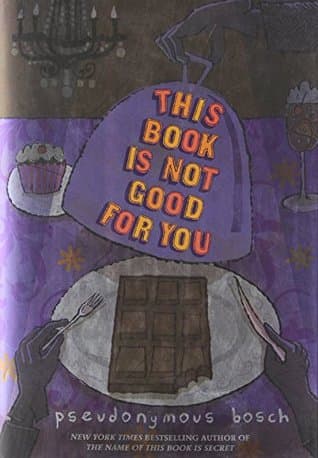
Pseudonymous Bosch (2009)
Genre
Fantasy / Children's / Mystery / Young Adult
Reading Time
525 min
Key Themes
See below
Sign in to track this book
When her mom is kidnapped by an evil chocolatier for a legendary tuning fork, Cass and her friend Max-Ernest must unravel the mystery of his delicious, yet dangerous, confections before it's too late.
The story begins with the narrator, Pseudonymous Bosch, introducing the book's dangers and appeal. We meet Cass, a survivalist-in-training who notices details, and Max-Ernest, a boy with two names, many allergies, and a love for trivia. Cass's mother, Gloria, a performance artist, is preparing for her chocolate-themed show when she disappears from their apartment. The only clue is a note on a chocolate wrapper, suggesting a kidnapping by Señor Hugo. Cass, using her observation skills, suspects foul play and starts investigating, with a reluctant Max-Ernest joining her.
Cass and Max-Ernest follow clues from Gloria's disappearance to a local museum. There, they meet Dr. L and Ms. Mauvais, who are very interested in a specific exhibit. The children find out Gloria had been researching ancient artifacts connected to a 'tuning fork' said to have mystical powers. They realize Señor Hugo's reason for the kidnapping might involve this artifact, not just the chocolate. The museum visit deepens the mystery, hinting at a larger, older conspiracy beyond Gloria's disappearance.
Following more clues, Cass and Max-Ernest track Señor Hugo to his chocolate factory. They sneak inside and observe the strange, almost hypnotic effect his chocolate has on people. While exploring, they discover an invitation to a 'Chocolate Ball' hosted by Señor Hugo. The invitation suggests a grand reveal and a special performance. They conclude that Gloria's kidnapping and Señor Hugo's interest in the tuning fork are linked to this event, and they must attend to find the truth and rescue Gloria.
Cass and Max-Ernest get into the Chocolate Ball, blending with guests who are all under the spell of Señor Hugo's confections. During the event, Señor Hugo reveals his plan: to use the legendary tuning fork to strengthen the 'secret ingredient' in his chocolate, making it addictive and giving him control over the world's taste buds. Gloria is brought out as a captive, forced to help with the ritual. The children understand the real danger of Señor Hugo's ambition and the tuning fork's power.
As Señor Hugo prepares to activate the tuning fork, Cass and Max-Ernest discover the 'secret ingredient' in his chocolate: it's not a flavor enhancer, but a substance that drains people's creative energy and life force, putting it into the chocolate and making it captivating. This explains his customers' devotion. They realize Gloria, as an artist, was targeted for her creative essence. This discovery shows Señor Hugo's true villainy and his chocolate empire's harmful nature.
During the Chocolate Ball's climax, Cass and Max-Ernest try to stop Señor Hugo's ritual. Using Cass's resourcefulness and Max-Ernest's knowledge, they create a diversion. This allows for a chaotic escape, during which Gloria, weakened but still defiant, tries to resist Señor Hugo. The tuning fork activates, but with interference, leading to unexpected effects and a struggle for control. The children's actions disrupt Señor Hugo's careful plan.
Just when things look bad, Dr. L and Ms. Mauvais, whom Cass and Max-Ernest met at the museum, reveal they are agents of the Terces Society, a secret group protecting ancient artifacts and knowledge. They intervene, confronting Señor Hugo and his henchmen. Their arrival changes the power balance, confirming the children were not alone and that a larger, hidden world of secret societies exists, adding to the mystery.
A battle starts between the Terces Society agents and Señor Hugo's forces, with the tuning fork as the prize. Cass and Max-Ernest, with Gloria, are caught in the middle, using their wits to survive and help the Terces Society. The tuning fork's power creates strange effects, amplifying sounds and causing chaos. The fight is intense, showing the characters' abilities and the danger of the artifact in the wrong hands. The children see the consequences of the secret world they've entered.
With the Terces Society's help, Cass's quick thinking, and Max-Ernest's unexpected contributions, Señor Hugo is defeated. The tuning fork is safe, and Gloria is rescued. The chocolate factory is shut down, and its secret ingredient is revealed. The immediate threat is over, but the experience affects Cass and Max-Ernest. They have not only saved Gloria but have also seen a hidden world of ancient secrets and ongoing battles, suggesting future adventures and their own destinies.
After Señor Hugo's defeat, the Terces Society invites Cass and Max-Ernest to join them, recognizing their courage and unique abilities. They learn the tuning fork is one of many ancient secrets the Society protects, and that the world is more mysterious than they imagined. While Gloria recovers, the children consider their new knowledge and their possible roles in this secret world. The narrator ends by saying that while one mystery is solved, many more await, and the children's journey has just begun.
The Protagonist
Cass evolves from a solo investigator focused on her family to a member of a secret society, realizing her skills are vital to a larger cause.
The Protagonist
Max-Ernest learns to overcome some of his fears and use his intellectual strengths in real-world dangerous situations, embracing his unique identity.
The Antagonist
Señor Hugo remains a static villain, driven by his insatiable desire for power and control, ultimately defeated but not changed.
The Supporting
Gloria is rescued but remains largely unchanged, serving as a symbol of the creative energy the villains seek to exploit.
The Supporting
Dr. L transitions from an enigmatic observer to an active ally and recruiter for the Terces Society, guiding the protagonists into a new world.
The Supporting
Ms. Mauvais reveals her true nature as a capable agent, helping to guide Cass and Max-Ernest into the world of the Terces Society.
The Narrator
The narrator's 'arc' is more about maintaining his mysterious persona while subtly guiding the reader through the story's themes.
The Mentioned
This character's 'arc' is to remain an enigmatic, looming threat for future books.
The novel explores the two sides of secrets: their appeal and their risks. The narrator often warns the reader against learning the story's mysteries, but also makes them irresistible. The 'secret ingredient' in Señor Hugo's chocolate is the best example of this theme – it's delicious and tempting, but its true nature is dark and dangerous. Cass and Max-Ernest's journey is driven by their desire to uncover secrets, which leads them into danger but also to better understanding.
“A secret, once told, is no longer a secret. It becomes a truth, or a lie, or something in between. But whatever it is, it is no longer yours.”
A main conflict is the use of creative energy. Señor Hugo wants to drain people's creativity and life force to improve his chocolate and control their wills. Gloria, as an artist, is a main target. The children, especially Cass with her observation skills and Max-Ernest with his unique way of thinking, represent the free, individual power of creativity and intellect, which resists and defeats Señor Hugo's control. The book supports freedom of thought and creation against manipulation.
“True creativity comes from within, not from a recipe. And it certainly cannot be stolen.”
The book uses chocolate as a symbol for addiction and the tempting nature of unhealthy desires. Señor Hugo's chocolate is described as the best in the world, yet it is 'not good for you' because it takes away the consumer's vitality. This shows how intensely pleasurable things can be harmful, and how easily people can be manipulated by their cravings. The story warns against giving in to superficial pleasures without understanding their true cost, connecting to the broader theme of telling truth from appealing deceptions.
“The most delicious things are never good for you. This story is particularly scrumptious.”
Cass and Max-Ernest both deal with their identities. Cass is a survivalist in an ordinary world, often feeling out of place, while Max-Ernest struggles with his two names, many allergies, and tendency to ramble, which makes him feel different. Their adventure forces them to use their unique qualities – Cass's practical nature and Max-Ernest's knowledge – as strengths. Through their partnership, they learn to accept who they are and realize their quirks make them able to solve the mystery and face danger.
“It's not about being normal. It's about being yourself, no matter how many names you have or how many things you're allergic to.”
A narrator who constantly warns the reader and interjects with personal commentary.
Pseudonymous Bosch, the narrator, frequently breaks the fourth wall to warn the reader about the dangers of the story and the secrets within. This device creates a meta-fictional layer, making the reader an active participant in the story's themes of secrets and forbidden knowledge. It also builds suspense and provides humorous commentary, simultaneously drawing the reader in while pretending to push them away. This narrative style reinforces the book's central message that 'this book is not good for you' but is irresistibly tempting.
A legendary artifact with mystical properties, central to the plot.
The legendary tuning fork serves as the primary MacGuffin of the story. Its existence and mystical properties (the ability to amplify certain energies) are what Señor Hugo seeks to exploit and what the Terces Society aims to protect. While its specific powers are crucial to the plot, its true significance lies in being the object that drives the characters' actions and brings them into conflict. It's the catalyst for Gloria's kidnapping and the grand confrontation, propelling the narrative forward.
A clandestine organization dedicated to protecting ancient knowledge.
The Terces Society is a secret organization that operates behind the scenes, protecting ancient artifacts and knowledge from falling into the wrong hands. Its existence introduces a larger, hidden world beyond the immediate conflict, suggesting a long-standing battle between good and evil. The Society's agents, Dr. L and Ms. Mauvais, provide crucial intervention and mentorship, eventually recruiting Cass and Max-Ernest. This device expands the scope of the narrative, setting the stage for future adventures and a deeper exploration of the book's mythology.
Subtle hints and misleading clues that build suspense and mystery.
The book employs extensive foreshadowing, often through the narrator's cryptic warnings or subtle details noticed by Cass, hinting at the true nature of Señor Hugo's chocolate and the tuning fork. Simultaneously, it uses red herrings, such as initial suggestions that the kidnapping is purely about chocolate, to misdirect the reader and the characters. This interplay keeps the reader engaged in solving the mystery alongside the protagonists, while also reinforcing the theme that appearances can be deceiving and secrets are complex.
“This book is not good for you. It's a waste of time. It will not improve your mind. It will not prepare you for a career. It will not help you get into a good college.”
— The very first lines of the book, setting a meta-narrative warning.
“If you are reading this, you have probably ignored my warning. This is not surprising. Most people do. And that, dear reader, is precisely the problem.”
— Following the initial warning, addressing the reader's defiance.
“Life is not a story. It’s a mess. And the sooner you realize that, the sooner you can start cleaning it up.”
— A philosophical musing on the nature of life versus narrative.
“The secret to a good story is not to tell the truth, but to tell a believable lie.”
— The narrator's insight into storytelling and deception.
“Sometimes, the most dangerous thing you can do is nothing at all.”
— A realization about the consequences of inaction in a perilous situation.
“There are some things that cannot be explained, only experienced. And those are often the best things.”
— Reflecting on the mystical and unexplainable elements of the world.
“The world is full of secrets, and most of them are hidden in plain sight.”
— A recurring theme about hidden truths and observation.
“Never trust a book that tells you it's not good for you. It's probably trying to trick you into reading it.”
— A meta-joke about the book's own premise and the narrator's trustworthiness.
“The greatest adventures are rarely planned. They just happen, usually when you least expect them.”
— A comment on the spontaneous nature of adventure and discovery.
“Curiosity is a powerful force. It can lead you to great discoveries, or to great danger. Sometimes both.”
— Exploring the double-edged sword of curiosity.
“Even the most ordinary objects can hold extraordinary secrets, if you know where to look.”
— Encouraging a deeper look at the world around us.
“The truth is rarely simple, and often inconvenient.”
— A pragmatic view on the nature of truth.
“A story is a way of understanding the world, even if the world itself doesn't make much sense.”
— The narrator's perspective on the purpose and power of stories.
“Sometimes, the best way to find what you're looking for is to stop looking for it.”
— A paradoxical piece of advice about searching and discovery.
Ready to see how well you understood this book? Take our interactive quiz with 10 questions.







