“Fat man. You killed her. She was my daughter. Now you are thin.”
— The Romany elder, Taduz Lemke, curses Billy Halleck after the hit-and-run.

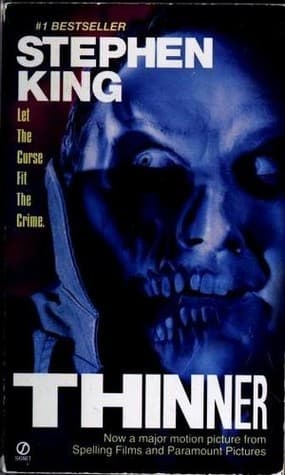
Richard Bachman (1984)
Genre
Thriller / Fantasy / Mystery
Reading Time
6 hours 24 minutes
Key Themes
See below
Sign in to track this book
After a Romani elder's curse causes a morbidly obese lawyer to waste away following a hit-and-run, he must desperately fight a supernatural affliction that promises a slow, agonizing death.
Billy Halleck, an obese and successful lawyer in Fairview, Connecticut, drives home with his wife, Heidi, after a dinner party. Distracted by Heidi, Billy runs over and kills an elderly Romani woman named Suzanne Lempke, who was crossing the street. Because of his connections, local police chief Duncan Hopley and Judge Cary Rossington ensure Billy is acquitted. As Billy leaves the courthouse, Suzanne's ancient father, Taduz Lemke, approaches him, touching his cheek and whispering, 'Thinner.' This cryptic utterance starts Billy's terrifying ordeal, as he immediately begins to lose weight at an alarming and uncontrollable rate.
Initially, Billy is thrilled by his rapid weight loss, thinking it is due to a new diet and exercise. However, as the pounds continue to melt away unnaturally—sometimes several pounds a day—he becomes increasingly alarmed. Doctors are baffled, finding no medical explanation for his condition. His wife, Heidi, and daughter, Linda, grow worried, while Billy's own health worsens, leaving him weak and gaunt. He begins to suspect that Taduz Lemke's whispered word was not a coincidence but a curse, remembering the Romani family's presence at the courthouse and their ominous stares.
Desperate, Billy seeks out the Romani encampment. He finds Taduz Lemke, who is now surrounded by his family. Lemke, a wizened old man, confirms that Billy is cursed with the 'white man's burden,' a slow, agonizing death by wasting away, as revenge for Suzanne's death and Billy's legal freedom. Lemke reveals that he also cursed Judge Rossington with 'Lizard' (scales) and Chief Hopley with 'Leper' (skin lesions), showing Billy is not the only victim. Billy pleads for the curse to be lifted, but Lemke is unmoved, explaining that the curse is a form of justice.
Billy visits Judge Rossington, who is now covered in grotesque, scaly growths, his skin flaking off and his body contorting in pain. Rossington, driven mad by his affliction, eventually commits suicide. Billy then visits Chief Hopley, who suffers from a horrifying skin disease, his face and body covered in festering sores. Hopley too is quickly deteriorating, a living corpse. Witnessing the gruesome fates of the other men confirms Billy's belief in the curse's power and intensifies his fear. He realizes his own condition is just as deadly, a slow, torturous descent into nothingness.
With his body now alarmingly thin, Billy remembers Richard Ginelli, a ruthless mobster and former client whom Billy once helped escape a murder charge. Desperate and seeing no other option, Billy contacts Ginelli and explains his unbelievable predicament, including the Romani curse. Ginelli, intrigued by the supernatural aspect and indebted to Billy, agrees to help. He promises to use his brutal methods to force Taduz Lemke into lifting the curse, vowing to make the Romani suffer until they give in. This alliance marks a dark turn for Billy, as he takes a morally wrong path to save his own life.
Ginelli begins his campaign against the Romani. He starts by destroying their vehicles, then kills their dogs, and eventually shoots and injures one of the Romani men. Each act is carefully planned to inflict maximum psychological pressure and fear, without directly killing Taduz Lemke or his immediate family. Ginelli's methods are brutal and effective, causing panic and disarray within the Romani community. He reports back to Billy, who, despite his disgust at Ginelli's tactics, feels a glimmer of hope that the mobster's ruthlessness might finally break Lemke's resolve and force him to lift the curse.
Ginelli's relentless attacks finally force Taduz Lemke to yield. He contacts Billy and offers a solution: a strawberry pie, baked with a drop of Billy's blood and infused with the curse. The person who eats the pie will take on the curse, lifting it from Billy. Lemke warns Billy that if he does not eat the pie himself, he must ensure someone else does, and that the curse will be transferred to the first person to take a bite. Billy, now a skeletal figure, is both relieved and horrified by this proposition, understanding the terrible moral dilemma he now faces.
Billy takes the pie home, intending to give it to his wife, Heidi, whom he blames for the initial accident due to her distraction. He carefully places the pie in the refrigerator, planning to offer it to her during their anniversary celebration. His internal struggle is immense, torn between the desire to save himself and the horrific act of knowingly condemning another. He justifies his decision by focusing on Heidi's culpability and his own suffering, convincing himself that she deserves to bear the burden of the curse for her part in the accident and for her lack of support during his ordeal.
During their anniversary dinner, Billy presents the strawberry pie. Heidi, unaware of its true nature, enthusiastically takes the first slice and eats it. Almost immediately, Billy feels the curse lift from him; his weight loss stops, and he feels a surge of strength and hunger. However, his relief is short-lived. He watches in horror as Heidi's eyes glaze over, and she begins to rapidly waste away, the curse now transferred to her. The scene is a chilling reversal of his own suffering, confirming the brutal effectiveness of Lemke's magic and the devastating price of his survival.
The next morning, Billy finds Heidi's emaciated corpse. His daughter, Linda, wakes up and, seeing the leftover pie, takes a bite before Billy can stop her. The curse transfers again, and Linda immediately begins to waste away. Billy is consumed by grief and despair, realizing the horrific extent of his actions. He has sacrificed his wife and now his daughter to save himself. The curse, once a personal torment, has now become a family tragedy, a clear example of the Romani's unyielding justice and Billy's own moral failure. He is left alone, healthy but utterly broken.
Devastated and with nothing left to lose, Billy takes a piece of the pie for himself. He sits alone, watching his daughter suffer the curse, and then, in a final act of despair or perhaps a twisted form of atonement, he eats a piece of the pie. The curse transfers back to him, as he intended. He is now once again on the path of rapid, uncontrollable weight loss, but this time, he is utterly alone, stripped of his family and any semblance of his former life. The cycle of the curse has come full circle, leaving Billy to face his original fate, but with an even greater burden of guilt and loss.
The Protagonist
Billy transforms from a privileged, morally ambivalent man into a desperate, ruthless survivor who ultimately sacrifices his family, only to end up cursed again, alone and broken.
The Antagonist
Lemke remains steadfast in his commitment to Romani justice, ultimately offering a way to transfer the curse but never truly relenting on the principle of retribution.
The Supporting
Ginelli remains consistently ruthless and effective in his methods, acting as a catalyst for Billy's desperate actions.
The Supporting
Heidi starts as a somewhat superficial wife, becomes increasingly worried about Billy, and ultimately suffers a horrific, undeserved death as the first recipient of the transferred curse.
The Supporting
Linda remains an innocent character throughout, only to tragically become a victim of the curse due to her father's actions.
The Supporting
Hopley quickly deteriorates from a corrupt official into a grotesque, dying man, serving as a warning to Billy.
The Supporting
Rossington quickly deteriorates from a corrupt official into a maddened, suicidal figure, illustrating the curse's power.
The Mentioned
Her death is the inciting incident, driving the entire narrative of revenge and consequence.
The novel clearly contrasts the formal legal system with an older, more primal form of justice. Billy Halleck, a lawyer, uses his connections to manipulate the law and escape punishment for killing Suzanne Lempke. However, Taduz Lemke's Romani curse bypasses legal loopholes, delivering a brutal, undeniable form of retribution. The fates of Billy, Hopley, and Rossington show that while the law can be bent, true justice, in Lemke's eyes, cannot be avoided. The story questions how effective and moral a legal system is when it favors the powerful over the innocent.
“''Thinner,' Lemke said. His voice was a dry rustle. 'Yes. Thinner.'”
A main theme is that actions have consequences, especially moral wrongs. Billy's hit-and-run and his later escape from legal accountability lead directly to the curse. The suffering of Billy, Hopley, and Rossington are direct punishments for their involvement. Even when Billy tries to transfer the curse, the consequences multiply, engulfing his innocent family. The story emphasizes that avoiding responsibility through legal maneuvering does not erase the moral debt, which is ultimately collected through supernatural means.
“'You killed my daughter, fat man. And you got away with it. This is justice.'”
The novel explores how morally corrupt a person can become when driven by extreme self-preservation. Billy Halleck, initially a somewhat complacent but not openly evil man, steadily loses his morality as his body wastes away. His willingness to hire a mobster to terrorize an innocent community, and eventually to sacrifice his own wife and daughter to save himself, shows a complete abandonment of ethical principles. His journey highlights how fear and desperation can corrupt even seemingly ordinary individuals, turning them into monsters to survive.
“'He had killed Heidi. He had killed Linda. He had killed them both. And he was still alive. He was still himself.'”
Billy Halleck's initial privilege and social standing allow him to avoid justice. His wealth, connections, and status as a lawyer enable him to manipulate the legal system, with the help of equally privileged figures like Police Chief Hopley and Judge Rossington. This theme highlights how privilege can create a sense of immunity, leading individuals to believe they are above the consequences of their actions. The Romani curse acts as a leveling force, stripping away Billy's privilege and forcing him to confront a form of justice that cannot be bought or influenced, showing how fragile such societal advantages are.
“He had gotten away with murder. The thought was a cold, hard knot in his stomach. But he had gotten away.”
The supernatural elements in 'Thinner' are not just for horror; they are a cosmic force to restore balance when human systems fail. The Romani curse is a powerful, ancient magic that steps in where modern law is corrupt or insufficient. It acts as an equalizer, ensuring that justice is served, even if brutally, when the powerful avoid accountability. The curse's relentless nature and its ability to transfer suggest a deep, unforgiving logic that goes beyond human understanding, highlighting a world where unseen forces actively maintain a moral order.
“'The gypsy's curse,' Ginelli said. 'It's real. You're living proof.'”
A supernatural affliction causing rapid, uncontrollable weight loss or other physical deterioration.
The Romani curse is the central plot device, initiated by Taduz Lemke as retribution for his daughter's death. It manifests differently for each of its targets: Billy receives 'Thinner' (rapid weight loss), Rossington 'Lizard' (scaly skin), and Hopley 'Leper' (skin lesions). Its power is absolute and irreversible by conventional means, driving the entire narrative. The curse not only serves as a horror element but also as a symbolic representation of inescapable justice, forcing the characters to confront the consequences of their actions in a visceral, terrifying way. Its transferability through the pie adds a layer of moral horror.
A strawberry pie used to transfer the Romani curse from one person to another.
The cursed pie is a pivotal plot device, introduced by Taduz Lemke as the only means to transfer Billy's 'Thinner' curse. Baked with a drop of Billy's blood, it embodies the horrifying moral dilemma at the story's climax. The pie represents the ultimate test of Billy's humanity, forcing him to choose between his own life and the lives of others. Its innocuous appearance belies its deadly power, making its consumption by Heidi and Linda all the more tragic and emphasizing the insidious nature of the curse and Billy's desperation.
The visible and accelerating decline of the cursed characters' bodies.
This device is the primary manifestation of the curse, creating intense body horror and urgency. Billy's rapid weight loss, Rossington's lizard-like scales, and Hopley's leprosy-like sores are all described in gruesome detail, serving to externalize the internal corruption of the characters. This physical deterioration is relentless and medically inexplicable, constantly reminding the characters and reader of the curse's power and the ticking clock. It forces Billy to confront his mortality and drives his increasingly desperate actions, making the horror tangible and visceral.
The protagonist's escalating willingness to abandon ethical principles to survive.
Moral compromise is a crucial plot device that shapes Billy Halleck's character arc. From initially using his connections to avoid legal consequences, he progresses to hiring a brutal mobster to terrorize an innocent community, and finally, to knowingly sacrificing his wife and daughter. Each step down this path is a direct consequence of the curse's pressure, highlighting how extreme circumstances can erode one's moral compass. This device is not just a character trait but a driving force, pushing the narrative towards its tragic and morally devastating conclusion.
“Fat man. You killed her. She was my daughter. Now you are thin.”
— The Romany elder, Taduz Lemke, curses Billy Halleck after the hit-and-run.
“Thinner.”
— The single word Taduz Lemke whispers to Billy, initiating the curse.
“It was like watching a ghost move through a world of solids.”
— Billy observes himself in the mirror as he rapidly loses weight, feeling insubstantial.
“The weight was falling off him like leaves in an autumn storm.”
— A vivid description of Billy's accelerated weight loss.
“He understood what it meant to be an outsider, to be looked at askance, to be feared.”
— Billy's perspective shifts as his appearance becomes gaunt and frightening.
“There are things you can't buy back. Like time. Like health. Like a little girl's life.”
— Billy reflects on the irreversible consequences of his actions and the curse.
“You can't pay for what you did, white man. But you can pay for what you are.”
— Taduz Lemke explains the nature of the curse and its target.
“He was a walking skeleton, a cadaver in expensive clothes.”
— A stark description of Billy's emaciated appearance late in the story.
“Sometimes you have to do bad things to bad people.”
— Billy's internal justification for his increasingly desperate and violent actions.
“He had traded one kind of prison for another.”
— Billy realizes that escaping the legal system only led him into the curse's grip.
“The world was full of small, sharp pains that had nothing to do with knives.”
— Billy experiences the constant physical discomfort and weakness from his extreme weight loss.
“What do you say, fat man? You like pie?”
— Taduz Lemke offers Billy a poisoned pie, a twisted form of 'mercy' or final judgment.
“It was the ultimate diet, and it was killing him.”
— A grim summary of the curse's effect on Billy.
“He had been judged, and found wanting. And now, he was being consumed.”
— Billy's realization of his inescapable fate under the curse.
Ready to see how well you understood this book? Take our interactive quiz with 10 questions.

Biography coming soon.







