“I was invisible. Not just invisible like you can't see me in the dark, but really invisible.”
— Bobby describing his initial realization of his invisibility.

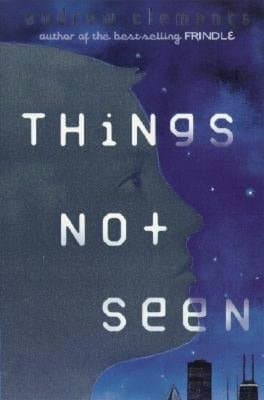
Andrew Clements (2002)
Genre
Fantasy / Children's / Mystery / Science Fiction / Young Adult
Reading Time
250 min
Key Themes
See below
Sign in to track this book
A 15-year-old boy becomes invisible and finds a friend in a blind girl. He must find a way to become visible again before his family faces serious trouble.
Fifteen-year-old Bobby Phillips wakes up feeling cold one winter morning. He sees no reflection in the bathroom mirror. Panicked, he realizes he is invisible, seeing through his hands. He tells his parents, Mr. and Mrs. Phillips, who are shocked. His physicist father starts thinking about the cause, while his mother deals with the emotional impact and the need to keep Bobby's condition secret from school and neighbors.
Bobby's invisibility makes him completely isolated. His parents pull him from school, saying he is very sick. He stays home, listening to the radio, watching TV, and trying to understand his new life. He learns to move around the house unseen. His parents create routines to feed him and pretend he is still there. The secrecy and losing his normal life make Bobby feel like a ghost, wanting any kind of connection.
Lonely and needing fresh air, Bobby starts taking walks at night, dressed in layers. One evening, he hears music from a house and goes toward it. He meets Alicia Van Dorn, a blind girl his age, on her porch. He hesitates but then talks to her, realizing she cannot see him. Alicia is friendly, and Bobby tells her about his invisibility. Her blindness lets them connect without his invisibility being a barrier, giving him his first real human connection since his change.
Mr. Phillips, a physicist, researches Bobby's condition. He thinks it might be from a problem with the electromagnetic spectrum or some quantum event. He spends hours in his home lab, doing experiments and reading scientific books. Meanwhile, Bobby's long absence from school starts to draw attention. School officials, including the truant officer, ask questions. This puts pressure on Mr. and Mrs. Phillips to explain more, stressing them and increasing the risk of Bobby's secret being revealed.
Bobby, with Alicia's help, visits the public library. His invisibility lets him find information privately. Alicia guides him, and they search for similar cases. Bobby finds an old newspaper article from 1903 about a woman who became invisible after a rare atmospheric event. The article mentions Dr. Sarah Yu, a scientist who studied the case and later disappeared. This clue suggests Bobby's condition might not be unique and could have happened before.
Excited by the lead, Bobby and Alicia research Dr. Sarah Yu. They think if Yu studied the 1903 case, she might have understood or even cured invisibility. They find an old address for Dr. Yu. With Alicia navigating, Bobby goes to the location. They find an abandoned, run-down house filled with scientific equipment and old notes. The house looks untouched, suggesting Dr. Yu might have also become invisible or simply vanished, leaving clues.
While exploring Dr. Yu's house, Bobby finds a small, invisible cat. The cat shows that invisibility is not just for humans and confirms the scientific nature of his condition. Bobby also notices that when he feels very cold, his invisibility gets stronger, and he feels a tingling. This observation, with the cat's similar traits and Dr. Yu's notes, suggests a link between extreme cold and invisibility, a key part of finding a cure.
Bobby tells his father about his cold theory. Mr. Phillips is skeptical at first but agrees to test it. He sets up a makeshift cold chamber using an old refrigerator. Bobby, despite his fears, goes inside. As the temperature drops, Bobby feels the tingling more strongly. His father sees small changes, and Bobby thinks he sees a faint outline of himself. The experiment, though not a full success, supports the cold theory and gives them a clear direction for more research, offering some hope.
Returning to Dr. Yu's house, Bobby and Alicia find more hidden papers. They learn that Dr. Yu was the invisible woman from the 1903 article. She had been living hidden for over a century, like Bobby. They realize she is still alive and has been watching them. Dr. Yu appears, an old but sharp woman. She learned to control her invisibility and has been subtly guiding Bobby and Alicia to her research, hoping they would finish her work and find a permanent solution.
Dr. Yu explains that the cure needs a specific mix of intense cold and a certain frequency of electromagnetic radiation, which she could not fully create. With Mr. Phillips's science skills and Dr. Yu's knowledge, they work to improve the process. The cure is complex and risky. Bobby must choose: stay invisible and live in hiding, or try the potentially dangerous procedure to become visible. The decision is hard, as it means losing the special connection with Alicia and the strange freedom his invisibility offered.
After thinking it over, Bobby decides to risk the full procedure. His parents, Dr. Yu, and Alicia are there, waiting nervously. Mr. Phillips carefully sets up the improved cold chamber and the electromagnetic field generator. Bobby goes inside. As the process starts, he feels intense cold, then warmth. For a moment, he sees a faint, shimmering outline of his body. The procedure is not an instant success, but it gives Bobby a clear glimpse of his former self, offering strong hope that with more work, he will become fully visible again and return to a normal life.
The Protagonist
Bobby transforms from an isolated, frightened boy into a brave, resourceful young man who learns to navigate his unique circumstances and forge meaningful connections.
The Supporting
He evolves from a purely scientific observer to a deeply invested father, leveraging his expertise to save his son while grappling with the unknown.
The Supporting
She learns to cope with an unimaginable situation, finding strength and resilience in protecting her son while maintaining a semblance of normalcy.
The Supporting
Alicia embraces an extraordinary friendship, proving that true connection transcends physical sight and brings profound meaning to both her and Bobby's lives.
The Supporting
After a century of solitary existence, Dr. Yu finds purpose and connection by helping Bobby, sharing her knowledge to potentially complete her life's work.
The Supporting
She remains a consistent external pressure, unknowingly pushing the Phillips family towards a resolution to Bobby's invisibility.
The Mentioned
Remains a background figure, representing the societal expectation for Bobby to be visible and present.
The novel explores how Bobby's invisibility affects his identity. He struggles with feeling 'not real' and questions who he is without a physical presence. His journey to accept his new state, and later, to want visibility again, shows how important self-perception is. His talks with Alicia, who cannot see him, help him build his inner sense of worth.
“"He was a missing person. But not just missing. He was gone, erased, a blank space where a boy used to be."”
A main theme is the strong bond Bobby forms with Alicia. Her blindness removes the barrier of his invisibility, letting them connect emotionally and intellectually. This relationship teaches Bobby that true friendship goes beyond physical looks and that real understanding can be found in unusual situations. Their bond gives Bobby important emotional support and a reason to hope.
“"He had found someone who could 'see' him, really see him, without using her eyes."”
The book contrasts scientific investigation with an unexplained, fantastical event. Mr. Phillips, the physicist, uses the scientific method to find a logical explanation and cure for Bobby's condition. The mystery of invisibility challenges his scientific view, pushing the limits of known physics. Finding Dr. Yu and her long research combines historical anomaly with modern science, showing how persistent investigation and open-mindedness can eventually explain the unknown.
“"His father, a physicist, was already working out equations in his head, trying to make sense of the impossible."”
Bobby's invisibility forces him into extreme isolation, cutting him off from school, friends, and the outside world. His family must live secretly, creating lies and routines to protect him. This theme examines the psychological effect of isolation on Bobby and the great pressure and fear his parents face. The need for secrecy creates suspense and shows the dangers of being 'different' in a world that expects conformity, making Bobby wish for the freedom of being seen.
“"It was a life of shadows, whispers, and never being able to be truly present."”
Allows readers to experience Bobby's internal thoughts and feelings directly.
The story is told from Bobby Phillips's perspective, immersing the reader in his unique experience of invisibility. This narrative choice effectively conveys his fear, loneliness, frustration, and eventual hope. It allows for a deep exploration of his internal monologue, making his struggles and triumphs profoundly personal and relatable, despite the fantastical premise. The reader 'sees' the world through his invisible eyes, enhancing the sense of mystery and isolation.
A crucial plot device that provides a historical precedent for Bobby's condition.
The discovery of the 1903 newspaper article about an invisible woman and Dr. Sarah Yu is a pivotal plot device. It transforms Bobby's unique predicament from an isolated incident into a historical mystery, giving him and Alicia a concrete lead to follow. This device introduces Dr. Yu, a key character, and provides the scientific and historical context necessary for understanding the cause and potential cure for invisibility, driving the plot forward and offering hope.
A narrative contrast that allows for genuine connection despite Bobby's invisibility.
Alicia's blindness serves as a brilliant counterpoint to Bobby's invisibility. Because she cannot see, Bobby's condition is irrelevant to their interaction, allowing for a pure, unburdened friendship. This device highlights the theme of inner connection over external appearance. It also provides a practical solution for Bobby to interact with the outside world (through her guidance) and pursue his research, making her not just a friend but a crucial enabler in his quest.
A recurring scientific element linking to the cause and potential cure of invisibility.
The recurring motif of cold, starting with Bobby's initial cold sensation, the invisible cat's preference for cold, and Dr. Yu's research, serves as a key scientific plot device. It provides a tangible, observable link to the phenomenon of invisibility, giving Mr. Phillips a direction for his experiments. The idea that extreme cold is both a trigger and part of the cure grounds the fantastical element in a quasi-scientific reality, making the resolution more plausible within the story's logic.
“I was invisible. Not just invisible like you can't see me in the dark, but really invisible.”
— Bobby describing his initial realization of his invisibility.
“It was just a normal Tuesday morning, and then it wasn't.”
— Bobby reflecting on the sudden change in his life.
“Being invisible isn't a superpower. It's just… inconvenient.”
— Bobby's pragmatic view on his condition.
“The hardest part wasn't not being seen. It was not being touched.”
— Bobby lamenting the lack of physical connection.
“Sometimes you have to look beyond what you can see to find the truth.”
— A thematic statement about understanding the unseen.
“My parents were still there. They just weren't… visible.”
— Bobby's initial confusion and fear regarding his parents' disappearance.
“It's like the world just decided I wasn't important enough to be there anymore.”
— Bobby's feelings of existential dread and insignificance.
“You can't just hide from your problems forever. Eventually, you have to face them.”
— A lesson Bobby learns about confronting his situation.
“Maybe being different isn't a curse. Maybe it's just… different.”
— Bobby starting to come to terms with his unique circumstances.
“The only way to figure out what happened was to keep trying, even when it seemed hopeless.”
— Bobby's determination to solve the mystery of his invisibility.
“What if seeing isn't believing? What if believing is seeing?”
— A philosophical question posed regarding perception and reality.
“You don't need eyes to feel someone's presence.”
— A profound statement about connection beyond physical sight.
“The world keeps moving, even when you feel like you've stopped.”
— Bobby observing the world continuing without him.
“Sometimes, the biggest adventures start with the smallest changes.”
— A reflection on the catalyst for Bobby's extraordinary journey.
Ready to see how well you understood this book? Take our interactive quiz with 10 questions.

Andrew Clements was a prolific author of children's literature, celebrated for his engaging and relatable stories. His notable works include the beloved "Frindle," "A Week in the Woods," and the "Jake Drake" series, which often explored themes of school, friendship, and growing up. Clements' accessible writing style and keen understanding of young readers earned him widespread critical acclaim and a dedicated fanbase.







