“The thing about hope, though, is that it's not a thing. It's an idea. And ideas are powerful.”
— A reflection on the nature of hope itself.

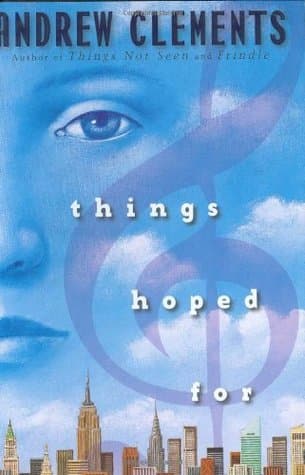
Andrew Clements (2006)
Genre
Fantasy / Children's / Mystery / Science Fiction / Young Adult
Reading Time
90 min
Key Themes
See below
Sign in to track this book
Gwen prepares for high-stakes music auditions, but her grandfather's sudden disappearance and a mysterious discovery with a fellow musician force her to confront a truth that changes her view of the future.
Seventeen-year-old Gwen is in New York City, staying with her grandfather, Mr. Eliot, a famous violinist. She is preparing for auditions at music schools like Juilliard. The day before her first audition, Gwen wakes to find her grandfather gone. He leaves a voicemail, telling her not to worry and to focus on her auditions. This message, however, makes Gwen more anxious. She tries calling him back, but his phone goes to voicemail. The apartment feels empty and quiet without him, adding to her worry and the pressure of her upcoming auditions.
Just as Gwen deals with her grandfather's disappearance, her great-uncle, Reverend Eliot, an imposing figure, arrives unannounced. He expects to see his brother and discuss family matters. Panicked, Gwen lies, saying her grandfather is out for a walk and will return later. This first lie forces her into more lies as Reverend Eliot insists on waiting. His presence adds stress, threatening to distract her from auditions and making her feel more alone and burdened by her grandfather's absence.
Seeking a break from her worries, Gwen goes to Central Park to practice her violin. There, she meets Robert, a boy her age also practicing his cello for auditions. They talk, finding they have similar goals and face the same pressure of classical music auditions. Robert is staying in a hotel with his musician mother. Their shared experiences and love for music create an instant connection, giving Gwen a needed sense of companionship and a distraction from her worries about her grandfather and great-uncle.
Gwen attends her first audition at Juilliard. She performs well despite her emotional state. Her mind, however, keeps going back to her grandfather. She wonders where he is, if he is safe, and how long she can keep up the act with her great-uncle. The audition process, usually a source of deep focus, is now shadowed by constant anxiety. Later, she meets Robert again, finding comfort in his company and their shared musical pursuits, but the mystery of her grandfather's location remains unsolved.
Reverend Eliot grows more impatient and suspicious of his brother's continued absence. He questions Gwen more aggressively, pressing her for details she does not have or cannot share. He starts hinting that something is wrong, making Gwen's attempts to cover for her grandfather harder and more stressful. His demands and imposing presence make Gwen feel trapped and alone, increasing her need to find out what happened to Mr. Eliot before her great-uncle discovers the truth and possibly harms her future.
Gwen and Robert spend time exploring New York City, finding moments of lightness amid their individual pressures. They visit landmarks and share their dreams and fears about their musical futures. During one outing, Gwen tells Robert about her grandfather's disappearance and the difficult situation with her great-uncle. Robert, in turn, shares his own quiet worries about his auditions. This shared openness deepens their friendship, and Robert offers Gwen his support, becoming her only confidant during this challenging time.
Back at her grandfather's apartment, driven by urgency, Gwen carefully searches for clues. She finds a hidden compartment in one of his old violin cases. Inside, she finds a small, folded note in her grandfather's handwriting. The note contains numbers and a fragmented, unusual phrase, suggesting something more complex than a simple walk. This discovery points her search in a new direction, hinting that her grandfather's disappearance is deliberate and perhaps linked to a secret.
Gwen shares the cryptic note with Robert, and they try to understand its meaning. The numbers and odd phrase seem to be a code. They brainstorm ideas, connecting it to her grandfather's past and his known quirks. Their combined efforts lead them to believe the numbers might correspond to specific pages or lines in a book, or perhaps a musical score. This shared intellectual challenge strengthens their bond, turning their friendship into a partnership focused on solving the mystery.
Following a hint from the decoded message, Gwen and Robert visit a specialized music library. There, they find an old, obscure book her grandfather often referenced. Within its pages, they find another clue: a hidden journal belonging to Mr. Eliot. This journal is not a typical diary. It is filled with scientific drawings, mathematical equations, and philosophical thoughts, revealing a side of her grandfather Gwen never knew. The journal suggests a secret project he had been working on for years, which seems to be the real reason for his disappearance.
As Gwen and Robert read the journal, they uncover the truth: her grandfather, Mr. Eliot, is not just a musician but also a brilliant, reclusive scientist. He has been secretly working on a project involving time manipulation or interdimensional travel. His disappearance is not an abduction or accident, but a deliberate journey into his own scientific creation. The journal entries detail his progress, hopes, and fears, showing he began this journey to explore the unknown, driven by curiosity and a desire to understand the universe.
With the truth known to Gwen and Robert, Reverend Eliot's patience breaks. He returns to the apartment, furious and demanding to know the truth about his brother. Gwen, with her new knowledge, is torn. She can no longer keep up the simple lie, but revealing the full, fantastical truth about a time-traveling grandfather seems impossible to explain to her strict, skeptical great-uncle. The confrontation is tense, and Reverend Eliot threatens to involve the authorities, making the situation critical.
As Gwen and Robert consider the meaning of her grandfather's scientific work, they notice something unusual in the journal entries. There are subtle references, almost prophecies, about two young musicians who would encounter his work. They realize her grandfather, through his scientific explorations, had foreseen their arrival and their role in understanding his legacy. This discovery connects them not just by shared experience and friendship, but by a deeper, almost fated link to Mr. Eliot's project and its potential impact on their lives.
With knowledge of her grandfather's journey, Gwen's view of her own life and goals changes. Her musical auditions, though still important, now seem part of a larger, more mysterious story. She and Robert, having shared this secret, decide to face the future together. They understand their lives are now tied to Mr. Eliot's scientific legacy. The book ends with them accepting this new reality, ready to explore what her grandfather's work means, suggesting a future of wonder and further discoveries beyond their musical aspirations.
The Protagonist
Gwen transforms from an anxious, focused musician into a brave, resourceful young woman who embraces the fantastical and unexpected, finding a deeper purpose beyond her initial aspirations.
The Supporting/Mysterious Figure
His arc is revealed posthumously (or post-disappearance), showing his hidden life as a scientific pioneer who embarks on a journey into the unknown, leaving a legacy that shapes Gwen's future.
The Supporting/Co-protagonist
Robert evolves from a supportive friend to an integral partner in an extraordinary discovery, finding his own unexpected connection to a fantastical reality.
The Antagonist/Obstacle
He remains largely static, representing the conventional, skeptical world that cannot comprehend the extraordinary events unfolding around Gwen.
The story shows how hope and ambition can change. Initially, Gwen's hope centers on her musical goals and getting into a top music school. Her ambition is clear. However, as her grandfather's mystery unfolds, her hopes grow to include understanding the unknown and embracing a fantastical reality. Her ambition expands to include discovery and connection beyond the usual. This is clear in how she still auditions, but her focus shifts from 'winning' to understanding the larger meaning of her grandfather's work, as seen in the final chapters where she and Robert decide to pursue the scientific legacy.
“And suddenly Gwen's hopes were turned upside down, and she and Robert were united in ways neither of them could have foretold.”
A central theme is that people, even those we know well, can have deep secrets and hidden lives. Gwen thinks she knows her grandfather as a famous musician, but she discovers he is also a brilliant, reclusive scientist. This theme appears through Mr. Eliot's secret scientific work, detailed in his hidden journal and revealed through clues. It suggests that reality is often more complex and mysterious than it seems, and that true understanding requires looking past surface appearances, as Gwen does when she searches his apartment for clues.
“He had a secret, a grand, impossible secret, and he had been working on it for years, right under her nose.”
The novel highlights how unexpected friendships can offer vital support and lead to remarkable discoveries. Gwen, initially isolated by stress and secrecy about her grandfather, finds an important ally in Robert. Their shared love for music forms their initial bond, but their work together to solve the mystery strengthens it into a deep, trusting partnership. Robert's calm nature and logical thinking complement Gwen's more anxious personality, helping them overcome challenges together. Their connection ultimately leads them to the truth about Mr. Eliot and a shared destiny, showing the impact of human connection when facing the unknown.
“They were two musicians, alone in the city, but together they were something more: a team, bound by a secret.”
The story subtly explores the perceived separation and eventual merging of artistic and scientific pursuits. Mr. Eliot is a master violinist, an artist, but also a brilliant scientist. This dual nature challenges the common idea that art and science are separate. His secret work shows that both fields require great creativity, discipline, and a desire to understand the unknown. Gwen, an artist, must use scientific logic to uncover her grandfather's truth, suggesting that both are paths to deep insight. The narrative implies that true genius can go beyond these traditional boundaries, finding harmony between the two.
“He saw music in the stars, and equations in a sonata. For him, there was no division.”
A central character's sudden, unexplained disappearance drives the entire plot.
Mr. Eliot's mysterious disappearance serves as the inciting incident, immediately establishing a central mystery and creating suspense. This device not only propels Gwen into action but also isolates her, forcing her to confront challenges independently. It also generates the initial conflict with Reverend Eliot, who demands answers Gwen doesn't have. The device is crucial because the 'whereabouts' of Mr. Eliot is the primary question that needs answering, leading to all subsequent discoveries and character developments.
A series of hidden messages and objects that guide the protagonist to the truth.
Gwen's discovery of the voicemail, followed by the hidden note with numbers and a phrase, and then the journal within a specific book, constitutes a classic scavenger hunt. This device creates a sense of progression and intellectual engagement, allowing Gwen and Robert to actively participate in solving the mystery. Each clue builds upon the last, gradually revealing the larger truth about Mr. Eliot's secret life and scientific endeavors, maintaining narrative momentum and suspense.
The protagonist's initial understanding of reality is incomplete or false.
Initially, Gwen (and thus the reader) believes her grandfather is simply a musician and that his disappearance is either accidental or a simple evasion. Her understanding of his life and motivations is based on limited information. As she uncovers more clues, her perception of reality shifts dramatically. This device creates a powerful reveal when Mr. Eliot's scientific life is exposed, challenging both Gwen's and the reader's preconceived notions and adding layers of complexity to the narrative.
A wise, guiding character who provides direction through their absence and legacy.
Although Mr. Eliot is physically absent for most of the story, he functions as a mentor figure through the clues and journal entries he leaves behind. His 'guidance' is posthumous or from a distance, but it directs Gwen's actions and understanding. His legacy, both musical and scientific, shapes Gwen's journey and ultimately influences her future choices, demonstrating how a mentor's impact can extend beyond their immediate presence, pushing the protagonist towards growth and discovery.
“The thing about hope, though, is that it's not a thing. It's an idea. And ideas are powerful.”
— A reflection on the nature of hope itself.
“Sometimes, the biggest mysteries aren't out there in the stars, but right here, in the hearts of people.”
— A character contemplating the source of true puzzles.
“You can't really lose something if you never truly had it to begin with, can you?”
— A poignant question about loss and possession.
“The future isn't something that just happens. It's something you make, with every choice you make today.”
— An encouraging thought about agency and the future.
“Even in the darkest places, a tiny spark of curiosity can light the way.”
— Highlighting the importance of curiosity in difficult situations.
“Knowing what you don't know is just as important as knowing what you do.”
— A wise observation about the limits of knowledge.
“Stories aren't just entertainment; they're maps. Maps to understanding ourselves and the world.”
— Emphasizing the deeper purpose of storytelling.
“Fear can be a useful warning, but it should never be the only voice in your head.”
— Discussing the role and limitations of fear.
“The greatest adventures often begin with the smallest, most unexpected discoveries.”
— A reflection on the origins of grand journeys.
“Sometimes, the truth isn't a single thing, but a collection of whispers, each one adding to the whole.”
— Describing the elusive nature of truth.
“What you believe often shapes what you see, more than what you see shapes what you believe.”
— A profound statement on perception and belief.
“Even if you can't change the whole world, you can always change a little piece of it.”
— An empowering thought about making a difference.
“The most valuable things aren't always the ones you can hold in your hand.”
— A lesson about intangible treasures.
“Imagination isn't just for making up stories; it's for figuring out what could be.”
— Highlighting the practical power of imagination.
Ready to see how well you understood this book? Take our interactive quiz with 10 questions.

Andrew Clements was a prolific author of children's literature, celebrated for his engaging and relatable stories. His notable works include the beloved "Frindle," "A Week in the Woods," and the "Jake Drake" series, which often explored themes of school, friendship, and growing up. Clements' accessible writing style and keen understanding of young readers earned him widespread critical acclaim and a dedicated fanbase.







