“The cat walked through the world, with its whiskers, ears, and paws.”
— Opening line, setting the scene for the cat's journey.

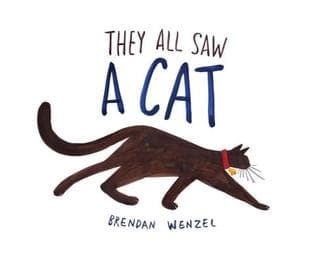
Brendan Wenzel (2016)
Genre
Children's / Creativity
Reading Time
5 min
Key Themes
See below
Sign in to track this book
A cat's journey shows how every creature, from a child to a bee, sees the same cat in its own way.
The story starts with a cat, simply described with whiskers, ears, and paws, walking. The story immediately shows the main idea: how different beings see the same cat. The cat is first shown from a child's view, appearing as a typical housecat. This first picture sets a base, showing the cat in a way most readers would know, before moving to the more varied interpretations that follow. This highlights how observation is subjective from the start.
A young child, the first person introduced, sees the cat as a fluffy, four-legged creature with a tail, whiskers, and a curious look. This view uses warm, soft colors and rounded shapes, showing an innocent and loving perception. The child's view is likely the most common and relatable, grounding the reader before the story moves into more unusual views of the same animal. It makes the cat a real thing in a shared world, though one that will soon be seen differently.
From a dog's view, the cat has sharp angles and a more aggressive stance, appearing as a blur of energy, perhaps a rival or a playmate to chase. The colors are bolder, and the lines are more active, showing the dog's strong senses and natural reaction. The cat's tail is bristling, suggesting it is ready for interaction, whether playful or confrontational. This contrast quickly shows how emotional state and species instincts change perception, turning a simple animal into a complex stimulus.
A fox's view changes the cat into a small, delicate, and possibly edible creature. The cat is a shadowy outline, blending into its surroundings, showing its weakness in the wild. The colors become more muted and earthy, reflecting the fox's predatory gaze and its focus on survival. This view introduces the food chain and how an animal's role in the ecosystem changes how it is seen, reducing the cat from a pet to just a resource.
Underwater, a fish sees the cat as a large, distorted, and somewhat threatening shape above the surface. The image is wavy and bent, showing the fish's limited vision and environmental filters. The cat's shape is less clear, appearing as a large shadow. This view shows how physical surroundings and sensory differences greatly alter visual information, turning the familiar cat into an alien and perhaps scary entity from another world.
For a mouse, the cat is an enormous, terrifying monster, all sharp teeth and claws, filling its entire vision. The picture is stark and scary, with exaggerated features that show the mouse's deep fear. The cat's eyes appear huge and piercing, and its body looms. This view clearly shows how fear and a big power difference can distort perception, making a common housecat into a symbol of danger and death.
A bee's compound eyes show the cat as many fragmented images, a series of geometric patterns and colors rather than one form. The cat's fur might look like a textured landscape of hairs. This unique view highlights biological differences in vision and how sensory organs shape perceived reality. It is a very abstract interpretation, showing that even basic visual input can be processed in very different ways.
From high above, a bird sees the cat as a small, unimportant dot on the ground, a possible threat, but one easily avoided by flying. The view is wide, with the cat appearing as just one part of a large landscape. The colors are muted, and details are minimal, reflecting the bird's distant position. This view shows how spatial relationship and scale influence perception, making the cat a mere speck in a larger world.
A worm, from deep in the earth, experiences the cat not visually, but through vibrations and perhaps as a blurry, earthy mass if it surfaces briefly. The cat's paw might appear as a huge, textured object. This view shifts from visual to touch and sound, showing that perception is not only about sight. It shows how profoundly different sensory tools lead to entirely different understandings of the same physical thing.
The cat eventually sees its own reflection in a puddle or window, recognizing itself. This moment shows a clear, realistic image of the cat, like the initial human view. It is a moment of self-awareness for the cat and a return to a common image after seeing many different views. This reflection reminds the reader that despite all the varied interpretations, the cat stays a single, consistent thing.
Finally, the cat sees itself and the world with its own eyes, shown as a curious and watchful creature. The picture shows the cat looking out with interest, embodying its own unique view of its surroundings. This ending view reinforces the idea that every creature, including the cat, has a distinct way of experiencing reality, and that the cat's internal experience is as valid and unique as any external observation.
The book ends by repeating that no matter how differently the cat is seen—whether as a cuddly pet, a strong foe, a blurry shape, or many small pieces—it is still the same cat. The final pages show the cat walking away, its form consistent, but leaving the reader to think about the many ways it was just seen. This emphasizes the main message: objective reality exists, but our experience of it is deeply subjective and shaped by who and what we are.
The Protagonist
The Cat's physical form remains constant, but its perceived identity shifts dramatically, highlighting the subjective nature of reality.
The Observer
The Child's perspective remains consistent, serving as a stable point of reference.
The Observer
The Dog's perspective is fixed by its species' typical behavior towards cats.
The Observer
The Fox's perception is defined by its role as a predator.
The Observer
The Fish's perception is limited and shaped by its aquatic environment.
The Observer
The Mouse's perception is dominated by primal fear and survival instinct.
The Observer
The Bee's perception is shaped by its unique biological vision.
The Observer
The Bird's perception is dictated by its aerial perspective and distance.
The Observer
The Worm's perception is primarily tactile and vibrational, due to its subterranean existence.
The main theme is how individual viewpoint shapes what we see. The book shows that the 'same' cat looks very different to various observers (child, dog, mouse, fish, bee, etc.). Each creature's unique biology, environment, and connection to the cat determine how it sees and feels about the cat. For example, the mouse sees a scary monster, while the child sees a cuddly pet. This highlights that there is no single 'objective' way to see the cat, but many subjective realities, all true from their own views.
“The cat walked through the world, with its whiskers, ears, and paws . . . and everyone saw a cat.”
By showing such different views, the book subtly promotes empathy and a wider understanding of other viewpoints. It asks readers to think about how others might experience the world differently, even when looking at the exact same thing. Seeing the cat through the eyes of a mouse (fear), a dog (playfulness), or a fish (distortion) implicitly asks the reader to step outside their own limited view and imagine another being's sensory and emotional reality. This encourages a sense of wonder about the many ways life is experienced.
“And the cat saw a cat.”
The book itself is an act of observation, carefully detailing how different beings see. It celebrates curiosity by prompting readers to look closer and consider the 'how' and 'why' behind these varied views. Each picture is a visual experiment in perception, encouraging both children and adults to observe their surroundings with more attention and to question their first ideas. The simple act of the cat walking becomes a deep study in how we interact with and interpret the world around us.
“What do you see?”
While stressing subjectivity, the book also touches on the existence of an underlying objective reality. Despite all the different views, it is always 'the cat.' This dual idea—that something can exist objectively but be experienced subjectively—is a deep concept for a children's book. It suggests that while our individual experiences are unique and valid, they are all interpretations of a shared, real world. The cat's final self-reflection supports this: it is one entity, no matter how others see it.
“And they all saw a cat.”
Each observer's perception is depicted with a unique artistic style.
This is the primary device. For each observer (child, dog, mouse, fish, etc.), the illustration of the cat changes dramatically in color palette, line quality, texture, and overall artistic rendering. For instance, the mouse's cat is sharp and monstrous, while the fish's cat is blurry and distorted. This visual metamorphosis is crucial for conveying the theme of subjective perception without explicit verbal explanation, allowing the reader to 'see' the world through different eyes.
The phrase 'And [observer] saw a cat' anchors each new perspective.
The consistent use of the phrase 'And the [observer] saw a cat' (or similar variations) acts as a structural anchor, clearly delineating each shift in perspective. This repetition creates a rhythmic, almost meditative quality to the narrative, while also emphasizing the central point: despite wildly different visual interpretations, the underlying object (the cat) remains constant. It reinforces the idea that all these varied views are still of 'a cat,' linking the subjective back to the objective.
Minimal narration allows the illustrations to convey the story.
The book employs very sparse text, relying heavily on its powerful illustrations to tell the story. The limited words guide the reader, but the visual changes are what communicate the profound differences in perception. This minimalist approach encourages visual literacy and active engagement from the reader, who must interpret the meaning conveyed through color, shape, and form. It makes the book accessible across ages and languages, prioritizing universal visual storytelling.
The story begins and ends with a relatively objective view of the cat.
The narrative structure is somewhat circular, starting with a conventional depiction of the cat (from a child's perspective) and ending with the cat seeing itself, and then simply walking on. This framing device suggests that while there are countless ways to perceive something, there is also a consistent, underlying reality. It provides a sense of completeness and reinforces the idea that the cat exists independently of its observers, even as its perceived form constantly shifts.
“The cat walked through the world, with its whiskers, ears, and paws.”
— Opening line, setting the scene for the cat's journey.
“And the child saw a cat, and the child thought, 'A cat!'”
— Describing the child's simple and direct perception of the cat.
“The dog saw a cat, and the dog thought, 'A chew toy! A chase! A friend!'”
— Illustrating the dog's energetic and playful view of the cat.
“The fox saw a cat, and the fox thought, 'A tasty treat!'”
— Showing a predatory animal's survival-driven perception.
“The fish saw a cat, and the fish thought, 'A big, scary monster!'”
— From the perspective of a small, vulnerable creature in water.
“The mouse saw a cat, and the mouse thought, 'A giant, terrifying beast!'”
— The mouse's view, emphasizing its fear and the cat's imposing size.
“The bee saw a cat, and the bee thought, 'A blurry flower!'”
— Depicting the bee's compound eye vision, seeing patterns and shapes.
“The bird saw a cat, and the bird thought, 'A perfect perch!'”
— The bird's perspective, seeing the cat as an object in its environment.
“The worm saw a cat, and the worm thought, 'A rumbling mountain!'”
— The worm's ground-level, tactile perception.
“The bat saw a cat, and the bat thought, 'A squeaky sound!'”
— Illustrating the bat's reliance on echolocation.
“The world was full of cats, and they all saw a different one.”
— A key takeaway from the book, summarizing the diversity of perception.
“Even the cat saw itself, and the cat thought, 'A cat!'”
— The cat's self-perception, a moment of self-awareness.
“Each creature, with its own eyes and its own mind, saw a different cat.”
— Reinforcing the central theme of individual interpretation.
“And though they all saw a different cat, they all saw a cat.”
— The concluding thought, highlighting both the differences and the shared reality.
Ready to see how well you understood this book? Take our interactive quiz with 10 questions.
Dan Gemeinhart
4.5
Kate O'Hearn
4.4

Jeanne Birdsall
4.4

Jen Wang
4.4
Wendelin Van Draanen
4.3

John Marsden
4.3

Chris Van Allsburg
4.3
Jennifer A. Nielsen
4.2