“One should never underestimate the power of a well-placed curse, particularly when wielded by an annoyed mummy.”
— Theodosia reflecting on the dangers and magical elements she encounters at the museum.

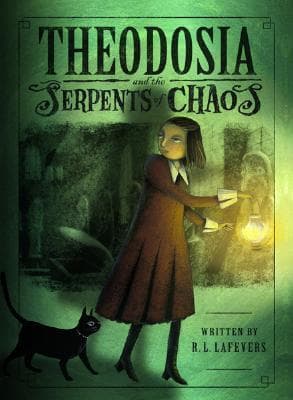
R.L. LaFevers (2007)
Genre
Fantasy / Children's / Historical Fiction / Mystery / Young Adult
Reading Time
300 min
Key Themes
See below
Sign in to track this book
In a Victorian London museum filled with ancient curses, a young girl secretly uses Egyptian magic to protect her unaware father and the British Empire from a newly found, dangerous artifact.
Theodosia Throckmorton, a twelve-year-old girl in 1907 London, works with her Egyptologist father, Alistair Throckmorton, at the Museum of Legends and Antiquities. Theo can see and feel the ancient curses and dark magic on the Egyptian artifacts. She secretly spends her nights and early mornings performing rituals, using her grandmother's old Egyptian spellbook and ingredients, to cleanse these objects. Her brother, Henry, often tries to catch her, thinking she is just playing in the museum. One morning, Theo worries about a new exhibit from a recent dig in Egypt, sensing a strong, bad aura from it, which she thinks is a powerful curse.
Theo's mother, Henrietta Throckmorton, a famous archaeologist, returns from her latest trip in Egypt, bringing a legendary and powerful amulet called the Heart of Egypt. Theo immediately feels great fear and a strong wave of dark magic from the amulet, stronger than anything she has met before. She tries to warn her mother about the amulet's danger, but Henrietta, who does not believe in superstitions, thinks it is a valuable historical find. Theo realizes this curse is not small, but something that could cause widespread chaos and destruction, threatening the entire British Empire.
Soon after the Heart of Egypt arrives at the museum, strange things begin to happen in London. People, including museum staff and important figures, start acting strangely, showing unusual aggression, forgetfulness, and a general unease. Theo notices that even her father, Alistair, becomes more distracted and annoyed. She connects these events directly to the amulet and its powerful curse. She learns that the curse is not a simple hex, but an ancient Egyptian plague meant to cause disagreement and chaos, which she identifies as the Serpents of Chaos, old beings that grow stronger from human conflict and confusion.
Realizing the great danger, Theo knows she cannot handle this curse alone. She asks for advice from her grandmother's old friend, an unusual antique dealer named Mr. Hatik. Mr. Hatik, who also understands ancient magic, confirms how serious the Serpents of Chaos are and tells Theo what extreme steps are needed to fight them. He also introduces her to a very old, seemingly normal cat named Isis, who, to Theo's surprise, can talk to her telepathically and gives mysterious but helpful advice, revealing herself as a protector of ancient knowledge and an ally in Theo's fight against the growing chaos.
Theo learns about a secret group called the Serpents of Chaos, a society that wants to use the amulet's dark power for their own bad goals. She finds out they have been subtly influencing events to make sure the amulet came to London. Their leader, a shadowy figure, believes chaos will bring a new world order. During her investigation, Theo realizes the amulet has been stolen from the museum, likely by members of this group. This theft makes her more urgent, as the amulet's power, now loose and uncontrolled, could have terrible effects on the city and the world.
Theo finds unexpected allies. Her older brother, Henry, at first doubtful and often bothered by Theo's secret activities, eventually learns about the real danger and helps her, using his knowledge of the museum's layout and his skill for observation. She also becomes friends with a street boy named Will, who is surprisingly resourceful and street smart, which helps a lot in finding hidden parts of London and gathering information. Together, they start looking for clues about the amulet's location and the identity of the Serpents of Chaos, facing more danger and meeting the group's agents.
Guided by Mr. Hatik and Isis, Theo learns that the only way to stop the Serpents of Chaos is to perform a complex and dangerous ancient Egyptian ritual. This ritual needs specific ingredients, exact timing, and great focus, as it involves pulling the chaos back into the amulet and sealing it. Theo spends days studying her grandmother's old texts, practicing the spells, and gathering the needed parts, which include rare herbs, specific minerals, and even a live scarab beetle. The pressure grows as the chaos in London gets worse, causing widespread panic and almost riots.
Theo, Henry, and Will finally find the stolen Heart of Egypt and the Serpents of Chaos's hidden base under London. They get into the base, facing traps and members of the society who are trying to fully unleash the amulet's power. Theo confronts the mysterious leader, who explains his twisted belief that chaos is needed for progress. A tense fight happens, with Theo using her knowledge of ancient magic and her allies distracting and helping her to get the amulet back and stop its full activation.
In a key scene, Theo gets the Heart of Egypt and begins the cleansing ritual. As she says the old spells and uses the magical parts, the Serpents of Chaos, now seen as swirling, dark figures, try to stop her, lashing out with dark energy. Theo must use all her will and magic to contain them. With Henry and Will protecting her from the remaining society members, and Isis guiding her, Theo channels the chaotic energy back into the amulet, sealing it again and restoring balance.
With the Serpents of Chaos contained, the widespread strange behavior and unrest in London slowly stop. People return to normal, many not remembering the chaotic time. The Serpents of Chaos society is broken up, its members either caught or scattered. Theo, tired but successful, understands the great responsibility that comes with her unique abilities. Her family, especially her mother, largely remains unaware of the real danger she faced, though Henry now knows her secret. Theo accepts her role as a protector against ancient evils, knowing her work at the museum is not over, and that she must stay watchful for future threats.
The Protagonist
Theo develops from a secretive, solitary protector to someone who learns to trust and rely on others, embracing her unique destiny.
The Supporting
Alistair remains largely unchanged, serving as a representation of the adult world's skepticism towards the unseen.
The Supporting
Henrietta remains unaware of the magical crisis, highlighting the contrast between mundane and magical realities.
The Supporting
Henry transforms from an annoying brother into a trusted confidante and active participant in Theo's magical world.
The Supporting
Mr. Hatik serves as a static mentor figure, providing wisdom and resources without undergoing significant personal change.
The Supporting
Isis acts as a constant, unwavering guide, her wisdom unchanging.
The Supporting
Will evolves from an independent street urchin into a trusted friend and member of Theo's inner circle.
The Antagonist
The leader's plans are thwarted, but their ideology represents a recurring threat that Theo may face again.
Theo, though a child, carries the heavy task of protecting her family and the world from unseen magic. She must work in secret, often feeling alone, because adults around her do not notice or dismiss the threats. This theme shows in her secret cleansing rituals, her solitary research, and her desperate attempts to warn her parents, highlighting the isolation and weight of her unique abilities. Her journey forces her to accept this responsibility and find strength in it.
“It was up to her. It was always up to her.”
The story explores the conflict between scientific understanding and the old, mystical forces Theo sees. Her parents, Alistair and Henrietta, represent science, dismissing curses and magic as superstition. Theo, however, lives in a world where magic is real and dangerous. This clash shows how different ways of understanding can lead to not seeing things, as the adults' doubt stops them from seeing the real threats, leaving Theo to face them alone. The museum itself symbolizes this, holding magical objects that are only seen as historical items.
“Her father would say it was merely an old wives' tale, but Theo knew better.”
The story highlights the importance of ancient knowledge, especially Egyptian magic. Theo's grandmother's spellbook, the old rituals, and the wisdom of characters like Mr. Hatik and Isis are essential to understanding and fighting the curses. This theme suggests that modern society, in its pursuit of progress, has forgotten valuable wisdom from the past, and that these old arts hold the key to solving unique problems. The Heart of Egypt itself is a strong symbol of this ancient power, capable of both great good and great evil.
“The old ways were not dead, merely sleeping, waiting to be awakened by someone who understood.”
The main conflict is about the Serpents of Chaos, old beings that thrive on disagreement and strange behavior, threatening to upset society. This theme looks at the delicate balance between order and chaos, and how easily that balance can be broken. The amulet acts as a trigger, bringing out the worst in people and leading to social breakdown. Theo's goal is to restore order by containing the chaos, showing the human need for stability and the dangers of uncontrolled destructive forces, whether magical or societal.
“Chaos, once unleashed, has a hunger that is never sated.”
A powerful ancient artifact that serves as the story's central MacGuffin and source of conflict.
The Heart of Egypt is a legendary amulet imbued with an ancient and potent curse, capable of unleashing the Serpents of Chaos. It acts as the primary MacGuffin, driving the plot as its arrival in London initiates the conflict and its possession becomes the goal for both Theo and the antagonist society. Its magical properties are the source of all the strange occurrences and the impending doom, making it the focal point of the narrative and Theo's efforts.
An ancient tome of Egyptian magic that provides Theo with the knowledge and rituals she needs.
This inherited spellbook is Theo's primary source of magical knowledge and serves as a vital tool throughout the story. It contains the ancient Egyptian rituals, incantations, and magical lore that Theo uses to cleanse artifacts and ultimately to combat the Serpents of Chaos. It acts as a symbol of inherited wisdom and the connection to the past, enabling Theo to perform feats beyond her years and providing a tangible link to the 'old ways' of magic.
The primary setting, a place where ancient artifacts and hidden magic coexist.
The museum is more than just a setting; it's a character in itself, a repository of history and a nexus of ancient magic. It's where Theo lives and works, and where the magical and mundane worlds constantly intersect. The artifacts within its walls are not merely exhibits but living sources of power and curses, making the museum a dangerous yet fascinating place. It symbolizes the forgotten power of the past and serves as a constant reminder of Theo's unique burden.
Ancient magical entities that embody and spread discord and irrationality.
The Serpents of Chaos are not just the name of a secret society, but also the actual magical entities, manifestations of ancient curses that feed on human strife and confusion. They are the invisible force behind the widespread irrationality and unrest in London, growing stronger as the chaos spreads. They serve as the direct magical threat Theo must physically and magically confront, representing the insidious nature of unchecked negative emotions and the destructive power of ancient magic.
“One should never underestimate the power of a well-placed curse, particularly when wielded by an annoyed mummy.”
— Theodosia reflecting on the dangers and magical elements she encounters at the museum.
“The problem with ancient Egyptian artifacts, you see, is that they never truly stay put.”
— Theodosia's constant struggle with artifacts coming to life or causing trouble.
“Being a protector of ancient magic was a lonely business, but someone had to do it.”
— Theodosia's internal thoughts about her unique responsibilities.
“A good librarian knows where to find information. A great librarian knows what information to hide.”
— A wisdom shared with Theodosia, highlighting the secretive nature of some knowledge.
“Chaos, after all, was merely order waiting to be rearranged.”
— Theodosia's philosophical take on the forces she combats.
“One cannot simply 'dust' a cursed object. It requires a more… delicate touch.”
— Theodosia explaining the nuances of handling magical artifacts to someone less experienced.
“Sometimes the greatest treasures are not those found in tombs, but those hidden in plain sight.”
— A reflection on the overlooked details and secrets within the museum.
“Even the most formidable curses have a weakness, if you know where to look.”
— Theodosia's determination to find solutions to magical problems.
“It wasn't enough to simply know about ancient magic; one had to understand its whispers.”
— Theodosia's unique ability to sense and interpret magical energies.
“Family, even the most eccentric sort, was still family.”
— Theodosia's acceptance of her unusual parents and brother.
“Never trust an artifact that smiles back.”
— Theodosia's practical advice for dealing with potentially dangerous magical objects.
“The past had a way of reaching out and grabbing you, whether you wanted it to or not.”
— Theodosia's constant involvement with ancient Egyptian magic and its consequences.
“A true adventurer wasn't afraid of a little dirt, or a lot of ancient evil.”
— Theodosia's courageous attitude towards her dangerous tasks.
Ready to see how well you understood this book? Take our interactive quiz with 10 questions.







