“There are some things you can't learn from a book.”
— Hadrian reflecting on the practicalities of combat versus theoretical knowledge.

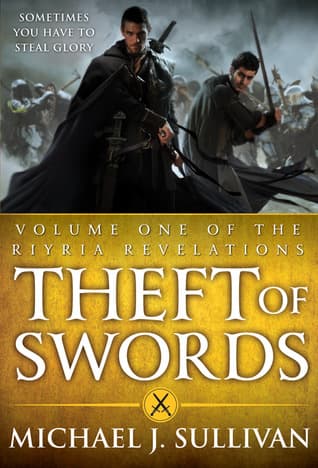
Michael J. Sullivan (2011)
Genre
Fantasy
Reading Time
12-15 hours
Key Themes
See below
Sign in to track this book
Framed for regicide, a cynical thief and his honorable mercenary partner must unravel a kingdom-shattering conspiracy while dodging assassins and uncovering ancient secrets.
Hadrian Blackwater, a master swordsman, and Royce Melborn, a skilled thief, are hired by an unknown client to steal a sword from a nobleman's estate. During their break-in, royal guards ambush and capture them. They are accused not of theft, but of regicide—the murder of King Amrath of Melengar. They are thrown into the royal dungeons, a deep prison beneath the castle. Gaunt, a shadowy figure, ensures their capture and makes them appear guilty, setting the stage for a larger conspiracy.
Imprisoned, Hadrian and Royce face execution. Princess Arista, King Amrath's daughter, secretly believes them innocent and sees them as her only hope to find the truth behind her father's death. She arranges their escape with her guard, Myron, and a sympathetic jailer. Arista tasks them with finding the real killers and proving their innocence, promising freedom and a reward. Their escape is dangerous, involving stealth and combat, solidifying their reluctant alliance with the princess.
Following a clue from King Amrath—a passage from an old book mentioning 'the Eye of the Ancestors'—Hadrian, Royce, and Princess Arista travel to the remote Elven ruins of Percepliquis. They believe this location holds secrets related to the king's murder and the larger conspiracy. Their journey is dangerous, with hostile creatures and difficult terrain. Royce's tracking and Hadrian's combat skills prove essential, while Arista's knowledge of history and her royal connections start to reveal the plot's depth.
During their travels, the trio seeks help from Baron Dunmore, a close advisor to the late King Amrath. Dunmore initially seems helpful, offering support. However, it soon becomes clear that he is involved in the conspiracy. He tries to betray Hadrian, Royce, and Arista, revealing his loyalty to Gaunt and the true plotters of the king's death. A tense confrontation follows, forcing Hadrian and Royce to fight their way out of Dunmore's grasp, further narrowing Arista's circle of trust.
As they examine old texts and the secrets of Percepliquis, Hadrian, Royce, and Arista uncover references to the 'Heir of Novron,' a legendary figure prophesied to unite humanity and elvenkind. They realize the king's murder is not an isolated event but part of a larger plan to prevent the Heir's emergence or manipulate the prophecy. The 'Eye of the Ancestors' is an artifact connected to this prophecy, sought by the conspirators.
The investigation leads Hadrian and Royce to realize that Gaunt, the one who framed them, is a high-ranking member of the Imperial Church, specifically a fanatical group called the Patriarch. This group seeks to dominate the kingdoms and eliminate any threats to its power, including the potential rise of the Heir of Novron. Gaunt's true identity and the Church's involvement reveal the vast scale and religious fanaticism behind the conspiracy, making their enemies far more formidable.
To expose the Church's plot and clear their names, Hadrian and Royce, with Arista, must infiltrate the heavily guarded Imperial City. This is where the Patriarch holds power and where the conspirators, including Gaunt, operate. Their mission is to gather undeniable evidence and present it to the Emperor or other influential figures. This infiltration requires all of Royce's stealth and Hadrian's combat skills as they navigate a city filled with enemies, getting closer to the truth.
As the plot unfolds, Esrahaddon, an old wizard, appears as a central figure. He has been imprisoned for centuries, and his release or manipulation is key to the conspirators' plans. However, Esrahaddon's true loyalties and motives are mysterious. He seems to be playing a long game, influencing events from behind the scenes, possibly even the Church's actions. His complex role adds another layer of intrigue, suggesting the current conspiracy is just one piece of a much older scheme.
Through their investigation and interpretation of old prophecies, Hadrian, Royce, and Arista finally uncover the true Heir of Novron. To their surprise, it is not a grand hero, but a seemingly ordinary individual whose lineage connects them to the old imperial bloodline. This revelation shatters their ideas and confirms the conspirators' fears, as the Heir's existence threatens to disrupt the established order and challenge the Church's authority, making them a target for elimination or control.
With their plot exposed and the Heir's identity revealed, the Church, led by Gaunt, attacks the kingdom of Melengar. Their goal is to eliminate Princess Arista, the Heir, and anyone who stands in their way, consolidating their power. Hadrian, Royce, and the loyal Melengar forces, despite being outnumbered, defend the kingdom. The battle is fierce, testing their resolve and combat skills as they fight to protect the kingdom and prevent the conspirators from achieving their goal.
During these events, the full scope of the conspiracy is revealed. It is not just about the current king's murder but an old plot spanning centuries, orchestrated by powerful, hidden figures within the Church, dating back to Novron and the Elves. Their goal is to prevent the union of humans and elves, maintain their control, and suppress any knowledge of the world's true history. The 'Eye of the Ancestors' and the Heir of Novron are central to this old struggle, connecting the current crisis to a much larger conflict.
Through their combined efforts, Hadrian and Royce, with Princess Arista and their allies, stop the immediate threat to Melengar and expose some of the conspirators. Gaunt is defeated, and the immediate danger to the Heir is averted. However, the victory is uncertain. The Church's network remains largely intact, and the true masterminds behind the old plot are still at large. While their names are cleared, Hadrian and Royce realize they are now involved in a larger, ongoing conflict that promises future challenges.
The Protagonist
Initially reluctant to get involved in royal politics, Hadrian grows to care for Arista and the fate of the kingdoms, accepting a role beyond mere mercenary work.
The Protagonist
Royce, initially only motivated by self-preservation and profit, slowly opens up and begins to care about the larger cause, revealing glimpses of his hidden loyalty and morality.
The Supporting
Arista transforms from a grieving princess into a capable leader and strategist, learning to navigate the treacherous world of politics and war.
The Supporting
Myron matures from an innocent scholar into a courageous and steadfast companion, witnessing and adapting to the brutal realities of the world outside the monastery.
The Antagonist
Gaunt's unwavering fanaticism drives him to escalating acts of violence and manipulation, ultimately leading to his downfall but leaving his ideology intact.
The Supporting
Dunmore's duplicity is exposed, leading to his confrontation and defeat, demonstrating the perils of hidden allegiances.
The Mentioned
Esrahaddon's ancient plot is slowly revealed, showing his manipulation of events over centuries to achieve a grand, unknown purpose.
The Mentioned
Though deceased, his legacy and the mystery of his murder drive the narrative, revealing the depth of the conspiracy he uncovered.
The novel explores the tension between legal and moral right. Hadrian and Royce are framed for a crime, becoming outlaws, yet they pursue justice for the murdered king. Princess Arista, representing the law, must break it to achieve a higher form of justice. This theme is clear when they realize the Church, an institution of law, is behind the injustice, seen in Gaunt's fanaticism.
“'Sometimes the law is a tool for the wicked, and justice is found in the hands of those who break it.'”
"Theft of Swords" changes traditional fantasy heroism. Hadrian and Royce are not prophesied heroes; they are cynical rogues motivated by profit. Yet, they consistently choose to do the right thing, often at personal risk, becoming effective champions for justice. Their heroism is accidental, born from circumstance. This is clear when Hadrian feels compelled to protect Arista, and Royce uses his skills to expose a vast conspiracy.
“'We're not heroes, Princess. We're just the best at what we do, and right now, what we do happens to be saving your royal posterior.'”
The entire plot relies on layers of conspiracy and deception. The king's murder is a planned frame-up, designed to implicate Hadrian and Royce and remove obstacles to the Church's power. The true motives and identities of the antagonists, especially Gaunt and the Patriarch, are hidden behind religious authority. The old prophecies and the mystery of the Heir of Novron are manipulated by different groups to further their agendas. The characters must constantly distinguish truth from lies.
“'Truth is a weapon. You just have to know when to use it, and against whom.'”
The novel explores both the good and bad aspects of belief and faith. Princess Arista's belief in Hadrian and Royce's innocence, despite evidence, sets them free and allows the truth to be found. Conversely, Gaunt's fanatical faith in the Imperial Church's doctrine drives his ambition and justifies his actions. Myron's gentle faith offers moral support, while historical faith in old prophecies shapes the political landscape and fuels the conspiracy. Corrupted belief becomes a dangerous weapon.
“'Faith without reason is blindness, but reason without faith is despair.'”
Old history and prophecy are crucial, intertwined with current events. The mystery of Novron, the Heir, and the Elven ruins are active forces shaping the present. The conspirators are driven by an old fear or misunderstanding of prophecy, trying to control or prevent a foreseen future. The characters must examine historical texts to understand the current danger. This theme shows how past events and long-held beliefs continue to influence the fate of kingdoms and individuals.
“'The past isn't dead, Hadrian. It's not even past. It's just waiting for someone to dig it up.'”
A classic setup where innocent protagonists are falsely accused of a major crime.
The framing of Hadrian and Royce for King Amrath's murder serves as the inciting incident, immediately thrusting the protagonists into danger and forcing them to act. This device establishes their outlaw status, creating immediate stakes and forcing them to operate outside the law. It also generates sympathy for the characters and provides a clear, personal motivation for them to uncover the truth and clear their names, driving the entire narrative forward and leading them into the larger conspiracy.
A mysterious object or person that drives the plot and is sought by all factions.
The 'Eye of the Ancestors' (a powerful artifact) and the 'Heir of Novron' (a prophesied figure) function as the central MacGuffins. They are the ultimate goals that both the protagonists and antagonists are pursuing, though for different reasons. The identity of the Heir and the nature of the Eye are initially vague, providing a compelling mystery that the characters must unravel. Their significance escalates throughout the story, revealing the true scale of the ancient conspiracy and connecting individual events to a grander historical and magical conflict.
Protagonists who are initially unwilling to engage in heroic deeds.
Hadrian and Royce embody the reluctant hero archetype. They are not noble knights or chosen ones; they are professional rogues primarily motivated by money and self-preservation. Their involvement in the royal conspiracy is accidental, and they repeatedly express a desire to avoid grand causes. However, their innate morality and loyalty to each other, and eventually to Arista, compel them to continue their quest. This device allows for character growth and adds a layer of realism and relatability, as their heroism feels earned rather than destined.
Mysterious hints and messages that guide the protagonists' investigation.
Cryptic clues, such as King Amrath's last message referencing 'the Eye of the Ancestors' and passages from ancient texts, are vital for propelling the plot. These clues provide the characters with directions and goals, leading them from one location or revelation to the next. They often require interpretation, drawing on Arista's scholarly knowledge and Myron's memory, engaging the reader in the mystery and slowly revealing the layers of the conspiracy. This device ensures a continuous sense of discovery and intellectual challenge for the characters.
“There are some things you can't learn from a book.”
— Hadrian reflecting on the practicalities of combat versus theoretical knowledge.
“It's never a good idea to anger a wizard.”
— Royce advising caution when dealing with powerful magic users.
“Hope is a powerful thing. Some say it's a type of magic itself.”
— A character musing on the nature of hope and its impact.
“The world is not as simple as good and evil, Hadrian. There are shades of grey in everyone.”
— Royce offering a cynical but realistic view of morality.
“Sometimes the best way to hide something is in plain sight.”
— Royce explaining a common thieving tactic.
“A man without a past is a man without a future.”
— A character contemplating the importance of history and identity.
“Loyalty is a rare commodity these days. Hold on to it when you find it.”
— Hadrian valuing the bonds of friendship and trust.
“Never underestimate the power of a good story.”
— Someone discussing how narratives can influence people and events.
“Every man has his price, Hadrian. It's just a matter of finding out what it is.”
— Royce's jaded perspective on human motivation.
“Fear is a weapon, and like any weapon, it can be turned against its wielder.”
— A character observing the double-edged nature of fear.
“The greatest treasures are not always gold and jewels.”
— A reflection on the true value of things beyond material wealth.
“It's not about how hard you hit, it's about how hard you can get hit and keep moving forward.”
— Hadrian's philosophy on perseverance in combat and life.
“Sometimes the right thing to do is the hardest thing to do.”
— A character grappling with a difficult moral choice.
“Magic is not just spells and incantations; it's the will to change the world.”
— A broader definition of magic's essence and potential.
Ready to see how well you understood this book? Take our interactive quiz with 10 questions.

Biography coming soon.







