“The past is a story we tell ourselves. The future is a story we try to live.”
— A recurring philosophical theme throughout the book, often pondered by characters across different reincarnations.

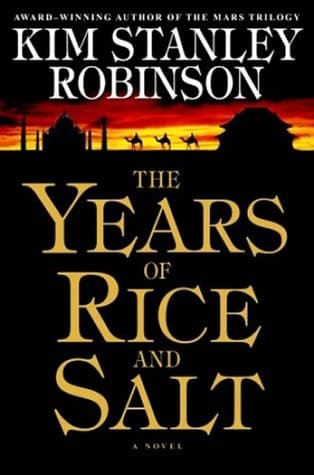
Kim Stanley Robinson (2002)
Genre
Fantasy / Historical Fiction / Spirituality / Science Fiction
Reading Time
1500 min
Key Themes
See below
Sign in to track this book
In an alternate 14th century where the Black Death wipes out 99% of Europe, "The Years of Rice and Salt" reimagines a millennium of human history, tracing the rise and fall of Eastern empires and the evolution of a world shaped by different hands.
The novel opens in a drastically altered 14th century, where the Black Death has wiped out 99% of Europe's population. This event leads to 'Jomon' (a recurring soul) being reborn as a bear in the untouched forests of former Europe. Meanwhile, the Islamic world and China become dominant global powers. We meet characters like Bold, a warrior in the Golden Horde, and P'an, a scholar in Ming China, whose lives intertwine across various reincarnations. The initial chapters establish a world without a powerful Christian Europe, where the Silk Road thrives, and power shifts dramatically towards the East, setting the stage for centuries of development without European colonialism.
Centuries later, the characters are reborn, often with a faint, subconscious memory of past lives. This section focuses on early interactions between the Islamic world and China. We see explorations and scientific advancements led by Islamic scholars and navigators. Iwang (a reincarnation of Jomon), a Chinese scholar, deals with philosophical and religious differences when encountering the more dogmatic aspects of Islam, particularly its Sufi traditions. The narrative explores early global trade routes and the exchange of ideas, highlighting the intellectual skill of both civilizations and the subtle tensions from their distinct worldviews, especially concerning spirituality and reality.
The narrative progresses to a period like the Age of Exploration, but with Chinese and Islamic powers in the lead. Characters like Kheim (Jomon) become involved in naval expeditions across the Pacific and Atlantic, leading to the discovery of the Americas (referred to as 'New World'). This discovery sparks new rivalries and expansion, but also raises ethical questions about colonization and the treatment of indigenous populations. The focus remains on the distinct approaches of the Chinese, who tend towards trade and cultural exchange, and the Islamic nations, who sometimes show a more missionary zeal. These interactions set the groundwork for future global power struggles.
This book mirrors the European Enlightenment and Industrial Revolution, but within the context of the Islamic and Chinese empires. Characters like Busho (Jomon) are reborn as scientists and alchemists, driving innovation in metallurgy, gunpowder, and early forms of steam power. The scientific method grows, leading to significant technological advancements that reshape society, warfare, and daily life. The interplay between traditional knowledge and new scientific inquiry is explored, often through the philosophical debates and personal struggles of the reincarnated characters. They grapple with the implications of these new discoveries for their understanding of the world and their place in it.
As the world becomes more interconnected, ideological and religious conflicts grow. This section depicts a period of global warfare, driven by competing interpretations of Islam, tensions between Islamic and Chinese spheres of influence, and the struggle for resources and dominance in the 'New World.' Characters find themselves on opposing sides of these conflicts, experiencing war's brutality and moral ambiguities. The cycle of reincarnation highlights the enduring nature of human conflict, but also the potential for individual characters to learn and grow across lifetimes, even as humanity struggles with its darker impulses. The theme of pilgrimage, both literal and spiritual, runs through this turbulent era.
This book explores the economic consequences of global trade and resource exploitation, particularly the 'Gold Road' from the Americas. It details the development of sophisticated economic systems, like early capitalism, within the dominant empires. The pursuit of wealth leads to new forms of social stratification, labor exploitation, and environmental damage. Characters like Kokila (Jomon) are reborn into various social roles, from merchants to laborers, experiencing the promises and pitfalls of this economic expansion. The narrative examines the ethical dilemmas inherent in rapid economic growth and the widening gap between rich and poor, reflecting on the human cost of progress.
As the centuries progress, new social movements and philosophies emerge, challenging the established order. This section focuses on a period of intellectual and social change, with characters like Nsara (Jomon) leading or participating in movements for social justice, equality, and environmental protection. These movements often draw inspiration from diverse philosophical and religious traditions, seeking to create a more equitable and sustainable world. The narrative explores the tension between tradition and innovation, the struggle for individual freedoms against authoritarian regimes, and the growing awareness of global interconnectedness and shared responsibility. The 'Nsara' character embodies the spirit of reform and revolution.
This book depicts a world of vast, technologically advanced cities, mirroring the modern era. Urbanization brings both innovation and significant environmental challenges, such as pollution and resource depletion. Characters like Bao (Jomon) navigate these complex urban landscapes, working as engineers, artists, or activists. The narrative explores technology's impact on human society, the challenges of governance in densely populated areas, and the growing awareness of the planet's fragility. Despite the advancements, the recurring themes of conflict, inequality, and the search for meaning persist, highlighting the ongoing human struggle to balance progress with sustainability.
The world enters an era of complex global politics, with various nations and alliances vying for influence. This section explores attempts at establishing lasting peace and cooperation, often through international organizations and diplomatic efforts. However, underlying tensions and historical grievances continue to fuel conflicts. Characters like Kwan (Jomon) are involved in diplomacy, peace movements, or even covert operations, struggling to navigate the intricate web of international relations. The concept of the mandala, symbolizing interconnectedness and the cyclical nature of existence, becomes relevant as humanity grapples with its shared future and the possibility of global catastrophe.
In the final book, humanity faces a culmination of environmental crises, resource scarcity, and the ever-present threat of war. These challenges force a re-evaluation of human values and priorities. Characters like Jomon, now a woman named Dawn, are part of a generation dealing with the consequences of centuries of development. The narrative explores various responses, from technological solutions to radical shifts in societal organization and spiritual understanding. The cycle of reincarnation reaches a point where the characters begin to collectively remember and understand their past lives, striving for a future where peace and sustainability are truly possible. This leads towards a more enlightened collective consciousness.
The Protagonist (collective)
From individual struggles in early lives to a growing awareness of past existences, Jomun's arc culminates in a collective awakening and a push for global harmony.
The Protagonist (early incarnation of Jomun)
From a pragmatic warrior, Bold begins the long, unconscious quest for understanding and connection that defines the Jomun soul.
The Protagonist (early incarnation of another recurring soul)
From a traditional scholar, P'an's soul evolves to embrace broader global perspectives and scientific inquiry, while retaining a core intellectual curiosity.
The Protagonist (early incarnation of another recurring soul)
From a driven explorer, Kheim's soul learns the complexities of cultural interaction and the ethical implications of expansion.
The Protagonist (later incarnation of P'an's soul)
Iwang's soul expands from purely internal Chinese thought to engaging with and attempting to reconcile diverse global philosophies.
The Protagonist (later incarnation of Jomun's soul)
Busho's soul shifts from individual scientific discovery to a growing awareness of the collective impact of technology on society and the environment.
The Protagonist (later incarnation of another recurring soul)
From a focus on individual wealth and trade, Kokila's soul develops a deeper understanding of social justice and the collective impact of economic systems.
The Protagonist (later incarnation of another recurring soul)
Nsara's soul evolves from individual acts of defiance to leading collective movements for widespread social and environmental change.
The Protagonist (final incarnation of Jomun's soul)
Dawn's arc completes the Jomun soul's journey, leading humanity towards a conscious understanding of its past and a unified future.
The central theme of the novel is reincarnation, where a small group of souls (the 'jami') are repeatedly reborn into different bodies, genders, cultures, and social strata across centuries. This allows the narrative to explore human history from multiple perspectives and to show how individual experiences contribute to a larger, collective learning process. The faint memories and recurring connections between these souls suggest a deeper, underlying unity of human experience, regardless of historical context. For example, Jomon's transformation from a bear to a warrior to a scientist highlights the fluidity of identity and the enduring essence of the soul.
“For the Jami, life was not a line, but a circle, a great wheel turning through the ages, each spoke a life, each revolution a lesson learned.”
The novel's foundational premise is the 'what if' of the Black Death's extreme devastation of Europe. This allows Robinson to explore how drastically different human history could have unfolded without European dominance. It highlights the contingency of historical events, demonstrating that the rise and fall of civilizations are not predetermined but are the result of specific circumstances and choices. The flourishing of Islamic and Chinese empires, their scientific advancements, and their distinct approaches to exploration and colonization show how different cultural values can shape global development, challenging Eurocentric views of progress. The absence of a Christian Europe fundamentally alters the course of global power and ideology.
“A continent emptied, and the world remade. Not by gods, but by a microbe, and the choices that followed.”
Throughout the centuries, the novel portrays the complex dynamics of cultural exchange and conflict, primarily between the Islamic world and China, and later with the indigenous peoples of the Americas. It explores how ideas, technologies, and philosophies are shared and adapted, leading to periods of innovation and mutual respect. However, it also details the clashes from differing religious beliefs, political ambitions, and economic interests. The characters, through their various incarnations, experience these tensions firsthand, from philosophical debates between scholars like P'an and Kheim to the realities of inter-empire warfare, illustrating the enduring human struggle to bridge divides.
“The world was a tapestry woven from a thousand threads, each one a culture, a language, a god. And sometimes, those threads snarled and tore.”
As the centuries progress, a recurring theme is humanity's relationship with the natural world and the growing awareness of environmental degradation. The novel illustrates how technological advancements and economic expansion, regardless of which civilization leads them, can lead to pollution, resource depletion, and climate change. Characters, particularly in later incarnations, become environmental activists or scientists dealing with these issues. The repeated cycles of human progress leading to environmental crisis show a universal challenge, implying that humanity must learn to live sustainably or face dire consequences. The final books emphasize the urgent need for a collective shift towards ecological balance.
“The Earth, once a boundless mother, now seemed a fragile thing, shrinking under the endless hunger of man.”
The novel questions the concept of 'progress,' showing that while technological and scientific advancements occur, fundamental human flaws like greed, violence, and prejudice persist. Each era brings new innovations but also new forms of conflict and suffering. The cyclical nature of reincarnation suggests that true progress is not merely technological but spiritual and ethical, requiring humanity to learn from its past mistakes across generations. The characters' repeated experiences of war, injustice, and environmental crises force a re-evaluation of what constitutes a 'better' world, ultimately pointing towards collective enlightenment as the true measure of advancement.
“Each age built higher, faster, further, yet the old shadows still clung to the foundations.”
The central mechanism for character development and historical exploration.
Reincarnation is the primary plot device, allowing the narrative to follow a small group of interconnected souls (the 'jami') through multiple lives spanning centuries. This device enables Robinson to explore different historical periods, cultural contexts, and social roles without introducing an entirely new cast of characters each time. It provides continuity and a unique perspective on the evolution of human civilization, as the souls accumulate experiences and subtle memories, influencing their actions and understanding in subsequent lives. It also serves as a philosophical framework for exploring themes of identity, memory, and collective learning.
A specific group of souls whose recurring lives form the core narrative.
The 'jami' are the handful of souls that reincarnate together throughout the novel. This specific group dynamic is crucial because it creates recurring relationships and conflicts. Characters who are lovers in one life might be rivals or family members in another. This device allows Robinson to explore the enduring nature of human connection and conflict across different historical settings. The interactions between these specific souls drive much of the personal drama and philosophical debate, demonstrating how individual destinies are intertwined and how past lives subtly influence present interactions, even if consciously forgotten.
Each chapter or book focuses on a different incarnation, providing varied perspectives.
The novel frequently shifts its point of view, with each book or major section focusing on a different incarnation of one of the 'jami' souls. This device is essential for covering such a vast historical scope and for illustrating the diversity of experiences within the alternate timeline. By inhabiting different characters—male and female, warrior and scholar, rich and poor, Chinese and Islamic—the reader gains a multifaceted understanding of the world Robinson has created. It prevents the narrative from becoming stagnant and allows for deep dives into specific cultural and historical moments from an intimate, character-driven perspective.
The initial historical divergence that sets the entire alternate history in motion.
The novel's foundational plot device is the 'what if' of the Black Death wiping out 99% of Europe. This single, catastrophic historical divergence is the catalyst for the entire alternate history. It acts as a powerful thought experiment, allowing Robinson to explore how different global powers (Islamic and Chinese empires) would have developed and interacted without the rise of a dominant Christian Europe. This device is not just a backdrop but actively shapes every aspect of the plot, from technological advancements to geopolitical conflicts, demonstrating the profound impact of historical contingency on human civilization.
“The past is a story we tell ourselves. The future is a story we try to live.”
— A recurring philosophical theme throughout the book, often pondered by characters across different reincarnations.
“When you are born again, you are given a new chance to learn what you missed.”
— Often discussed when characters recognize or sense past connections and lessons.
“The world is not ending, it's just changing. And change is hard.”
— Said during a period of significant societal upheaval or environmental transformation.
“History is not a straight line, but a braided river.”
— A reflection on the divergences and convergences of historical paths in the alternate timeline.
“To truly live is to be aware of the suffering of others and to try to alleviate it.”
— A moral or ethical realization by one of the characters after witnessing hardship.
“The greatest prison is a mind that refuses to see beyond its own walls.”
— A character reflecting on dogmatism or narrow-mindedness, often in a religious or political context.
“Every act of kindness is a stone laid on the path to a better future.”
— A hopeful sentiment expressed during times of despair or rebuilding.
“Memory is not just what happened, but what we make of what happened.”
— Characters often grapple with fragmented memories or interpretations of their past lives.
“The only constant is change, and the only certainty is uncertainty.”
— A common observation about the unpredictable nature of life and history.
“We are all connected, like threads in a vast, invisible tapestry.”
— A spiritual realization about the interconnectedness of souls across different lives.
“Fear is a poor guide, but a powerful motivator.”
— A character observing how fear can drive both destructive and constructive actions.
“The true measure of a civilization is how it treats its most vulnerable.”
— A social commentary made during periods of societal development or collapse.
“To understand is to forgive, and to forgive is to begin again.”
— A character's journey through understanding past wrongs and seeking reconciliation.
“The world is full of wonders, if only you open your eyes to see them.”
— An observation made during moments of beauty or discovery in the natural or built world.
Ready to see how well you understood this book? Take our interactive quiz with 10 questions.
Biography coming soon.







