“In the world according to Garp, we are all of us in the soup.”
— A recurring phrase, often said by Jenny Fields, summarizing the unpredictable and often messy nature of life.

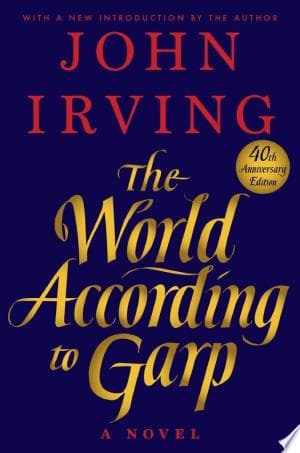
John Irving (2018)
Genre
Literary Fiction
Reading Time
18 hours 8 min
Key Themes
See below
Sign in to track this book
A feminist leader and her son navigate tragedy and comedy in a violent, intolerant world, showing that 'we are all terminal cases'.
The story starts with Jenny Fields, a nurse at a New England boys' school. She wants a child but has no interest in sex. During World War II, she has sex with a dying, brain-damaged sergeant, Technical Sergeant Garp, in a hospital ward. He cannot consent or refuse. This unusual act leads to the birth of her son, T. S. Garp. Jenny, a very independent woman, raises Garp alone at the Steering School where she works. Her memoir, 'A Sexual Suspect,' tells about her life and ideas as a single mother. It unexpectedly becomes an important book for a growing feminist movement, giving her an unplanned but influential public role.
Garp spends his childhood at Steering School, a place filled with boys and sometimes odd staff. He becomes close with his mother, Jenny, and enjoys wrestling. More importantly, Garp finds his love for writing. He is especially drawn to the school's wrestling coach, Ernie Holm, and his family, particularly his daughter, Helen Holm. Garp's early stories often show the strange and sometimes violent things he sees, hinting at the tragicomic nature of his future work. His goal to become a writer is set during these early years.
After Garp finishes school, he marries Helen Holm, his former English teacher's daughter and the love of his life. They move to Vienna, Austria, so Garp can focus on writing while Helen studies. In Vienna, Garp writes his first novel, 'The Pension Grillparzer,' a dark and unusual story based on his experiences. Helen supports him, but their early marriage is marked by Garp's intense focus on his writing and the emotional toll it sometimes takes. When it is published, 'The Pension Grillparzer' gets some good reviews, making Garp a promising new writer.
Garp and Helen return to America and live near the Steering School. They have two sons, Duncan and Walt. Garp continues to write a lot, and his later novels are more successful, though some critics find his themes of violence, infidelity, and death disturbing. Jenny Fields's feminist movement, helped by her memoir, grows. She becomes a public figure, and many 'Ellen Jamesians'—women who have had their tongues cut out by men—come to their home for shelter. The family's life is a mix of home life, Garp's demanding writing, and the constant flow of Jenny's followers. This creates a messy but loving home.
One afternoon, Garp, Helen, and their two sons, Duncan and Walt, are in a terrible car accident. The accident happens when Garp is driving and is distracted by Helen's affair with Michael Milton, one of his graduate students. Helen and Milton are having sex in the car. The car goes off the road and hits a tree. Tragically, their younger son, Walt, dies right away. Duncan loses an eye, and Helen is badly hurt. Garp is also injured but recovers physically. The accident shatters the family, leaving them with grief, guilt, and the permanent loss of Walt. This changes their relationships and Garp's view of life and writing forever.
After Walt's death, the Garp home is full of deep sorrow. Garp struggles greatly with the loss and the accident's circumstances. Helen, full of guilt over her affair, also suffers deeply. To cope, Garp seeks revenge on Michael Milton. He finds Milton and brutally attacks him, acting on a violent urge from his sadness and anger. This act of violence gives Garp a temporary feeling of revenge, but it does little to ease the pain and trauma that still affects the family.
Jenny Fields, who has become an internationally known feminist and leader of the Ellen Jamesians, is assassinated. She is shot during a public event by a disturbed man who strongly opposes her feminist views. This shocking event devastates Garp, who loved his mother, and further adds to the family's grief and feeling of vulnerability. Jenny's death becomes an important moment in the story, showing the dangers and extreme reactions her radical ideas sometimes caused. It leaves a deep emptiness in the lives of her followers and, especially, her son.
After his mother's death and the lasting trauma of Walt's accident, Garp continues to write. He produces increasingly complex and often darker novels. His work receives significant praise and popular success, but he remains a controversial figure, both for his books' explicit content and his connection to his famous mother. Garp struggles with the demands of fame, his readers, and the constant threat of violence that seems to fill his world, reflecting the themes in his own fiction. He thinks more and more about how fragile life is and how death is certain, often showing these worries through his characters and stories.
Duncan, Garp's surviving son, grows up with the physical and emotional scars of the car accident. He deals with his identity, his father's fame, and the lasting influence of his grandmother, Jenny Fields. As he gets older, Duncan becomes involved with the Ellen Jamesians, women who have had their tongues removed, either literally or symbolically. They find comfort and strength in Jenny's teachings. He develops a close relationship with some of these women, especially Roberta Muldoon, who becomes like a mother to him. Duncan's experiences offer a different view of the feminist movement and the impact of violence against women.
In a cruel twist, Garp himself is assassinated while coaching wrestling at the Steering School. A disturbed Ellen Jamesian shoots him. She mistakenly thinks he is an anti-feminist because of a misunderstanding and her own mental instability. Garp dies young, leaving behind Helen, Duncan, and his many literary works. His death highlights the widespread violence and absurdity that marked his life. Despite his early end, Garp's stories, his unique view of the world, and his impact on those around him continue to be felt, ensuring his legacy as a writer and a complex person.
The Protagonist
Garp evolves from an ambitious young writer into a mature author deeply scarred by tragedy, ultimately finding solace and meaning in his art despite life's pervasive absurdities.
The Supporting
Jenny transforms from a private, unconventional woman into a reluctant but powerful public figure, ultimately becoming a martyr for her cause.
The Supporting
Helen's journey is one of navigating marital complexities, enduring profound grief, and ultimately finding resilience and a quiet strength in the face of life's betrayals and losses.
The Supporting
Roberta transitions from a male athlete to a woman, finding her true identity and purpose as a compassionate protector and loyal follower of Jenny Fields.
The Supporting
Duncan grows from a traumatized child into a thoughtful young man, grappling with personal loss and finding his place within his unconventional family's history.
The Supporting
Walt's character arc is cut short by his tragic death, serving as a catalyst for the profound grief and changes experienced by his family.
The Supporting
Ernie remains a consistent figure, embodying a stable, traditional masculinity and sportsmanship in contrast to the changing world around him.
The Mentioned
Milton's brief appearance serves as a catalyst for the novel's central tragedy, leading to his own violent retribution.
The Supporting
The Ellen Jamesians evolve from a marginalized group seeking solace to a significant social force, reflecting both the strengths and potential dangers of collective identity.
Violence, both random and planned, is a constant, almost unavoidable force in 'The World According to Garp.' From Garp's unusual birth during wartime to the car accident that kills Walt and hurts Duncan, and the murders of both Jenny and Garp, the novel repeatedly shows how life can be broken by unexpected brutality. Irving shows violence not as a single event but as a core, often absurd, part of being human. This idea is clear in Garp's own focus on violence in his writing and his attempts to understand a world where safety is an illusion, as shown by the repeated phrase, 'in this life, we are all terminal cases.'
“In this life, we are all terminal cases.”
The novel deeply looks at how feminism and traditional gender roles change through Jenny Fields and the Ellen Jamesians. Jenny's independent choice to have a child and her memoir make her a feminist symbol, challenging old rules. The Ellen Jamesians, women who have experienced sexual violence and have symbolically or literally lost their voices, show the extreme results of misogyny and the shared search for power. Garp, as a man, often finds himself caught between these changing gender roles, trying to understand and support the women in his life while also being seen as a threat or an ally. This theme explores the difficult parts of male-female relationships, sexual politics, and how society reacts to new ideas about gender.
“A man's world is a woman's world; they can't be separated.”
Garp's life and his art are closely connected throughout the novel. His experiences—his unusual birth, his family life, the tragedies he lives through, and what he sees in the world—directly shape his fiction. In turn, his writing often helps him process and understand the chaos and sadness of his life. Irving often blurs the lines between Garp's 'real' life and the fictional worlds he creates, suggesting that art reflects reality and helps organize it. The novel itself includes parts of Garp's stories, showing how his personal worries and events, especially the constant threat of violence and death, appear in his writing.
“He was a writer who wrote about what he knew, and what he knew was sometimes horrible.”
At its heart, 'The World According to Garp' tells about the complicated nature of family relationships and how love lasts through infidelity and tragedy. The Garp family, despite its quirks and deep losses, stays a unit held together by strong affection. Garp's marriage to Helen is tested by affairs on both sides, yet their love continues. The bond between Garp and his sons, and his steady love for his mother, form the emotional core of the story. The novel shows how love, even when it is not perfect or is challenged by betrayal and grief, can be a strong force, offering comfort and meaning in a often chaotic world.
“We are a family, after all, and even if we don't always like one another, we love one another.”
Many characters in the novel deal with questions about who they are. Jenny Fields strongly defines herself outside of what society expects of women. Garp works to create his own identity as a writer, separate from his famous mother's influence, and to balance his roles as artist, husband, and father. Roberta Muldoon's journey as a transgender woman is a powerful example of defining oneself against societal norms. Duncan, scarred by the accident and living in the shadow of his family's fame and tragedy, also searches for his place in the world. This theme shows the constant human effort to understand oneself and create a unique life.
“You are your own story; it's a good story.”
Incorporating Garp's own fictional works within the novel's main narrative.
Irving frequently embeds Garp's short stories and novel excerpts directly into the main plot. This metafictional device serves several purposes: it allows the reader to experience Garp's artistic process firsthand, it blurs the line between Garp's 'real' life and his creative output, and it often foreshadows or comments on events in the main narrative. For instance, 'The Pension Grillparzer' and Garp's later, darker stories reflect his anxieties and the tragedies he experiences, making his art a direct mirror of his life and vice-versa. This technique deepens the reader's understanding of Garp's character and the novel's central theme of the interplay between life and art.
Hints and predictions of future tragedies and events.
The novel is replete with subtle and overt foreshadowing, often creating a sense of impending doom and tragedy. Garp himself frequently expresses anxieties about accidents and death, which often manifest in his stories before they occur in his life. The repeated phrase 'in this life, we are all terminal cases' serves as a constant, morbid reminder of mortality. The descriptions of specific events, like the children's car seat and the potential for an accident, build tension and prepare the reader for the inevitable tragedies that befall the Garp family. This device heightens the novel's tragicomic tone, making the reader aware of the fragility of life even in moments of joy.
The boys' school as a setting that reflects broader societal themes.
The Steering School, where Garp is born, grows up, and eventually returns to, functions as a microcosm of the larger world. Its all-male environment, strict rules, and the wrestling culture within it provide a backdrop for exploring themes of masculinity, violence, and social order. The school's transition from a traditional boys' institution to one that eventually houses the Ellen Jamesians reflects the changing societal landscape and the clash of traditional versus feminist ideologies. It serves as a consistent, yet evolving, backdrop for the Garp family's life, symbolizing both stability and the inevitable forces of change and disruption.
A symbolic community representing the impact of sexual violence and the search for voice.
The Ellen Jamesians are more than just a group of characters; they are a powerful symbolic device. Their literal or metaphorical loss of tongues represents the silencing of women who have experienced sexual violence and patriarchal oppression. Their collective presence at the Garp household highlights the widespread nature of such trauma and the desperate need for a supportive community. They serve as a constant reminder of the darker, violent undercurrents of society that Jenny Fields's feminism seeks to address. Their actions, though sometimes extreme, underscore the urgency and desperation of their cause, and their eventual role in Garp's death brings the theme of violence full circle.
“In the world according to Garp, we are all of us in the soup.”
— A recurring phrase, often said by Jenny Fields, summarizing the unpredictable and often messy nature of life.
“You can't be a serious writer if you don't write. You can't be a serious anything if you don't do it.”
— Garp's belief in the importance of action and dedication to one's craft.
“Life is a hospital, but the patients are all insane.”
— A cynical observation reflecting the chaotic and often irrational behavior in the world.
“We are all terminal cases.”
— A stark reminder of human mortality, often appearing in Garp's thoughts or discussions.
“Beware of people who want to share their dreams with you.”
— A warning about the potential imposition or burden of others' unfulfilled aspirations.
“He was, in short, a man who saw the world as a place where things were always happening, and usually for the worse.”
— Describing Garp's generally pessimistic, yet often realistic, worldview.
“The world is full of people who are trying to get you to do something you don't want to do.”
— A reflection on the pressures and manipulations present in social interactions.
“Most people are born, they live, they die, and they're forgotten. And they don't even care.”
— Garp's observation on the common human experience and the lack of a lasting legacy for many.
“It was not a good time for women. It was not a good time for men. It was a good time for children, if they were lucky.”
— A comment on the societal conditions and gender roles of the time period depicted in the novel.
“Life is a series of collisions with the future.”
— A metaphorical description of how life unfolds, with unpredictable encounters and changes.
“You get to a certain age, and you realize you're not going to be what you thought you were going to be.”
— A poignant reflection on the disillusionment that can come with maturity and unfulfilled youthful aspirations.
“Writing is a lonely profession. It's just you and the page.”
— A straightforward acknowledgment of the solitary nature of the writing process.
“The world is full of accidental deaths. The world is full of intentional deaths. The world is just full of deaths.”
— A grim and repetitive observation on the prevalence and inevitability of death in all its forms.
“Slightly mad and totally sane, that's what a good writer is.”
— Garp's view on the necessary blend of eccentricity and groundedness required for a writer.
Ready to see how well you understood this book? Take our interactive quiz with 10 questions.

John Winslow Irving is an American-Canadian novelist, short story writer, and screenwriter.







