“Memory, she knew, was a fickle thing. It changed shape and color with each retelling, each new piece of information.”
— Marianne reflects on the nature of memory and how it's not a static record.

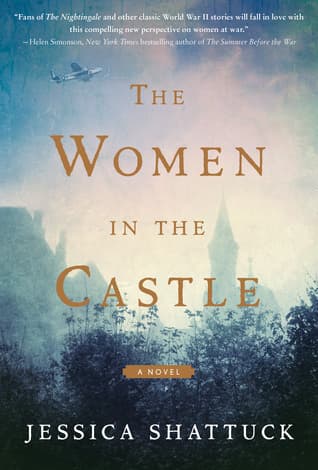
Jessica Shattuck (2017)
Genre
Historical Fiction
Reading Time
356 min
Key Themes
See below
Sign in to track this book
Three German widows of resistance fighters navigate the moral complexities and dark secrets of survival in the aftermath of World War II, living together in a crumbling Bavarian castle.
Immediately after World War II, Marianne von Lingenfels, widow of a German resistance fighter executed for his role in the 1944 plot against Hitler, returns to her husband's family's crumbling ancestral castle in Bavaria. Driven by a promise made to her husband and his fellow conspirators, she aims to find and protect their wives and children. Her first act is to rescue six-year-old Martin, the son of her childhood friend Benita, from a Nazi reeducation home. Together, they travel through the ravaged landscape of post-war Germany, heading towards Berlin where Benita is thought to be, having fallen into the hands of the occupying Red Army.
Marianne and Martin arrive in devastated Berlin, a city scarred by war and occupied by the Soviets. They eventually find Benita, Martin's mother, but she is not the naive, lively woman Marianne remembers. Benita has endured horrific experiences with the Red Army, leaving her emotionally fragile, withdrawn, and dependent on a Soviet officer named Vasily for protection. This relationship deeply disturbs Marianne. The reunion is full of unspoken pain and the stark realization of how much war has changed them all, especially Benita's spirit and her ability to care for her son.
Continuing her mission, Marianne travels to a refugee camp where she finds Ania, the wife of another executed resistance member, and her two young sons, Waldemar and Gunther. Ania, a woman from a humbler background with a practical and resilient nature, is cautious but accepts Marianne's invitation to live at the castle. The three women and their children gather at the dilapidated castle, trying to create a home and family amid the ruins. Their different social classes, personalities, and wartime experiences immediately create tension within the makeshift household.
Life in the castle is a constant struggle for survival. Food is scarce, the castle is falling apart, and the women must work together to maintain it and feed the children. As they face these daily hardships, their individual secrets and unresolved traumas begin to surface. Marianne, initially strict in her moral code, struggles to reconcile the 'heroes' of the resistance with the complex, flawed women they left behind. Benita remains emotionally distant, while Ania, resourceful and protective of her children, often clashes with Marianne's aristocratic sensibilities and Benita's passive nature. The children also cope with their losses in different ways, adding another layer of complexity to the household.
Over time, the women's pasts begin to unfold. It is revealed that Benita's husband, Peter, was not as deeply involved in the resistance as Marianne believed; his participation was more a matter of circumstance and pressure than ideological conviction. Furthermore, Benita holds a dark secret about her own wartime actions, specifically a relationship with a high-ranking Nazi official that began before the war. This revelation shatters Marianne's idealized view of the resistance and forces her to confront the moral ambiguities of survival during such a brutal period, challenging her black-and-white perception of good and evil.
Ania's past also comes to light, revealing her own practical and often morally ambiguous choices for survival. It is discovered that she maintained a relationship with a former Nazi officer, Georg, who later becomes an important figure in their post-war lives. Ania's actions, while ensuring her children's survival, directly contradict Marianne's strict moral framework, leading to further tension. Ania's resilience and willingness to do whatever is necessary for her family stand in stark contrast to Marianne's idealism, highlighting the different ways people adapted to and survived the war's brutality, often at great personal and moral cost.
As the years pass, the children grow up in the shadow of their parents' pasts. Difficult decisions are made regarding their education and future. Martin, Benita's son, eventually leaves the castle for a new life, reflecting his mother's desire for him to escape the trauma. Waldemar and Gunther, Ania's sons, embody the resilience of the generation growing up in post-war Germany, learning to navigate a world vastly different from their parents'. The women, despite their ongoing disagreements, find a fragile common ground in their shared commitment to the children's well-being.
The relationships between Marianne, Benita, and Ania continue to change, marked by intense conflict and moments of deep understanding. Marianne grapples with her disillusionment, realizing that her husband's resistance was not as pure as she once believed, and that the women he left behind are far more complex than she imagined. Benita slowly begins to heal, finding her voice and some independence, though her trauma remains. Ania, always practical, continues to make choices that ensure her family's stability, often clashing with Marianne's ideals. Despite their differences, a unique bond of shared experience and mutual, if sometimes reluctant, respect forms between them.
Ultimately, the women must confront the full, honest truths of their individual and collective pasts. This includes facing the morally ambiguous choices each made for survival, the complexities of their husbands' roles in the resistance, and the profound betrayals and losses they endured. The process is painful, challenging their initial perceptions of themselves and each other. Through these confrontations, they begin to understand that survival in wartime often requires compromises that blur the lines between right and wrong, and that true forgiveness, both for themselves and for others, is essential for moving forward.
Decades later, the women, though aged and marked by their experiences, find a semblance of peace at the castle. Their makeshift family has endured, transforming from a promise-bound obligation into a genuine, if unconventional, bond. They have learned to live with their secrets, their grief, and their shared history. The castle, once a symbol of aristocratic German past and then a ruin, becomes a symbol of their resilience and the enduring power of human connection. Their story becomes a quiet legacy of survival, forgiveness, and the redefined meaning of family in the wake of unimaginable hardship.
The Protagonist
Marianne evolves from a rigid idealist to a more compassionate and understanding woman, accepting the complexities of morality and survival.
The Protagonist/Supporting
Benita transforms from a traumatized, passive victim to a woman who slowly reclaims her agency and finds a path toward healing.
The Protagonist/Supporting
Ania remains steadfast in her pragmatism and maternal devotion, finding stability and a unique form of strength.
The Supporting
Martin grows from a quiet, traumatized child into a young man seeking his own identity separate from the castle's past.
The Supporting
They grow up resiliently, embodying the future of post-war Germany, shaped by their mother's pragmatism.
The Mentioned
His idealized memory is challenged and recontextualized through the women's revelations.
The Mentioned
His perceived heroism is deconstructed, revealing a more complex and human figure.
The Supporting
He remains a figure of moral ambiguity, highlighting the compromises of survival.
The novel explores the complex moral choices people made to survive during and after World War II. Marianne's initial black-and-white view of good versus evil, especially concerning the resistance, is challenged by Benita's and Ania's past actions. Benita's relationship with a high-ranking Nazi and her later reliance on a Soviet officer, and Ania's practicality in dealing with Georg, a former Nazi, force Marianne to confront the uncomfortable truth that survival often required morally compromised decisions. The book shows that heroism and villainy were not always clear-cut, especially in total war.
“Perhaps there were two kinds of resistance: the kind that sought to change the world, and the kind that simply sought to survive it.”
The lasting psychological and emotional scars of World War II are a central theme. Benita's deep trauma from her experiences with the Red Army leaves her withdrawn and unable to fully connect with her son. Marianne, though outwardly strong, carries the grief of her husband's loss and the disillusionment of her shattered ideals. Even the children, like Martin, bear the invisible wounds of displacement and loss. The novel shows how war's impact extends far beyond the battlefield, shaping individual lives and relationships for decades, making genuine healing a long and difficult process.
“The war had ended, but its ghosts still walked among them, whispering of what had been lost.”
After immense loss and societal upheaval, the novel examines how individuals create new definitions of family and belonging. Marianne's initial mission to gather the 'resistance widows' stems from a sense of duty, but the makeshift family that forms at the castle goes beyond blood ties and shared ideology. Despite their deep differences and conflicts, Marianne, Benita, and Ania, along with their children, create an unconventional, yet lasting, family unit. This theme highlights the human need for connection and support in times of crisis, showing how shared hardship can create bonds stronger than conventional relationships.
“Family was not always blood, not always chosen, but sometimes, it was simply who was left.”
The characters constantly grapple with their memories of the past, often idealized or suppressed, and the painful process of uncovering the full truth. Marianne's idealized memory of her husband and the resistance is challenged by revelations about Peter's ambiguous involvement and Benita's secrets. Benita herself must confront the truth of her own wartime choices to begin healing. The journey towards forgiveness, both of others and of oneself for the compromises made, is central to the women's ability to move forward. The novel suggests that true healing requires acknowledging the uncomfortable truths of history and personal experience.
“The past was not a neat story, but a tangle of half-truths and forgotten moments, waiting to trip you up.”
A physical and symbolic setting representing past grandeur and present ruin.
The crumbling Bavarian castle serves as both a literal refuge and a powerful symbol throughout the novel. Initially, it represents the decaying aristocratic past of Germany, a symbol of a world that no longer exists. For Marianne, it embodies her duty and a connection to her husband's lineage. As the women inhabit it, it becomes a metaphor for their own lives: once grand, now broken, but still offering shelter and the potential for rebuilding. Its physical decay mirrors their emotional and societal ruin, while its enduring structure signifies their resilience and the possibility of new beginnings.
A driving motivation for Marianne's actions, initially seen as a clear moral imperative.
Marianne's promise to her deceased husband and his fellow conspirators – to protect their wives and children – acts as the primary catalyst for the entire plot. It provides her with a clear sense of purpose in the immediate aftermath of the war. However, this plot device is subtly subverted as the story progresses. The 'promise' initially represents a black-and-white moral code, but as Marianne encounters the complex realities of Benita and Ania, she realizes the 'heroes' of the resistance left behind women who made morally ambiguous choices for survival, challenging the purity of her original intention and forcing her to redefine the meaning of her promise.
The gradual unveiling of characters' past actions and motivations.
The slow, deliberate revelation of the women's wartime secrets and the true nature of their husbands' involvements in the resistance is a key plot device. These secrets, held by Benita (her relationship with a Nazi official) and Ania (her pragmatic alliance with Georg), and even the nuanced truth about Peter's role, serve to drive the narrative tension and challenge Marianne's rigid worldview. Each revelation forces the characters, particularly Marianne, to re-evaluate their perceptions of morality, heroism, and the sacrifices made during wartime, fundamentally altering their relationships and understanding of themselves.
Representing innocence, the future, and the burden of the past.
The children (Martin, Waldemar, Gunther) serve multiple functions. They are a poignant reminder of the innocence lost to war and the profound impact of adult choices on the next generation. They are also a primary motivation for the women's survival and their efforts to rebuild a life. Furthermore, as they grow, they represent the future of Germany, burdened by the shadows of their parents' pasts but also embodying hope for renewal. Their differing personalities and coping mechanisms highlight the varied long-term effects of war on young minds.
“Memory, she knew, was a fickle thing. It changed shape and color with each retelling, each new piece of information.”
— Marianne reflects on the nature of memory and how it's not a static record.
“The past was a country no one could ever truly leave. It followed you, a shadow, sometimes faint, sometimes glaring.”
— Marianne's internal thoughts on the inescapable influence of past events.
“Survival was not a virtue, not always. Sometimes it was just a matter of luck, or a willingness to do what others would not.”
— Benita's pragmatic and somewhat cynical view on her own survival during the war.
“Love, like grief, was a landscape you had to learn to navigate, to find your way through even when the landmarks were gone.”
— Marianne considers the enduring nature of love and grief in the aftermath of loss.
“The world had broken, and they were trying to piece it back together with the wrong fragments.”
— The women struggle to rebuild their lives and society after the war.
“Guilt was a heavy cloak, and it never quite came off, no matter how much you washed it.”
— Benita's internal struggle with her past actions and decisions.
“There were so many ways to be brave, and not all of them involved a uniform or a weapon.”
— Marianne reflects on the different forms of courage shown by ordinary people.
“Secrets were like splinters. They burrowed deep, and if you didn't get them out, they festered.”
— An observation about the corrosive nature of keeping secrets among the characters.
“Hope was a dangerous thing, but sometimes, it was all you had.”
— An internal thought reflecting the precarious balance between despair and optimism in dire times.
“They were women who had been forged in fire, and the marks would never fully fade.”
— A description of the enduring impact of the war on the lives and identities of the main characters.
“To forget was a mercy, sometimes. To remember was a duty, always.”
— Marianne grapples with the tension between wanting to forget the horrors and the responsibility to remember.
“The war had ended, but the battle for peace, inside and out, was just beginning.”
— A reflection on the challenges of adjusting to post-war life and finding inner peace.
“She learned that people could be both terrible and wonderful, often at the same time.”
— Marianne's evolving understanding of human nature through her experiences with various characters.
“The castle, for all its history, was now just a shell, holding the echoes of lives that were irrevocably altered.”
— A description of the physical setting reflecting the psychological state of its inhabitants.
Ready to see how well you understood this book? Take our interactive quiz with 10 questions.







