“When your mother is a witch, you are a witch. It is in the blood.”
— Mar'ya telling Vasya about her heritage and the inevitability of her nature.

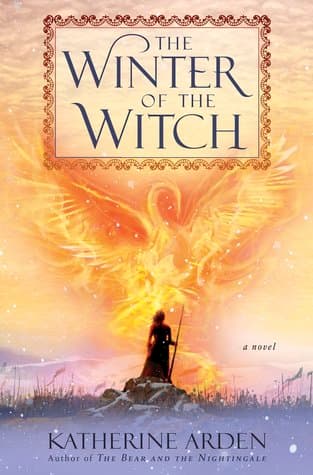
Katherine Arden (2019)
Genre
Fantasy / Historical Fiction / Young Adult / Romance
Reading Time
450 min
Key Themes
See below
Sign in to track this book
In Moscow, on the edge of war, a young witch with frost in her veins must defy demons and a Grand Prince to save Russia's mortal and magical realms, even if it costs her everything.
After the Moscow fire, Prince Dmitri Ivanovich's men arrest Vasya, accusing her of witchcraft and arson. They blame her for his brother Sergei's death and the city's ruin. Dmitri, grieving and angry, listens to the priest Konstantin, who uses people's fear of paganism. Vasya faces a public trial, where Konstantin turns the crowd against her, demanding her death. Morozko, the frost-demon, is weak from the fire and cannot help. Vasya faces her accusers alone, with only her quick thinking and subtle magic.
At the trial, Vasya escapes execution when her brother Sasha, now a monk, and her friend Olga create a distraction. She flees into the forest, a familiar refuge. There, she recovers her strength and reconnects with wild magic. She still feels the pain of Moscow's destruction and Morozko's near-death, knowing she is now an outcast in the human world.
Deep in the forest, Vasya senses a growing evil. She discovers that Medvyed, the ancient Bear-demon and Morozko's brother, has grown stronger from Russia's fear and chaos. He wants to absorb all old gods and spirits, taking their power to rule both worlds. Medvyed plans to manipulate Dmitri into war with the Tatars, using the bloodshed to increase his power and bring a dark age to Russia. Vasya realizes she must confront him, despite her own weakness and Morozko's fragile state.
To understand Medvyed's power and find a way to defeat him, Vasya decides to go to the Midnight Realm, the land of ancient spirits and the dead. This dangerous journey pushes her magic to its limits. There, she meets powerful beings, including the ancient sorceress Lesnaya, who gives her cryptic advice. Vasya learns about the cosmos, the balance of creation and destruction, and her own connection to both worlds as a child of mortal and magical heritage.
During Vasya's journey, Morozko slowly regains strength, though he is still weak. Their bond deepens as they share their fears. Morozko reveals more about his past, his rivalry with Medvyed, and ancient pacts that hold the world together. He recognizes Vasya's unique power and her role as a bridge between worlds. Together, they plan to counter Medvyed's growing power and protect Russia, knowing their combined, though diminished, strength is their only hope.
Vasya knows Medvyed is pushing Prince Dmitri into war with the Tatars, so she tries to return to Moscow to warn him. She faces much resistance and disbelief, as Konstantin continues to turn Dmitri against her and paganism. Despite the danger, Vasya uses her magic to subtly influence events, trying to expose Konstantin's corrupt nature and Medvyed's influence. She wants to show Dmitri the real threat, hoping to prevent the battle Medvyed wants for its destructive energy. Her efforts meet suspicion and fear, making it hard to earn his trust.
Despite Vasya's efforts, Prince Dmitri, influenced by Konstantin and Medvyed, marches his army toward the Don River to fight the Tatar horde. The stage is set for the Battle of Kulikovo, a historical conflict Medvyed plans to use for power. Vasya, with Morozko, Sasha, and Olga, follows the armies, knowing Russia's fate rests on this battle. The air is tense as the human world prepares for war, unaware of the ancient, dark forces at play.
The Battle of Kulikovo begins in a brutal, bloody fight. As people die, Medvyed's power grows, feeding on fear, pain, and death. He appears in a terrifying, huge form, trying to absorb all of Russia's spirits, old and new. Vasya, with Morozko, confronts Medvyed on the battlefield. She uses all her magic, drawing on the strength of the land, spirits, and her heritage. The fight is not just for the soldiers' lives, but for Russia's soul and the cosmos' balance.
In a final fight, Vasya realizes Medvyed cannot simply be killed, but must be contained. She understands that her unique nature, a mix of mortal and magical, makes her the only one who can truly confront him. She makes a great sacrifice, using her life force and connection to the magical world to bind Medvyed, stopping him from consuming Russia's magic. This act costs her much, changing her forever, and forcing Morozko to make a heartbreaking choice to save her.
With Medvyed defeated, the land slowly heals, and the balance between the seen and unseen worlds is restored, though changed. Prince Dmitri, sobered by war and Konstantin's deceit, begins to lead more wisely. Vasya, changed by her sacrifice, finds herself in a new state, more connected to the magical world, yet still tied to humanity. She and Morozko, their bond strong from shared trials, must navigate their new reality. Vasya chooses to be a guardian of Russia's magic, a true witch, always watching over her land.
The Protagonist
Vasya fully embraces her identity as a witch, makes a profound sacrifice to save Russia, and ultimately chooses a path of eternal guardianship over domesticity.
The Supporting/Love Interest
Morozko is severely weakened, recovers, and ultimately chooses to sacrifice his own freedom to save Vasya, forever binding their fates.
The Antagonist
Medvyed rises to near-absolute power, forcing a final confrontation, and is ultimately bound and contained by Vasya's sacrifice.
The Antagonist
Konstantin rises to influence through manipulation, incites war, and is ultimately exposed and loses his power, facing a grim fate.
The Supporting
Dmitri is manipulated into war, experiences profound loss, and ultimately learns to lead with greater wisdom and less susceptibility to fanaticism.
The Supporting
Sasha grapples with his faith and loyalty, ultimately choosing to protect his sister despite the spiritual cost, finding a more nuanced understanding of belief.
The Supporting
Olga grows to accept and protect Vasya's true nature, demonstrating her unwavering loyalty and strength as a sister and leader.
The Mentioned/Supporting
Lesnaya serves as a catalyst for Vasya's self-discovery and understanding of her power, remaining a mysterious, guiding presence.
The novel shows the conflict between old pagan ways and rising Christianity in medieval Russia. Vasya, a witch, represents the old, while Konstantin shows the strong, often violent, push of the new faith. This clash is not just religious but also cultural and political, as changing beliefs affect the chyerti's power and the world's balance. Moscow's burning and Vasya's persecution result from this conflict, showing intolerance's destructive power when old gods are forgotten and new ones are not fully understood.
““They are not devils, Vasya. They are only spirits. They are as old as the world.””
A main theme is that true power and love often need great sacrifice. Vasya often risks her life and freedom to protect others, ending with her sacrifice to bind Medvyed. Through these actions, she saves Russia and fully understands her identity as a powerful witch, moving past limits set by society and her own fears. Morozko also makes a big sacrifice, choosing to bind himself to Vasya to save her, showing that love can demand an eternal commitment that changes one's being.
““There is no good without evil, no light without shadows, and no life without death.””
The trilogy always highlights the clear link between the mortal, 'seen' world and the magical, 'unseen' world. In 'The Winter of the Witch,' this theme is key as Medvyed's attempt to control both realms shows the delicate balance needed. Vasya, as a 'bridge' between these worlds, is essential to their salvation. The health of one affects the other; human fear and hate strengthen destructive magic, while faith and love can empower protective forces. Russia's well-being depends not just on human actions, but on recognizing and respecting the spirits in the land.
““The unseen world is not separate from the seen, little bear. It is woven into it.””
Vasya struggles with fate throughout the book – whether her path is set or if she has real choice. She constantly defies expectations and even prophecies, choosing her own way. Her choice to become a wandering guardian of Russia, instead of settling or following an expected fate, shows her strong independence and the power of individual will. Even Morozko, an ancient being, chooses to change his own fate by binding himself to Vasya, showing that even powerful, fated beings can choose their own paths through love and sacrifice.
““Let them call me witch. Let them call me monster. I am what I am.””
The novel explores different types of power: the obvious political and military power of princes, the Church's spiritual power, and the ancient, primal power of the magical world. It shows how power can corrupt (Konstantin, Medvyed) but also how it can be used for protection and good (Vasya, Morozko). The story suggests that true, lasting power is not about control, but about balance, understanding, and willingness to sacrifice for the greater good. Vasya's power is unique because it comes from empathy and connection, not from control.
““Power is a hungry thing. It eats all it can find, until only it remains.””
A catastrophic event that ignites the central conflict and sets the plot in motion.
The fire that devastates Moscow serves as the inciting incident, immediately placing Vasya in mortal danger and exposing the deep-seated fears and superstitions of the populace. It directly leads to her accusation as a witch, forcing her to flee and setting her on a path to confront Medvyed. The destruction also weakens Morozko and strengthens Medvyed, dramatically shifting the balance of power in the magical world and raising the stakes for the entire narrative.
An ethereal, magical dimension that serves as a source of ancient knowledge and power.
The Midnight Realm functions as a mystical setting that Vasya must visit to gain crucial understanding and power. It is a place where time and space are fluid, inhabited by ancient spirits and powerful entities like Lesnaya. Her journey there allows her to delve deeper into the lore of the world, understand Medvyed's true nature, and learn more about her own unique magical heritage. It is a place of profound revelation, essential for her growth and ability to confront the ultimate antagonist.
A historical battle serving as the climax where mortal and magical conflicts converge.
The Battle of Kulikovo is a pivotal plot device, serving as the physical and magical climax of the story. It is a real historical event, which grounds the fantasy elements in a tangible reality. In the narrative, this battle is not merely a human conflict but is actively orchestrated by Medvyed to feed on the resulting fear, chaos, and death. It is the stage upon which Vasya must make her ultimate stand against the Bear-demon, where the fate of both the seen and unseen Russias hangs in the balance.
A unique magical attribute symbolizing her destiny and connection to life and death.
Vasya's 'firebird heart' is a symbolic and literal magical attribute that sets her apart. It represents her unique connection to both life and death, creation and destruction, and her ability to bridge the mortal and magical worlds. It is a source of immense power, but also a vulnerability. This device highlights her fated role and is crucial to her ultimate sacrifice, as she uses its unique properties to bind Medvyed, demonstrating that her power is not just destructive but capable of profound, life-altering creation and containment.
“When your mother is a witch, you are a witch. It is in the blood.”
— Mar'ya telling Vasya about her heritage and the inevitability of her nature.
“To be brave, you must have something to lose.”
— Vasya reflecting on her own courage and the sacrifices she has made.
“Love is not a cage, little bird. It is a flight.”
— Morozko to Vasya, encouraging her freedom and to follow her own path.
“The world is not always kind to girls who are not afraid.”
— Vasya's internal thought, acknowledging the dangers of defying societal expectations.
“A human life is a river, always flowing, always changing.”
— Morozko's philosophical observation on the transient nature of human existence.
“Power is not given. It is taken.”
— Vasya's realization about asserting her own will and capabilities.
“Fire purifies. It burns away the old to make way for the new.”
— Vasya contemplating the destructive and regenerative power of fire.
“To live is to choose. To choose is to lose.”
— Morozko's bittersweet wisdom about the nature of choice and sacrifice.
“Grief is a heavy cloak. It can smother you if you let it.”
— Vasya's internal reflection on dealing with loss and moving forward.
“The forest remembers. The stones remember. The earth remembers.”
— Vasya's understanding of the enduring memory of the natural world.
“Even a witch can be lonely.”
— Vasya's poignant thought, highlighting her isolation despite her powers.
“True strength is not in never falling, but in rising every time you fall.”
— Vasya's internal monologue about perseverance and inner fortitude.
“Some things, once broken, can never be mended, only rebuilt.”
— Vasya's somber realization about the irreversible nature of certain events.
“Magic is not good or evil. It is merely a tool.”
— Vasya's evolving understanding of the neutrality of magic and the intentions of its user.
Ready to see how well you understood this book? Take our interactive quiz with 10 questions.

Biography coming soon.







