“Never mistake an illusion for a hope.”
— Kestrel speaking to Bowman, reflecting on the nature of their quest.

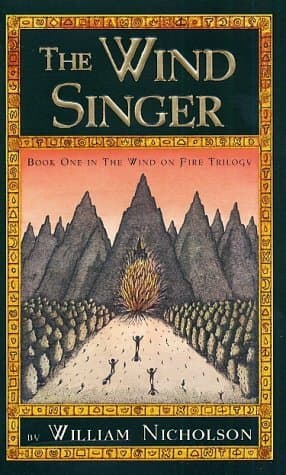
William Nicholson (2000)
Genre
Fantasy / Children's / Science Fiction / Young Adult
Reading Time
450 min
Key Themes
See below
Sign in to track this book
In a city obsessed with work and social climbing, three children defy a tyrannical system to seek a mythical instrument, the Wind Singer, hoping its ancient voice can free their people from a dreamless life guarded by a monstrous entity and its army of perfect killing machines.
Aramanth is governed by a strict rating system, where citizens work to improve their family's station. Kestrel Hath, a defiant girl, dislikes this endless work and the suppression of creativity it brings. During a critical exam, designed to determine her family's future dwelling, Kestrel openly challenges the authorities, refusing to participate in the tests. Her rebellion causes a city-wide scandal, leading to her family, the Haths, being demoted to the lowest dwelling, the Grays. This public defiance sets Kestrel apart from her more compliant twin brother, Bowman, and their timid friend, Mumpo, but also starts her desire for change.
After Kestrel's disruptive behavior, the Emperor of Aramanth, a figure of ultimate authority, summons her. Instead of punishing her, he gives her a challenge: to find the 'voice' of the Wind Singer, an ancient, colossal instrument that stands silent at the city's heart. Legend says that if the Wind Singer's voice is restored, Aramanth will be saved from its stagnant life. The Emperor gives Kestrel an ancient, cryptic map and an old compass, hinting at a journey beyond the city's walls. This challenge, initially a form of exile, becomes Kestrel's only path to redemption for her family and the city.
Kestrel, with her reluctant twin brother Bowman and their loyal but fearful friend Mumpo, prepares for the dangerous quest. They decide their only option is to escape Aramanth, a city known for its impenetrable walls. Their escape route leads them into the city's vast and dangerous sewer system, a dark, complex world beneath the surface. Here, they encounter fearsome mud-larks, grotesque creatures that live in the depths, and must navigate treacherous currents and hidden passages. This first part of their journey immediately tests their courage and resourcefulness, forcing them to rely on each other to survive.
Emerging from the sewers, the three children find themselves in a vast, scorching desert, a sharp contrast to the orderly city. They face extreme heat, sandstorms, and constant dehydration. Their journey is guided by the mysterious map and compass, which lead them through desolate landscapes. Along the way, they meet unusual characters and face unforeseen challenges, pushing their physical and mental limits. Mumpo's habit of collecting trinkets sometimes proves helpful. The desert journey strengthens their bond and prepares them for greater trials, slowly revealing the ancient world beyond Aramanth's knowledge.
After the difficult desert trek, Kestrel, Bowman, and Mumpo arrive at the Clayr's Palace, an ancient, isolated stronghold high in the mountains. The Clayr are a mysterious race of seers, known for their ability to perceive the past, present, and potential futures. They are the keepers of ancient knowledge and are key to understanding the Wind Singer's secret. The children hope to gain insight into the map and the nature of the Wind Singer's voice from the Clayr, who initially seem distant. Their arrival marks a turning point, offering a glimpse into a larger mystical world.
The Clayr, particularly the wise Hamiya, eventually decipher parts of the map and reveal the true nature of the Wind Singer's voice: it is not a sound, but a powerful, ancient song of life and balance. They also unveil the danger awaiting the children: the Morah, a malevolent, shadowy entity of pure evil that seeks to silence all life and creativity. The Morah has enslaved the Zars, perfect, unthinking killing machines, to guard the Wind Singer and prevent its voice from ever being restored. The Clayr equip the children with crucial knowledge and a magical 'listening stone' to aid their quest.
Following the Clayr's guidance, Kestrel, Bowman, and Mumpo venture deeper into the dangerous land where the Wind Singer resides. Here, they encounter the Zars, the Morah's formidable army. These creatures are emotionless, perfectly engineered killing machines, designed to eradicate any threat to the Morah's dominion. The children must use their wits, agility, and the unique talents they've discovered within themselves to evade and outsmart these relentless pursuers. The encounters with the Zars are terrifying and force the children to confront their deepest fears, showing the immense power of their adversary.
The map leads the children to the Morah's stronghold, a dark, oppressive palace that gives off despair and silence. This is the heart of the Morah's power and where the Wind Singer's voice is held captive. Infiltrating the palace is a monumental challenge, requiring stealth and bravery. They navigate its complex corridors, filled with traps and the lurking presence of Zars. The atmosphere within the palace is suffocating, a representation of the Morah's goal to extinguish all joy and life. They understand that restoring the Wind Singer's voice means directly confronting the evil within these walls.
Within the Morah's palace, the children face the Morah's ultimate defenses. During a desperate confrontation with the Zars, Bowman, who has always been more empathetic and perceptive than Kestrel, discovers a latent ability. He realizes he can understand and subtly influence the Zars, not through force, but through a deep, almost telepathic connection to their inherent, suppressed programming. This unexpected power, rooted in his compassion, proves to be a turning point, allowing them to bypass or neutralize some of the Zars, giving them a chance to reach the Wind Singer itself.
As they reach the core of the Morah's power, near the imprisoned Wind Singer, Mumpo, who has always been the most timid, performs an act of incredible bravery and self-sacrifice. His actions, perhaps a distraction or an unexpected maneuver, create a crucial opening. Kestrel, using the knowledge from the Clayr and the magical listening stone, manages to activate the Wind Singer. Its voice, a powerful, ancient song of life and joy, erupts, shattering the oppressive silence of the Morah's palace. This release of the voice begins to undo the Morah's hold, causing the palace to crumble and the Zars to falter.
The unleashed voice of the Wind Singer overwhelms the Morah, causing it to dissipate and its power to wane. The palace collapses around them, but the children, along with a newly transformed Mumpo, manage to escape. The journey back to Aramanth is different; the world seems brighter, filled with new hope and possibility. They carry with them not just the knowledge of their success, but also a deep understanding of courage, friendship, and the true meaning of life beyond endless toil. They anticipate returning to an Aramanth that will be changed by the Wind Singer's awakening.
Upon their return, Kestrel, Bowman, and Mumpo find Aramanth undergoing a transformation. The Wind Singer, now resonating with its powerful voice, has begun to inspire creativity, joy, and a sense of purpose beyond mere ratings. The rigid class system is starting to dissolve, and people are encouraged to pursue their passions. The city is no longer gray and monotonous but vibrant with new colors and sounds. The Haths, once outcasts, are now celebrated as heroes. The children's adventure has not only saved Aramanth but also changed its societal structure, bringing in an era of freedom and imagination for its citizens.
The Protagonist
Kestrel evolves from a defiant rebel into a true leader, learning to temper her impulsiveness with strategic thinking and relying on her companions' strengths.
The Protagonist
Bowman grows from Kestrel's reluctant follower to a co-leader, discovering his unique empathetic abilities and using them to overcome seemingly insurmountable obstacles.
The Supporting
Mumpo transforms from a fearful, clumsy follower into a selfless hero, demonstrating immense courage when it matters most.
The Supporting
The Emperor's true intentions are revealed, showing him to be a weary leader hoping for Aramanth's redemption, rather than a pure antagonist.
The Antagonist
The Morah is presented as a static force of evil, ultimately defeated and dissipated by the re-awakened voice of the Wind Singer.
The Antagonist
The Zars remain largely static, serving as obstacles, but Bowman's interaction with them reveals a hidden depth to their nature, making them more complex than mere automatons.
The Supporting
The Clayr act as guides, providing exposition and magical tools, remaining largely unchanged themselves.
The Supporting
Jem's character remains largely consistent, representing the quiet suffering and hope of those oppressed by Aramanth's system, ultimately vindicated by his children's success.
The story's main conflict is between the individual's desire for self-expression and the pressure to conform. Aramanth forces its citizens into a rigid system of ratings and endless work, suppressing creativity and unique thought. Kestrel's rebellion, her refusal to be a cog in the machine, challenges this directly. The silent Wind Singer symbolizes the conformity enforced by the Morah, while its voice represents the freedom of individual expression and life's diversity. Aramanth's transformation at the end shows individuality's triumph.
“Better today than yesterday. Better tomorrow than today.”
The book champions imagination and creativity as forces for good against oppression. Aramanth, before the Wind Singer's voice is restored, is a city without art, music, or original thought, leading to a stagnant, joyless life. Kestrel's dreaming and Mumpo's collections are initially seen as weaknesses but become assets. The Morah, by contrast, seeks to silence all creativity and impose uniformity. The Wind Singer's 'voice' is not just a sound, but the embodiment of life's imaginative spirit, which ultimately defeats the Morah.
“The wind Singer was not a machine that made sounds, but a machine that listened to the sounds of the world, and gathered them, and made them into a song.”
The journey of Kestrel, Bowman, and Mumpo shows different forms of courage and the power of self-sacrifice. Kestrel displays a fiery, defiant courage, while Bowman shows a quieter, empathetic bravery. Mumpo, initially timid, performs the most selfless act, proving that courage is not the absence of fear, but the willingness to act despite it. Their willingness to face overwhelming odds, endure hardship, and put themselves in danger for their city and each other highlights these themes as essential virtues against tyranny.
“Cowards die many times before their deaths; the valiant never taste of death but once.”
Aramanth's citizens are trapped in endless work, striving for superficial 'ratings' without deeper meaning. This leads to emptiness and stagnation. Kestrel's quest is a search for a profound purpose, for herself and her city. The Wind Singer's voice represents this deeper meaning – a connection to life, joy, and the inherent value of existence beyond material gain or social standing. The journey itself forces the children to confront existential questions and discover their own unique purposes.
“Aramanth was a city where people had forgotten how to dream.”
An ancient, colossal instrument that holds the key to Aramanth's salvation.
The Wind Singer is both a literal structure and a powerful symbol. Physically, it is a massive, silent instrument at the heart of Aramanth. Symbolically, its silence represents the city's stagnation and suppression of creativity, while its 'voice' (an ancient song of life) embodies freedom, imagination, and the vibrant spirit of existence. It acts as the central MacGuffin, driving the entire plot, and its activation is the ultimate goal of Kestrel's quest, representing the restoration of balance and joy to the world.
A rigid societal hierarchy that dictates every aspect of life in Aramanth.
The Rating System is a pervasive social construct that governs all aspects of life in Aramanth, from housing to daily activities. It functions as a primary source of conflict, creating an oppressive atmosphere and driving Kestrel's initial rebellion. This system is a clear allegory for oppressive societal structures that value conformity and superficial achievement over individual well-being and creativity. It establishes the initial stakes for the Hath family and provides the motivation for Kestrel to seek change beyond the city's walls.
Mysterious artifacts that guide the children on their perilous journey.
The ancient map and compass, given to Kestrel by the Emperor, serve as essential tools for the quest. They are not straightforward guides but cryptic puzzles that require interpretation and intuition. This device not only provides direction but also symbolizes the forgotten knowledge and history that Aramanth has lost. Their ambiguity forces the children to rely on their own intelligence and the wisdom of others (like the Clayr), making the journey more challenging and enriching than a simple guided tour.
Bowman's unique ability to understand and subtly influence the Zars.
Bowman's developing ability to empathize with and subtly influence the Zars is a crucial plot device that highlights the theme of compassion over brute force. It provides a unique solution to overcoming seemingly invincible antagonists, moving beyond traditional combat. This ability underscores Bowman's character arc and reinforces the idea that understanding and connection, even with seemingly emotionless entities, can be a powerful force. It is a moment of unexpected revelation that shifts the tide of battle in the children's favor.
“Never mistake an illusion for a hope.”
— Kestrel speaking to Bowman, reflecting on the nature of their quest.
“The past is a story we tell ourselves. The future is a story we hope to tell.”
— The Emperor speaking to the children, emphasizing the power of narrative.
“True courage is not the absence of fear, but the triumph over it.”
— Bowman contemplating his own anxieties before a challenge.
“The greatest prison is a mind without questions.”
— Kestrel challenging the rigid thinking of the people of Aramanth.
“To be truly alive, you must be willing to be lost.”
— Mumpo's journey of self-discovery and venturing into the unknown.
“Sometimes the most important battles are fought not with swords, but with words and ideas.”
— Reflecting on the power of Kestrel's defiance against the established order.
“The world doesn't need more answers, it needs more questions.”
— Kestrel's core philosophy driving her rebellion against the system.
“Even the smallest voice can change the direction of the wind.”
— Highlighting the impact of individual action against a powerful system.
“There are some things you can only learn by being brave enough to be wrong.”
— Bowman's learning process through trial and error during his quest.
“Happiness is not a destination, it's a way of traveling.”
— A subtle theme throughout the journey, emphasizing the importance of the process.
“The greatest treasure is not what you find, but who you become in the finding.”
— The ultimate lesson of the quest for the Wind Singer.
“Every secret holds a key, and every key opens a door to another secret.”
— The unraveling of the mysteries surrounding the Wind Singer and Aramanth.
“It is easier to build a wall than to understand why it was built.”
— Reflecting on the societal structures and traditions of Aramanth.
“To truly see, you must look beyond what is shown.”
— The necessity of critical thinking and questioning appearances.
Ready to see how well you understood this book? Take our interactive quiz with 10 questions.







