“It was not a dream, not a nightmare, but a waking terror that filled her with a cold dread she had never known.”
— Elisa's reaction to her brothers' transformation into swans.

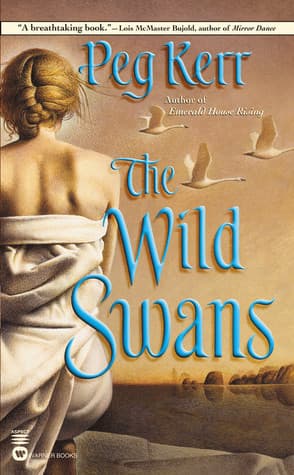
Peg Kerr (2001)
Genre
Fantasy / Historical Fiction / Romance
Reading Time
460 min
Key Themes
See below
Sign in to track this book
Two outcasts, a 17th-century woman accused of witchcraft and a 20th-century man with AIDS, endure journeys of sacrifice and discovery, connected by family and a world that rejects them.
In 1689 England, Lady Eliza Grey shares a close bond with her eleven older brothers, sons of Lord Grey of Fenwick. Their lives change with their new stepmother's arrival, a beautiful but cold woman. Driven by jealousy and a desire to secure her own son's inheritance, the stepmother, a sorceress, curses the brothers. One day, while hunting, the eleven young men turn into wild swans, leaving Eliza heartbroken. Lord Grey, influenced by the stepmother, believes Eliza is involved in the magic and disowns her, casting her out of Fenwick.
Banished from home, Eliza is found by her swan brothers. They carry her across the Atlantic Ocean to the New World, a land rumored to hold ancient magic and a chance for salvation. They settle in the harsh wilderness of colonial America, far from Eliza's English upbringing. Her brothers, as swans, communicate with her through a shared understanding. They tell her she must weave eleven shirts from nettles and remain silent until the task is complete, a vow that will last years.
Eliza commits herself to gathering nettles and weaving the shirts. The nettles sting her hands, causing great pain and leaving her fingers raw and bleeding, but she endures it silently, driven by her love for her brothers. She lives alone in a crude shelter, surviving on what she can find and occasional help from her swan brothers, who bring her food and protect her. Her silence isolates her further, making her appear strange to any rare passersby, a necessary sacrifice for the curse to break. This period tests her strength and endurance.
One day, while collecting nettles, Eliza is found by Reverend John Cotton, a Puritan preacher. Intrigued by her beauty and silent manner, he takes her in, believing she needs spiritual guidance. Eliza cannot speak to explain her situation. Her silence, unusual habits, and the mysterious swans around her lead to suspicion among the superstitious townsfolk. The fear and paranoia of the time, combined with her inability to defend herself, soon lead to accusations of witchcraft, putting her in great danger.
In 1981 New York City, Elias Latham, a young man living a bohemian life, receives a devastating diagnosis: AIDS, a new and terrifying disease with no known cure. The news shatters his world. When he tells his wealthy, conservative father, a prominent judge, Elias is met with rejection. His father, horrified and ashamed, banishes Elias from his home, disowning him. This abandonment leaves Elias adrift, facing a terminal illness with no support, forcing him to confront prejudice and mortality.
Cast out and alone, Elias lives on the streets of New York. He quickly learns to survive, enduring hunger, cold, and violence. Despite the hardship, Elias finds an unexpected community among other marginalized people—runaways, drug users, and others with AIDS. He forms a close bond with Raven, a young, transgender sex worker, who becomes his friend. This new, unconventional family gives Elias a sense of belonging and support denied by his biological family, helping him cope with his illness and the prejudice he faces.
Eliza is brought to trial, accused of consorting with evil spirits and practicing witchcraft. The evidence against her is circumstantial but convincing to the fearful community: her silence, strange appearance, solitary habits, and the mysterious swans seen near her. Despite the serious charges and the certain death sentence for a convicted witch, Eliza remains silent, her hands working on the nettle shirts, even in the courtroom. She is almost finished, with only one sleeve left to weave, but her life is in danger, and she cannot speak to save herself.
As Elias's health declines, he finds purpose and a way to express his pain through art. He begins to draw and paint, capturing the suffering he sees on the streets and his own struggles. His art becomes a voice for the voiceless, depicting the AIDS crisis and the marginalization of those affected. Despite his creative awakening, his physical condition worsens quickly, with increasing weakness, fevers, and Kaposi's sarcoma lesions. He thinks about his past, his strained relationship with his father, and the meaning of his life and impending death.
During the climax of Eliza's trial, as the jury prepares to deliver a guilty verdict, she frantically stitches the last threads of the eleventh nettle shirt. The moment she finishes, her eleven swan brothers burst into the courtroom through an open window. Eliza, with her last effort, throws the shirts over them. Instantly, the swans turn back into her human brothers, though one, missing a sleeve from his shirt, retains a swan's wing. Their sudden appearance and Eliza's breaking her silence to explain the curse shock the court and save her from the gallows.
Elias's journey ends as he dies from AIDS. Despite the tragic circumstances, he finds peace and dignity, surrounded by his chosen family on the streets. His art continues to live on, recognized for its power and social commentary. It becomes a testament to his resilience and a voice for the forgotten, raising awareness about the AIDS epidemic and the humanity of those affected. His legacy, though cut short, inspires others and helps foster understanding and compassion.
With the curse broken and her brothers restored, Eliza finally speaks, telling her story to the stunned court. The revelation of the stepmother's treachery and the transformation leaves the community in awe. While some remain skeptical, the undeniable evidence of the brothers' return from swan form is too strong to ignore. Eliza and her brothers are acquitted, and they decide to stay in America, building a new life together, free from their wicked stepmother and the prejudices of their former home. They begin to heal from their traumatic experiences, rebuilding their family in the New World.
The Protagonist
Eliza transforms from a protected noblewoman into a solitary, enduring figure who sacrifices everything for her family, ultimately finding her voice and agency.
The Protagonist
Elias evolves from a disowned, dying man into an artist who finds a chosen family and leaves a lasting legacy through his work.
The Supporting
They are transformed from human princes to swans and back, symbolizing the breaking of the curse and the enduring power of familial love.
The Antagonist
Remains static in her villainy, serving as the catalyst for the main conflict.
The Supporting
His initial compassion gives way to fear and adherence to societal norms, making him a complex figure of both aid and peril.
The Supporting
Remains a steadfast and supportive friend, embodying the power of chosen family.
The Mentioned
Remains largely static, representing the unyielding prejudice Elias faces.
Both Eliza and Elias endure great personal suffering and make sacrifices, not always for external rewards, but for a form of redemption. Eliza's years of silent, painful nettle weaving are a sacrifice for her brothers' salvation, leading to their freedom from the curse. Elias, facing a terminal illness and societal rejection, sacrifices his former life and finds redemption in his art and chosen family, giving meaning to his suffering. His art redeems his life by giving a voice to the marginalized.
“She would not speak. She would not cry out. She would not give up. For them, she would endure.”
A main theme is being an outcast and forming 'chosen families' in response to societal rejection. Eliza is cast out by her father and later by the colonial community because of her silence and perceived witchcraft. Elias is disowned by his father after his AIDS diagnosis and finds himself on the streets. Both characters, in different eras, find comfort and support not in their biological families or mainstream society, but among other marginalized people, like Eliza's swan brothers or Elias's friends on the street, especially Raven. These chosen families offer love, understanding, and help them survive.
“He had lost one family, but he had found another, forged in the crucible of the street.”
The novel shows the destructive power of prejudice and superstition across centuries. In 17th-century colonial America, Eliza is accused of witchcraft based on her unusual behavior and silence, reflecting the era's fear. In 1980s New York, Elias faces strong prejudice and abandonment due to his AIDS diagnosis and homosexuality, which were misunderstood and stigmatized. Both characters are victims of societal fear and judgment, showing how different forms of prejudice can lead to similar outcomes of ostracization and persecution, regardless of the historical context.
“The whispers followed him like a shadow, 'plague', 'sinner', 'unclean'.”
Storytelling and artistic expression are vital for communication, survival, and legacy for the protagonists. Eliza's quest is rooted in a magical fairy tale, and her eventual breaking of silence allows her to tell her story, saving her life and revealing the truth. Elias, facing a terminal illness and unable to change his physical fate, finds his voice through painting. His art becomes a powerful narrative of his suffering, his community, and the AIDS crisis, ensuring his experiences and the experiences of others are not forgotten. It turns personal pain into a public statement.
“His canvases spoke when he no longer could, a testament to lives lived, and lives lost.”
The novel explores the universal and lasting nature of human suffering, showing how pain and hardship cross time and circumstance. Both Eliza and Elias experience deep physical and emotional torment: Eliza with the nettles and the threat of execution, Elias with AIDS and homelessness. Their suffering is not just personal but also reflects broader societal injustices. The parallel narratives emphasize that while the specific causes of suffering may change (witchcraft accusations vs. AIDS epidemic), the human experience of enduring, coping, and finding meaning in pain remains constant.
“Though centuries apart, their pain echoed, a testament to the heart's enduring capacity for sorrow.”
Two distinct stories in different eras that mirror each other thematically.
The novel uses parallel narratives to tell the stories of Eliza in 17th-century colonial America and Elias in 1980s New York. These narratives, though separated by centuries, are linked by shared themes of suffering, societal rejection, sacrifice, and the search for redemption. This device allows the author to explore the enduring nature of human experience and prejudice across different historical contexts, highlighting the universality of the protagonists' struggles despite their disparate circumstances. It enriches the thematic depth by drawing explicit comparisons between seemingly unrelated events.
Eliza's forced silence as a magical requirement for breaking the curse.
Eliza's vow of silence is a critical plot device that drives much of her narrative. Magically imposed as part of the curse-breaking ritual, it prevents her from explaining her situation, leading directly to her being accused of witchcraft. This silence amplifies her isolation and suffering, making her particularly vulnerable to the prejudices of her time. It also heightens the dramatic tension, as readers know she could save herself if she spoke, but doing so would doom her brothers. The breaking of her silence at the climax is a powerful moment of triumph and revelation.
The painful material Eliza must use to weave the shirts for her brothers.
The nettles symbolize Eliza's arduous sacrifice and the physical manifestation of her suffering. The act of gathering and weaving with the stinging plant causes her immense pain, leaving her hands raw and bleeding. This physical torment is a constant reminder of her mission and the high cost of love. The nettles are not just a magical requirement; they are a tangible representation of her endurance, resilience, and the self-inflicted pain she willingly undergoes for the sake of her family, making her sacrifice deeply felt by the reader.
The magical curse turning Eliza's brothers into swans.
The transformation of Eliza's brothers into swans is the inciting incident of the 17th-century plot. It serves as the primary magical element and the central problem Eliza must solve. The swans represent both the brothers' cursed state and their continued protective presence. Their partial transformation back into human form (one retaining a swan's wing) is a powerful symbol of the lasting scars of trauma and the imperfect nature of healing, even after a curse is broken. It grounds the fantastical element with a touch of enduring reality.
“It was not a dream, not a nightmare, but a waking terror that filled her with a cold dread she had never known.”
— Elisa's reaction to her brothers' transformation into swans.
“To save them, she must not speak, must not cry, must not even sigh. Silence was her only weapon, and her only hope.”
— The witch's instructions to Elisa on how to break the curse.
“Each stitch was a prayer, each knot a promise, each strand of nettle a whisper of pain and love.”
— Elisa weaving the shirts of nettles for her brothers.
“The world had turned against her, but her heart remained steadfast, a tiny ember in a gathering storm.”
— Elisa facing accusations of witchcraft while silently working.
“He saw not a mute girl, but a woman of fierce will and tender heart, a queen in all but crown.”
— The King's perception of Elisa, despite her silence.
“The nettles stung her hands, burned her fingers, but the thought of her brothers, trapped in their feathered prison, burned hotter still.”
— Elisa enduring the physical pain of her task.
“A kingdom could be built on lies, but true love, like true magic, required truth, even the painful kind.”
— Reflecting on the King's struggle with Elisa's silence.
“Her silence was not an absence of voice, but a presence of purpose, a shield against despair.”
— Elisa's interpretation of her vow of silence.
“The feathers of a swan were beautiful, but they were not skin and bone, not the embrace of a brother.”
— Elisa longing for her brothers to return to human form.
“Sometimes, the greatest battles are fought not with swords, but with needles and thread, with silence and an unwavering heart.”
— A reflection on Elisa's quiet heroism.
“The wind carried their cries, not as the calls of birds, but as the echoes of boys trapped in a spell.”
— Elisa hearing her brothers as swans.
“Love, she learned, was not always a gentle thing. Sometimes it was sharp and stinging, like the nettles she worked with, but just as vital.”
— Elisa's understanding of the nature of love through her ordeal.
“The last shirt, unfinished, was a testament to the fragile line between victory and despair.”
— The climax of the story, with Elisa nearly failing.
“Even in the deepest darkness, a single thread of hope, if held fast, could weave a path to the light.”
— A thematic reflection on Elisa's journey.
Ready to see how well you understood this book? Take our interactive quiz with 10 questions.







