“For the mind of man is a dark forest, and his ways are not to be known.”
— Narrator's reflection on the mystery of human nature.

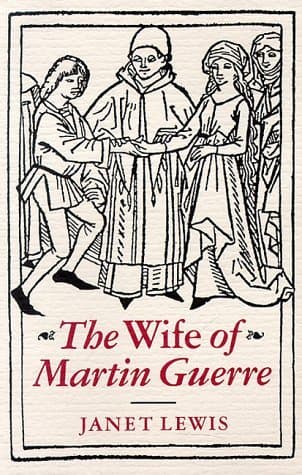
Janet Lewis (1941)
Genre
Historical Fiction
Reading Time
90 min
Key Themes
See below
Sign in to track this book
In 16th-century France, a woman's search for truth about her husband's changed behavior after his eight-year absence reveals a carefully planned deception, forcing her to choose between a comfortable lie and the harsh reality of exposing an imposter.
The story begins with the arranged marriage of Bertrande de Rols and Martin Guerre, both children, in Artigat, France. Their wealthy families arrange the union to combine lands and status. Bertrande is a spirited and intelligent girl, while Martin is somewhat sullen and withdrawn. Their early marriage lacks affection and intimacy, with Martin often distant and cold. For several years, they don't have a child, causing whispers and concern in their rural, patriarchal society where fertility is important.
Tension in the Guerre household grows when Martin is accused of stealing grain from his father, Sanxi. Although the accusation is later proven false, the shame leads to a violent fight between father and son. In anger and humiliation, Martin Guerre suddenly leaves Artigat, abandoning his young wife, Bertrande, and their infant son, Sanxi, who was born shortly before his departure. His sudden absence leaves Bertrande in a difficult position, under her in-laws' authority and the village's scrutiny, without a husband to support or protect her.
Eight years pass with no news from Martin Guerre. Bertrande lives a life of quiet endurance under her strict in-laws, especially her father-in-law, Sanxi Guerre the elder. She raises her son, Sanxi, and manages the household, keeping her reputation despite social pressure and her husband's unknown fate. She often thinks about Martin, hoping for his return or quietly accepting his likely death. The village mostly believes Martin is dead, and Bertrande, still young, is effectively a widow but bound by her marriage's legal and social rules.
One day, a man arrives in Artigat, claiming to be Martin Guerre. The entire Guerre family, including Martin's uncle Pierre Guerre and his sisters, welcomes him with great joy and relief. The man looks much like the missing Martin, knows private family details, and remembers specific events and people. Bertrande, at first hesitant, is overwhelmed by the general happiness and the promise of stability. She notices this 'Martin' is more affectionate, cheerful, and attentive than the husband she remembered, which both pleases and subtly troubles her. He quickly re-establishes himself as the head of the household.
Initially, Bertrande accepts the return of 'Martin,' finding a happiness and closeness she never had with her first husband. They have two children together. However, small inconsistencies start to appear. The 'new Martin' is too perfect, too agreeable, and lacks some of the specific physical scars and behaviors she remembers. He is also better with money and less impulsive. Her memories of the original Martin, though distant, conflict with the present reality. These small differences, along with a deep feeling, make Bertrande doubt him, causing an inner struggle between her desire for the returned peace and her need for truth.
Bertrande's doubts grow stronger due to suspicions from some villagers and, importantly, from her uncle-in-law, Pierre Guerre. Pierre, having lost money in a land deal with 'Martin,' becomes sure of the imposter's true identity and urges Bertrande to act. Torn between her loyalty to the man who brought her happiness and her conscience, Bertrande eventually gives in to Pierre's pressure and her own growing certainty. She makes the serious decision to formally accuse the man claiming to be Martin Guerre of being an imposter, a charge that carries severe penalties, including death, and risks her own reputation and safety.
The first trial happens in Rieux, where many witnesses are called to testify. Villagers, family members, and acquaintances give conflicting accounts. Some firmly identify the accused as Martin Guerre, citing specific memories and physical traits. Others, including Bertrande and Pierre Guerre, provide evidence suggesting he is an imposter, pointing out inconsistencies in his knowledge or appearance. The accused, who identifies himself as Arnaud du Tilh, defends himself well, showing impressive knowledge of Martin Guerre's life and family history. The judges, facing such a complex web of testimony and a lack of clear proof, cannot give a definite verdict.
Because the first trial was inconclusive, the case is appealed and moved to the Parliament of Toulouse, a higher court. The proceedings become even more intense, drawing much public attention. Arnaud du Tilh, staying calm and persuasive, continues to argue his identity with conviction, questioning Bertrande's motives and casting doubt on her character. He points out that Bertrande herself lived with him for years and had children with him, implying her involvement or at least her initial acceptance. Bertrande, under great pressure and scrutiny, struggles to explain her complex experience of love and deception.
As the trial in Toulouse nears its end, with the judges still deciding and leaning towards acquitting Arnaud du Tilh, a dramatic event occurs. A man, scarred from battle and with a wooden leg, enters the courtroom. Several family members, including Martin's sisters and his uncle Pierre Guerre, immediately recognize him as the true Martin Guerre. His sudden, undeniable presence shatters Arnaud du Tilh's carefully built deception. Faced with the real Martin, Arnaud's composure finally breaks, and he confesses his fraud, revealing his true identity and the elaborate plan he carried out.
Arnaud du Tilh confesses his deception, admitting he learned details of Martin Guerre's life from soldiers and decided to impersonate him after Martin left. He describes how he charmed the family and the village with his appeal and knowledge. The court sentences Arnaud du Tilh to death by hanging, a harsh punishment for his crime. However, the ordeal is far from over for Bertrande. The true Martin Guerre, bitter from his years of war and his wife's perceived betrayal, shows her no mercy. He publicly questions her loyalty and intelligence, accusing her of willingly living with an imposter, leaving Bertrande to face a future burdened by shame and an unforgiving husband.
The Protagonist
Bertrande transforms from a passive, dutiful wife into a woman who defies societal expectations to expose a fraud, finding her voice and agency in the process.
The Supporting/Antagonist
Absent for most of the story, he returns as a physically and emotionally damaged man, unable to reconcile with his past or forgive Bertrande.
The Antagonist
From a successful imposter who brings a strange happiness, he is ultimately exposed and faces the consequences of his audacious deception.
The Supporting
He transitions from accepting 'Martin' to becoming his most vocal and persistent accuser, driving the legal process.
The Supporting
He remains largely static, representing the rigid patriarchal structure and the desire for social order.
The Supporting
They attempt to navigate a complex legal and human dilemma, ultimately providing a verdict based on the dramatic unveiling of truth.
The novel explores what makes up a person's identity. Is it physical appearance, shared memories, or how one acts and makes others feel? Arnaud du Tilh's successful impersonation for years challenges these ideas. He not only looks like Martin but also acts like a better version of him, leading Bertrande and the village to accept him. The theme questions whether 'truth' is only objective or if it can be shaped by what people see, want, and need. The story shows how easily identity can be faked and how hard it is to prove, especially when the imposter meets a community's needs.
“What was the truth? Was it that which was known to all the village, or that which was known only to herself?”
Bertrande's main conflict is between her duty to her family and society (to accept the returned 'Martin' and keep the peace) and her personal need for truth and real connection. For years, she lives with the imposter, finding a happiness and closeness she never had with her true husband. Yet, her conscience and intellect push her to uncover the deception, even if it means risking social exclusion, her children's legitimacy, and the life of the man she came to love. This theme highlights the deep sacrifices required when personal honesty conflicts with social expectations.
“She had accepted the peace, knowing it for a lie; but now the lie had become intolerable.”
The story takes place in a strict, male-dominated society where women like Bertrande have little power. Her marriage is arranged, her life controlled by her father-in-law, and her reputation constantly watched. She is expected to be obedient and dutiful. Her decision to accuse 'Martin' is a radical act of rebellion against this system, as it challenges male authority and disrupts the established order. Despite immense pressure and the possibility of her own ruin, Bertrande asserts her will and seeks justice, showing a powerful, though limited, form of female action in her historical setting. Her ultimate fate, while not fully resolved, reflects the ongoing challenges women faced.
“A woman's truth was a fragile thing, easily broken by a man's word.”
The novel explores the many sides of justice. While Arnaud du Tilh's crime is clear and his punishment severe, justice is complicated by the happiness he brought Bertrande and the family. The judges struggle with what justice means, questioning whether exposing the truth, despite the pain it causes, is always the fairest outcome. Furthermore, the theme of forgiveness is sharply contrasted by the true Martin Guerre's unforgiving attitude towards Bertrande. His inability to forgive her for being deceived, despite her own suffering, leaves a bitter feeling and raises questions about who truly suffers and who is truly just.
“Justice, she thought, was a cruel thing, that must tear apart what had been whole.”
The audience often knows or suspects the truth before the characters.
The reader, often having knowledge of the historical case or simply sensing the inherent tension, is aware of the deception long before Bertrande or the villagers fully grasp it. This creates a sense of foreboding and suspense, as we watch Bertrande fall for the imposter and witness the subtle clues that eventually lead to his downfall. It heightens the emotional impact of Bertrande's internal struggle, as her happiness is always tinged with the reader's knowledge of its false foundation.
Subtle hints and clues throughout the narrative suggest future events.
From the very beginning, small details hint at the future deception. Martin Guerre's sullen nature and his eventual desertion foreshadow the void that Arnaud du Tilh will fill. Bertrande's initial unease and the subtle discrepancies she notices in the 'new Martin' (like his unfamiliarity with certain family heirlooms or his too-perfect demeanor) serve as foreshadowing for her eventual accusation and the unveiling of the truth. These hints build suspense and prepare the reader for the dramatic climax.
Bertrande's subjective experience shapes the perception of events.
While not strictly an unreliable narrator in the traditional sense, the story is largely told through Bertrande's perspective, emphasizing her internal thoughts, feelings, and evolving perceptions. This means the reader experiences the 'new Martin' through her eyes – his charm, his affection, and eventually, her growing doubts. This subjective lens allows the author to explore the psychological impact of deception and the difficulty of discerning truth when emotions and desires are involved, making the reader question alongside Bertrande what is real.
“For the mind of man is a dark forest, and his ways are not to be known.”
— Narrator's reflection on the mystery of human nature.
“It is not the face but the heart that makes the difference.”
— Bertrande's internal thought when first questioning the 'new' Martin.
“A man may change his clothes, but not his nature.”
— A villager's comment on Martin Guerre's initial return, foreshadowing.
“She had given herself to a man who was not her husband, but whom she had loved more than her husband.”
— Bertrande's realization of her feelings for the imposter.
“The truth is a hard thing, and often it is not what we wish it to be.”
— Reflection on the unfolding trial and its consequences.
“There are some choices that are made for us, and some that we must make for ourselves, and both are hard.”
— Bertrande contemplating her predicament.
“He had taken her life and made it his own, and in doing so, had given her a life.”
— Bertrande's complex feelings about Arnaud du Tilh's presence.
“How could a woman know her own husband, if he had changed so much?”
— Bertrande's initial doubt about the returning Martin.
“Fear is a cold companion, and doubt a sharper one.”
— Bertrande's internal state as the truth begins to unravel.
“The shadow of a man can be more real than the man himself, if the heart believes it.”
— Narrator's comment on Bertrande's deep affection for the imposter.
“Justice is a blind goddess, and sometimes she stumbles.”
— A reflection on the imperfections of the legal system.
“To live with a lie is to die a little every day.”
— Bertrande's internal torment as she keeps the secret.
“The past is never truly buried; it always finds a way to rise.”
— The eventual return of the true Martin Guerre.
“It is a strange thing to love a ghost, and to find him flesh and blood.”
— Bertrande's reaction to Arnaud du Tilh, who brought life back to her.
Ready to see how well you understood this book? Take our interactive quiz with 10 questions.

Biography coming soon.







