“I am not afraid of the dark. I am afraid of the things that hide in the dark, and the dark that hides in people.”
— Elizabeth Woodville's early reflections on the dangers of court and human nature.

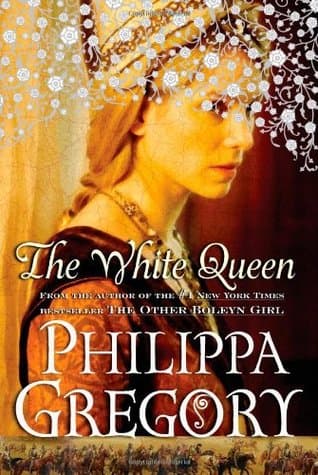
Philippa Gregory (2009)
Genre
Historical Fiction / Romance
Reading Time
500 min
Key Themes
See below
Sign in to track this book
A commoner secretly marries a king, putting her into the Wars of the Roses where her sons become the 'Princes in the Tower,' changing England's future.
The story begins in 1464 with Elizabeth Woodville, a beautiful Lancastrian widow with two young sons. She lives in poverty after her husband's death at the Second Battle of St Albans. Her family, the Woodvilles, are minor gentry with Lancastrian loyalties. Elizabeth confronts the newly crowned Yorkist King Edward IV in a forest, asking for the return of her deceased husband's lands for her sons. Edward, taken by her beauty, tries to seduce her, but Elizabeth refuses. Intrigued, Edward proposes marriage. Against the advice of his cousin, Richard Neville, Earl of Warwick ('The Kingmaker'), and his court, Edward secretly marries Elizabeth on May 1, 1464, at Grafton Regis, without a priest present, only Elizabeth's mother, Jacquetta, and a few servants as witnesses. This marriage, seen as below a king, causes immediate scandal and political trouble.
Edward publicly announces his marriage to Elizabeth, shocking his court, especially Warwick, who had been negotiating a French alliance through a royal marriage for Edward. Elizabeth is crowned Queen of England at Westminster Abbey in 1465, a grand ceremony meant to solidify her position. However, her Lancastrian background and the quick advancement of her large, ambitious family — her sisters and brothers marry into prominent noble families, and her sons from her first marriage get titles — create deep resentment among the established nobility, particularly the Nevilles. Warwick, feeling slighted and less influential, begins to openly oppose the King and Queen, viewing Elizabeth and her family as newcomers corrupting Edward's rule.
The growing bad feelings between the Woodvilles and the Nevilles leads to Warwick's open rebellion against Edward IV, supported by Edward's younger brother, George, Duke of Clarence, who also feels ignored. Warwick causes unrest in the north, leading to the Battle of Edgecote Moor in 1469. Edward's forces are defeated, and Warwick captures him. During this time, Elizabeth, pregnant with her first child by Edward, takes refuge in Westminster Abbey with her mother and daughters. Warwick tries to rule England through the imprisoned Edward, but the kingdom becomes chaotic. Warwick also arranges for the execution of Elizabeth's father, Richard Woodville, Earl Rivers, and her brother, John Woodville, further worsening the family feud.
Edward IV, with help from loyal supporters, escapes Warwick's custody. He quickly gathers an army and confronts Warwick, forcing him to flee to France with George, Duke of Clarence. While in exile, Warwick, in a surprising turn, forms an alliance with his former enemy, Margaret of Anjou, the deposed Lancastrian Queen, and her husband, the mad King Henry VI. The alliance is sealed by the marriage of Warwick's daughter, Anne Neville, to Margaret and Henry's son, Edward of Westminster, the Lancastrian heir. This alliance marks a shift in the Wars of the Roses, as Warwick now actively works to restore the Lancastrian dynasty and remove Edward IV.
In 1470, Warwick, backed by French support and the Lancastrian cause, invades England. His forces quickly gain strength, and Edward IV, caught off guard, flees to Burgundy with his younger brother, Richard, Duke of Gloucester. Elizabeth, heavily pregnant with her son Edward, again seeks sanctuary in Westminster Abbey, with her daughters and mother. There, she gives birth to Edward, Prince of Wales, in difficult circumstances. Henry VI is briefly restored to the English throne, a period called the 'Readeption.' England again falls under Lancastrian rule, and the future of the Yorkist dynasty, and Elizabeth's family, looks bad.
With financial and military aid from his brother-in-law, Charles the Bold of Burgundy, Edward IV returns to England in 1471. He gathers support and marches on London, reclaiming the city and his throne. Elizabeth is reunited with her husband. The decisive battles of Barnet and Tewkesbury follow. At Barnet, Warwick is killed, ending the Neville threat. At Tewkesbury, the Lancastrian heir, Edward of Westminster, is killed, and Margaret of Anjou is captured. These victories re-establish Edward IV's rule and largely end the Lancastrian claim to the throne, bringing a period of peace for the Yorkist dynasty.
After the defeats of Warwick and the Lancastrians, Edward IV's reign has a period of stability and prosperity. Elizabeth, now securely Queen, focuses on raising her growing family, which includes two sons, Edward and Richard, and several daughters. She continues to use her influence to advance her family's interests and enjoys the power. However, a dark prophecy, told to her by her mother Jacquetta, hangs over her: that a 'water king' will take the throne, and her sons will be lost. This prophecy, linked to the mythical Melusina and the river goddess, influences Elizabeth's worries and her reliance on her mother's 'witchcraft' to protect her children.
In 1483, Edward IV dies suddenly, leaving his twelve-year-old son, Edward V, as the heir. Before his death, Edward IV names his younger brother, Richard, Duke of Gloucester, as Lord Protector for his young son. This creates a power vacuum and a dangerous rivalry between the Woodville family, who want to keep their influence over the young King, and Richard, who is determined to assert his authority as Protector. Elizabeth, fearing for her son's safety and the Woodville family's position, tries to rush her son's coronation, but Richard intercepts Prince Edward on his journey to London, seizing control of him and the government.
Richard of Gloucester, acting as Protector, quickly isolates the young King Edward V. He arrests and executes Elizabeth's brother, Anthony Woodville, Earl Rivers, and her son, Richard Grey, for treason. Elizabeth again seeks sanctuary in Westminster Abbey with her remaining children, including her younger son, Richard, Duke of York. Richard of Gloucester then declares Edward IV's marriage to Elizabeth invalid, citing a pre-contract between Edward and Lady Eleanor Butler, making their children illegitimate. He then takes the Duke of York from sanctuary and places both young princes, Edward V and Richard, Duke of York, in the Tower of London, supposedly for their safety pending coronation, but effectively as prisoners. Richard then claims the throne as Richard III.
Richard III is crowned King of England. The two young princes, Edward V and Richard, Duke of York, remain confined in the Tower of London. They are seen less and less, then vanish entirely; their fate becomes one of history's greatest mysteries. Elizabeth, trapped in sanctuary, grieves and fears for her sons. Rumors spread that Richard III murdered them. Desperate, Elizabeth secretly allies with Margaret Beaufort, the Lancastrian mother of Henry Tudor, who is in exile. They agree to marry Elizabeth's eldest daughter, Elizabeth of York, to Henry Tudor, uniting the warring houses and ending the conflict, if Henry can overthrow Richard III.
Henry Tudor invades England from France. He meets Richard III's forces at the Battle of Bosworth Field in 1485. During the battle, several noblemen desert Richard III, leading to his defeat and death. Henry Tudor is crowned King Henry VII, establishing the Tudor dynasty. As part of the agreement with Elizabeth Woodville, Henry VII marries her daughter, Elizabeth of York, uniting the houses of York and Lancaster and bringing a formal end to the Wars of the Roses. Elizabeth Woodville, though no longer Queen, sees her daughter become Queen of England, ensuring her family's royal lineage continues, but with the lingering sorrow of her lost sons.
After Henry VII becomes king, Elizabeth Woodville's influence decreases. She is initially welcomed at court but is eventually moved to Bermondsey Abbey, often seen as a semi-retirement or subtle confinement. She lives to see her daughter, Elizabeth of York, give birth to a son, Prince Arthur, securing the Tudor succession. However, the mystery of her sons, the Princes in the Tower, remains unsolved and a source of constant grief and speculation for her. She occasionally hears whispers and rumors, but no definitive answers emerge. Elizabeth Woodville dies in 1492, taking her secrets and sorrows with her, forever marked by the loss of her children and the turbulent years she spent as Queen.
The Protagonist
From a determined widow seeking restitution, she rises to become a powerful queen, only to suffer profound loss and end her days in quiet sorrow, forever marked by the disappearance of her sons.
The Supporting
He rises as a strong king, consolidates power, but his impulsive marriage and sudden death leave his legacy vulnerable.
The Supporting
As a wise and mystical matriarch, she guides her daughter to power but cannot avert the ultimate tragedy of her grandsons.
The Antagonist
From a powerful ally and Kingmaker, he transforms into a bitter enemy, ultimately dying in his quest for power.
The Supporting
Driven by ambition and jealousy, he betrays his brother multiple times, eventually leading to his execution.
The Antagonist
From a loyal brother, he transforms into a cunning usurper, becoming King but haunted by the disappearance of his nephews.
The Supporting
Driven by an unshakeable religious conviction, she endures hardship to see her son become king.
The Supporting
From a royal princess, she becomes a pawn in political alliances, ultimately becoming Queen and uniting the warring factions.
The novel shows the pursuit of power and what people will do to get and keep it. Elizabeth Woodville's ambition to elevate her family, Warwick's desire to control the crown, and Richard III's usurpation all show this. Characters navigate political intrigue, betrayal, and warfare, showing how uncertain life and position were in 15th-century England. Elizabeth's struggle for survival, for herself and her children, is a main force, as she uses her beauty, intelligence, and even her mother's 'magic' to protect her family against powerful enemies.
““There is no peace in England, not for a queen, not for a mother of kings. There is only the fight to keep what you have.””
At its heart, 'The White Queen' is a story about a mother's strong love and desperate efforts to protect her children in a dangerous world. Elizabeth Woodville's main motivation throughout the novel is her sons' and daughters' safety and advancement. Her decisions, from her marriage to her alliances, are all about maternal protection. The disappearance of her sons, Edward and Richard, in the Tower of London, is the ultimate sign of her failure to protect them, leaving her with grief and unanswered questions. This idea is echoed in Jacquetta's protection of Elizabeth and Margaret Beaufort's drive for her son, Henry Tudor.
““A mother’s heart is always on the rack when her children are in danger.””
The novel weaves a mystical thread through the historical story, especially through Jacquetta and Elizabeth's connection to an ancient lineage and perceived 'witchcraft.' Jacquetta's prophecies, especially about the 'water king' and the loss of Elizabeth's sons, shape Elizabeth's understanding of her destiny and influence her fears. While others often dismiss these as superstition, these mystical elements are a psychological basis for Elizabeth's worries and her attempts to control an uncontrollable future. The novel explores the blurred lines between folk magic, intuition, and political manipulation in a superstitious age, suggesting that some events are predetermined or influenced by forces beyond human control.
““We are daughters of the river goddess, Melusina. We feel the pull of the tides, and we know what is coming.””
The book focuses on the experiences of women who, despite societal limits, have influence and power in a male-dominated world. Elizabeth Woodville, Jacquetta, and Margaret Beaufort are central figures who navigate political landscapes through strategic marriages, alliances, and personal cunning. They use their intelligence, beauty, and maternal roles to shape history, often from behind the scenes. The novel shows the challenges and vulnerabilities women in power face, especially queens and noblewomen, whose status and children are constantly at risk during dynastic struggles.
““They may be kings, but we are queens. And we have our own kind of power.””
The story is told entirely from Elizabeth Woodville's perspective, offering an intimate and subjective view.
By employing a first-person narrative from Elizabeth Woodville's point of view, the author provides an intimate and often biased insight into the tumultuous events of the Wars of the Roses. This allows readers to experience Elizabeth's personal anxieties, ambitions, and heartbreaks directly, making her a relatable and sympathetic character despite her political machinations. It also limits the reader's knowledge to what Elizabeth knows or perceives, contributing to the mystery surrounding events like the fate of the Princes in the Tower, which she only hears through rumors and second-hand accounts.
Jacquetta's prophecies, particularly about the 'water king' and lost sons, guide and foreshadow Elizabeth's fate.
Jacquetta's mystical abilities and recurring prophecies, especially the one concerning a 'water king' and the eventual loss of Elizabeth's sons, serve as a significant plot device. These prophecies create a pervasive sense of dread and foreshadow the tragic events that unfold. They not only build suspense but also provide a psychological framework for Elizabeth's actions and anxieties, suggesting a predetermined fate that she desperately tries to avert. This device blends historical events with a supernatural undercurrent, enriching the narrative's emotional depth.
The unsolved disappearance of Elizabeth's sons is a central, unresolved plot point.
The historical mystery of the Princes in the Tower is the climactic and most enduring plot device in the novel. By leaving their fate ambiguous, as it remains in history, the author emphasizes Elizabeth's profound grief and the lasting impact of the event. The novel explores various theories and rumors through Elizabeth's perspective but offers no definitive answer, thereby maintaining the historical integrity of the mystery while highlighting the personal tragedy for the mother of the lost princes. This unresolved element underscores the brutality and uncertainty of the era.
The recurring use of Westminster Abbey as a place of refuge for Elizabeth and her family.
Sanctuary, specifically Westminster Abbey, functions as a recurring plot device, symbolizing both a temporary haven and a stark reminder of Elizabeth's precarious position. She seeks refuge there multiple times – during Warwick's rebellion, during the Readeption of Henry VI, and after Edward IV's death when Richard III seizes power. Each time, it marks a moment of extreme vulnerability and fear for her and her children. It highlights the limited options available to even a queen when stripped of political power, emphasizing her reliance on religious protection in times of crisis.
“I am not afraid of the dark. I am afraid of the things that hide in the dark, and the dark that hides in people.”
— Elizabeth Woodville's early reflections on the dangers of court and human nature.
“A queen is not made by her crown, but by her people.”
— Elizabeth's understanding of her legitimacy and power coming from popular support, not just royal decree.
“Love is a battlefield, and I am a warrior.”
— Elizabeth's passionate and often combative approach to her relationship with Edward IV.
“There is no greater power than a mother's will to protect her children.”
— Elizabeth's fierce determination to safeguard her sons, especially the Princes in the Tower.
“We are all pawns in God's game, but some of us are queens.”
— Elizabeth's perspective on destiny and her own agency within the larger historical forces.
“The greatest weapon a woman can wield is her beauty, and the greatest shield is her wit.”
— Elizabeth's strategy for survival and advancement in the male-dominated court.
“Loyalty is a fickle thing in times of war and ambition.”
— Elizabeth's observation on the shifting alliances and betrayals during the Wars of the Roses.
“A crown can be a heavy burden, even for a king.”
— Elizabeth's empathy for Edward IV's struggles with his royal duties and the pressures of power.
“Magic is not in spells, but in the will to believe.”
— Elizabeth's connection to her mother's 'riverside magic' and her own faith in her destiny.
“History is written by the victors, but the truth is whispered by the defeated.”
— Elizabeth's reflection on the biased nature of historical accounts and her own perspective as a 'loser' in the long run.
“To be a queen is to be alone, even in a crowded court.”
— Elizabeth's sense of isolation despite her position and family.
“The river knows all secrets, if you know how to listen.”
— Elizabeth's connection to the natural world and the ancient wisdom passed down by her mother.
“Every choice has a consequence, and some consequences are paid in blood.”
— Elizabeth's understanding of the high stakes and violent outcomes of political decisions.
Ready to see how well you understood this book? Take our interactive quiz with 10 questions.

Biography coming soon.







