“There are things in the world that are bigger than us, and we must learn to live with them.”
— Early in the book, a young elephant reflects on the dangers and mysteries of the savanna.

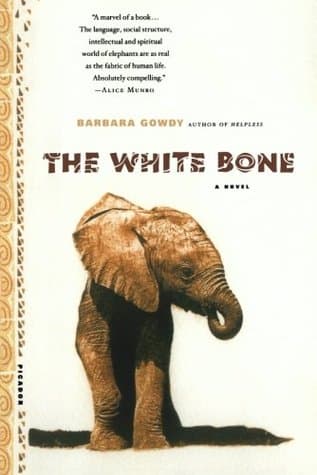
Barbara Gowdy (1999)
Genre
Literary Fiction / Fantasy
Reading Time
560 min
Key Themes
See below
Sign in to track this book
Threatened by humans, a young, clairvoyant elephant calf named Mud goes on a dangerous quest to find the mythical 'White Bone,' believed to be the key to her herd's survival.
The story begins with Mud, a young female elephant. Her herd, led by the matriarch Old One, suffers greatly from a severe drought. Water holes are dry, food is scarce, and the herd is weak and desperate. Old One, guided by ancient knowledge, believes there is a legendary 'Safe Place' – a green paradise where elephants can live without fear of humans and find endless resources. The herd, including Mud's sister Little Mud, and the cynical She-Screams, starts a dangerous journey. Mud has a unique ability to 'read' the white bones of dead elephants, gaining insights into their past lives and the path ahead, a skill Old One encourages.
As the drought worsens, the herd's youngest member, a calf named Small, dies from starvation and weakness. This loss deeply affects Mud and the others. Soon after, the herd finds human poachers, known as 'tuskers.' The tuskers are ruthless, leaving behind death and destruction, targeting elephants for their ivory. This encounter creates deep fear in the herd, showing the urgency of finding the Safe Place and the constant threat to their lives. Mud's sense of responsibility for Little Mud grows.
During a chaotic stampede caused by a tusker attack, Mud is separated from Old One, Little Mud, and the rest of her herd. Lost and scared, she finds herself alone in the vast, dangerous landscape. Devastated but determined, Mud decides she must find the Safe Place herself, believing it is the only way to reunite with her family. Her unique connection to the 'white bone' – the spiritual essence and memories in the bones of dead elephants – becomes her main guide. She interprets the bone's messages, which appear as visions and feelings, to navigate the terrain and avoid human threats, a hard task for a young elephant.
As Mud continues her solitary journey, she meets other elephants who have also been separated from their herds or are seeking the Safe Place. She first meets Grope, a solitary male elephant, who, despite his initial roughness, becomes a protective and loyal companion. Grope, having seen much suffering, is at first doubtful of the Safe Place but is drawn to Mud's strong belief. Later, they are joined by other elephants, including the wise but traumatized old female, Star-Scratcher, and her calves. These alliances give Mud needed companionship and support, though the dangers of the journey and the tuskers remain present.
Mud's ability to 'read' the white bone grows stronger. Through her visions, she gains deeper insights into the history of elephants, the true nature of the Safe Place, and the cruelty of humans. The bones reveal not just a path, but also warnings of traps, tusker locations, and the immense suffering that has affected elephantkind for generations. She learns that the Safe Place is not just a physical location but a spiritual idea, a state of being where elephants are truly free. These revelations both fuel her hope and burden her with the weight of her species' fate, making her even more determined to find it.
Mud, Grope, and their companions encounter a wide, dangerous river that acts as a barrier on their path to the Safe Place. The crossing is difficult, with strong currents and hidden dangers. As they cross the river, they are ambushed by tuskers waiting for them. The attack is brutal and swift, leading to the tragic loss of several more elephants, including Star-Scratcher and her calves. Mud is traumatized by the violence, seeing firsthand the effectiveness of the poachers. This event strengthens her resolve, but also leaves her with deep emotional scars and a growing sense of urgency.
Following the white bone's guidance, Mud and Grope eventually find a lush, water-rich valley that seems to be the Safe Place they have been searching for. For a short time, they feel peace and relief, believing their hard journey is over. However, their joy is brief. They soon discover that this 'paradise' is a trap set by the tuskers to lure desperate elephants. The realization is crushing, deepening Mud's despair and testing her faith in the white bone's guidance. The discovery of human cunning and cruelty leaves them both feeling defeated.
After the discovery of the false Safe Place, Mud and Grope, weakened and disheartened, continue their journey. Miraculously, they are reunited with Old One, Little Mud, and a few other surviving members of Mud's original herd. The reunion is joyous but mixed with the shared grief of their losses. Old One, now frail but still determined, reveals the true meaning of the Safe Place. She explains that it is not a physical location, but a spiritual state of being, a collective consciousness of all elephants, living and dead, where their memories and spirits reside, free from human harm. It is a place they carry within them.
As the remaining herd, including Mud, Little Mud, Grope, and Old One, travels towards what Old One now identifies as the true spiritual Safe Place, they are again confronted by tuskers. The situation is serious, with the elephants exhausted and outnumbered. In a final act of love and leadership, Old One, knowing her time is near, makes a selfless sacrifice. She confronts the tuskers directly, drawing their attention, allowing Mud, Little Mud, and the others a chance to escape to safety. Her death, though heartbreaking, is a heroic act of preservation, ensuring the survival of the younger generation.
Following Old One's sacrifice, Mud, changed by her journey and the losses she has endured, steps into the role of matriarch. Guided by the white bone's wisdom and Old One's spiritual legacy, she leads Little Mud, Grope, and the remaining elephants. She understands that the Safe Place is not a physical refuge from human cruelty, but a spiritual sanctuary within the collective memory and spirit of elephantkind. Mud dedicates herself to protecting her new family and passing on the ancient knowledge, ensuring that the hope for a future where elephants can live in peace, even if only in spirit, continues. The cycle of life and death, and the spirit of the elephants, continues.
The Protagonist
Mud transforms from a hopeful, somewhat naive young elephant into a wise and resilient matriarch, embracing her unique gift and the heavy responsibility of leadership.
The Supporting
Old One maintains her unwavering faith and wisdom throughout the journey, ultimately making the ultimate sacrifice to ensure the survival of her herd's future.
The Supporting
Little Mud remains a symbol of hope and the future, surviving the perils under Mud's protection.
The Supporting
Grope evolves from a cynical loner to a loyal protector and partner, finding purpose and hope through his bond with Mud.
The Supporting
She-Screams continues to be a voice of pragmatism, struggling with the herd's spiritual quest while focused on immediate survival.
The Supporting
Star-Scratcher, a symbol of past suffering, finds brief companionship before succumbing to the dangers of the journey.
The Mentioned
Small's death is a pivotal early event, highlighting the harsh realities and driving the herd's desperation.
The Antagonist
The Tuskers remain a consistent, unyielding destructive force throughout the narrative, symbolizing the relentless threat to elephant existence.
The main theme is the elephants' desperate search for the 'Safe Place,' a mythical sanctuary free from human persecution and environmental hardship. This quest embodies the universal desire for peace, security, and a place to belong. It shows in Old One's strong faith, Mud's determined journey, and the collective hope of the herd, even as they face great losses. The eventual revelation that the Safe Place is more spiritual than physical highlights that true sanctuary can be found within community and shared memory, rather than just a place.
“The Safe Place was not a place. It was a condition of mind, a state of grace, a memory shared by all elephants, living and dead.”
The novel is full of themes of loss and grief, as the elephants constantly face death from drought, starvation, and human poachers. The death of Small, the repeated tusker attacks, and Old One's sacrifice all contribute to a pervasive sadness. However, with this grief is an extraordinary resilience. Mud, despite her deep emotional wounds, continues to lead and maintain hope. The elephants' ability to endure, to continue their journey, and to find comfort in their bonds despite overwhelming difficulty, shows the strength of their spirit and their will to survive.
“Grief, Mud had learned, was a thing that gathered and gathered, until it was too heavy to carry, and then it exploded, leaving only a hollow ache.”
A strong and repeated theme is the devastating effect of humanity on the natural world and, specifically, on elephants. The 'tuskers' are a faceless, relentless force of destruction, driven by greed for ivory. Their actions cause immense suffering, fear, and death, forcing the elephants into a desperate struggle for survival. The novel critiques human encroachment, the ivory trade, and the general disregard for wildlife, showing humans as the ultimate threat to the elephants' existence and the primary reason for their suffering and displacement. This theme highlights the book's ecological message.
“The tuskers. They were the reason for everything. The drought, the hunger, the constant, gnawing fear. They were the reason for the Safe Place.”
The 'white bone' is a central metaphor for the deep spiritual connection among elephants, the power of collective memory, and the passing down of ancestral wisdom. Mud's ability to 'read' the bones allows her to access the experiences and guidance of past generations, linking the living with the dead. This theme suggests that knowledge and spirit are not lost with death but continue to exist and guide the living. Old One's spiritual leadership and her understanding of the Safe Place as a state of being, rather than a physical location, further emphasize the spiritual dimension of elephant life and their connection to their heritage.
“The white bone was the story of everything. The story of the earth, of the rain, of the sun, and of all who had walked before.”
A mystical device allowing Mud to access ancestral memories and guidance.
The 'white bone' is a unique narrative device that functions as both a literal and metaphorical element. Literally, it refers to the bones of deceased elephants, which Mud can 'read' to gain visions, insights, and guidance. Metaphorically, it represents the collective memory, spiritual essence, and ancestral wisdom of all elephants, living and dead. It serves as a source of hope, a warning system, and a means of transmitting knowledge across generations. This device allows the author to explore themes of spirituality, memory, and the enduring spirit of a species facing extinction, providing Mud with a unique form of leadership and foresight.
The mythical sanctuary that drives the elephants' quest.
The 'Safe Place' is a powerful plot device that acts as the primary motivation for the elephants' arduous journey. Initially presented as a tangible, physical paradise, it represents the ultimate goal and hope for survival. Its elusive nature and the challenges encountered on the way to finding it create suspense and drive the narrative forward. The eventual revelation that the Safe Place is not a physical location but a spiritual state of being – a collective consciousness and memory – transforms it into a profound symbol of enduring hope, resilience, and the internal sanctuary that elephants carry within themselves, even in the face of external threats.
Attributing human-like thoughts, emotions, and complex social structures to elephants.
Anthropomorphism is a key plot device used throughout the novel to create deep empathy for the elephant characters. The elephants are given human-like names (Mud, Grope, Old One), engage in complex internal monologues, express profound emotions like grief, love, fear, and hope, and possess intricate social structures, communication methods, and spiritual beliefs. This device allows readers to connect with the elephants on a deeply emotional level, making their struggles and triumphs highly relatable. It effectively highlights the tragedy of their plight and the devastating impact of human actions from a non-human perspective, enhancing the novel's ecological and ethical messages.
A relentless environmental crisis that initiates the herd's journey and ongoing struggle.
The drought is a crucial environmental plot device that sets the entire narrative in motion. It creates the initial crisis, forcing Mud's herd to leave their familiar territory in search of water and sustenance. The relentless scarcity of resources due to the drought constantly exacerbates the elephants' suffering, weakens them, and makes them more vulnerable to other threats, particularly the tuskers. It serves as a constant, tangible antagonist, highlighting the harsh realities of nature and the desperate struggle for survival, thereby intensifying the urgency of their quest for the Safe Place and underscoring the broader ecological challenges faced by wildlife.
“There are things in the world that are bigger than us, and we must learn to live with them.”
— Early in the book, a young elephant reflects on the dangers and mysteries of the savanna.
“The earth is our mother, and we must respect her. She gives us life, and she will take it away.”
— An elder elephant shares wisdom about their connection to the land and the cycle of life and death.
“To forget is to die twice.”
— Whisper, an old elephant, emphasizes the importance of memory and tradition for the herd's survival.
“We are all part of the same story, even if we don't know the ending.”
— Mud, a young elephant, ponders the interconnectedness of all creatures and their shared fate.
“Sometimes the greatest strength is to know when to run.”
— A pragmatic lesson learned by the elephants when facing overwhelming threats.
“The heart remembers what the mind forgets.”
— An observation on the lasting emotional impact of events, even when specific details fade.
“Fear is a scent that travels faster than any sound.”
— A description of how fear spreads through the herd and among other animals.
“To be alone is to be incomplete.”
— Reflecting the strong communal bonds and reliance within the elephant herd.
“The past is a heavy burden, but it is also a map.”
— The elephants often look to ancestral knowledge and past experiences to navigate present challenges.
“Every life leaves a trace, even if only in the wind.”
— A poetic reflection on the legacy and impact of each individual, even after death.
“The greatest stories are not told with words, but with tusks and trunks and the dust of many seasons.”
— An insight into the non-verbal communication and rich history shared within the elephant community.
“Hope is a fragile thing, easily trampled, but it can also lift the heaviest heart.”
— The elephants often cling to hope for their future, despite constant threats.
“We are the keepers of the earth's oldest songs.”
— Emphasizing the elephants' ancient wisdom and their role as a living archive of the natural world.
“The moon knows our secrets, and the stars watch over our dreams.”
— A poetic expression of the elephants' spiritual connection to the cosmos.
“Sometimes the world gives you a gift disguised as a wound.”
— A reflection on the often harsh lessons learned through hardship and loss.
Ready to see how well you understood this book? Take our interactive quiz with 10 questions.

Barbara Gowdy is a celebrated Canadian novelist known for her evocative prose and unflinching exploration of the human condition. Her novel, "The White Bone," was shortlisted for the Booker Prize and garnered international acclaim for its powerful narrative. Gowdy's work consistently delves into themes of love, loss, and the complexities of relationships.







