“Nancy Drew was a beautiful girl of eighteen, with a keen mind and an adventurous spirit.”
— Opening description of Nancy Drew.

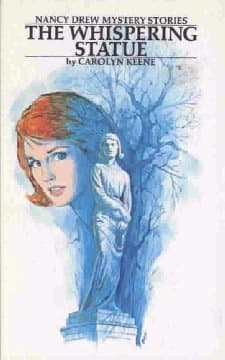
Carolyn Keene (1937)
Genre
Children's / Mystery / Young Adult
Reading Time
150 min
Key Themes
See below
Sign in to track this book
Disguised as an art gallery assistant, Nancy Drew investigates a swindling art dealer, stolen rare books, and a whispering statue that resembles her.
Nancy Drew receives two cases from her father, Carson Drew. First, Mrs. Merriam suspects art dealer Mr. Henri of swindling her in the sale of rare books. She believes Henri is undervaluing her books and possibly replacing them with fakes. Second, a marble statue, 'The Whispering Statue,' has vanished from Josiah Crowley's estate. This statue is rumored to whisper and looks like Nancy, making the case personal. Carson asks Nancy to investigate both, thinking they might be connected or challenging for her.
Nancy, with friends Bess Marvin and George Fayne, begins by watching Mr. Henri's gallery and bookshop. She notices odd behavior from Henri and how he handles Mrs. Merriam's books. Nancy learns Henri has a suspicious assistant, Mr. Crane, who seems too involved in book transactions. She also finds Henri often meets with Mademoiselle Dupres, who influences his business. Nancy's observations confirm Mrs. Merriam's belief that something illegal is happening at Henri's.
While Nancy focuses on Mr. Henri, the Whispering Statue reappears at the Crowley estate. Closer inspection reveals it is a clever reproduction. The original valuable marble statue is still missing, and the replica is of poor quality, made to deceive. This makes the mystery deeper, suggesting a sophisticated criminal operation, not a simple theft. The fake statue's return indicates the thieves might be trying to cover their tracks or gain time. Nancy concludes the fake statue's return is a deliberate trick to mislead investigators.
To get closer to Mr. Henri and gather evidence, Nancy goes undercover. She dyes her hair and uses the name 'Miss Smith,' applying for a salesclerk job at Henri's. She is hired. This gives her direct access to Henri's office, records, and interactions. Working with Mr. Crane, Nancy observes their operations for clues about the rare book scheme and any links to the stolen statue. Her disguise works; no one, not even Henri, suspects she is Nancy Drew.
As 'Miss Smith,' Nancy quickly uncovers Henri's rare book swindle. He is replacing Mrs. Merriam's valuable first editions with expertly made reproductions, selling the originals for a profit through a network of fences. Mr. Crane helps with the substitutions and sales. Nancy finds hidden compartments and false bottoms in crates, where the genuine books are stored before being swapped. She also finds a ledger detailing the illegal transactions, proving Henri's fraud against Mrs. Merriam.
While investigating the book scheme, Nancy finds a link to the Whispering Statue. She discovers the Crowley estate, where the statue was stolen, had hired Mr. Henri to appraise some art. More importantly, she finds a coded message among Henri's papers mentioning 'the silent twin' and 'Crowley's treasure.' This suggests Henri is involved in both the book swindle and the theft of the original Whispering Statue, likely seeing it as another valuable item to sell. The statue's resemblance to Nancy makes her a target for the criminals.
Nancy's undercover work becomes dangerous. Mr. Crane grows suspicious of 'Miss Smith's' curiosity. One evening, alone in Henri's office, Nancy is ambushed by Mademoiselle Dupres and Mr. Crane. They have found out who she is and try to stop her from exposing them. Nancy, quick-witted, escapes using her knowledge of the gallery. This close call confirms the criminals are dangerous and her mission is urgent.
After her escape, Nancy returns to the Crowley estate with Bess and George to re-examine the pedestal where the original Whispering Statue stood. She carefully inspects it, remembering a detail she noticed earlier. Behind a loose panel, she finds a hidden compartment with a cryptic message from Josiah Crowley. It indicates the statue holds a clue to a hidden treasure or a secret about his past. The message confirms the statue is more than just art; it is a key to a deeper mystery, making its recovery even more important.
With Nancy's evidence and the new lead from the pedestal, Carson Drew plans to trap Henri and his accomplices. They arrange for a fake 'buyer' to show interest in the rare books and 'unique' art pieces, hoping to make the thieves reveal the original Whispering Statue's location. Nancy, back in her own identity, works with her father and the police to coordinate the sting. The plan relies on the thieves' greed and their belief they are ahead of the authorities.
The trap is set at Mr. Henri's gallery. As the fake buyer shows interest in the 'unique' items, Henri, Mr. Crane, and Mademoiselle Dupres become confident. When they try to finalize a deal for what they believe are Mrs. Merriam's last genuine books and hint at another 'special' item, the police, led by Chief McGinnis, raid the premises. A confrontation follows, but Nancy's detailed evidence leaves the criminals unable to deny their guilt. Henri, Crane, and Dupres are arrested, and the original Whispering Statue, along with Mrs. Merriam's rare books, is found in a hidden vault within the gallery. The two mysteries are solved.
The Protagonist
Nancy's character remains consistently sharp and brave, but her experiences in this case reinforce her confidence in her undercover abilities and her growing understanding of sophisticated criminal operations.
The Supporting
Carson's unwavering belief in Nancy's abilities is reaffirmed, solidifying their effective partnership.
The Antagonist
Henri's overconfidence and criminal enterprise are exposed and ultimately lead to his downfall and arrest.
The Supporting
Crane's involvement in the criminal ring is exposed, leading to his arrest alongside Henri.
The Supporting
Dupres's cunning attempts to thwart Nancy are ultimately unsuccessful, leading to her arrest.
The Supporting
Mrs. Merriam's trust is vindicated, and her valuable collection is restored thanks to Nancy's efforts.
The Supporting
Bess's loyalty to Nancy is reinforced through their shared experiences, though her cautious nature remains.
The Supporting
George's steadfast nature and courage are once again highlighted as she supports Nancy through peril.
The Mentioned
Though deceased, his character serves as the catalyst for the second mystery, and his secrets are ultimately revealed.
A main theme is how appearances can deceive. Mr. Henri, a seemingly respectable art dealer, is a swindler. The Whispering Statue appears to be returned, but it is a fake. Nancy's use of an alias and disguise ('Miss Smith') shows how outward appearances can hide true identities. The story asks the reader to look beyond the surface, like Nancy's investigation of uncovering layers of deceit to find the truth, as when she finds the fake books and Henri's true business.
“''Things are seldom what they seem in the world of crime,' Nancy mused to herself.”
The novel explores the value of art and the importance of authenticity. Mrs. Merriam's rare books are valuable because they are genuine first editions, a value Henri tries to exploit by replacing them with reproductions. The Whispering Statue's original marble has artistic and historical worth, which is lessened by the inferior replica. This theme shows that true value comes from originality and integrity, contrasting with the imitation and fraud by the criminals. Nancy's goal is to restore the authentic and expose the fakes.
“'A genuine masterpiece is irreplaceable, no matter how clever the imitation,' Nancy remarked.”
Nancy's resourcefulness and willingness to go undercover are vital to solving both mysteries. Her decision to use the name 'Miss Smith' and work in Henri's gallery shows her adaptability and courage. This strategy lets her gather inside information that would otherwise be unavailable. The theme emphasizes creative problem-solving and thinking differently when faced with criminal operations, showing Nancy's detective skills beyond simple deduction.
“'Sometimes, the best way to catch a fox is to join the pack,' Nancy told her father.”
The main theme is the pursuit of justice and exposing corruption. Nancy is driven by a strong moral sense to correct wrongs, whether it is Mrs. Merriam being swindled or a valuable statue being stolen. The story celebrates the idea that clever criminals, no matter how hidden their operations, will be brought to justice through diligent investigation. Nancy's success in exposing Henri's scheme and recovering the stolen items reinforces the triumph of good over evil and the importance of upholding ethical standards.
“'No criminal scheme is perfect, and eventually, the truth will always come out,' Carson Drew advised Nancy.”
Nancy adopts a false identity to infiltrate the criminal organization.
Nancy's use of the alias 'Miss Smith' and a disguise is a crucial plot device. It allows her direct access to the antagonist, Mr. Henri, and his operations, providing an insider's perspective. This device generates suspense as Nancy constantly risks exposure and adds layers to her character, showcasing her bravery and acting skills. It is instrumental in gathering the concrete evidence needed to expose the rare book swindle and link Henri to the statue theft, moving the plot forward by revealing hidden information.
A mysterious object that drives the plot forward.
The Whispering Statue functions as a MacGuffin, particularly in the second mystery. While its 'whispering' quality is intriguing, its primary role is to motivate Nancy's investigation and serve as a focal point for the criminals' actions. Its theft, return as a fake, and ultimate recovery propel the plot, leading Nancy to uncover deeper secrets, including Josiah Crowley's hidden message. The statue's resemblance to Nancy also adds a personal stake to the investigation.
A misleading clue designed to divert the investigation.
The return of a reproduction of the Whispering Statue serves as a classic red herring. It is deliberately placed by the criminals to make investigators believe the case is partially resolved or that the original statue is simply a lesser-valued item. This deception temporarily misdirects attention from the true nature of the theft and the more sophisticated criminal operation at play, adding a layer of complexity to the mystery and challenging Nancy's deductive skills to see through the ruse.
Secret messages and hidden compartments that reveal vital information.
The use of hidden clues, such as the coded message in Henri's papers and Josiah Crowley's message behind the pedestal panel, is a key plot device. These elements provide critical breakthroughs in the investigation, connecting the seemingly separate mysteries and revealing the criminals' true scope. They serve to reward Nancy's meticulousness and observation, pushing the narrative towards resolution by providing the 'missing pieces' of the puzzle that link the various criminal acts.
“Nancy Drew was a beautiful girl of eighteen, with a keen mind and an adventurous spirit.”
— Opening description of Nancy Drew.
“The old mansion loomed before them, dark and silent against the twilight sky.”
— Nancy, Bess, and George arrive at the abandoned mansion.
“A good detective never overlooks the smallest detail.”
— Nancy advises Bess and George during their investigation.
“Sometimes the most obvious solution is the one we least expect.”
— Nancy ponders a puzzling clue.
“The statue seemed to watch them with its sightless eyes, as if guarding a secret.”
— Describing the titular whispering statue.
“Courage is not the absence of fear, but the triumph over it.”
— Nancy reflects on a scary situation.
“Every lock has a key, if you only know where to look.”
— Nancy is trying to open a locked box.
“The truth has a way of revealing itself, no matter how deeply it's buried.”
— Nancy is close to solving the mystery.
“It takes more than just brains; it takes a bit of daring, too.”
— Nancy credits her success to her adventurous nature.
“The quietest places often hold the loudest secrets.”
— Nancy investigates a seemingly deserted part of the estate.
“Even the most ordinary objects can become extraordinary clues.”
— Nancy examines a common item found at the scene.
“Friendship is a strong bond, especially when facing danger.”
— Nancy relies on Bess and George for support.
“There's always a logical explanation, no matter how strange things seem.”
— Nancy reassures her friends about a spooky occurrence.
“The past is never truly gone; it leaves echoes for us to find.”
— Nancy uncovers historical details relevant to the mystery.
Ready to see how well you understood this book? Take our interactive quiz with 10 questions.

Carolyn Keene is the pseudonym for the authors of the Nancy Drew Mystery Stories series. Under this pen name, numerous authors have penned over 170 books since 1930, captivating young readers with thrilling mysteries and adventures. The series, including notable titles like "The Secret of Red Gate Farm" and "Mystery of Crocodile Island," has become a cultural phenomenon, selling millions of copies worldwide and inspiring adaptations across various media.

Dan Gemeinhart
4.5
Kate O'Hearn
4.4

Jeanne Birdsall
4.4

Jen Wang
4.4

Wendelin Van Draanen
4.3

John Marsden
4.3

Chris Van Allsburg
4.3
Jennifer A. Nielsen
4.2