“When you’re a ghost, you don’t get to choose your company. You take what you’re given.”
— Lucy contemplating her situation with the skull and Lockwood's team.

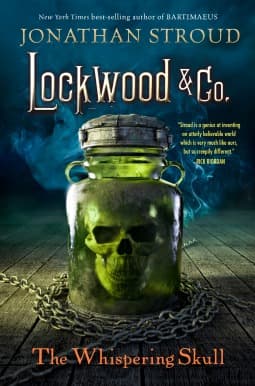
Jonathan Stroud (2014)
Genre
Fantasy / Children's / Mystery / Young Adult
Reading Time
9-10 hours
Key Themes
See below
Sign in to track this book
When a spectral relic vanishes from a Victorian doctor's grave, London's most unusual ghost-hunting agency, Lockwood & Co., must outwit rivals and their own internal disagreements to retrieve it before its dangerous power is unleashed.
Six months after their dangerous encounter at Combe Carey Hall, Lockwood & Co., consisting of Anthony Lockwood, Lucy Carlyle, and George Cubbins, struggles against their rivals, Quill Kipps and his Fittes agency. This rivalry leads to Lockwood impulsively challenging Kipps to a public contest, with the loser admitting defeat in The Times. Soon after, a new client, Mr. Saunders, hires Lockwood & Co. to oversee the exhumation of Edmund Bickerstaff, a Victorian doctor rumored to have experimented with talking to the dead. Their job is to ensure the coffin is properly sealed with silver to prevent any supernatural escape. During the exhumation, George's curiosity leads him to briefly open the coffin, attracting a malevolent ghost that they barely contain. Back at Portland Row, Lockwood reprimands George for his carelessness, while Lucy is increasingly disturbed by urgent whispers from the skull in their ghost jar.
The team is called to DEPRAC headquarters, where they learn that Bickerstaff's coffin was raided after their initial work, and a mysterious glass object buried with the corpse has vanished. To Lockwood's annoyance, Quill Kipps and his team are also present, having been called in by Inspector Barnes. Barnes reveals that the stolen relic, a Bickerstaff Ghost-Glass, is very dangerous and could amplify psychic energies, making it a serious threat. He tasks both agencies with its recovery, making the Bickerstaff case the subject of their public challenge. This unexpected turn forces the rival agencies into an uneasy collaboration, much to the discomfort and competitive spirit of both Lockwood and Kipps, especially in front of Barnes.
Lockwood & Co. and Kipps's team begin their separate investigations, with Lockwood focusing on Bickerstaff's former homes. The skull in the ghost jar whispers more intensely to Lucy, revealing fragmented clues and a growing sense of evil. Lucy finds herself more open to its influence, experiencing vivid visions and hearing its voice more clearly than ever. During one such investigation at a derelict Bickerstaff property, they encounter a powerful Type Two entity — a terrifying, intelligent ghost that is hard to contain. The skull's input, though unsettling, provides important information that helps them survive the encounter and gather more pieces of the puzzle surrounding Bickerstaff's experiments and the stolen relic.
Through their combined efforts and separate leads, the agencies uncover information about a secret auction where the Bickerstaff Ghost-Glass is being offered to wealthy collectors of supernatural artifacts. They learn that the likely buyer is a notorious and dangerous individual known for their ruthless pursuit of powerful relics. This discovery raises the stakes considerably, as the Ghost-Glass in the wrong hands could have catastrophic consequences. Both teams race to infiltrate the auction and prevent the relic from falling into the hands of this dangerous collector, highlighting a moral imperative beyond their competitive challenge. The skull's whispers continue to guide Lucy, hinting at the relic's true power and Bickerstaff's dark intentions.
Recognizing the urgency, Lockwood and Kipps reluctantly agree to coordinate their efforts to infiltrate the auction. They create a complex plan, using the strengths of both agencies. Lucy's enhanced psychic abilities, influenced by the skull, are very helpful in sensing hidden dangers and the relic's location. The infiltration is tense and dangerous, as they navigate the security and the suspicious attendees of the black-market auction. The competitive friction between the two teams remains, but the shared goal of recovering the dangerous Ghost-Glass forces a fragile alliance, pushing them to overcome their personal dislikes for the greater good. George's research skills are crucial in understanding the auction's structure.
Inside the auction, the two teams move to stop the sale. They identify the buyer as a formidable and cunning individual, not easily deterred. A tense confrontation follows, leading to a chaotic struggle for possession of the Bickerstaff Ghost-Glass. During the fight, the relic activates, unleashing a terrifying surge of psychic energy that affects everyone present, especially Lucy, who is already linked to the skull. The Ghost-Glass amplifies the spiritual presence, making the ambient psychic residue of the location incredibly potent and dangerous. The true extent of Bickerstaff's ambition and the relic's capacity for destruction becomes terrifyingly clear, forcing both teams to fight for their lives and to contain the artifact.
As the Ghost-Glass unleashes its power, the skull in Lockwood's jar speaks directly to Lucy, revealing its true identity and its deep connection to Bickerstaff. It explains that Bickerstaff intended to use the Ghost-Glass not just to communicate with the dead, but to control them and amplify his own psychic abilities, blurring the lines between life and death. The skull, a powerful and ancient entity itself, was trapped by Bickerstaff and now seeks release or revenge. This revelation exposes the full, horrifying scope of Bickerstaff's experiments and the immense danger posed by the Ghost-Glass, making its recovery even more critical. Lucy grapples with the skull's manipulative nature and the moral implications of its assistance.
Through quick thinking, teamwork, and Lucy's increasingly potent abilities (aided by the skull), the agencies manage to recover the Bickerstaff Ghost-Glass and escape the volatile auction house. They leave behind a scene of chaos, but the immediate threat of the relic falling into dangerous hands is averted. However, the experience deeply affects Lucy. Her connection to the skull has grown, making its voice almost constant and its influence more pervasive. The victory is bittersweet, overshadowed by growing unease about the skull's intentions and the ethical boundaries Lucy is forced to cross to use its power. Lockwood and George notice the change in Lucy, but are unsure of its true extent.
Upon their return, DEPRAC agents, led by Inspector Barnes, quickly take possession of the Bickerstaff Ghost-Glass, securing it in their vaults. With the relic safely contained, the focus shifts back to the challenge between Lockwood & Co. and Fittes. Despite the uneasy collaboration, both agencies contributed to the recovery. Barnes acknowledges the complex nature of the operation, making a clear 'winner' difficult to declare. Ultimately, a compromise is reached regarding the public announcement, allowing both agencies to save face while recognizing their contributions. The intense rivalry eases slightly, replaced by a grudging respect, though the competitive fire still smolders, especially between Lockwood and Kipps.
With the immediate crisis resolved, Lucy faces a more personal struggle. The skull's presence in her mind is stronger than ever, its whispers constant and its demands growing more insistent. It reveals its desire for freedom, hinting at its true power and offering Lucy even greater abilities in exchange for its release. Lucy is torn between the allure of enhanced power and the moral implications of trusting such a manipulative, malevolent entity. She confides some of her worries to Lockwood, who, while concerned, doesn't fully grasp the extent of the skull's hold. The novel concludes with Lucy facing a deep internal conflict, her future tied to the dangerous entity within the ghost jar.
The Protagonist
Lockwood learns to temper his impulsiveness with strategic thinking, recognizing the value of collaboration and the dangers of unchecked rivalry, while still maintaining his independent spirit.
The Protagonist/Narrator
Lucy's psychic abilities deepen, but she faces a profound internal conflict as she grapples with the manipulative influence of the skull, forcing her to question her own moral boundaries and control.
The Supporting
George learns to balance his intellectual curiosity with practical caution, understanding the real-world consequences of his actions while continuing to be an invaluable source of knowledge.
The Supporting/Antagonist
The Skull's influence over Lucy intensifies, revealing its true manipulative nature and its deep, dark connection to the novel's central mystery.
The Supporting/Antagonist
Kipps is forced into an uneasy collaboration with Lockwood, leading to a slight thawing of his animosity and a grudging respect for Lockwood's unconventional methods.
The Supporting
Barnes witnesses the effectiveness of both conventional and unconventional methods, leading to a slightly more nuanced understanding of the private agencies' roles.
The Mentioned/Antagonist (posthumous)
As the story progresses, Bickerstaff's true, terrifying intentions and the extent of his manipulation of spirits, including the Skull, are gradually revealed.
The Mentioned
Mr. Saunders's role is limited to initiating the central conflict, and he does not undergo significant character development.
This theme appears primarily through Edmund Bickerstaff's actions after his death. His obsessive desire to communicate with and control the dead, shown by his creation of the Bickerstaff Ghost-Glass, leads to deep and lasting danger. His ambition, without ethical limits, creates powerful and evil artifacts that continue to threaten the living. The pursuit of power without considering the consequences is a recurring warning, as seen when the Ghost-Glass unleashes chaotic energy during the auction, a direct result of Bickerstaff's unchecked scientific and psychic experiments.
““Some men seek to touch the beyond, not for understanding, but for dominion. That is where true terror lies.””
The intense rivalry between Lockwood & Co. and Kipps's Fittes agency is a central element, initially driven by pride and competition. Lockwood's impulsive challenge to Kipps sets the stage for their contest. However, as the threat of the Bickerstaff Ghost-Glass grows, both teams are forced into an uneasy collaboration. This dynamic shows how personal dislikes can hinder progress, but a shared, greater threat can compel even the fiercest rivals to work together. While the rivalry never fully disappears, the need for collaboration to recover the dangerous relic shows a practical shift in their relationship, proving that sometimes, two heads (or agencies) are better than one.
““It galled him, I knew, to admit that Lockwood & Co. had even a fraction of their talent. But the Ghost-Glass was too dangerous for pride to stand in the way.””
This theme is most clearly explored through Lucy's deepening connection with the skull in the ghost jar. The skull offers Lucy enhanced psychic abilities and important insights, making her a valuable asset to the team. However, this power comes at a significant cost: the skull's insidious influence, its manipulative whispers, and its constant demands for freedom. Lucy struggles with the ethical dilemma of using an evil entity for good, questioning where her own will ends and the skull's begins. The allure of power and knowledge is strong, but the story constantly reminds the reader of the psychological and moral toll it takes.
““It gave me strength, yes. But it took something too, something I couldn’t quite name, but felt slipping away.””
The novel explores the ambiguity of good and evil through characters and their choices. While ghosts are generally seen as evil, the Skull, an evil entity, acts as an unreliable informant, providing important aid while pursuing its own dark agenda. This blurs the lines, suggesting that 'evil' can sometimes lead to a 'good' outcome, though with dangerous conditions. Conversely, the living characters, like Bickerstaff, show that deep evil can come from human ambition. The story challenges simple definitions, showing that even heroes like Lucy must navigate morally gray areas when dealing with supernatural forces.
““A ghost is a ghost. But some are more than that. Some are… echoes of pure malice, given voice.””
A sentient, malevolent Type Three ghost trapped in a jar, acting as an unreliable narrator/informant.
The Skull serves as a significant plot device, primarily through its direct communication with Lucy. It provides cryptic clues, foreshadowing, and crucial information about Bickerstaff's experiments and the Ghost-Glass, which is vital for the team's investigation. However, its advice is always tinged with its own malevolent agenda, subtly manipulating Lucy and tempting her with enhanced power. This creates internal conflict for Lucy and adds an element of suspense and moral ambiguity, as the team relies on a dangerous, unpredictable entity for success, forcing Lucy to constantly question its motives and the cost of its help.
A dangerous relic that amplifies psychic energy and facilitates communication with the dead.
The Bickerstaff Ghost-Glass is the central MacGuffin of the plot. Its theft drives the entire investigation and the uneasy alliance between Lockwood & Co. and Fittes. Its inherent power to amplify psychic energy makes it a highly dangerous artifact, capable of causing widespread supernatural chaos if it falls into the wrong hands. The race to recover it provides the primary external conflict and raises the stakes significantly, pushing the characters to their limits. It also serves as a direct link to Edmund Bickerstaff's dark experiments and the lingering threats he left behind.
A competitive wager between Lockwood & Co. and Fittes, dictating the terms of their rivalry.
Lockwood's impulsive challenge to Kipps, with the loser publicly admitting defeat in The Times, serves as a powerful motivator and a framework for the narrative. It heightens the competitive tension between the two agencies, pushing them to outperform each other even while working on the same case. This device allows for moments of both comedic friction and serious professional rivalry. It ultimately forces a degree of collaboration, as the stakes of the Bickerstaff case transcend their personal pride, but the underlying competitive drive remains a constant undercurrent throughout their joint investigation.
The supernatural talents of agents and the dangerous consequence of direct contact with ghosts.
The psychic abilities of the agents (Listeners, Observers, etc.) are fundamental to the world-building and plot. Lucy's heightened listening and observing skills, amplified by the Skull, are crucial for uncovering clues and surviving encounters. Conversely, the concept of 'ghost-touch' – the dangerous and often fatal consequence of physical contact with a ghost – serves as a constant threat and a limiter on the agents' actions. It heightens the stakes of every ghost encounter and reinforces the perilous nature of their profession, driving the need for specialized equipment and careful strategy to avoid fatal contact.
“When you’re a ghost, you don’t get to choose your company. You take what you’re given.”
— Lucy contemplating her situation with the skull and Lockwood's team.
“The problem with having a talking skull in a jar is that it’s very hard to keep it a secret.”
— Lucy reflecting on the inherent difficulty of concealing the skull's presence.
“Never trust a ghost with an easy smile. They’re usually planning something particularly nasty.”
— Lucy's observation about a malevolent ghost they encounter.
“Sometimes, the only way to get through a really bad situation is to pretend it isn't happening.”
— Lucy's coping mechanism during a particularly terrifying encounter.
“We’re not heroes, Lucy. We’re just the people who happen to be around when things go wrong.”
— Lockwood's pragmatic view of their role in fighting the Problem.
“The dead don’t always stay dead. Sometimes they just get louder.”
— A macabre description of a particularly active Type Two ghost.
“It’s amazing how much more you can achieve when you’re absolutely terrified.”
— Lucy realizing her own bravery when pushed to her limits.
“The best way to deal with a difficult client is to make them think it was their idea all along.”
— George's cynical but effective advice on client management.
“There are some things even a ghost can’t explain. Mostly because they’re dead.”
— The Skull's sarcastic remark about the limits of its knowledge.
“Curiosity killed the cat, but satisfaction brought it back. Or in our case, got us into a lot more trouble.”
— Lucy reflecting on their tendency to investigate dangerous mysteries.
“It’s not the size of the ghost, it’s the nastiness of its intentions.”
— Lucy's assessment of a seemingly minor but malevolent entity.
“Everyone thinks they know what they’re doing until the screaming starts.”
— A grim observation about the reality of ghost-hunting.
“Sometimes the greatest mysteries aren’t about what’s hidden, but what’s right in front of your face.”
— Lucy realizing a crucial detail about a case.
“You can’t run from your past, Lucy. Not when it’s got teeth and wants to eat your soul.”
— The Skull's blunt warning to Lucy about lingering dangers.
Ready to see how well you understood this book? Take our interactive quiz with 10 questions.

Biography coming soon.







