“The world is full of obvious things which nobody by any chance ever observes.”
— Holling Hoodhood reflects on how people often miss what's right in front of them.

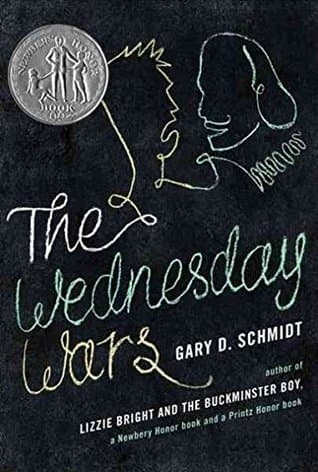
Gary D. Schmidt (2007)
Genre
Children's / Historical Fiction / Young Adult
Reading Time
300 min
Key Themes
See below
Sign in to track this book
Seventh-grader Holling Hoodhood faces Shakespeare, angry rats, and yellow tights while navigating Vietnam and cream puff-demanding bullies, finding courage during his dreaded Wednesday afternoons with Mrs. Baker.
The 1967-1968 school year begins with Holling Hoodhood, a seventh-grader at Camillo Junior High, feeling alone. As the only Presbyterian in his class, he does not attend religious instruction with the Catholic or Jewish students on Wednesday afternoons. This leaves him alone with his English teacher, Mrs. Baker, whom he believes dislikes him. His father, an architect focused on his business's image, tells Holling to stay out of trouble. Mrs. Baker first gives Holling small tasks like cleaning erasers, but soon, to Holling's dislike, she makes him read Shakespeare aloud. His first book is 'The Merchant of Venice,' a play he finds confusing and dull.
Holling's initial dislike for Shakespeare is made worse by several bad events. While reading 'The Tempest,' he must clean the classroom's rat cage. He accidentally leaves the cage door open, letting the two pet rats, Sycorax and Caliban, into the school. This happens at the same time he agreed with his classmates: if he got cream puffs for everyone, they would stop bothering him. He uses money his father gave him for baseball tickets to buy the cream puffs, but the rats escape during delivery, destroying most of them. Mrs. Baker, surprisingly, helps him replace the cream puffs, though he still faces trouble from the school principal over the escaped rats.
The escaped rats, Sycorax and Caliban, cause more trouble when they interrupt a visit from the Board of Education, almost attacking the superintendent. Mrs. Baker, despite her frustration, continues Holling's Shakespeare lessons, moving to 'Romeo and Juliet.' Holling's father, always focused on appearances, is angry about the rat incident and Holling's part in it. However, Holling starts to see Shakespeare differently after he goes to a performance of 'Romeo and Juliet' with Meryl Lee Kowalski, a girl he likes. He is moved by the play, finding connections to his own life and realizing that Shakespeare might be good after all.
As Christmas nears, Holling is cast as Ariel, a fairy in yellow tights, for the yearly Holiday Extravaganza. His father, embarrassed, tells him not to wear the tights, but Holling does. On the same night as the play, Yankee baseball hero Mickey Mantle is signing autographs at the Baker Sporting Emporium. Holling wants to meet Mantle but must choose the play. After his performance, still in his Ariel costume, he rushes to the sporting goods store, but Mickey Mantle insults his costume and will not sign his baseball. Mrs. Baker's husband's old baseball hero, Joe Pepitone, signs the ball and says kind words, making Holling feel better.
The new year brings news that Mrs. Baker's husband, Lieutenant Tybalt Baker, is missing in action in Vietnam. Mrs. Baker becomes quiet and worried, and Holling, despite their early dislike, feels sympathy for her. He starts to see her not just as a teacher but as a person dealing with deep personal pain. Meanwhile, Holling's older sister, Heather, becomes more rebellious against their father's strict rules and more vocal about her anti-war feelings, causing stress in the Hoodhood home. She even says she wants to run away to California.
On Valentine's Day, Holling takes Meryl Lee Kowalski to see 'Romeo and Juliet' again. During their date, Holling, trying to impress her, accidentally shares details of his father's architectural plan for the new junior high school gym. Meryl Lee's father, also an architect, is competing for the same contract. Meryl Lee feels betrayed and uses Holling's information to help her father change his own plan, causing Mr. Hoodhood to lose the bid. Holling is sad about the unintentional betrayal and the fight with Meryl Lee, feeling his father's disappointment.
Holling joins the cross-country team, coached by Mrs. Baker. He trains hard, even though he is not athletic at first. During a race, Doug Swieteck's brother, a known bully, trips Holling. But Holling's friends, including Meryl Lee, Mai Thi, and Danny Hupfer, support him. Danny, showing true friendship, gives up his chance to win the race to help Holling finish. Mrs. Baker also shows her support and guidance, showing her growing care for Holling beyond their Wednesday afternoon sessions; she is a real mentor.
Heather finally runs away to California, wanting a more independent life. Holling's father, as expected, is angry and more concerned with appearances than his daughter's well-being. Holling, however, is worried about his sister. He uses his savings to buy a bus ticket for Heather to come home, showing his growing maturity and compassion. This event shows the problems in the Hoodhood family and Holling's changing understanding of his parents' limits.
Holling contacts Heather and sends her money for a bus ticket back to Long Island. He meets her at the bus station, and they share a moment of sibling support. Soon after, Holling's father faces a big financial audit from the IRS, which makes him panic. This audit, along with losing the gym contract and Heather's rebellion, shows a more vulnerable side to Mr. Hoodhood, showing Holling that his seemingly strong father also feels fear and worry, making Holling's understanding of adulthood and responsibility more complex.
As the school year ends, Mrs. Baker gets the good news that her husband, Lieutenant Tybalt Baker, has been found and is coming home. The whole school celebrates his safe return, a moment of happiness amid the ongoing worries of the Vietnam War. Holling, thinking about the year, realizes how much he has changed. He has learned to appreciate Shakespeare, handled complex friendships and family problems, and found his own sense of self amid the chaos. He looks forward to summer with new confidence and understanding of the world.
The Protagonist
Holling transforms from a fearful, self-pitying boy into a more mature, empathetic, and courageous young man who stands up for himself and others.
The Supporting
She evolves from a seemingly cold, demanding teacher to a compassionate, vulnerable mentor who finds strength and hope amidst personal tragedy.
The Supporting
His character remains largely static, but Holling's perception of him shifts from an all-powerful figure to a flawed, anxious man.
The Supporting
She rebels against her father's control, runs away, and eventually returns, demonstrating a yearning for independence and a complex relationship with her family.
The Supporting
Danny remains a steadfast and loyal friend, showcasing consistent moral character and unwavering support for Holling.
The Supporting
She navigates the complexities of first love and family loyalties, ultimately maintaining her friendship with Holling.
The Supporting
She adapts to a new culture and finds acceptance and friendship in her new home.
The Supporting
He remains a consistent source of conflict and bullying for Holling, showing little personal growth.
The Mentioned
His status shifts from being an absent soldier to missing in action, and finally, to safely returned, bringing closure to Mrs. Baker's personal ordeal.
Holling's journey is about finding who he is among outside pressures. He begins as a boy defined by his father's expectations and his feeling of being alone as the only Presbyterian. Through Shakespeare, his challenges, and his relationships, he learns to form his own opinions, stand up for himself, and understand his own values, separate from his family's image. His change from fearing Mrs. Baker to truly caring for her, and from disliking Shakespeare to liking it, shows his growth.
““Sometimes when you are in a dark place you think you have been buried, but actually you have been planted.””
The Vietnam War is a constant, present background to Holling's personal story. It directly affects Mrs. Baker, whose husband is deployed and later missing, and indirectly affects Holling's family through his sister Heather's anti-war actions and the general anxiety it causes. The war brings home the reality of global conflict and personal sacrifice, making Holling aware of a world beyond his immediate concerns. Mai Thi's presence as a Vietnamese refugee also shows the war's human cost.
““The world was not a place for good people to be safe. It was a place for good people to have to make choices.””
The Hoodhood family is a main focus, showing themes of family expectations, rebellion, and the search for connection. Holling struggles under his father's demanding, image-focused nature, while Heather actively rebels. Despite their problems, Holling and Heather eventually show sibling loyalty. Mrs. Baker's loneliness because her husband is gone also shows how important family is, and Mai Thi's integration into the community, finding a home with Mrs. Baker, speaks to finding belonging.
““It was a cruel thing to do, but it was a cruel world.””
Shakespeare's plays, at first a burden for Holling, become a way to understand life's difficulties. Mrs. Baker, by making him read and discuss the plays, subtly guides Holling. He finds similarities between Shakespearean characters and his own experiences, learning about betrayal, love, ambition, and strength. This literary education, along with Mrs. Baker's growing personal support, shapes Holling's view of the world and his emotional understanding.
““When you're trying to find yourself, it's a good idea to start with what you know.””
Holling's friendships with Danny Hupfer and Meryl Lee Kowalski are important for his development. Danny's loyalty, shown by his sacrifice in the cross-country race, teaches Holling about true companionship. Meryl Lee's changing relationship with Holling, marked by shared experiences and a moment of betrayal, explores the difficulties of trust and forgiveness. These friendships give Holling emotional support and a sense of belonging outside his troubled family.
““Sometimes it's not the biggest thing that makes a difference. Sometimes it's the little things.””
The plays of William Shakespeare provide a framework and thematic parallels for Holling's experiences.
Each month, Holling reads a different Shakespeare play with Mrs. Baker, and the themes and plot points of these plays often mirror or foreshadow events in Holling's own life. For example, 'The Tempest' introduces chaos (the rats), 'Romeo and Juliet' explores love and conflict, and 'Macbeth' touches upon ambition and betrayal. These allusions serve as a literary lens through which Holling and the reader understand his coming-of-age journey and the tumultuous world around him.
The story is told entirely from Holling Hoodhood's perspective, resembling a diary or journal.
The novel is presented as Holling's personal account of his seventh-grade year. This allows readers direct access to his thoughts, anxieties, and unique voice. His often-sarcastic and self-pitying tone provides humor, while his evolving reflections reveal his growth and increasing empathy. This narrative choice immerses the reader in Holling's subjective experience, making his journey of self-discovery more intimate and relatable.
The cream puffs represent Holling's attempts to gain acceptance and the fragility of his social standing.
Holling's promise to buy cream puffs for his classmates is an early attempt to buy their goodwill and stop the bullying. The subsequent destruction of the cream puffs by the escaped rats symbolizes how easily his efforts can be undermined and how precarious his social position feels. The cream puffs represent his vulnerability and his longing for acceptance, and their loss highlights his initial misfortunes.
The ongoing war provides a significant historical context and influences the characters' lives.
While not directly participating, the Vietnam War profoundly impacts the characters. Mrs. Baker's husband is serving, creating immense anxiety and sadness for her. Heather's anti-war activism reflects the era's social unrest. Mai Thi's presence as a refugee directly links the war to the classroom. This historical context grounds the personal stories in a larger reality, highlighting themes of fear, loss, and the search for peace amidst global conflict.
Represents Mr. Hoodhood's rigid expectations and the pressure Holling feels to conform.
Holling's father's architectural firm, Hoodhood and Associates, is a constant presence, symbolizing Mr. Hoodhood's obsession with success, image, and control. Holling often feels that his own life and choices are dictated by what will benefit the business or maintain its reputation. The competition for the new school gym contract, and Mr. Hoodhood's subsequent loss, underscores the fragility of his father's perceived invincibility and the pressures Holling lives under.
“The world is full of obvious things which nobody by any chance ever observes.”
— Holling Hoodhood reflects on how people often miss what's right in front of them.
“Sometimes you read a book and it fills you with this weird evangelical zeal, and you become convinced that the shattered world will never be put back together unless and until all living humans read the book.”
— Holling describes the power of Shakespeare's plays, which he reads with Mrs. Baker.
“You can't always get what you want, but if you try sometimes, you might find, you get what you need.”
— Holling learns this lesson through his experiences, echoing the Rolling Stones song.
“The quality of mercy is not strained. It droppeth as the gentle rain from heaven upon the place beneath.”
— Holling recites this line from Shakespeare's "The Merchant of Venice" during a school performance.
“Sometimes you have to do things that are hard, because if you don't, you'll never know what you're capable of.”
— Holling realizes this while facing challenges like running cross-country or dealing with bullies.
“A friend is someone who knows all about you and still likes you.”
— Holling reflects on his friendship with Meryl Lee and how it grows throughout the story.
“The only thing necessary for the triumph of evil is for good men to do nothing.”
— Holling discusses this idea in relation to the Vietnam War and social issues of the 1960s.
“Life is what happens to you while you're busy making other plans.”
— Holling learns this as unexpected events, like the war and family dynamics, shape his year.
“To thine own self be true.”
— Holling encounters this Shakespearean quote from "Hamlet" and applies it to his own identity struggles.
“Sometimes the hardest part isn't letting go but rather learning to start over.”
— Holling deals with changes, such as his sister's activism and his father's expectations.
“The past is never dead. It's not even past.”
— Holling reflects on how historical events like the Vietnam War impact his present life.
“We are such stuff as dreams are made on, and our little life is rounded with a sleep.”
— Holling reads this from Shakespeare's "The Tempest," pondering life's fleeting nature.
“It is not in the stars to hold our destiny but in ourselves.”
— Holling learns to take control of his own life despite external pressures.
“The only way to have a friend is to be one.”
— Holling realizes this through his interactions with classmates and Mrs. Baker.
Ready to see how well you understood this book? Take our interactive quiz with 10 questions.

Biography coming soon.

Dan Gemeinhart
4.5

Kate O'Hearn
4.4

Jeanne Birdsall
4.4

Jen Wang
4.4
Wendelin Van Draanen
4.3

John Marsden
4.3

Chris Van Allsburg
4.3
Jennifer A. Nielsen
4.2