“Water always wins. Everyone else loses.”
— Angel Velasquez, a 'water knife,' reflects on the ultimate power of water in the parched American Southwest.

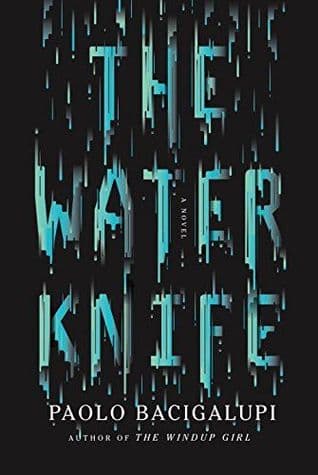
Paolo Bacigalupi (2015)
Genre
Thriller / Fantasy / Science Fiction
Reading Time
9-12 hours
Key Themes
See below
Sign in to track this book
In a dry future Southwest, water is the ultimate currency. A 'water knife,' a journalist, and a refugee race for survival amid corporate greed and shifting alliances, where the price of a single drop might be everything.
Angel Velasquez, a 'water knife' for powerful Las Vegas businesswoman Catherine Case, arrives in a dry Phoenix, Arizona. His job is to secure water rights for Case's luxury developments, often through threats, violence, or legal tricks. Phoenix is a city near collapse, ruined by extreme drought. Angel is investigating rumors of a 'mega-permit' for water that could reroute a large part of the Colorado River. This would devastate states like Arizona and strengthen California's and Nevada's control. He starts his search at a run-down law office, looking for a specific lawyer, but finds little information beyond the widespread need for water.
Lucy Monroe, a journalist trying to make a living in dying Phoenix, is also investigating the 'mega-permit.' Her editor, Mr. Ashworth, pushes her to find a strong story. Lucy visits the property of a deceased water lawyer, finding evidence of a complex, decades-old water rights claim. Meanwhile, Maria Villarosa, a young refugee from Texas, struggles to survive in the dirty 'arcologies' – vertical slums – of Phoenix. She uses her cleverness to get food, water, and safety for herself and her sick younger sister. Maria constantly faces violence and exploitation, especially from older men, and dreams of escaping Phoenix for a better life in California, a place she imagines as a paradise.
Angel's investigation leads him to the same deceased lawyer Lucy is researching. He uses his brutal methods to get information, often leaving violence behind. Lucy, seeing the aftermath, realizes the stakes are higher than she first thought. Angel reports to Catherine Case, who is ruthless and demanding. She stresses the importance of securing the mega-permit for her interests. Case makes it clear that failure is not an option, and the permit's political and economic effects are huge, potentially changing the balance of power in the Southwest. Angel feels the weight of his job, knowing his life, and possibly many others, depends on his success.
Angel discovers that the mega-permit is connected to a historical land grant and ancient water rights, which are complex and hard to trace. He uses his network to find descendants of the original claimants. Lucy, on her own, follows similar leads, putting together the legal details with help from her contacts. Maria, using her street smarts and connections in the refugee communities, accidentally finds information related to the same water rights, as some of the original families now live in poverty in the arcologies. All three characters, from different places, are getting close to the same important information, unaware of how their quests are linked.
As Angel gets closer to the truth, violence increases. He questions people, leaving no doubt about how serious his mission is. He discovers that the water rights are held by a group of elderly Native American descendants who do not know the huge value of what they have. Lucy faces threats from others also seeking the water rights, including California interests. She realizes her life is in danger. Maria sees the brutal reality of the water wars firsthand, as people around her are used and killed for even a hint of water. Alliances are fragile, and trust is something no one can afford.
Maria, using her cleverness and ability to move unseen, gets access to the elderly descendants of the original water rights holders. She earns their trust, or at least their tolerance, and finds physical evidence – old maps, deeds, and legal documents – needed to prove the mega-permit's validity. She understands that these documents are her way out of Phoenix. Her ability to navigate dangerous streets and talk with marginalized communities proves very valuable, placing her at the center of the story, even as powerful players largely underestimate her.
The different groups — Angel for Catherine Case, California interests, and Lucy with her independent investigation — meet at the place where Maria hid the important documents. A violent fight breaks out, with gunfights and hand-to-hand combat. Angel, driven by loyalty to Case and his own survival, fights hard. Lucy, wanting to expose the truth and protect innocent lives, gets caught in the fighting. Maria, using her street smarts and surprising courage, tries to protect the documents, knowing they are her only hope for a future. The chaotic scene shows the desperation and extreme actions people will take for water.
In the chaotic aftermath, some important documents are secured, though not always by the intended parties. Lives are lost, and Phoenix is further damaged. Angel, having partly completed his mission, reports to Case, but the permit's full effects are still unclear. Lucy, deeply affected by the violence, continues to try to expose the truth, facing a world that often ignores inconvenient facts. Maria, having survived, must decide her next step, holding onto whatever pieces of the future she managed to secure. The mega-permit's fate remains unclear, suggesting continued conflict.
Ultimately, Catherine Case uses the information and documents Angel secured, strengthening her power and ensuring her developments in Las Vegas continue to thrive. The mega-permit, or at least a large part of its benefits, goes to powerful interests aligned with Nevada and California. Phoenix, already a shell of its former self, faces an even worse future, with its remaining water supplies further reduced. The city becomes a clear example of resource depletion and societal collapse, a warning of what happens when water becomes the ultimate currency. The rich get wetter, and the poor get dust, as Angel's world continues to operate on the same brutal principles.
Angel Velasquez, still a water knife, continues to serve Catherine Case, his hands marked by the violence needed to maintain water flow to her empire. He survives, but his spirit is tired. His journey has shown him the depths of human desperation and the cold logic of power. Maria, having endured Phoenix's horrors, escapes the city, heading west towards California. She carries the scars of her past but also a strong will to build a better life. Her journey shows a small amount of hope amid widespread desolation. Her future, however, is still uncertain in a world defined by water scarcity.
The Protagonist
Angel starts as a hardened enforcer, but his encounters in Phoenix subtly challenge his worldview, though he ultimately remains bound by his profession.
The Protagonist
Lucy begins as an investigative reporter and evolves into a survivor, forced to confront the brutal realities of the water wars and the limits of her profession.
The Protagonist
Maria transforms from a desperate survivor into a proactive agent in her own fate, seizing an opportunity for escape and a new beginning.
The Antagonist
Case remains a constant, unwavering force of ambition and power, her influence growing as she achieves her goals.
The Supporting
Jaime's arc is largely complete before the story begins, serving as a tragic figure who reflects the consequences of Angel's path.
The Supporting
Ashworth remains a constant, grounding figure for Lucy, embodying the struggle to maintain journalistic standards in a chaotic world.
The Supporting
Sandra's role is primarily to hold the key to the water rights, her fate intertwined with the larger conflict.
The Antagonist
Their role is to act as a rival force, constantly challenging Angel and Case's efforts to secure the water rights.
The novel's main theme explores a future where water is the most valuable resource, leading to violent conflicts between states and individuals. Phoenix's collapse due to drought, the aggressive actions of 'water knives' like Angel, and the political struggles over the Colorado River show how scarcity can break down society and push people to extreme actions. The book clearly shows a world where access to water determines wealth, power, and survival, making it a constant, dangerous presence.
“Water was wealth. Water was power. Water was life. And the Southwest was dying of thirst.”
The novel shows a society divided by access to resources. The wealthy in Las Vegas and California enjoy green environments, while the poor and refugees in Phoenix's 'arcologies' suffer from dehydration, disease, and violence. Maria's struggle as a 'Tejana' refugee shows the prejudice and exploitation faced by those displaced by environmental collapse. This theme shows how environmental disasters harm the vulnerable most, worsening existing social inequalities and creating new forms of oppression.
“The rich stayed wet while the poor got dust.”
Lucy Monroe's character shows the struggle of journalism to uncover truth in a world where information is controlled and manipulated. Her efforts to expose corruption and the real nature of the water wars are met with indifference, danger, and the overwhelming power of those who benefit from the current situation. This theme questions the media's role when society breaks down and highlights how hard it is to stay honest and inform the public in a climate of fear and desperation.
“No one wanted to hear about the truth. Not when it meant accepting that their lives were built on lies.”
Every character, from Angel to Maria, is driven by the basic need to survive in a harsh world. Angel adapts by becoming a ruthless enforcer, Lucy by seeking truth, and Maria by using her street smarts. The novel explores the different ways people survive — violence, manipulation, resilience, and hope — in a world of scarcity and danger. It shows human endurance, but also the moral compromises extreme situations require.
“You did what you had to do to survive. Everyone did.”
The constant pursuit of 'progress' through developments and luxury resorts, as seen with Catherine Case, comes at a high cost of environmental damage and human suffering. The novel critiques unchecked corporate greed and the short-sighted use of natural resources. The greenness of Las Vegas contrasts sharply with the dust and death of Phoenix, showing the destructive results of prioritizing profit and luxury over sustainability and fair resource distribution.
“Everything was built on stolen water, and everyone knew it.”
The story is told through the alternating viewpoints of Angel, Lucy, and Maria.
The novel employs a multi-perspective narrative, primarily shifting between Angel Velasquez, Lucy Monroe, and Maria Villarosa. This device allows the reader to experience the water crisis from different angles: the enforcer, the journalist, and the refugee. It provides a comprehensive view of the societal breakdown, the political machinations, and the human cost. Each perspective offers unique insights into the motivations and struggles of various segments of the population, enriching the understanding of the complex, interconnected conflicts over water.
The city of Phoenix serves as a stark symbol of societal collapse due to water scarcity.
Phoenix functions as a central plot device, acting as a dystopian microcosm of the larger water wars. Its transformation from a thriving city to a desiccated, lawless wasteland highlights the devastating consequences of extreme drought and resource depletion. The decaying infrastructure, the 'arcologies' filled with refugees, and the constant threat of violence make Phoenix a character in itself, embodying the grim future awaiting other regions if water scarcity continues. It serves as a stark warning and the primary setting for the narrative's intense conflicts.
A historical legal document that becomes the macguffin driving the plot.
The 'mega-permit,' tied to ancient water rights and land grants, serves as the primary macguffin of the story. It is a tangible object (or concept) that all major factions are desperately seeking, believing it holds the key to controlling vast amounts of water from the Colorado River. Its historical complexity and unknown whereabouts propel the plot forward, forcing characters to uncover its secrets through investigation, violence, and manipulation. The permit represents the ultimate prize in the water wars, symbolizing control over life itself.
Angel's profession as a 'water knife' embodies the brutal nature of resource acquisition.
The term 'water knife' is both Angel's literal profession and a powerful metaphor for the ruthless, precise, and often violent methods used to secure water rights. It evokes the image of cutting or severing, reflecting how water is 'cut' from one area to benefit another, often leaving the former to die. The metaphor extends to the sharpness and brutality of the legal and physical battles over water, where individuals like Angel are tools used to carve out advantage, regardless of the human cost. It encapsulates the novel's core theme of resource warfare.
“Water always wins. Everyone else loses.”
— Angel Velasquez, a 'water knife,' reflects on the ultimate power of water in the parched American Southwest.
“The Colorado River was a myth, a legend, a ghost of what it had been.”
— The narrator describes the degraded state of the Colorado River, a critical but overused resource.
“The law was a thing for rich people to hide behind, and poor people to get crushed under.”
— A character's cynical view on the justice system and its disparity.
“Even a dying city could still be beautiful, in its own way. Like a cracked desert flower.”
— Maria, a journalist, observes the decaying beauty of Phoenix.
“You could always tell a powerful man by the size of his water share.”
— A common understanding in a world where water is the ultimate currency and status symbol.
“Everyone had a story about how they came to the desert. And most of them were lies.”
— Reflecting on the desperation and false pretenses of those seeking a new life in the arid lands.
“Hope was a dangerous thing in the desert. It made you careless.”
— Angel's pragmatic and cynical view on the perils of false hope in a harsh environment.
“The future wasn't something you waited for; it was something you took.”
— A character's philosophy on agency and proactive survival in a cutthroat world.
“The only thing cheaper than a human life was a human right.”
— A bleak commentary on the devaluation of human life and rights in a society driven by scarcity.
“Even the air tasted like dust and desperation.”
— A sensory description of the pervasive atmosphere of the drought-stricken Southwest.
“You couldn’t buy water, not really. You could only rent it.”
— Highlighting the transient and controlled nature of water access.
“Phoenix was a city of ghosts, built on stolen water, waiting for its final gasp.”
— Maria's vivid and somber assessment of Phoenix's unsustainable existence.
“The desert didn't care about your plans. It just took what it wanted.”
— A reminder of the unforgiving and indifferent nature of the environment.
“Survival wasn't a right; it was a constant negotiation.”
— A character's understanding of the continuous struggle required to stay alive.
“Every drop of water was a battle won, or lost.”
— Emphasizing the constant conflict and high stakes surrounding water resources.
Ready to see how well you understood this book? Take our interactive quiz with 10 questions.

Biography coming soon.







