“Time is not a line; it is a series of now-points.”
— Thaniel reflects on the nature of time and memory.

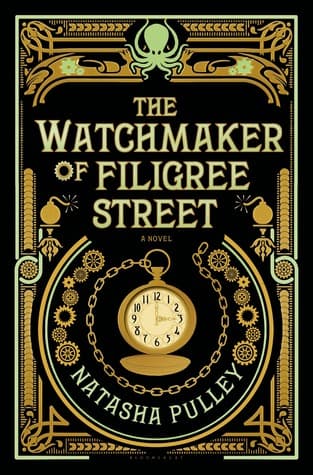
Natasha Pulley (2015)
Genre
Fantasy / Historical Fiction / Mystery / Science Fiction
Reading Time
6-7 hours
Key Themes
See below
Sign in to track this book
In gaslit 1883 London, a mysterious Japanese watchmaker, a gifted physicist, and a Scotland Yard telegraphist become entangled by a sentient golden pocket watch, revealing a hidden world of clockwork precognition, ancient Japanese magic, and dangerous loyalty.
In 1883 London, Thaniel Steepleton, a telegraphist for the Home Office and part-time musician, returns to his apartment to find a gold pocket watch on his pillow. Six months later, the watch chimes, urging him to leave his desk at Scotland Yard moments before an Irish Fenian bomb detonates. The building is destroyed, and many colleagues die. Thaniel is one of the few survivors, his life saved by the mysterious timepiece. Haunted by the event and the watch's foresight, he decides to find its creator. His search leads him to a reclusive Japanese immigrant named Keita Mori, who lives in a hidden shop on Filigree Street.
Thaniel finds Mori's shop, a place filled with clockwork automatons and quiet mystery. Mori, a reserved man, admits to making the watch. He invites Thaniel to live with him, offering a room and a new life. Thaniel accepts, drawn by Mori's kindness and the comfort of his home. As Thaniel settles in, he sees Mori's extraordinary abilities. Mori is not just a watchmaker; he sees glimpses of the future, which he puts into his clockwork creations, allowing them to subtly influence events or warn of danger, as the pocket watch did for Thaniel.
Grace Carrow, a brilliant but socially awkward Oxford physicist, is introduced. She is interested in 'ether clocks' and the 'Lepidoptera' clock, believed to move backwards in time. Her academic pursuits often face skepticism from her male colleagues, but she continues. Grace's research leads her to Mori's shop, as she thinks he might understand these timepieces. She is interested in a clock she saw in Mori's window, which she suspects is the Lepidoptera, unaware of its true nature or Mori's connection to it.
Thaniel feels increasingly drawn to Mori, developing a deep affection for the watchmaker. Their quiet life together has Mori's subtle, often unsettling, predictions. Through flashbacks, Mori's past in Japan is slowly revealed. Born with the ability to see and manipulate 'threads' of probability, he was part of a resistance group against the Meiji Restoration during a time of upheaval and civil war. He created automatons and devices to aid their cause, including a mechanical octopus named Katsu, who remains his loyal companion. Mori's past includes loss and the weight of his abilities, which he now uses to try and prevent future tragedies.
Grace's search for the Lepidoptera clock eventually leads her to Mori's workshop. She is fascinated by his creations and his apparent understanding of time. Mori, intrigued by her intelligence, allows her access to some of his less dangerous mechanisms. As Grace spends more time at Filigree Street, she meets Thaniel, who is initially wary of her intrusion. Grace, focused on her scientific theories, remains largely unaware of the deeper mysteries surrounding Mori, interpreting his abilities through a mechanical and scientific lens, rather than recognizing their fantastical nature.
Mori begins to see 'threads' indicating another Fenian attack targeting London. He struggles with the moral questions of his foresight, torn between preventing harm and the ethical problem of manipulating events. He confides in Thaniel, who, despite his growing unease with Mori's powers, agrees to help. They work together to decipher Mori's predictions, which are often vague and need careful interpretation. This shared burden deepens their bond, but also shows the danger and isolation Mori experiences due to his gift. The impending attack creates tension in their lives, as they try to understand and avert the disaster.
Mori, using his automatons and subtle manipulations, plans to thwart the Fenian bombing. He sends Thaniel to a specific location, seemingly for a mundane task, but in reality, to be in the right place at the right time to prevent a key part of the plot. Mori himself takes a more direct, and dangerous, role, attempting to disarm the bomb or divert its impact. His actions are precise and calculated, relying on his ability to see multiple possible futures. The plan is risky, and Mori puts his own life at stake, showing his commitment to protecting others, even those who misunderstand or fear him.
The Fenian attack is averted, but not without incident. Mori is injured, and the events leave Thaniel shaken. While grateful for his life and the lives saved, Thaniel questions the ethics of Mori's interventions. He questions whether it is right to manipulate fate, even with good intentions, and the extent of Mori's control over their lives. This internal conflict creates a rift between them, as Thaniel struggles to reconcile his love for Mori with his discomfort regarding Mori's abilities. He begins to pull away, seeking a more 'normal' existence, despite the reality of Mori's gifts.
Grace, still pursuing her scientific understanding of Mori's creations, begins to understand the true nature of his abilities. She realizes that his clocks don't just measure time; they influence it. Her scientific curiosity, combined with her lack of understanding of the social and personal implications, leads her to consider publishing her findings. This is a threat to Mori, who has guarded his secret for decades. If his powers were revealed, he would face persecution, jeopardizing his peaceful life in London. Thaniel becomes aware of Grace's intentions and the danger they represent.
Thaniel is caught in a dilemma. He cares for Grace and admires her intellect, but he also loves Mori and understands the danger her discovery poses to him. He tries to subtly dissuade Grace, but her scientific drive is too strong. Mori, sensing the inevitable, prepares for the consequences. The tension culminates in Thaniel having to make a difficult choice: protect Mori's secret and their shared life, or allow Grace to pursue her scientific truth, potentially exposing Mori to a hostile world. This decision forces Thaniel to confront his own desires and loyalties, leading him to reaffirm his bond with Mori.
To protect himself and those he cares about, Mori decides to leave London, creating a new, simpler watch that is less tied to his dangerous abilities. His departure is bittersweet, leaving Thaniel with a sense of loss but also a clearer understanding of their bond. Thaniel eventually accepts Mori's unique nature and their unusual relationship. He continues his life in London, changed by his experiences. The novel concludes with quiet hope and the understanding that their connection, though unconventional, is enduring. Thaniel learns to live with the knowledge of Mori's gifts, finding comfort in the unseen threads that connect them.
The Protagonist
Thaniel evolves from a passive recipient of fate to an active participant, learning to accept the fantastical and choose loyalty over conventional understanding.
The Major Supporting Character/Deuteragonist
Mori learns to trust and open himself to Thaniel, finding companionship and a measure of peace after a lifetime of isolation and burden.
The Major Supporting Character
Grace remains largely consistent in her scientific drive, but her interactions with Thaniel and Mori expose her to a world beyond pure science, though she struggles to integrate it.
The Supporting Character
Katsu remains a constant, unwavering presence, symbolizing Mori's enduring connection to his past and his unique abilities.
The Supporting Character
Professor Philip remains largely static in his views, highlighting the societal obstacles Grace faces.
The Supporting Character
His death serves as a catalyst for Thaniel's journey, emphasizing the stakes of the plot.
The Mentioned Character
N/A (Historical figure, plot device)
The Mentioned Character
N/A (Illustrative character)
The novel explores the tension between predetermined destiny and the ability to choose one's path. Mori's power to see and manipulate 'threads' of the future directly challenges free will, yet he constantly makes choices about how and when to intervene. Thaniel questions the ethics of Mori's interventions, asking if it is right to alter fate. The characters' struggles to accept or defy their perceived destinies, often through Mori's subtle nudges, form the core of this exploration.
““There were a million small things that had to happen to make a future. Mori could see them all, a vast, complex machine of probabilities.””
Many characters struggle with their place in the world. Mori, as a Japanese immigrant with extraordinary powers, is an outsider burdened by a past he cannot escape. He wants a place where he truly belongs and is understood. Thaniel, initially adrift, finds purpose and belonging with Mori. Grace, an intelligent woman in a patriarchal academic world, fights for her intellectual identity and recognition. The characters' journeys are often about finding acceptance, both from others and within themselves, in a world that doesn't always accommodate their unique natures.
““He felt as though he had been waiting for Mori all his life, without knowing it.””
The novel looks at different forms of love and the need for human connection. The central relationship between Thaniel and Mori evolves from employer-lodger to a deep, complex, and romantic bond. Their connection is built on understanding, acceptance of the fantastical, and shared vulnerability. Grace's intellectual attraction to Thaniel, and her pursuit of scientific truth, also show different facets of human connection and drive. The story suggests that true love involves accepting others for who they are, even their most extraordinary and challenging aspects.
““There was a silent language between them, a current that flowed between Mori’s quiet certainty and Thaniel’s growing trust.””
The story blurs the lines between scientific understanding and what appears to be magic. Grace Carrow, a physicist, tries to explain Mori's abilities and his automatons through scientific principles, seeking a rational explanation for the seemingly impossible. Mori's powers, while fantastical, are often described in mechanical terms ('threads,' 'clockwork of probability'). The novel suggests that some phenomena exist beyond current scientific comprehension, inviting readers to consider the limits of empirical knowledge and the potential for a deeper, more intricate reality.
““Grace had always believed that everything, given enough time and enough thought, could be understood. Mori was a challenge to that belief.””
Mori's ability to foresee the future is a burden. He constantly sees potential tragedies and the consequences of his actions, leading to isolation and a heavy sense of responsibility. Knowing what might happen forces him to make difficult ethical choices and live with the weight of unseen futures. Thaniel also experiences this burden, grappling with the moral implications of Mori's interventions and the knowledge that his own life was saved by an act of manipulation. The theme explores whether ignorance is sometimes better, and the cost of knowing too much.
““To see a future was not to be free of it, but to be bound to it, a terrible, lonely burden.””
A magical artifact that saves Thaniel's life and connects him to Mori.
The watch is the central inciting incident and a powerful symbol. It is not merely a timepiece but a complex automaton imbued with Mori's foresight, capable of subtly influencing its owner. It chimes to warn Thaniel of danger, demonstrating the reality of Mori's powers and drawing Thaniel into his world. The watch represents Mori's protective nature and his ability to subtly manipulate fate, a constant reminder of the fantastical elements at play and the profound connection between Thaniel and Mori.
Intricate clockwork creations that serve various functions, from companionship to subtle manipulation of events.
Mori's automatons, such as Katsu the octopus, and various birds and mechanisms, are more than mere toys; they are extensions of Mori's abilities. They can observe, communicate, and even subtly influence the world around them, acting as Mori's eyes, ears, and hands. They blur the line between mechanical ingenuity and magic, serving as tangible manifestations of Mori's foresight and his ability to weave 'threads' of probability. They add to the novel's unique blend of historical fiction, fantasy, and steampunk aesthetics.
Mori's unique ability to perceive and manipulate future possibilities.
This is Mori's defining magical ability, driving much of the plot and thematic exploration. Mori doesn't see a single, fixed future, but rather 'threads' of probability, allowing him to choose which future to nudge towards. This device introduces the central conflict of fate versus free will and the ethical dilemmas of intervention. It allows for suspense as Mori tries to decipher and act upon his visions, and it explains the seemingly miraculous events that occur throughout the story, such as Thaniel's survival from the bombing.
The real-world settings that ground the fantastical elements and provide thematic resonance.
The novel uses the backdrop of 1880s Victorian London, with its gas lamps, bustling streets, and political tensions (like Fenian bombings), to ground its fantastical elements in a recognizable reality. Mori's past is set against the Meiji Restoration in Japan, a period of rapid modernization and civil war, providing context for his displacement and the origins of his powers. This historical context enriches the narrative, adding layers of social commentary and realism that contrast with the magical elements, making the fantastical feel more plausible and resonant.
A legendary, mythical clock that symbolizes Grace's scientific quest.
The Lepidoptera clock is a mythical device believed by Grace Carrow to be capable of moving backward in time, thus defying the laws of physics. It serves as Grace's 'white whale,' driving her scientific inquiry and eventually leading her to Mori. While its literal existence as a time-traveling device is ambiguous, it represents the ultimate scientific puzzle and the boundary between known science and the unknown. Its pursuit highlights Grace's ambition and the human desire to understand and control time itself.
“Time is not a line; it is a series of now-points.”
— Thaniel reflects on the nature of time and memory.
“A watch is a small rebellion against the inevitable.”
— Keita Mori explains his philosophy of watchmaking.
“We are all clockwork, but some of us are more finely made.”
— Mori discusses human nature and determinism.
“The future is not fixed; it is only probable.”
— Mori explains his ability to see possible futures.
“Silence is not empty; it is full of answers.”
— Thaniel learns to listen in moments of quiet.
“A single thread may seem weak, but it can hold a tapestry together.”
— Mori describes the interconnectedness of events.
“To remember everything is to forgive everything.”
— Mori reflects on memory and compassion.
“The past is a story we tell ourselves to make sense of the present.”
— Thaniel contemplates history and personal narrative.
“Magic is not in the breaking of rules, but in understanding them so well you can bend them.”
— Mori explains his approach to clockwork and fate.
“Sometimes the most ordinary things are made extraordinary by context.”
— Thaniel observes the significance of small details.
“A life without mystery is a life half-lived.”
— Mori argues for the importance of the unknown.
“We are all watches, waiting to be wound by chance.”
— Thaniel muses on luck and opportunity.
“The heart is a clock that keeps its own time.”
— Reflection on emotions and their unpredictable nature.
“To see the future is to be haunted by the might-have-beens.”
— Mori describes the burden of his foresight.
Ready to see how well you understood this book? Take our interactive quiz with 10 questions.

Biography coming soon.







