“To collect is to rescue things, valuable things, from neglect, from oblivion, from the abyss of time.”
— The Cavaliere reflects on his passion for collecting art and antiquities.

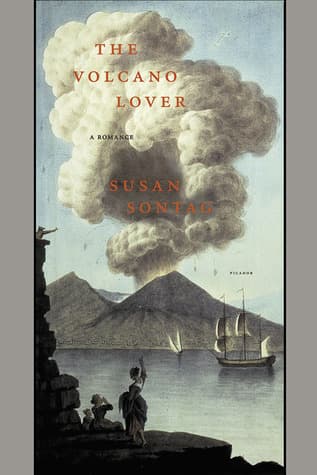
Susan Sontag (1992)
Genre
Historical Fiction / Romance
Reading Time
540 min
Key Themes
See below
Sign in to track this book
In 18th-century Naples, a passionate and unconventional love triangle emerges between a British ambassador, his wife, and Lord Nelson, set against a backdrop of volcanic activity, art, and revolution.
The novel begins with Sir William Hamilton, the British Envoy to the Court of Ferdinand IV and Queen Maria Carolina in Naples. A man of refined tastes, Sir William is dedicated to his collections of ancient vases, bronzes, and volcanic minerals. He sees them as a way to understand history and nature. His main interest is Mount Vesuvius, which he studies with scientific care, often risking his life to observe eruptions. His first wife, Catherine, is a quiet, supportive presence. She shares his intellectual interests and deals with the superficiality of the Neapolitan court. Their life is one of cultured routine, with diplomatic duties and Sir William's scholarly pursuits. All of this happens against the busy, often chaotic setting of 18th-century Naples.
After his wife Catherine dies, Sir William feels a deep loss. His nephew, Charles Greville, a man with little money but social ambition, sends his mistress, Emma Lyon (later Lady Hamilton), to Naples. The idea is to offload her. Emma, from humble beginnings but with great beauty, charm, and talent, quickly impresses the grieving Sir William. Her liveliness, natural intelligence, and desire to learn draw him in. He finds himself unexpectedly attracted to her. Despite initial social impropriety, Emma becomes part of his household. Their relationship grows from a platonic mentorship to a romantic one.
Sir William marries Emma in London, going against social rules and his family's expectations. When they return to Naples, Emma, now Lady Hamilton, truly thrives. She becomes a celebrated figure, known for her beauty and her 'Attitudes' – living tableaux where she would pose dramatically, often draped in shawls, to represent classical figures or emotions. These performances captivated European aristocrats and intellectuals who visited Naples, including Goethe. They established her as an artistic muse and a social sensation. Sir William takes pride in her success, seeing her as his most beautiful 'acquisition' and a living work of art. Emma enjoys her new status and influence.
The political situation in Europe worsens with the French Revolution and Napoleon's rise. Admiral Horatio Nelson, a British naval hero, arrives in Naples, seeking supplies and diplomatic support. Nelson, a man of intense passion and military skill, quickly falls for Emma. Despite his missing an eye and an arm, and being married to Fanny Nelson, he and Emma are drawn to each other. Sir William initially admires Nelson as a patriot and hero, but finds himself increasingly ignored as Emma and Nelson's affair grows. Naples' social life continues, but tension exists between the three, hinting at big changes to come.
As French revolutionary armies advance, Naples experiences political chaos. The royal family, urged by Emma and Nelson, flees to Palermo on Nelson's ship. This dramatic evacuation solidifies Emma's role as a trusted advisor to Queen Maria Carolina. During this time of danger and uncertainty, Emma and Nelson's affair becomes clear and public. Sir William, while keeping his composure and diplomatic duties, is aware of the betrayal. He struggles with his love for Emma, his admiration for Nelson, and the painful reality of Emma's changed feelings for him. The personal drama happens during war, revolution, and shifting loyalties in the Neapolitan court.
In Palermo, the temporary home for the Neapolitan court, Emma and Nelson's relationship deepens. Emma gets pregnant with Nelson's child, a secret they try to keep. Sir William accepts the situation with a sad resignation, continuing his intellectual pursuits and observing the drama with a detached, philosophical view. He thinks about love, possession, and time, realizing that while he still loves Emma, her heart is now with someone else. The closeness of their exile highlights the complexities of their unusual ménage à trois. They navigate social expectations, personal desires, and war demands, all while Sir William keeps his diplomatic role.
After the French leave, the royal family, with the Hamiltons and Nelson, returns to Naples. The city is changing, with punishment against revolutionaries and a complex political situation. Emma's influence with the Queen and Nelson's military reputation are at their highest. Sir William, though still the British Envoy, finds his diplomatic power overshadowed by Emma's personal sway and Nelson's fame. He continues his collecting and intellectual work, observing the human drama with a mix of amusement and sadness. The Hamiltons' grand villa, once a place of art and culture, now acts as a center for political maneuvering and the increasingly public display of Emma and Nelson's affection.
Sir William is eventually called back to England. The trio—Sir William, Emma, and Nelson—travels back together. The journey is full of social awkwardness due to their unusual arrangement. When they arrive in England, the scandal of Emma and Nelson's affair becomes a major topic of public talk. Sir William, always stoic, tries to maintain his dignity among the whispers and judgments. Emma, once celebrated in Naples, faces a more conservative and less forgiving British society. Nelson, a national hero, is criticized for his open adultery, creating immense pressure on all three.
In England, the ménage à trois continues, but with social disapproval. Sir William, increasingly weak and accepting, withdraws further into his intellectual world. He keeps collecting and studying, finding comfort in the beauty and order of his objects. He observes Emma and Nelson's passionate, but strained, relationship with philosophical detachment. He acknowledges their deep connection while dealing with his own feelings of loss. His health declines. He reflects on his life, his interests, and the lasting power of love and art, even as his personal life is public. He cherishes memories of Catherine and his early years with Emma, understanding human desire.
Sir William Hamilton dies peacefully in 1803, with Emma and Nelson present. His death changes things, allowing Emma and Nelson to openly pursue their relationship. However, their happiness is short. Nelson returns to sea, leading the British fleet to victory at the Battle of Trafalgar in 1805, where he is fatally wounded. His death leaves Emma devastated and without money. The novel ends by hinting at Emma's later decline, her inability to manage her finances, and her eventual poverty, a contrast to her earlier success as Lady Hamilton.
The Protagonist
From a contented scholar and diplomat, he becomes a resigned, philosophical observer of his own life's unraveling, ultimately finding solace in his inner world.
The Protagonist/Supporting
From a naive mistress, she transforms into a celebrated muse and influential figure, only to fall from grace after the deaths of both Sir William and Nelson.
The Supporting
His character arc is largely defined by his military triumphs and his consuming love affair, culminating in his heroic death at Trafalgar.
The Supporting
Her brief appearance sets the stage for Sir William's subsequent emotional journey, her death being the catalyst for Emma's entrance.
The Supporting
Her character remains largely consistent as a powerful political figure, her interactions with Emma serving to highlight Emma's influence.
The Mentioned
His primary role is to set the plot in motion; his personal arc is not deeply explored.
The Mentioned
His role is to provide external validation for Emma's artistic talent.
The Mentioned
His character serves as a backdrop to the political machinations and the more dynamic personalities around him.
The novel explores various forms of obsession, especially through Sir William's interest in collecting. He acquires ancient vases, volcanic minerals, and even Emma, seeing them as objects of beauty and study. This theme extends to his scientific interest in Vesuvius, which he documents with dedication. The urge to collect is shown as a way to order chaos, to possess beauty, and to understand the world, but it also shows detachment and a tendency to objectify. Emma's 'Attitudes' are also a form of collection, combining different emotions and classical figures into one performance.
“A collector is a man who collects. That's all. It is a form of love, that's all. A form of knowledge. A form of power.”
Beauty, both natural and man-made, is a central theme. Emma's physical beauty and her artistic 'Attitudes' are presented as a form of living art, captivating audiences and inspiring Goethe. Sir William's collections of antiquities represent a timeless beauty, while Vesuvius shows nature's grand art. The novel questions the nature of artifice versus authenticity, and how beauty can be both powerful and temporary. Emma's performances are a deliberate act of self-creation, changing her humble origins into a celebrated public figure.
“Emma's 'Attitudes' were art, and she was the work of art. Her body was the canvas, her emotions the paint.”
The complex dynamics of love are explored through the relationships between Sir William, Emma, and Nelson. Sir William's love for Emma changes from paternal affection and admiration for her beauty to a resigned acceptance of her passion for Nelson. Emma feels both true affection for Sir William and an intense desire for Nelson. The theme shows different sides of love: intellectual companionship, aesthetic appreciation, and raw, physical passion. Betrayal is always present, especially for Sir William, as he sees his wife's affair, but he deals with it philosophically instead of with anger.
“Love is an act of the will, but desire is a force of nature.”
Mount Vesuvius is a strong symbol of wild nature, always threatening Naples and showing humans their small place. Sir William's scientific study of Vesuvius tries to understand and categorize this raw power, showing humanity's desire to control or at least understand the natural world. In contrast, the social rituals of the Neapolitan court and Sir William's arranged collections represent the ordered, civilized world. Vesuvius's eruptions often mirror the eruptions of passion and political chaos in the human drama, blurring the lines between nature and human life.
“Vesuvius was the true master of Naples, a constant reminder of the fragility of human endeavors.”
Emma's journey from Amy Lyon to Lady Hamilton explores self-invention. She constantly reinvents herself, adapting to new environments and social roles, using her charm and talent to rise socially. Her 'Attitudes' are acts of adopting new identities. Sir William also builds his identity through his intellectual pursuits and his role as a diplomat and collector. The novel questions whether identity is inherent or constructed, and how much of ourselves is shaped by external views and internal will. The characters often play roles, both consciously and unconsciously.
“One invents oneself. One must. And then one must live with the invention.”
Sir William's perspective as a detached, intellectual observer.
Sir William's character often functions as a narrative device, offering a 'collector's gaze' on the events and people around him. He observes Emma, Nelson, the Neapolitan court, and even Vesuvius with a detached, analytical, and aesthetic appreciation. This perspective allows the narrator to offer philosophical insights into human nature, art, and history, often filtering the emotional intensity of the plot through a more intellectual lens. It creates a sense of measured reflection, even amidst personal turmoil and political upheaval, shaping the novel's contemplative tone.
The volcano symbolizes passion, destruction, and the unpredictability of nature and human affairs.
Mount Vesuvius is not merely a setting but a constant, living metaphor throughout the novel. Its eruptions parallel the explosions of passion between Emma and Nelson, the political upheavals of the French Revolution, and the destructive potential of human desire. It represents the untamed, primal forces of nature that contrast with Sir William's ordered, civilized world. The volcano's presence emphasizes the fragility of human life and the inevitable cycles of creation and destruction, serving as a powerful, ever-present reminder of the deeper, uncontrollable forces at play.
Emma's living tableaux vivants as a device for self-creation and artistic expression.
Emma's 'Attitudes' are a key plot device that allow her to transcend her humble origins and become a celebrated figure. These performances are not just entertainment; they are acts of self-invention and artistic expression that blur the lines between life and art. They demonstrate her talent, charisma, and ability to embody different personas, reflecting the theme of identity as a construct. The 'Attitudes' also serve to highlight the artificiality of court life and the power of theatricality in shaping public perception and personal destiny.
A shifting, often omniscient, voice that offers philosophical commentary.
The novel employs an unnamed, often omniscient narrator who frequently interjects with philosophical reflections, historical context, and psychological insights into the characters. This narrative voice is not confined to a single perspective but shifts, sometimes aligning with Sir William's contemplative tone, sometimes offering a broader, more critical view. This device allows Sontag to weave in her own intellectual concerns about art, history, and human nature, making the novel as much a meditation on these themes as it is a historical romance. The narrator often directly addresses the reader, inviting them into the intellectual discourse.
“To collect is to rescue things, valuable things, from neglect, from oblivion, from the abyss of time.”
— The Cavaliere reflects on his passion for collecting art and antiquities.
“Love is a kind of possession, and possession is a kind of love.”
— The Cavaliere contemplates his relationship with his wife, Emma.
“We are all volcanoes. Long periods of quiescence are followed by eruptions that change everything.”
— A metaphorical reflection on human nature and historical upheaval.
“The past is not dead; it is not even past.”
— A philosophical observation on history's lingering influence.
“Beauty is a contract between the beholder and the beheld.”
— The Cavaliere muses on aesthetics and perception.
“To be a spectator is to be complicit.”
— A critique of passive observation during turbulent times.
“The heart has its reasons, which reason does not know.”
— Reflecting on the irrational nature of love and desire.
“Every object tells a story, if you know how to listen.”
— The Cavaliere's approach to his collection of artifacts.
“Passion is a fire that consumes everything in its path.”
— Describing the destructive power of intense emotions.
“In the end, we are all collectors of our own memories.”
— A reflective thought on personal history and identity.
“The line between admiration and obsession is perilously thin.”
— The Cavaliere's warning about his own collecting habits.
“History is written by the survivors, but felt by the victims.”
— A poignant remark on the subjective nature of historical narrative.
“To love is to risk everything, and to lose is to understand the risk.”
— A meditation on the vulnerabilities inherent in love.
“The volcano does not care for the villages at its feet.”
— A metaphor for indifferent forces of nature and history.
Ready to see how well you understood this book? Take our interactive quiz with 10 questions.

Biography coming soon.







