BookBrief
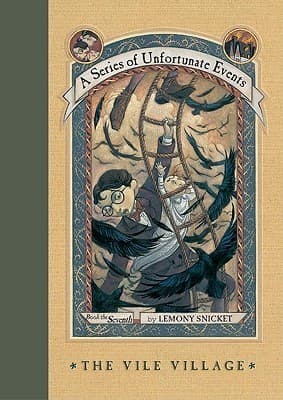
The Vile Village cover
Archivist's Choice

The Vile Village

Lemony Snicket (2001)

Genre

Fantasy / Children's / Mystery / Young Adult

Reading Time

180 min

Key Themes

See below

Track Your Reading

Sign in to track this book

In a village obsessed with crows and rules, the Baudelaire orphans confront an angry mob, unjust arrests, and the mystery of V.F.D., all while sporting very strange hats.

Synopsis

Violet, Klaus, and Sunny Baudelaire arrive at the Village of Fowl Devotees (V.F.D.) and are cared for by the whole town, which is run by strange rules and an Elder Council. They meet Jacques Snicket, who they think is a helpful member of the secret organization V.F.D. But Jacques is soon murdered. Count Olaf, disguised as Detective Dupin, and his henchwoman Esmé Squalor frame the Baudelaires for his death. Imprisoned and facing an unfair trial, the children must use their skills—Violet's inventiveness, Klaus's research, and Sunny's biting and cooking talents—to find the truth about Jacques's death, expose Count Olaf, and escape the hostile village before they are executed. They find clues in a fountain, a secret message, and the village's crow population. They uncover Olaf's deception and make a daring escape into the unknown, leaving behind a village still controlled by injustice and odd rules.
Reading time
180 min
Difficulty
Easy
Pacing
Fast
Mood
Melancholy, Suspenseful, Witty, Absurdist
✓ Read this if...
You enjoy dark humor, clever wordplay, and a series of unfortunate events where children outsmart inept adults.
✗ Skip this if...
You prefer happy endings and straightforward plots without constant peril and moral ambiguity.

Plot Summary

Arrival at the Village of Fowl Devotees

After escaping their last guardian, Violet, Klaus, and Sunny Baudelaire are sent by Mr. Poe to the Village of Fowl Devotees (V.F.D.), a town run by strict rules and an Elder Council. Their new guardianship is unusual; the entire village is meant to care for them, which immediately makes Klaus suspicious. The village is obsessed with its many crows, which migrate daily, and its strict rules. The children are given a rundown shack to live in and assigned chores, quickly realizing their new home offers little comfort or safety, and that the villagers distrust outsiders.

The Mysterious 'Jacques Snicket'

While living in V.F.D., the Baudelaires meet Jacques Snicket, a kind man researching the village's history. To their dismay, Jacques looks a lot like Count Olaf, with a unibrow and an eye tattoo on his ankle. Despite the physical similarities, Jacques acts completely differently, confusing the children. He says he is part of a secret organization and warns them about a conspiracy. Before he can say more, the village authorities arrest him for breaking a rule against 'suspicious looking people,' after Count Olaf, disguised as Detective Dupin, points him out.

Jacques's Demise and the Baudelaires' Framing

Jacques Snicket is found dead in the village's fountain, having fallen from the high clock tower. Count Olaf, still disguised as Detective Dupin, immediately accuses the Baudelaire orphans of his murder, saying they pushed him. The villagers, easily swayed and already suspicious of the children, believe Olaf's made-up story. The Baudelaires, despite pleading their innocence and trying to explain Olaf's true identity, are quickly arrested and locked in the 'Deluxe Cell,' a small, uncomfortable cage for criminals. Their situation becomes serious as they realize Olaf has again manipulated a community to further his evil plans.

Investigation and Rule-Breaking

Imprisoned, the Baudelaires realize they must prove their innocence and expose Count Olaf. Klaus, always the researcher, notices odd details about the village's rules, especially Rule #283: 'No person shall be allowed to remove a single crow from the village.' He also finds a coded message hidden in a newspaper article about Jacques's death, which reads 'Baudelaire orphans are innocent. Check the fountain.' This message, left by Jacques, shows he knew he was in danger. The children realize they need to investigate the fountain, but escaping their cell and navigating the rule-obsessed village without getting caught is a big challenge.

Escape and the Fountain Clue

Using their combined skills, the Baudelaires escape the Deluxe Cell. Violet, with her inventive skills, makes a makeshift lock-picking device, while Sunny's sharp teeth help gnaw through restraints. They go to the fountain, where Klaus carefully examines the area. He finds a broken piece of a spyglass and a note from Jacques, confirming he was investigating the village and its V.F.D. connection, and that Count Olaf was involved. This evidence further shows Olaf is responsible for Jacques's death and that the village's rules are being misused.

The Trial and Count Olaf's Manipulation

The Baudelaires are brought to trial. Count Olaf, still disguised as Detective Dupin, acts as the prosecutor, and the Council of Elders serves as the jury. The trial is a complete joke, designed to convict the children. Olaf presents fake evidence and manipulates the villagers, playing on their fear and rule-following. The children try to present their evidence – the broken spyglass and Jacques's note – but Olaf dismisses it. The villagers, fooled by Olaf's charm and their own bias, are ready to condemn the Baudelaires, making their situation seem hopeless.

Violet's Invention and the Truth Revealed

During the trial, Violet realizes the broken spyglass could expose Olaf. She cleverly rebuilds it and, using its reflective surface, reveals Olaf's unibrow, which he had painted over. The villagers gasp as Olaf's true face is shown. Klaus then presents Jacques's note, proving Olaf's involvement in the murder. However, the village council, still holding to their absurd rules, declares that while Olaf is indeed Count Olaf, the children are still guilty of breaking Rule #283 by removing a crow, upholding their conviction on a technicality.

The Crow Chase and the Rule of Crows

Despite exposing Olaf, the Baudelaires are still found guilty. They realize their only option is to escape. Remembering Rule #283, which forbids harming the crows, Violet plans. They release the village's entire crow population, causing chaos and confusion. The children grab onto the legs of the migrating crows, using them to fly away from the village. Count Olaf, angry at their escape, chases them in a vehicle, but the children evade him, soaring into the sky with the birds, leaving the confused villagers and enraged Olaf behind.

The Great Unknown

The Baudelaire orphans, clinging to the legs of the migrating crows, escape the Village of Fowl Devotees. They eventually land safely, far from Count Olaf and the misguided villagers. However, their relief is short-lived. They are again alone, without a guardian, and no closer to finding the full truth about V.F.D. or their parents' past. As they walk away, they know Jacques Snicket was a good man, a member of the secret organization, and a victim of Count Olaf, strengthening their resolve to continue seeking answers and safety.

Principal Figures

Violet Baudelaire

The Protagonist

Violet consistently uses her inventive skills to solve immediate problems and escape danger, demonstrating her unwavering resourcefulness and protective nature.

Klaus Baudelaire

The Protagonist

Klaus continues to rely on his research skills to uncover truths and expose deception, showing his growing ability to apply knowledge under pressure.

Sunny Baudelaire

The Protagonist

Sunny's communication skills develop further, and her unique abilities become increasingly vital to the Baudelaires' survival.

Count Olaf

The Antagonist

Count Olaf continues his pattern of elaborate disguises and manipulative schemes, always driven by his insatiable greed, but is eventually exposed.

Mr. Poe

The Supporting

Mr. Poe remains largely oblivious and ineffective, highlighting the recurring theme of adults failing to protect the Baudelaires.

Jacques Snicket

The Supporting

Jacques serves as a brief beacon of hope and a source of crucial information, whose untimely death propels the plot and deepens the mystery of V.F.D.

The Council of Elders

The Supporting

The Council demonstrates unwavering adherence to rules over reason, serving as an obstacle to justice and highlighting the dangers of blind obedience.

Detective Dupin

The Mentioned

This persona allows Olaf to exert authority and manipulate the entire village, demonstrating his skill in deception before ultimately being exposed.

Themes & Insights

Incompetence of Adults

Adult incompetence continues to endanger the Baudelaire children. Mr. Poe's decision to send them to the Village of Fowl Devotees, with its odd communal guardianship, immediately puts them in danger. The Council of Elders, with their rigid adherence to senseless rules, are easily fooled by Count Olaf's disguise as Detective Dupin. They fail to see through his obvious deception even when the children present clear evidence. This theme shows the children's constant need to rely on their own intelligence and resourcefulness to survive, as the adults around them consistently fail to protect them.

“It is a curious thing, but very often good and sensible people are not able to perceive the truth, even when it is staring them in the face.”

Lemony Snicket (Narrator)

The Dangers of Blind Obedience

The Village of Fowl Devotees shows the dangers of blind obedience to rules. The villagers prioritize their many, often illogical, 'Rules of V.F.D.' over common sense, justice, and human compassion. This rigid adherence allows Count Olaf, disguised as Detective Dupin, to manipulate the entire community. They readily believe his made-up story about the Baudelaires' guilt and will not consider any evidence that goes against their rules or trust in authority figures. This theme highlights how a society can become unjust and dangerous when critical thinking is suppressed in favor of unquestioning compliance.

“It is a sad truth, but one that must be acknowledged, that the rules of the world are not always fair, and that justice is not always served.”

Lemony Snicket (Narrator)

Identity and Disguise

Identity and disguise are central to the story, especially with Count Olaf's repeated ability to fool adults. In V.F.D., he successfully acts as Detective Dupin, a seemingly legitimate authority figure, by simply painting over his unibrow. The confusion grows with the arrival of Jacques Snicket, who shares physical features with Olaf but is morally his opposite. This contrast shows how easily appearances can be deceiving and how hard it is for the children to convince adults of Olaf's true identity, forcing them to rely on their own deductive skills to tell friend from foe.

“It is a curious thing, the way a person's appearance can be so misleading.”

Lemony Snicket (Narrator)

The Power of Knowledge and Invention

Throughout their ordeal, the Baudelaire orphans consistently use their unique talents – Violet's inventiveness, Klaus's knowledge, and Sunny's sharp teeth – to overcome problems. Klaus deciphers Jacques's coded message and finds clues about the fountain. Violet invents a device to escape their cell and later rebuilds the spyglass to expose Olaf. Sunny's biting skills help in their escape. This theme emphasizes that despite their youth and vulnerability, their combined intellectual and practical skills are their most powerful tools for survival against incompetent adults and Count Olaf's schemes.

“There is no such thing as a problem that cannot be solved, if one only has enough information.”

Klaus Baudelaire

Plot Devices & Literary Techniques

Red Herring

A misleading clue or character used to distract the audience and characters.

The character of Jacques Snicket serves as a significant red herring. His physical resemblance to Count Olaf (unibrow, eye tattoo) initially leads the Baudelaires, and the reader, to suspect him of being Olaf in disguise. This misdirection is crucial in building suspense and confusion, making Olaf's actual disguise as Detective Dupin more effective. It also highlights the Baudelaires' constant vigilance and their struggle to discern truth from deception, as they must learn to look beyond superficial similarities to judge character.

Deus ex Machina (subverted)

An unexpected power or event saving a seemingly hopeless situation (often with a twist).

The use of the migrating crows to escape the village could be seen as a subversion of a Deus ex Machina. While the crows appear suddenly and provide a means of escape, their utility is directly tied to a specific village rule (Rule #283) that the children cleverly exploit. It's not an entirely random, out-of-nowhere solution but rather a resourceful use of existing circumstances and rules, demonstrating the children's ingenuity rather than a purely miraculous intervention. It provides a fantastical element to their escape, yet it's grounded in the established world.

The Unreliable Narrator

The story is told by a narrator whose credibility is questionable.

Lemony Snicket, as the narrator, consistently warns the reader against continuing the story due to its bleakness and unpleasantness. He frequently interjects with his personal opinions, historical anecdotes, and definitions, often lamenting the tragic fate of the Baudelaires. This device creates a unique tone, adding a layer of meta-commentary and dark humor. It also serves to heighten the sense of dread and inevitability, making the Baudelaires' struggles feel even more poignant as the narrator himself seems powerless to change their misfortunes.

The MacGuffin

An object or device that serves merely as a trigger for the plot.

The Baudelaire fortune, while not directly pursued in this book, continues to function as the ultimate MacGuffin. It is the underlying motivation for Count Olaf's relentless pursuit of the children, driving the entire series' plot. In 'The Vile Village,' Olaf's immediate goal is to frame the children for murder to gain access to their inheritance, even if indirectly. The fortune's existence shapes every decision and every danger the children face, serving as the constant, overarching trigger for their misfortunes.

Critical analysis

Notable Quotes

There are many things in the world that are not good for children to know about, and even if they are good for children to know about, there are many people in the world who would rather children not know about them.

The narrator's frequent lament on the grim realities children face.

It is a sad but true fact that sometimes the most important information is hidden in the most unlikely places.

The Baudelaires often find clues in unexpected ways.

If you are a person who has ever had a secret, then you know that a secret can be a very dangerous thing.

The secret of V.F.D. is a major plot point.

The world is a vast and complicated place, and there are many people in it who are not what they seem.

The Baudelaires constantly encounter deceptive adults.

Even the most ordinary events can lead to the most extraordinary complications.

The Baudelaires' arrival in the village quickly spirals into disaster.

It is a curious thing, but the more you try to avoid a certain type of person, the more often you seem to run into them.

The constant reappearances of Count Olaf.

Sometimes, the only way to get through a very bad day is to remember that you have gotten through very bad days before.

The Baudelaires' resilience in the face of adversity.

The expression 'the truth will out' is a phrase that means that no matter how hard people try to hide the truth, it will eventually become known.

The Baudelaires' quest to uncover the truth about their parents and V.F.D.

It is a truth universally acknowledged that a single man in possession of a good fortune must be in want of a wife, but it is not a truth universally acknowledged that a single man in possession of a bad fortune must be in want of a disguise.

A humorous nod to classic literature while highlighting Count Olaf's modus operandi.

The worst kind of fear is the kind that makes you afraid of yourself.

The Baudelaires' internal struggles and moral dilemmas.

Libraries are full of ideas—perhaps the most dangerous and powerful of all weapons.

The Baudelaires' reliance on books and knowledge.

It is often said that the first step is the hardest, but this is not always true. Sometimes the second step is the hardest, or the third, or the seventy-ninth.

The ongoing struggles of the Baudelaire orphans.

The only thing that can console a person who has just been wronged is the knowledge that they are not alone.

The Baudelaires often find solace in each other's company.

Quiz

Test Your Knowledge

Ready to see how well you understood this book? Take our interactive quiz with 10 questions.

10
Questions
~5
Minutes
?
Best Score

Key Questions (FAQ)

The Baudelaire orphans are sent to live in the theocratic Village of Fowl Devotees (V.F.D.) under the care of the entire village, governed by a strict set of rules, particularly those concerning crows. They soon discover that Count Olaf is hiding in plain sight as Detective Dupin, attempting to frame them for murder and steal their fortune once again.

About the author