“The world is full of obvious things which nobody by any chance ever observes.”
— Sherlock Holmes to Dr. Watson, discussing human observation skills.


Arthur Conan Doyle (1914)
Genre
Thriller / Historical Fiction / Mystery
Reading Time
6 hr., 25 min.
Key Themes
See below
Sign in to track this book
Sherlock Holmes uncovers the dark secrets of a country manor, revealing a sinister plot by a secret organization that spans from the English countryside to American coal mines.
The novel begins with Sherlock Holmes receiving a coded message from Porlock, a trusted informant in Professor Moriarty's criminal network. Holmes and Dr. Watson decode the message, which warns that 'Douglas of Birlstone' is in danger. Holmes recognizes the seriousness of the situation, given Porlock's directness and the link to Moriarty's large organization. Before Holmes can act, Inspector MacDonald from Scotland Yard arrives with news of a murder at Birlstone House, the estate mentioned in the cipher. This coincidence confirms Holmes's fears and prompts their immediate travel to the crime scene.
Holmes, Watson, and Inspector MacDonald arrive at Birlstone House, a moated country manor, where they find a puzzling crime scene. John Douglas, the owner, is dead in his study from a shotgun wound to the head. The weapon, a sawed-off shotgun, lies beside him. The room is locked from the inside, and Douglas's wedding ring is missing, though other valuables are untouched. Mrs. Douglas, his young American wife, and Cecil Barker, a close friend and guest, claim they were woken by the shot. Local police, led by Sergeant Fuller, have secured the scene, but the locked room mystery immediately interests Holmes, suggesting a more complex situation than a simple murder or suicide.
Examining the study, Holmes quickly finds several inconsistencies that challenge initial conclusions of suicide or a simple murder. The shotgun wound is close-range, but the weapon is unusually short. He notes the missing wedding ring and a strange bloodstain on the window sill. Most importantly, Holmes observes that the body's position and wound do not entirely match a self-inflicted shot, and the locked room, while seemingly secure, has subtle clues suggesting someone else was there. He also finds American playing cards and a small, American-made revolver in a hidden compartment, hinting at a foreign link to the deceased. These details lead Holmes to suspect a carefully planned deception.
Through his observations, especially the missing wedding ring and the body's condition, Holmes concludes that the deceased is not John Douglas. Instead, it is another man, likely a visitor, who was murdered and disguised to look like Douglas. The real John Douglas, Holmes believes, faked his own death. This revelation shocks MacDonald and Watson. Holmes explains that the body was too disfigured for positive identification by anyone unfamiliar with Douglas's subtle features. The reason for this elaborate deception remains unclear, but it shifts the investigation from a simple murder to a complex scheme involving hidden identity and a secret past.
After Holmes confronts Mrs. Douglas and Cecil Barker with his theory, the 'real' John Douglas appears from his hiding place in Birlstone House. He admits to staging his death, revealing that the deceased was his enemy, Ted Baldwin, a man from his past in America. Douglas explains he recognized Baldwin lurking around the estate and, fearing for his life and his wife's safety, confronted him. During the struggle, Baldwin was killed. Douglas, with help from Barker and his wife, then set up the scene to make it look like he had been murdered, hoping to escape his past. He recounts a history of violence and a secret organization he once belonged to in America.
The story then shifts to a long flashback about Douglas's life in America, specifically the Vermissa Valley (the 'Valley of Fear'). Here, he was John McMurdo, an undercover Pinkerton detective sent to infiltrate the 'Scowrers' (a fictional version of the Molly Maguires). The Scowrers, led by the ruthless Boss McGinty and the sinister Bodymaster Ettie Shafter, terrorized the mining community, extorting, assaulting, and murdering those who defied them. McMurdo, a seemingly rough man with a mysterious past, quickly gains their trust through his apparent ruthlessness and willingness to join their violence, all while secretly gathering evidence. He falls in love with Ettie Shafter's daughter, Ettie, further complicating his mission.
McMurdo's infiltration of the Scowrers is dangerous. He must participate in violent acts, including beatings and an assassination attempt on an official, to maintain his cover. He sees firsthand the Scowrers' terrifying control over the community, operating freely due to fear and corruption. His internal conflict grows as he becomes more embedded, struggling with the moral compromises needed to keep his disguise. He develops a complex relationship with Ettie, torn between duty and growing affection. The Scowrers' rituals, secret handshakes, and brutal enforcement of their 'laws' are detailed, showing a lawless land ruled by fear, as McMurdo secretly collects evidence.
McMurdo's true identity as a Pinkerton agent is revealed during the Scowrers' trial. His testimony and collected evidence lead to the conviction and execution of many gang leaders, including Boss McGinty. The Vermissa Valley is freed from their control. However, McMurdo, now a hero, is also a target. Surviving Scowrers, especially Baldwin, vow revenge. Realizing his life is in constant danger in America, McMurdo, with his Pinkerton superiors' help, fakes his death and escapes to England, becoming John Douglas and hoping to find peace with his new wife, Ettie, the former Ettie Shafter. This explains his elaborate plan at Birlstone.
Back in the present, Douglas's confession poses a legal problem for Inspector MacDonald. While Douglas acted in self-defense against Baldwin, a clear threat from his past, he also obstructed justice by staging his death. Douglas is acquitted of murder but faces potential charges for his deception. Holmes, however, remains concerned. He knows the criminal network Douglas escaped from is vast and relentless. He warns Douglas that despite the legal outcome, the 'Valley of Fear' — the vengeful Scowrers — will never truly let him go. Holmes believes Douglas's life will always be in danger as long as his former enemies and larger evil forces like Professor Moriarty are active.
Despite Holmes's warnings, John Douglas, now free, tries to start a new life. However, his past catches up to him. Months later, Holmes learns that Douglas's ship, sailing to South Africa, was lost at sea with no survivors. While officially an accident, Holmes, knowing Professor Moriarty's widespread influence, is certain Douglas's death was not accidental. He believes Moriarty, having learned of Douglas's past and his connection to the Vermissa Valley, orchestrated his death. Holmes recognizes that the threat to Douglas was not just the surviving Scowrers, but the larger criminal web controlled by his enemy, proving that no one truly escapes the 'Valley of Fear' when such powerful forces are against them.
The Protagonist
Holmes's arc reinforces his role as the ultimate detective, demonstrating his ability to connect seemingly isolated events to a larger criminal underworld.
The Supporting
Watson's arc remains consistent, serving as the steadfast chronicler and moral compass for Holmes's investigations.
The Protagonist
Douglas attempts to escape his violent past but ultimately succumbs to its inescapable grip, even faking his own death in a desperate attempt.
The Supporting
Ettie remains fiercely loyal to Douglas, enduring hardship and danger alongside him, consistently supporting his efforts to escape their past.
The Supporting
Barker's arc reveals his unwavering loyalty to John Douglas, even at personal risk.
The Supporting
MacDonald's arc shows his initial skepticism giving way to admiration for Holmes's unique brilliance.
The Antagonist
Moriarty's presence is established as the ultimate, inescapable force of evil that even Holmes struggles to fully defeat, foreshadowing their eventual confrontation.
The Mentioned
Baldwin's arc culminates in his pursuit of vengeance, leading to his demise at the hands of John Douglas.
The Mentioned
McGinty's arc depicts his rise to tyrannical power and subsequent downfall due to McMurdo's infiltration.
The Mentioned
Porlock's brief arc demonstrates his precarious position as an informant, emphasizing Moriarty's reach and the danger of defying him.
This theme is central to the story, especially through John Douglas's character. Despite his efforts to escape his violent past as John McMurdo in the Vermissa Valley, taking a new name and moving to England, his old enemies pursue him. Ted Baldwin's arrival at Birlstone House forces Douglas to confront the life he tried to leave, leading to the murder and cover-up. Even after seemingly escaping justice, Douglas's death at sea, orchestrated by Moriarty, shows that some pasts, especially those involving powerful criminal groups, are impossible to truly escape. The 'Valley of Fear' symbolizes this persistent shadow.
“''The past is like a dead man's hand upon you, and there is no shaking it off.''”
The novel explores the tension between formal legal justice and a more personal, perhaps morally justified, form of justice. John Douglas, as McMurdo, works undercover to bring down the Scowrers, a group that operates outside the law and terrorizes a community. His actions, while sometimes technically illegal, ultimately serve a greater good. In the present, Douglas kills Ted Baldwin in self-defense, a morally defensible act given Baldwin's intent to harm him. However, his subsequent deception to stage his own death conflicts with the law. Holmes and MacDonald struggle with applying the law to a man whose past actions, both heroic and criminal, are tied to a desperate fight for survival. This highlights the complexities of morality when legal structures sometimes fail to address deeper injustices.
“''The law is not always justice. When the law fails, men must make their own justice.''”
This theme is shown through the two main criminal organizations: the Scowrers and Professor Moriarty's network. The Scowrers demonstrate how local evil can terrorize a community, operating freely through fear and corruption. Their reach, even across continents and years, shows how deeply rooted such malice can become. Moriarty, however, represents a more insidious and widespread evil, a 'Napoleon of Crime' whose influence is global and systematic. His ability to orchestrate Douglas's death years later, without appearing directly, illustrates the pervasive and inescapable nature of truly organized crime. Holmes's struggle against Moriarty is a constant battle against a force that threatens society, showing that even when one part of the hydra is cut off, others remain or new ones emerge.
“''It is not the individual criminal, Watson, but the organization, the system, that is the real danger. And the greatest system of all is that which has its roots in the very heart of London, and its branches reaching to the ends of the earth.''”
The novel relies heavily on the theme of changing identities and elaborate deceptions. John Douglas's entire life in England is a carefully built lie, a new identity (John Douglas) created to escape his former self (John McMurdo) and its dangers. The central Birlstone murder mystery depends on the deception that the deceased is Douglas, when it is actually Ted Baldwin. This identity switch is crucial to Douglas's plan to disappear. Holmes's brilliance lies in seeing through these layers of deception to uncover the true identities and motives. The theme shows how people can reinvent themselves, but also how fragile such assumed identities are when confronted by a past that refuses to stay buried.
“''You have been a man of many names, Mr. Douglas. But a man cannot change his skin as easily as his coat.''”
A classic mystery setup where a murder occurs in an apparently sealed room.
The Birlstone murder initially presents as a locked room mystery, with John Douglas found dead in his study, the door locked from the inside. This device immediately creates an intriguing puzzle, challenging the initial assumptions of suicide or a straightforward murder. Holmes meticulously investigates the room for any hidden entry points or mechanisms of deception, ultimately revealing that the room was locked from the outside after the fact, and the victim was not who he appeared to be. The locked room serves as a powerful initial hook, drawing the reader into the complex web of deceit and misdirection.
A coded message that initiates the investigation and foreshadows danger.
The novel opens with Sherlock Holmes receiving a complex coded message from Porlock, an informant within Moriarty's network. This cipher, a seemingly random string of numbers and letters, must be painstakingly deciphered by Holmes and Watson. Its content, warning of danger to 'Douglas of Birlstone,' immediately sets the plot in motion and creates a sense of urgency and impending doom. The cipher serves as a classic Holmesian device, showcasing his intellectual prowess and hinting at the shadowy forces at play before the actual crime is even discovered by the authorities.
A lengthy interruption of the present-day plot to recount a character's past.
Approximately half of the novel is dedicated to a lengthy flashback, detailing John Douglas's (as John McMurdo) experiences infiltrating the Scowrers in the Vermissa Valley. This narrative device completely halts the present-day investigation at Birlstone, providing a deep dive into Douglas's backstory. It explains his motivations, the nature of his enemies, and the events that led to his desperate measures. The flashback is crucial for understanding the 'why' behind the Birlstone murder and the inescapable nature of Douglas's past, effectively creating a 'story within a story' that enriches the main plot and provides necessary context for the characters' actions and fates.
The use of a body disguised to appear as someone else.
A pivotal plot device is the mistaken identity of the victim. Holmes deduces that the deceased found in the study is not John Douglas, but another man (Ted Baldwin) who was murdered and then dressed and positioned to resemble Douglas. This elaborate deception is central to Douglas's plan to fake his own death and escape his past. The device creates an initial layer of confusion and misdirection for the police and the reader, only to be dramatically peeled back by Holmes's superior observational skills, revealing the true nature of the crime and the intricate scheme behind it.
“The world is full of obvious things which nobody by any chance ever observes.”
— Sherlock Holmes to Dr. Watson, discussing human observation skills.
“Data! Data! Data! I can't make bricks without clay.”
— Sherlock Holmes expressing his need for evidence to Dr. Watson.
“What is the meaning of it all, Watson? What object is served by this circle of misery and violence and fear? It must tend to some end, or else our universe is ruled by chance, which is unthinkable.”
— Holmes reflecting on the grim nature of the case and the universe.
“There is a certain piquancy in crime, Watson. It is the only thing which ever gives a spice to life.”
— Holmes's often-cynical view on the excitement crime brings to his life.
“The lowest and vilest alleys in London do not present a more dreadful record of sin than does the smiling and beautiful countryside.”
— Holmes commenting on the deceptive appearance of rural peace hiding dark secrets.
“The pressure of public opinion is a terrible thing. It is to be deplored that any man should have to live under it.”
— A character discussing the destructive power of societal judgment.
“It is a dangerous thing to guess, unless you have all the facts.”
— Holmes cautioning against premature conclusions.
“Violence does not always come to him who seeks it.”
— A reflection on the unexpected nature of danger.
“Crime is common. Logic is rare. Therefore, it is upon the logic rather than upon the crime that you should dwell.”
— Holmes guiding Watson on where to focus in an investigation.
“There are points in the best of lives when we would rather not have a visit from a detective.”
— Watson's wry observation about the unwelcome nature of a police inquiry.
“The greatest crimes are not always the most difficult to detect.”
— Holmes noting that the scale of a crime doesn't necessarily correlate with its complexity for detection.
“One should always look for a possible alternative, and provide against it.”
— Holmes's strategic approach to problem-solving and planning.
“The shadow of a man's past, Watson, is not so easily shaken off.”
— Holmes on the lasting impact of one's history and former actions.
“It is not my business to think what might be. It is my business to know what is.”
— Holmes stating his focus on facts and reality rather than speculation.
Ready to see how well you understood this book? Take our interactive quiz with 10 questions.
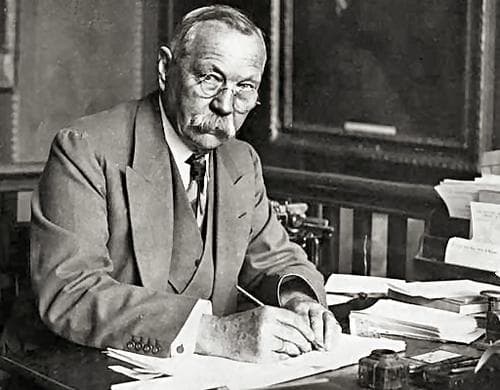
Sir Arthur Ignatius Conan Doyle was a British writer and physician. He created the character Sherlock Holmes in 1887 for A Study in Scarlet, the first of four novels and fifty-six short stories about Holmes and Dr. Watson. The Sherlock Holmes stories are milestones in the field of crime fiction.







