“I am a man of many masks, and none of them fit.”
— Victor Maskell reflecting on his dual life as a spy and art historian.

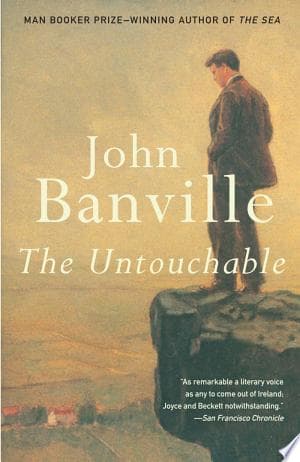
John Banville (2009)
Genre
Literary Fiction / Historical Fiction
Reading Time
768 min
Key Themes
See below
Sign in to track this book
An unmasked Cambridge spy, an art expert to the Queen, faces his past, revealing a life of deception and desire. He betrayed his country, family, and himself, searching for the truth of his downfall.
The novel starts with Victor Maskell, an older, disgraced former British intelligence member, thinking about his life after being exposed as a Soviet agent. He lives alone in his country home, dealing with public humiliation and the betrayal of former colleagues and his country. Maskell, once a celebrated art historian and advisor to the Queen, is now isolated and watched. He starts writing his memoirs, to clarify things and to understand the complex loyalties and deceptions that shaped his life. He wonders who finally exposed him, a question that stays with him throughout his story, suggesting a deeper, more personal betrayal than just political defection.
Maskell looks back at his past, specifically his time at Cambridge University in the 1930s. He describes an active intellectual environment, with discussions about politics, art, and philosophy, set against rising fascism in Europe. Here, he meets a group of young men, including the charming Nick, the intense Louis, and the seemingly harmless Boy. Influenced by these friends and a persuasive figure named 'Professor' (likely based on Anthony Blunt), Maskell gets involved in communist ideas and, eventually, joins Soviet intelligence. He describes his early involvement as an idealistic commitment to a cause he thought would bring a better world, mixed with a youthful thrill of rebellion.
When World War II starts, Maskell is in a difficult position, working for British intelligence while also giving information to his Soviet contacts. He describes the tension and paranoia of wartime London, the constant fear of being exposed, and the moral compromises he makes. His work involves decrypting enemy messages and analyzing intelligence, giving him access to secret information. He keeps up a careful public image, seeming like a loyal, if somewhat unusual, public servant. During this time, his relationships with his fellow spies, Nick and Louis, become more connected, marked by shared secrets, mutual suspicion, and a strange bond formed in deception. He also starts to explore his sexuality, having secret affairs with men.
After the war, Maskell rises in the British establishment, becoming a respected art historian and eventually an advisor to the Queen. He marries Esther, a sensible and loving woman, and they have children, creating a seemingly normal family life. However, his secret life as a Soviet agent continues, with secret meetings and constant pressure from his contacts. He thinks about the difference between his public image and his hidden identity, the compromises he made in his personal relationships, and the emotional cost of living a lie. His marriage to Esther gives him a fragile sense of normalcy, but it is always overshadowed by his spying, and his true affections are often elsewhere, with men he meets secretly.
As the Cold War gets more intense, Maskell's early idealism about the Soviet Union starts to fade. He sees the brutality of the Stalinist regime and the suppression of dissent, leading to growing disappointment. The friendship he once shared with Nick and Louis also weakens, replaced by suspicion and resentment. He becomes more paranoid that someone in his circle might betray him, or that his contacts might see him as disposable. The moral uncertainty of his actions weighs on him, as he questions the true purpose and effectiveness of his spying. He realizes he may have sacrificed his integrity for a cause that was as flawed as the system he wanted to change.
The defections of other members of his spy ring, especially Nick and Louis's dramatic escape to the Soviet Union, shock the British intelligence community and increase the search for remaining agents. Maskell finds himself under more scrutiny, his every move watched, his past carefully examined. He describes the intense tension of this time, the constant fear of exposure, and the elaborate steps he takes to keep his cover. He feels more isolated, unable to confide in anyone, even his wife. The pressure grows, and he starts to suspect that authorities are closing in, but he still hopes his cleverness and connections will protect him.
Despite the defections, Maskell avoids immediate exposure, largely because of his high position and the establishment's unwillingness to believe one of their own could be a traitor. However, he faces a series of increasingly pointed interviews and interrogations by British intelligence officers, especially the persistent Mr. Craven. These meetings are often disguised as casual talks or administrative reviews, but Maskell understands their real purpose. He uses all his wit and cunning to avoid suspicion, telling elaborate lies and half-truths, always seeming like an innocent victim. He finds a strange pleasure in the intellectual challenge, but the constant pressure affects his mental and emotional state.
Eventually, the situation tightens, and Maskell is publicly exposed as a Soviet spy. He never clearly says the exact moment or the precise person responsible for his exposure, keeping some ambiguity that suggests a complex, perhaps even self-inflicted, unraveling. The revelation destroys his carefully built life, leading to his immediate dismissal from all his positions, public humiliation, and isolation. He describes the deep sense of loss and disgrace, the end of a lifetime of work and reputation. The unmasking forces him to face the full results of his actions and the damage he caused to his family and those who trusted him. He retreats into a solitary life, thinking about betrayal and loyalty.
In his final years, Victor Maskell, now without public honors and living in disgrace, continues to write his memoirs. He uses them to analyze his many identities: Irishman and Englishman, husband and homosexual, loyal citizen and traitor, art lover and spy. He tries to understand who he truly is, beyond the roles he played. He thinks about memory, truth, and fiction, admitting that his story is as much about creating himself as it is about recounting facts. He re-examines his motivations, his relationships, and the political ideals that once drove him, seeking a final understanding of his complex and contradictory life, and the legacy he will leave.
The Protagonist
From an idealistic young man recruited into espionage, Maskell evolves into a cynical, self-preserving figure who, in old age, attempts to reconcile his fragmented identities and understand the meaning of his life of deception.
The Supporting
Begins as an idealistic yet reckless young man, becomes a dedicated spy, and eventually defects to the Soviet Union, leaving Victor to face the consequences.
The Supporting
Starts as a fervent communist, commits to espionage, and eventually defects to the Soviet Union, maintaining his ideological stance.
The Supporting
Remains a constant, grounding presence in Victor's life, eventually bearing the public shame of his unmasking with quiet dignity.
The Supporting
From a seemingly innocent recruit, he becomes a quiet and persistent spy, remaining in the shadows even after others are exposed.
The Supporting
Relentlessly pursues the truth of the Cambridge spies, ultimately playing a key role in Victor Maskell's exposure.
The Mentioned
Initiates Victor and his friends into the world of espionage, setting them on their path of betrayal.
The Supporting
Stands by her disgraced father, seeking to understand his complex life and legacy.
The novel explores identity through Victor Maskell's many roles: Irish outsider, English gentleman, husband, homosexual, art expert, and spy. Maskell constantly questions who he truly is, often creating stories to justify his actions and combine his conflicting selves. His self-deception is as deep as his deception of others, making his memoir an unreliable attempt to define a self that is always changing. This theme is key to his thoughts on his Irish heritage versus his adopted Englishness, and his public marriage versus his private homosexual life, all contributing to a fragmented sense of self.
“What is a man but a bundle of habits, a collection of tics and mannerisms, a walking, talking, breathing lie?”
Betrayal is at the heart of Maskell's story, including political treason, personal infidelity, and breaking trust. The novel examines the complex reasons for betrayal—idealism, adventure, personal gain, or a deeper psychological need to defy. It also explores loyalty, both to a country, an ideology, or to individuals. Maskell's loyalty to the Soviet cause, however wrong, conflicts with his loyalty to his adopted country and his family. The changing loyalties among the spy ring members, especially between Maskell, Nick, and Louis, show how fragile such bonds are under pressure. The biggest betrayal, for Maskell, might be the one he committed against his true self.
“Betrayal is not an act, it is a process, a slow, insidious corrosion of the soul.”
As Maskell writes his memoirs, the novel questions how reliable memory is and how subjective truth is. Maskell is an unreliable narrator, openly admitting to adding or removing details, creating a story that serves his own need for self-justification and understanding. Writing becomes a way for him to build a consistent version of his life, even if that version mixes fact and fiction. This theme shows how personal history is shaped by perspective, desire, and time, making it hard to tell objective truth from subjective interpretation. The reader is constantly asked to question Maskell's account.
“Memory is not a lamp, it is a mirror, reflecting not what was, but what we wish had been.”
Maskell's status as an Irishman in the English establishment is a constant theme, adding to his feeling of 'otherness' and perhaps contributing to his willingness to betray the system. The novel shows the details of the British class system, especially within the elite circles of Cambridge and London, which Maskell both joins and dislikes. His observations of the upper classes, their customs, manners, and assumptions of superiority, are often sharp and satirical. This theme explores how social class can shape identity, opportunity, and the perception of loyalty and belonging, influencing Maskell's rebellious side and his cynical view of the establishment.
“I was an Irishman, you see, and therefore, by definition, an outsider, even when I was at the very heart of things.”
Maskell's job as an art historian and advisor to the Queen is more than just a cover; it is deeply connected to his character and his worldview. Art represents beauty, order, and objective truth that contrasts with the messy, deceptive world of espionage. Maskell's appreciation for art gives him refuge and a way to understand life. He often compares creating art to building his own elaborate deceptions, seeing a certain beauty in the perfect lie. This theme suggests that for Maskell, life is a performance, a carefully created work of art, even if the canvas is stained with betrayal.
“Art, after all, is the only truth that matters, the only one that truly endures.”
Victor Maskell's subjective and self-serving recounting of events.
The entire novel is narrated by Victor Maskell in his old age, looking back on his life and actions. He openly admits to manipulating facts, omitting details, and shaping his narrative to present himself in a particular light. This device forces the reader to constantly question the veracity of his account, making the 'truth' of the Cambridge spy scandal elusive and subjective. Maskell's wit and intelligence make him a compelling, if untrustworthy, guide through his own convoluted history, blurring the lines between memoir and fiction.
The story is told entirely from Maskell's reflective viewpoint in his later years.
The narrative unfolds as Maskell writes his memoirs, allowing for extensive introspection, philosophical digressions, and a constant re-evaluation of past events through the lens of age and disgrace. This retrospective approach enables Maskell to comment on his younger self, his motivations, and the consequences of his actions with a detached, often cynical, wisdom. It also permits him to weave together different periods of his life, creating a complex tapestry of memory and interpretation rather than a linear plot.
References to historical figures and literary works, enriching the narrative.
Banville frequently alludes to historical figures (beyond the obvious Cambridge spies themselves, though they are fictionalized) and classic literature, particularly drawing on the works of Proust, Joyce, and other modernist writers. These allusions serve to deepen the intellectual texture of the novel, placing Maskell's story within a broader cultural and historical context. They also highlight Maskell's own erudition and his tendency to view his life through a literary lens, elevating his personal drama to a more universal exploration of human nature and betrayal.
The recurring motif of Maskell's multiple identities and roles.
Maskell's life is a continuous performance, a series of carefully constructed disguises. From his adopted English persona to his public role as an art expert, and his private life as a homosexual man, he constantly shifts roles. This device emphasizes the theme of identity and self-deception, showing how individuals can create and inhabit various 'characters' throughout their lives. The art world, where Maskell excels, itself deals with authenticity and forgery, mirroring his own existence as a master of deception. His 'performance' is both a means of survival and a reflection of his fragmented self.
“I am a man of many masks, and none of them fit.”
— Victor Maskell reflecting on his dual life as a spy and art historian.
“History is not what happened, but what is said to have happened.”
— Maskell discussing the nature of historical truth and memory.
“We are all actors in our own tragedies, but we write the scripts as we go along.”
— Maskell contemplating the role of agency and fate in his life.
“The past is a foreign country; they do things differently there.”
— A nod to L.P. Hartley, used by Maskell to describe his own past.
“Art is the only truth that matters, because it is the only lie that is honest.”
— Maskell comparing the honesty of art to the deceit of his spy life.
“I have spent my life in the service of two masters, and betrayed them both.”
— Maskell confessing his betrayals as a double agent.
“Memory is a treacherous thing; it edits and revises without our consent.”
— Maskell reflecting on the unreliability of his own recollections.
“The greatest sin is not to be found out, but to be forgotten.”
— Maskell fearing obscurity more than exposure.
“We are all untouchable in our own way, isolated by our secrets.”
— Maskell on the isolation that comes with hidden lives.
“Love is the one conspiracy from which I have always been excluded.”
— Maskell lamenting his emotional detachment and loneliness.
“The mirror shows me a stranger, and I have grown accustomed to his face.”
— Maskell observing his own reflection and fractured identity.
“To spy is to live in a world of shadows, where even the light deceives.”
— Maskell describing the pervasive deception of espionage.
“I have traded my soul for a handful of secrets, and now I have neither.”
— Maskell regretting the cost of his double life.
“The truth is a luxury I could never afford.”
— Maskell acknowledging the compromises of his existence.
Ready to see how well you understood this book? Take our interactive quiz with 10 questions.

William John Banville is an Irish novelist, short story writer, adapter of dramas and screenwriter. Though he has been described as "the heir to Proust, via Nabokov", Banville himself maintains that W. B. Yeats and Henry James are the two real influences on his work.







